Global Thaw

Mid-March

Minnesota

Gentle rain

Global thaw

Mid-March

Madness

This morning it was hot enough to fry and egg on the pavement… in Minnesota.

Anyone else think the absense of climate change/global warming/global thawing from the national spotlight on the way to a national election is madness?

Just asking.

Ya gotta love Bill Maher

Gordon C. Stewart  www.gordoncstewart.com  March 23, 2012

Ya gotta love Bill Maher. Well, actually, you don’t have to, but I do.

I rarely miss “Real Time with Bill Maher” (HBO). Why? Because he’s real. So are his guests. Is Bill’s language outlandish? Is his tongue stuck in the 7th grade locker room? Yes. Despite the frequency of the ‘f’ word, the saintliest, as well as the unstaintliest, mouths from left , right and center consider it an honor to sit on the panel or be a featured guest. on Real Time. Go figure how Madeleine Albright, Amy HolmesCornel West, Herman Cain, Sen. Bernie Sanders, Rep. Dana Rohrabacher, Rep. Keith Ellison, P.J. O’Roarke, Michael Moore, Andrew Sullivan, and David Frum appear on Maher’s show. They accept the invitation because it’s one place where manure is called what it is and where the real gutter talk is exposed for what it is. He’s not interested in being nice. He’s interested in truth. And he’s not afraid to engage the opposition in matters political, economic, or religious.

“If it weren’t for throwing conniption fits, we wouldn’t get any exercise,” he wrote (“Offense Intended – and that’s OK,” Star Tribune, 03.23.12). “I have a better idea. Let’s have an amnesty – from the left and from the right – on every made-up, fake, totally insincere, placated hurt, insult, slight and affront. Let’s make this Sunday the National Day of No Outrage. One day a year when you will not find some tiny thing someone said and pretend you can’t barely continue functioning until they apologize.”

Maher wasn’t born or raised in Minnesota where we’re proud of Minnesota Nice, most of the time .But you don’t have to have been raised elsewhere to know that Minnesota Nice often leaves us itching for some unpolished reality. How else do we explain the election of a tough-talking, often crude professional wrestler radio talk show host as our governor?  Jesse Venturawas elected because he said what he thought and meant what he said in a world where candidates for political office rarely say what they mean or mean what they say. Underneath Minnesota Nice is a volcano of Minnesota mean, as well as nice.

Jesse is one weird dude. And that’s partly what attracted the people who were tired of taking Minnesota Nice too far. We want civility, but sometimes we get a little tired of not really talking about what we’re really talking  about.

None of us really wants to live in Pleasantville. Remember “Pleasantville” – the film about two 1990s teenage siblings, Jennifer and David, who get sucked into their television set where they become characters in the make-believe town of Pleasantville, David’s favorite TV show? Nothing much ever happens in Pleasantville. There is no conflict, no real feelings; just polite, mannerly sameness that is insulated from and apathetic toward anything that might smack of unpleasantness. Pleasantville is a nice place – happy, smiling, repressed and suppressed, orderly…without color.

As Jennifer and David play along in the perfect and pure little town of Pleasantville, their presence soon cracks open the boredom of gray uniformity. Color begins to break through the grayness as the citizens of Pleasantville discover sex, art, books, music and the concept of non-conformity, leading the Mayor to campaign to turn Pleasantville back to what it once was – a nice place where nothing much ever happens, and no one speaks like Bill Maher.

Maher’s Op Ed piece concludes:

“I don’t want to live in a country where no one ever says anything that offends someone. That’s why we have Canada. That’s not for us. If we sand down our rough edges and drain all the color, emotion and spontaneity out of our discourse, we’ll end up with political candidates who say nothing but the safest, blandest, emptiest, most unctuous focus-grouped platitudes and cant. In other words, we’ll get Mitt Romney.”

This morning Unedited Politics posted an excerpt from 1994 Romney-Kennedy Debate on health care, veterans, spending, deficits.

The Surrogate Voice

Some moments last a lifetime.

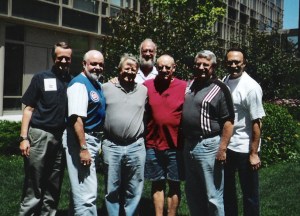
Chicago Seven - Dale Hartwig in red shirt

My friend Dale has Parkinson’s. He has boarded a train in Michigan (he’s now in a long-term care center there) to be with “The Chicago Seven” – the seven former classmates who gather annually at McCormick Theological Seminary. This year, Dale’s speech is hard to comprehend. He is reduced to listening. Death and dying are sitting at the table.At the morning reflection and round-table sharing, Dale is sitting to my right. When his turn comes, we look at Dale. There is an awkward silence. He hands me something. He wants me to read aloud what he’s written. I read his words aloud.

Gordon C. Stewart  – written in thanksgiving for the Chicago Gathering, 2004:

“THE SURROGATE VOICE”

The surrogate voice reads on,

the author sits and sobs

wrenching tears from primal depth:

from some abyss of joy or nothingness…or both.

The author’s sighs and piercing sobs

arrest routine,

invoke a hush,

dumb-found the wordy room.

He cannot speak,

his Parkinsons’ tongue tied,

his voice is mute, in solitude confined,

all but sobs too deep for words.

Another now becomes his  voice

offering aloud in a dummy’s voice

the muted contribution

in poetic verse the ventriloquist’s voice has penned.

The abyss of muted isolation ope’d,

his words, re-voiced aloud,

hush the seven to sacred silence,  all…

except from him, their author.

Whence comes this primal cry:

From depths of deep despair and death,

from loneliness, or depths of joy

We do not know.

The surrogate voice reads on

through author’s signs and sobs,

through his uncertain gasps for air

and our uncertain care.

The iron prison gates – the guards

of his despair – unlock and open out

to turn his tears from prison’s hole

to tears of comrade joy.

His word is spoken, his voice is heard,

a word expressed

in depth and Primal Blessing,

pardoned from the voiceless hell.

The stone rolls back,

rolls back, rolls back,

from the brother’s prison’s tomb,

the chains of sadness snap and break!

At one, at one, we Seven stand,

in Primal Silence before the open tomb,

as tears of loss, of gain, of tongues released

re-Voice unbroken chords of brotherhood.

 All moments are sacred. Some last a lifetime.

It’s Raining, It’s Pouring

Today, three years to the day after Katherine’s (“Katie’s”) death (May 9, 2010), we inter her cremains, an appropriate time to re-post the effect of Katie’s illness along the way. This is a re-posting of a piece written along the way of Katie’s illness.

I wrote this piece when we learned that my stepdaughter Katherine’s incurable Leiomyosarcoma had taken a turn for the worse. In memory of Katherine (“Katie”) Elizabeth Slaikeu Nolan.

Gordon C. Stewart   Feb. 11, 2009

It’s raining, it’s pouring
The old man is snoring
He went to bed and he bumped his head
And couldn’t get up in the morning

It’s a day like that.  I bumped my head on the illness of a 33 year-old loved one.  It’s raining sadness. I’m having trouble getting out of bed in the morning.

Terminal illness has a way of doing that unless you believe in miracles of divine intervention or you have extraordinary powers of denial.

My spirituality has become increasingly like that of Rebbe Barukh of Medzobaz, an old Hasidic master in Elie Wiesel’s tale of Four Hasidic Masters and Their Struggle Against Melancholy.  When he prayed the customary Jewish prayer, “Thank you, Master of the Universe, for your generous gifts – those we have received and those we are yet to receive” – he would startle others with his weeping.  ‘Why are you weeping?” one of them asked.  “I weep,” he said, “in thanksgiving for the gifts already received, and I weep now for the gifts I have yet to receive in case I should not be able to give thanks for them when they come.”

For my family at this critical time, the real miracle has already occurred – the shared gift of love – and it will come again in ways I cannot now anticipate when the last page of the final chapter of our loved one’s life is over.

The miracles are more natural, nearer to hand.  Although I don’t believe in selective divine intervention, I am on occasion a sucker for denial – except on days like this when it’s raining and gray and I’ve bumped my head on the hard fact that cancer is ransacking my loved one’s body.  A certain amount of denial, too, is a blessing in disguise, one of God’s generous gifts to keep us sane when the rain pours down and clouds are dark.

Faith comes hard sometimes.  In college mine was challenged and refined by Ernest Becker‘s insistence that the denial of death lies at the root of so many of our problems.  My faith has been refined along the way by the courage of Albert Camus and Jean-Paul Sartre to face the meaninglessness of the plague, the faith and courage of Dietrich Bonhoeffer and Paul Tillich who stuck their fingers in the gears of Nazism, and the humble witness of Mother Teresa working in the slums of Calcutta with more questions than answers and some anger at God.

The job of faith, as I see it, is to live as free as possible from illusion with a trust in the final goodness of Reality itself, despite all appearances to the contrary.  Faith is the courage and trust to look nothingness in the eye without blinking or breaking our belief in the goodness of mortal life.

When I look into my loved one’s eyes I see that courageous kind of faith that defies the cancer to define her, and a resilient spirit that makes me weep tears of joy over the gifts we’ve already received and the ones we have yet to come.

It’s still raining and it’s still pouring, but I refuse to snore my way through this.  I’ve bumped my head on the news of a loved one’s terminal illness, but I’m getting up in the morning.

POSTSCRIPT March 21, 2012

Conversation yesterday about “The List” posted on Bluebird Boulevard:

Karen:

My mother died of cancer eight years ago. Her loss is still visceral. She is in every bird I see.

Me:

The morning of Katherine’s memorial service Kay, Katherine’s mother, was standing by the large picture window gazing out at the pond in our back yard. Out of nowhere, it seemed, two Great Blue Herons flew directly toward the window and swooped upward just before they got to the house. “She’s here. That’s Katie,” said Kay without a second’s hesitation. On her last day of hospice care, Kay and I each remarked that her face looked like a baby bird. I’m a skeptic about such things. I’ve always been, and always will be, a  doubting Thomas. My assumptions and conclusions come the hard way. But on the day the herons flew directly at Kay from across the pond, I saw it with my own eyes…and HAD to wonder.

Within a minute a third Great Blue Heron perched on the log by the edge of the pond and stood alone for a LONG time.  It reminded me of a gathering on the steps of the State Capitol in Saint Paul following the tragic deaths of school children at Red Lake, MN. The crowd stopped listening to the speaker. They were looking up. “What’s going on?” I asked Richard, the Red Lake American Indian advocate and my co-worker at the Legal Rights Center.org. “Eagles,” he said. “Where?” “WAY up. They’re circling.”

I learned later that the eagles were also circling at that same moment over the grieving families gathered at Red Lake. I asked American Indian colleague what he took it to mean. “We don’t ask. That’s the white man’s question,” he said. “We just accept it. We live in the mystery.”

She Could Give a Kiss

Morning reflections composed today by my friend Steve Shoemaker

She Could  Give a Kiss

She could give a kiss

and not have less to share.

He could take a kiss

and still have more to give.

She could have a child

and still have time for him.

He could be a child

and run away from her.

–  Steve Shoemaker, 03.21.12

Your Dear Eyes

 Your dear eyes…

Macular Degeneration,

what a multi-syllabic curse.

Hazel:   sometimes blue,

sometimes green, birthing

children’s eyes of blue and gold…

Flashing with indignation,

pensive, wise, creative, wary–

yes, windows to a good soul.

Let us see all that we can see

while we can.  Travel, taste, hear,

feel and, yes, smell what is good

around the world.  All of us

are fading into dust:  some of us

receive a warning–fair or unfair.

– Steve Shoemaker 03.21.12


“And the Word became flesh….” and words.

Little Steve at Sheldon Jackson Church, Colorado

Sometimes it comes in a poet’s words. The flesh it comes in is all shapes and sizes. Here’s a photo of Steve (6’8” and shrinking) standing behind a historic pulpit at Sheldon Jackson Church in Colorado. Sheldon was a bit shorter. Who says ministers don’t have a sense of humor!LEAVE A COMMENT on Steve’s poems. He, I, and others would love to know what you think. Or, in today’s butchered English, “Me and him” look forward to seeing/hearing the words YOU share.

The List

“You have ca… You have can.. cancer. But we think it’s treatable.”

I read The List early this morning, the day after hearing a doctor tell a wonderful older couple the news. The full bone scan tells a different story. It can be treated with radiation, but at what price for an old man already writhing in unbearable pain? My friend has been on “the list” once before 20 years ago. Now he’s back on it, this time for good. He’s a strong man, but not that strong, not immortal, not invulnerable. The treatment will not stop it this time. Morphine and lots of love will see him through until he’s off the list for good.

My step-daughter, Katherine, was placed on “the list” at age 30. She was exited the list at 34. Her ashes are on the mantel now. Her courage, her buoyancy, her steadfast refusal to let being on “the list” define her, her compassion for the doctors and nurses who “treated” her with surgery, chemo, more surgery, radiation, lasers, and morphine, and for us, the members of the family to whom she brought so much delight, have left us with so much more than what’s left on the mantel.

I’ll post a piece written during the third year of Katherine being on “the list” later today. Look for “It’s raining; it’s pouring.”

For now, share your stories with a comment here, or go to Courteney Bluebird’s blog and comment there. All of her work is remarkable and worth the visit.

Sometimes I feel blue

Purple-yellow iris (Kay Stewart photography). Poem by you know who.

Purple-Yellow Iris

Sometimes I feel all blue

Sad      Sorry      Down

Like the Blues

A Rhapsody in Blue


Sometimes

When the Blues

Begin to play in me,

It happens –


Blue bursts into purple

Leaping into joy

And a burst of sun-burst yellow

Comes crashing through the blues

I feel all clean

All wet    All  up

Like a hymn

An ode to purple-yellow joy

A Sermon on Suffering

The post of my friend Steve Shoemaker’s poem “Murillo’s Christ after the Flagellation” and the comments that you posted prompted the sermon I delivered this morning at Shepherd of the Hill Presbterian Churchin Chaska, MN. The sermon never would have happened without your thoughtful, penetrating comments on the earlier post. THANK YOU. Here’s the sermon.

THE FLAGELLATION

“Now the men who were holding Jesus mocked him and beat him; they also blindfolded him and asked him ‘Prophesy! Who was it that struck you?’ And they spoke many other words against him and reviled him.”  Gospel of Luke 22:63

Two months ago I created a blog. One of my seminary classmates, Steve Shoemaker, wrote the other day to say that he was impressed by how prolific I was. I thought maybe he meant “wordy” until he said that my productivity embarrassed his laziness as a poet. So, he said, “Here’s the deal I’ve made with myself. For every piece you put up on your blog, I’ll write a poem.” Steve is 6’8 and a basketball player in college. Clearly, he hasn‘t lost his competitive spirit.

A poem arrived last Friday. It’s a reflection on a painting by sixteenth century Spanish artist Bartolomé Esteban Murillo. In the painting, Jesus is bent over on all fours after he being mocked and beaten.
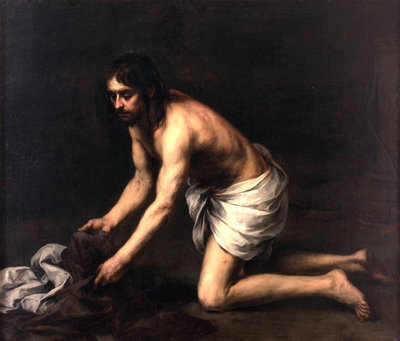
Christ after the Flagellation

Steve’s poem, “Murillo’s Christ after the Flagellation” changed the direction of the sermon this morning.  Here’s the poem.

The human had been tied to the whipping

post, a pillar that had been used many

times before by the Romans (and ages

earlier by the Greeks–but for a much

different purpose). Now, his pale skin looks

translucent (should it not have been darker,

with more blood?) His mother recalled his bris.

They had both cried then, too.

A strong young man, broad back, thick arms, now on

hands and knees, but head raised with eyes open:

seeing a cross that’s even worse ahead…

Still, unflinching, resigned–no, determined

to go on, face more pain, indignities,

shame, even death (there is no sign of God.)

Shortly there arrived a brief comment from a blogger who blogs about the daily struggle with mental illness.

“This poem brought tears to my eyes.”

Score one for my friend Steve.

Later in the day another comment arrived on the blog in response to Steve’s poetry. Like the first comment, this one also comes from someone with a history of some kind of long-term suffering. It reads as follows.

I have a response to the stories of Christ’s beating that often leaves others aghast. So brace yourselves:

He was beaten for several hours, or a day or two? Big deal. Those of us who have suffered years of abuse and terror know what real suffering is.

I don’t find focusing on Jesus’ suffering, or any of that 12 stages of the cross crap, to be helpful at all. I find it to be insulting. As if there is something noble and glorious about suffering. Nope, not a damn thing to recommend it. I know that Jesus voluntarily placed himself in the position for that to happen. So? Doesn’t help.

Please, fellow readers, don’t think that I am an isolated one, or few. There are lots and lots of us feeling this way.

The world is full – FULL – of people who have suffered much worse for decades or lifetimes. Think of people who live in North Korea. Or poor girls growing up in India. Or young girls in Fundamentalist Church of the Latter Day Saints settlements who get married off to much older men and are then raped daily for the rest of their lives. Jesus’ few days of humiliation are nothing in comparison.

The Lenten/Easter season is my favorite church season because I am reminded of how deeply I am loved and how quickly I am forgiven. Jesus’ brief beating plays no role in that….

The writer is hardly alone in his thinking about this. What do we say about those whose tenures of torture and suffering far exceed the relatively short period of Jesus’ suffering?  Is focusing on Jesus’s suffering and the stations of the cross insulting to those who have suffered, and continue to suffer, for decades or for a lifetime?

How would you reply to the writer?

Here’s how I responded:

Your thoughtful response calls for an equally thoughtful reply. So I’ll try.

The cross, in my theology, in no way minimizes or disrespects the suffering of others. Nor does it say, as it is too often understood by sacrificial atonement theology, that suffering itself is noble or glorious. The cross was an instrument of Roman torture and execution. The Jesus who was tortured and executed, as were thousands of his Jewish contemporaries, is not somehow God masquerading in human flesh. That being said, moving the cross to the sidelines of Christian faith and reflection is, in my view, a mistake. Well meaning because it reacts against the twisted theology that understood it to be separate from, and above, all other human suffering, but mistaken nonetheless.

When I look at the cross, I see all these people. And I see myself there as both the crucified and the crucifier. What I see in the crucifix is total abandonment. “My God, my God, why have you forsaken me!” And in some way I hear not only the cry of Jesus but the cry of the God Dietrich Bonhoeffer described as the Divine Center we push to the edge of the world.  I see in the Christ-event the tragedy and the hope of the divine-human encounter.

Sebastian Moore (The Crucified Jesus Is No Stranger and The Inner Loneliness) and Joseph Campbell awakened me to this richer Christology. Moore: “We have to think of God as closer to our evil than we ever dare to be. We have to think of God not as standing at the end of the way we take when we run away from our evil in the search for good, but as taking hold of us IN our evil, as the sore point which the whole idealistic thrust of man is concerned to avoid

“Redemption through the blood of Christ is (wrongly!) interpreted as the bending of Reality itself to man’s great dream of himself. And it is exactly the reverse. It is the ending of the dream. It is the beautiful collapse of the whole enterprise. It is the invasion of man by himself, with God at the center as love.” (Bolding added  for emphasis.)

Closer to home, another great theologian, my wife, Kay, reflected on the cross the other night at a Lenten series on “The Place of the Cross”:

“The Apostle Paul used to talk about all of his theology in terms of transformation at the foot of the cross. If a theological insight couldn’t go to the foot of the cross and be transformed there, then it wasn’t of God. This darkness is not for lightweight faith statements or testimonies. The annihilation of all goodness and all love which takes place in the action of one human being in violence to another human being—it cannot be redeemed by any other force but God’s pure love. That is a faith statement that lives inside a vacuum until manifested. There is no meeting of love and abandonment, they are mutually exclusive realities. We are lost. Period. And if God is to find us, then it is all about God’s initiative.”

From today’s perspective, Moore’s language is too gender- specific, not inclusive. But the substance of his Christology is totally inclusive. We’re all there. Anything short of that either drifts off into a new utopian project or into some new rendition  of the power of positive thinking. The power of Christian theology is its gravitas: it doesn’t turn away.

I told the blogger, “Love to hear more…. Hope we can keep the conversation alive.”

Hours later, an email arrived from the second blogger who had watched “The Leper” on the blog saying s/he was moved and grateful for the sermon.

If I could sit down in a coffee shop or in a living room by the fire to continue the conversation, this is what I would say.

The cross of Jesus does not minimize other suffering. It casts a light backward and forward into all darkness for all time. From inside the light we see the darkness of all human violence and abuse, and at the foot of the cross, we look up to realize that the protest against the suffering we impose on others and our own self-imposed suffering – our own reviling of others and our reviling or ourselves — is not just our protest. It is God’s. It is the suffering of God at the hands of a godless world. And the word for “they reviled him” is the same as the word “blasphemed” him.  Whenever we treat others cruelly, or treat ourselves cruelly, we blaspheme God. We are reviling and whipping the back of God.

From Jesus’s cry to God – “My God, my God, why have you abandoned me?” – there comes an echo from the heavens: “My children, my children, why have you abandoned me? My children, how could you forsake Me?”

The cross calls for an end to the reviling of others and our own sorry self-flagellation, as though those we revile, or we ourselves, would be or should be beyond love’s reach.

Who is the “the human tied to the whipping post”? Who puts her there?

Will you join the suffering of the God who wants it all to stop? Will you rejoice in the inevitable, eternal reach of God’s love and redeeming grace?

Footnote: Here is Steve, the poet, among the Bristle Cone Pines at 11,000 feet in Colorado:
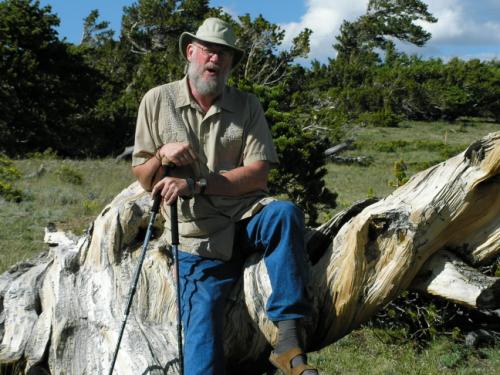
Steve Shoemaker

..

A fellow student at McCormick Theological Seminary in Chicago, we’ve continued the friendship for 47 years. A published poet, Steve was the Senior Minister of the McKinley Presbyterian Church and Director of the McKinley Foundation (campus ministry) at the University of Illinois for many years. He hosts “Keepin’ the Faith” on WILL, Illinois Public Radio,. He and his wife, Nadja, a research biologist, live in a geo-thermally-heated house on the prairie outside Urbana, IL where his neighbors often spot Steve’s kites riding the winds of the prairie skies.

Christ after the Flagellation

This morning Steve Shoemaker sent me his poem (see below this painting, “Christ after the Flagellation“) by Murillo. The “comments” below are a running conversation.  Chime in.

Christ after the Flagellation

The human had been tied to the whipping

post, a pillar that had been used many

times before by the Romans (and ages

earlier by the Greeks–but for a much

different purpose). Now, his pale skin looks

translucent (should it not have been darker,

with more blood?) His mother recalled his bris.

They had both cried then, too.

A strong young man, broad back, thick arms, now on

hands and knees, but head raised with eyes open:

seeing a cross that’s even worse ahead…

Still, unflinching, resigned–no, determined

to go on, face more pain, indignities,

shame, even death (there is no sign of God.)

Steve was a classmate at McCormick Theological Seminary in Chicago. We’ve been friends for 47 years. A published poet, Steve was the Senior Minister of the McKinley Presbyterian Church and Director of the McKinley Foundation (campus ministry) at the University of Illinois for many years. He hosts “Keepin’ the Faith” on WILL, Illinois Public Radio, and lives in a geothermally-heated house on the prairie outside Urbana, IL where his neighbors often spot his kites riding the winds of the prairie skies.

The Leper

Ever been a leper? I have. I still am.

Lepers are people separated from the mainstream society. Isolated. Beaten. Pushed to the side. Shamed. Ashamed. I have met the leper many times. I meet him every morning shaving. I meet her as the abused woman, the taunted gay teenager, the child who has trouble in school, the sentenced murderer,  the hooker, the heroin addict, the young person and the tenured professor who took their own lives, the depressed, oppressed, repressed, and suppressed souls who live in quiet despair. Sometimes we break the chains of the psychic and social code. Sometimes we move out of the leper colony, push our way through the crowd and cry out.

That’s what this sermon is about.  Shepherd of the Hill Presbyterian Church in Chaska, MN.

Let me know what you think. Better yet, let me know what you feel. Peace.