Minnesota Public Radio’s Public Insight Journalism asked the question after release of the film Seeking a Friend for the End of the Earth. Here’s how I responded.
Ernest Becker’s The Denial of Death makes the case that our culture is death-denying.
One could argue that our fascination with end of the world films and stories is an entertaining and objectified way of dealing with one’s own personal destiny. Every death is “The end of the world.” The end of the world writ large on the planetary screen moves the issue into the world of fiction, fantasy and myth from which, like all cultures before ours, we create meaning in the midst of time.
There are other reasons for our fascination, of course. Supreme among them, in my view, is the dualism and the violence that saturate Western culture: God/Satan, Good/Evil, Moral/Immoral, Saved/Damned, Blessed/Cursed.
It is this misreading of ancient Jewish and Christian texts that makes the will to power the central theme of our time. The late Japanese Christian theologian Kosuke Koyama said that all “sin” has the same root. It is the claim of “exceptionalism.” Under the banner of nationalist exceptionalism’s shameless stealing of the metaphor of “the city set on a hill” away from its proper setting in Jesus’ nonviolent Sermon on the Mount, we assume Western Culture and the U.S.A. to be the Golden City and the agent of divine will. The exercise of that fallacious conviction results in wars of foreign intervention, occupation, and “pre-emptive strikes” in the name of national security.
We have become a national security state. The “end of the world” fascination in our time is heightened by the knowledge that global destruction – nuclear night – is entirely possible. We fear it. We know it. Yet we are also a culture addicted to entertainment where our worst nightmares get projected onto a movie or television screen where we know that what we’re watching is fiction. The fiction is almost always a high-tech version of the old racist and xenophobic dualism my generation grew up on: cowboys and Indians.
Beneath the question of why our culture is fascinated with end of the world is human nature itself. We human beings, like all other animals, are mortal. We may be exceptional in that we are (more) conscious and self-conscious, but first and last, we are animals. We are born. We live. We die.
As conscious animals, we are capable of great feats. We are also, so far as we know, the only animal capable of self-deception, denial, illusion, and species suicide. The denial of death is the great denial, and immortality is the human species’ great illusion.
The fact of death looms over life for each of us existentially and for the species itself from the beginning and in the middle, not just at the end. Death is our shared destiny. Death is extinction. Our fascination with the end of the world is a strange Molotov cocktail comprised of all of the ingredients of the human condition, most especially the spiritual terror of annihilation, and the illusion of winning. It is the ongoing legacy of the biblical myth of Cain, humanity’s “first-born” who kills his brother Abel, the myth that describes our time and place in history.
If, like in the movie, you had only three weeks left before the end of the world… What would you do?
I’d do what I’m doing now only more consciously. I’d continue to write each morning. I’d do my best to live gratefully, attending to beauty in nature and in art (classical music and paintings) and to family and friends. I’d pray more thoughtfully. I’d walk my dogs more joyfully, stop yelling at them for barking, and find a place on the North Shore to look out to the horizon of Lake Superior. I’d eat lobster and Dungeness crab with lots of hot butter and salt, rib-eye steaks, garlic mashed potatoes. I would avoid Brussels sprouts! I’d end each meal with a Maine blueberry pie, flan, or Graeter’s ice cream, and a Makers Mark Manhattan. Then I’d settle down on the couch next to the love of my life, Kay, by the fireplace, turn off the news, see if we can make a little fire of our own, get anchored again in the Sermon on the Mount, and return to sources of joy and laughter in the poems of Hafiz. I’d give up being intentional/purposive. I’d live in the moment.
Shepherd of the Hill Presbyterian Church in Chaska has decided to use its space as temporary overnight accommodation for homeless families. The press release and the Chaska Herald’s online story just made its way to AOL.com.
Click HERE for the story. The project is targeting to begin in February, 2013. To help with the project, leave a comment here.
The Dove World Outreach Center (DWOC) is in the news again. Scroll down to the bottom to click the link to the Huffington Post story. Or, you’ve time, read this piece that was published by MPR following the DWOC’s threat to burn the Quran.
How a single voice threatened to spark a forest fire
by Gordon C. Stewart
September 28, 2010
Everyone from time to time feels insignificant. As I did, while watching fires burn across the world, lit by the words of one pastor in Florida. I felt like a spectator in the stands watching the game I care about go terribly wrong, a hostage of verbal terrorism uttered in the name of Christ.
I would imagine that the Rev. Terry Jones and his small congregation also had felt insignificant before they announced the 9/11 Quran burning, and that they were stunned when their pastor’s voice, although terribly misguided, lit the forest on fire without ever burning a Quran. One of their own, one who had felt insignificant, had raised his voice and now had the ear of a commanding general, the secretary of defense and the president of the United States.
The difference between the Rev. Jones and most people is that he has a pulpit. On any given Sunday he speaks and a few people actually listen. Most of us do our ranting and raving in the shower, at the water cooler or with like-minded people at the coffee shop, but we don’t much expect anyone to listen.
But as the Jones story developed, those of us with pulpits were feeling no less beside the point. Then, as I prepared for worship, I was drawn by some old lines about spiritual arson. “Consider what a great forest is set on fire by a small spark. The tongue is a fire … a restless evil, full of deadly poison” and “the seeds of righteousness are sown in peace by those who make peace” (Letter of James 3).
The thought crossed my mind: We could invite a Muslim friend to join me in the pulpit, perhaps my neighbor Muhammad or Abdi or one of their children, whom I meet daily while walking the dogs. I decided to invite Ghafar Lakanwal, a Pashtun Afghan-American cultural diversity trainer, a Muslim and naturalized U.S. citizen, to bring greetings of peace and share some passages about peacemaking from the Quran in our Sunday worship on 9/12.
Our little church in Chaska welcomed Ghafar, and his words about the spiritual “obligation to learn, not burn” still ring in our ears. Our service drew media attention, and Ghafar’s words were heard on the evening news and noticed by a stranger in Australia, who sent a message through the church website. “I was touched,” he wrote, “when I read about your recent Sunday service in the news. … I for one can testify that it has certainly comforted a far away Muslim to know that there are neighbors who will stand together in difficult times. My salaam [to you]. May we all grow together to attain Allah’s pleasure.”
“Ah!” someone will say. How can any Christian rejoice when the author uses the name “Allah” for God? But the reaction to the “name” is misbegotten. It is not the name of God; it’s the Arabic word for what we in English call God. The forest fire lit in defense of “God” in advance of the anniversary of 9/11 reminds us that two kinds of religion potentially exist everywhere people gather to practice their faith. One kind burns. The other kind learns. One hates; the other loves.
As James, writing to those who would follow Jesus, put it: “With [the tongue] we bless the Lord and Father, and with it we curse those who are made in the likeness of God. From the same mouth come blessing and cursing. My brothers and sisters, this ought not to be so” (James 3:9-10). We can set the forest ablaze with our small spark or we can use it to light a candle of hope and peace. But, after the events of this month, none of us can again think that what we say is insignificant.—-
When will we ever learn? Click HERE for the whole story and leave your comment.
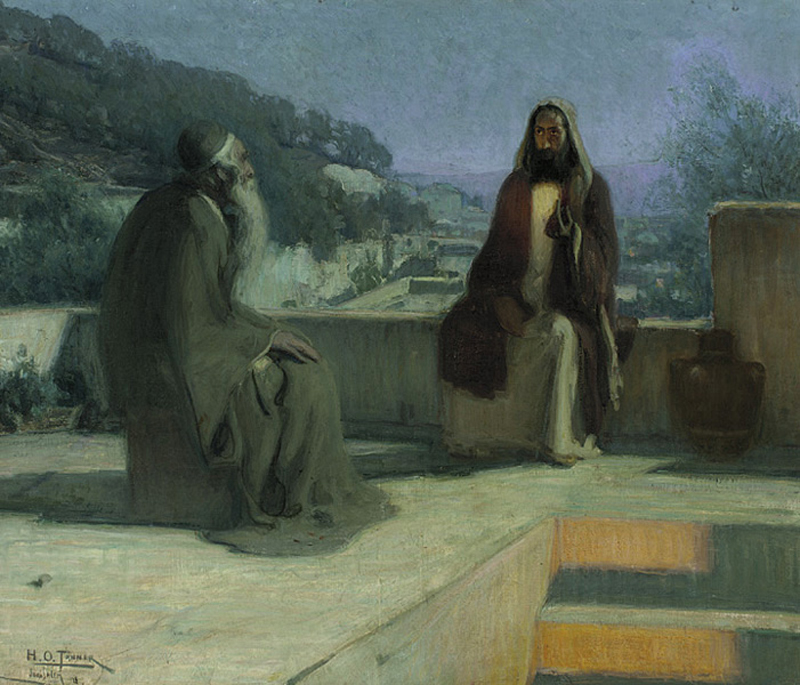
He comes by night. He slips along the buildings of the city streets in hopes that no one will notice. He is a man of position and authority, a learned teacher with a Ph.D. in religion on his way to the kindergarten teacher. “Everything I need to know in life I learned in Kindergarten,” wrote Robert Fulghum. Nicodemus has a sense that he has lost a thing or two along the way, that he needs to start over again.
He’s sent a private message asking for a confidential meeting. The arrangements have been made for the time and place…under the cover of darkness… at Nicodemus’ request.
Dressed in a hooded sweatshirt pulled up around his face and wearing an old trench coat to blend in with displaced people who spend the night on the street, Nicodemus changes his normally stately gait on the way to his secret meeting.
Arriving at the appointed address at the appointed time, he ducks quickly to his left into the alley and darts up the stairs to the flat roof where the kindergarten teacher is waiting.
“Shalom!”
“Shalom aleikem!”
They kiss each other on the cheeks, the left and then the right, as is the custom among their people.
The teacher motions to the wood stool his hands have made for occasions like this. The stool is well-worn by others who have come it at night, some by advance arrangement, others on the spur of the moment, when the darkness outside or within themselves has overwhelmed them and a hot cup of chamomile tea or warm milk won’t help them get back to sleep.
Nicodemus sits on the stool. But there is no second stool or chair. The teacher takes his customary place on the wall at the roof’s edge, his body and face partially lit by a full-moon, the city landscape and the whole world over the teacher’s shoulder, a strange kind of classroom. Nicodemus can see him – sitting calmly, erect, at full attention, his eyes fixed on his eyes, steady and searching and seeing, it seems, what even Nicodemus does not yet know about himself and the real reason he has come.
The man on the wall sits and waits for Nicodemus to break the silence. The wordlessness does not trouble him. He is at home with silence.
“You are a teacher who has come from God because no one can do what you do apart from the presence of God,” declares Nicodemus.
Nicodemus awaits a response to his declaration of honor, but there comes no response except for the eyes beholding him.
Nicodemus fidgets, uncomfortable with the silence. He repeats his declaration, increasing the decibels in case the teacher is hard of hearing, but not so loud as to wake the neighbors, the street people, or the police:
“You are a teacher who has come from God because no one can do what you do apart from the presence of God.”
Jesus gives a slight nod and looks at him from the wall.
“No one can see the kingdom of God unless he is born anew,” he says.
“So it’s about seeing?”
“Yes. It’s about seeing.”
Turning and pointing to the world over his shoulder, he asks Nicodemus, “Do you see this magnificent landscape behind me?… Look at it… Really look… What do you see?”
“I see a mess.”
“Ah, but look again, Nicodemus. You’re looking with the wrong eyes. It is a mess. Anyone can see the mess. If you look, you can see a different outline through the darkness. Maybe you need glasses. Maybe your ears will help you see.”
They fall again into the silence, but the words – “Maybe your ears will help you see” – speak to an inner darkness. Nicodemus looks with his ears at the night landscape and the distant horizon and the stars over the teacher’s shoulder, listening to the faintest sound of a familiar tune they both had learned in kindergarten at the synagogue.
Jesus, is humming. Softly. Without thinking, Nicodemus joins in humming the tune, and then begins to mouth the words, the familiar words spoken quietly by every faithful Jew living under Roman occupation and in the dark nights of the soul, the words sung or spoken in silence by every Jew on the way home from synagogue, a kind of lullaby of faith, a way of seeing with the ears:
“Peace unto you, ministering angels, messengers of the Most High, of the supreme King of kings, the Holy One, blessed be He.” (repeat twice)
“May your coming be in peace angels of peace, messengers of the Most High, of the supreme King of kings, the Holy one, blessed be He. (repeat twice)
“Bless me with peace, angels of peace, messengers of the Most High, of the supreme King of kings, the Holy one, blessed be He.” (repeat twice)
“May your departure be in peace, angels of peace, messengers of the Most High, of the supreme King of kings, the Holy one, blessed be He.” (repeat twice)
“For He will instruct His angels in your behalf, to guard you in all your ways. The Lord will guard your going out and your coming in from now and for evermore.”
– Steve Shoemaker, Urbana, IL. Steve’s Sunday evening program “Keepin’ the Faith” can be heard anytime @ www.will.illinois.edu/keepinthefaith, including archive programs, “two of which,” says Steve, “feature Gordon C. Stewart, my ‘publisher’.”
Whenever I hear Dave Brubeck, I think of Pentecost. Here’s a video of Brubeck and Al Jarreau that came to mind after reading my friend Steve’s poem (below) on Pentecost and jazz as the music of the Spirit.
PENTECOST (acrostic)
In Memory of Charles Reynolds*
(TO BE READ ALOUD )
Perhaps a jazz improvisation says
Exactly what is thinkable about
New life, fresh breath…the Holy Spirit. Has
There ever been a music without doubt
Except jazz? Faith, improvisation cause
Circles of sound to rise and fly throughout
Our cosmos. Tongues of flame are seen on heads
Singing or playing solos. Then without
Time passing–a new language: Jesus! Jazz!
*Charles Reynolds was Organist at the McKinley Church at the University of Illinois where Steve was the Senior Minister.
– Steve Shoemaker, Urbana, IL. Steve’s Sunday evening program “Keepin’ the Faith” can be heard anytime @ www.will.illinois.edu/keepinthefaith, including archive programs, “two of which,” says Steve, “feature Gordon C. Stewart,my ‘publisher'”.