Verse – “Of the Dead”

Steve hits a home run with this piece. OUCH – and a good laugh.

Verse – “Of the Dead”

De mortuis nihil nisi bonum.

Of the dead speak nothing but good.

As the family gathered

after my mother’s death,

of course we told stories.

My three younger brothers

did not seem to recall

what most disgusted me

about Mom in our youth.

On the phone, she would smile

and say in a sweet voice,

“Good-bye then…see you in church,”

hang-up, and then yell at me,

“Shut-up, when I’m on the phone!

Stop fighting!  You boys drive me crazy!”

Then, RING, and “Hello, there…”

in the sweetest low voice/ imaginable.

…..     …     …     …     …

I had been wanting to play

a CD of clever church songs

for my two unchurched grand-kids,

and as I dropped their father off

to  get his repaired car,

I hit the PLAY button, stepped around

to the driver’s seat, heard them yelling

at each other, smashed the OFF button,

and heard myself out-yell them,

“Shut up!  Stop fighting!

You kids are driving me crazy!”

– Steve Shoemaker, Urbana, Illinois, July 7, 2012

The Ocean and Homeland Security

Will we risk killing the hand that feeds us – the oceans and the order of nature – to insure homeland security?

I’m not a groupie and I’m not a shouter. I’m tired of all the emails telling me that the sky will fall if I don’t do this or that…give $5.00 by midnight tonight or sign the petition. If I don’t act now, Darth Vader will win. Delete, Delete. Trash.

But this morning’s email got my attention. It alerted me to a July 10 deadline for comment on a Navy testing program which, according to the Navy’s own research, will deafen 1,600 whales and dolphins and kill 1,800 more.

ABC News reported the story on May 11:

The Navy estimates its use of explosives and sonar may unintentionally cause more than 1,600 instances of hearing loss or other injury to marine mammals each year, according to a draft environmental impact statement that covers training and testing planned from 2014 to 2019. The Navy calculates the explosives could potentially kill more than 200 marine mammals a year.

The old Navy analysis – covering 2009-2013 – estimated the service might unintentionally cause injury or death to about 100 marine mammals in Hawaii and California, although no deaths have been reported.

The larger numbers are partially the result of the Navy’s use of new research on marine mammal behavior and updated computer models that predict how sonar affects animals.

The Navy also expanded the scope of its study to include things like in-port sonar testing – something sailors have long done but wasn’t analyzed in the Navy’s last environmental impact statement. The analysis covers training and testing in waters between Hawaii and California for the first time as well.

View from house in Sequim, WA

The request to comment took me back to the summer of 2010 when the house we rented for a week on a beautiful salt water lagoon on the coast of Sequim, Washington turned out to be next door to a highly classified U.S. Department of Energy marine research center.Ours was the last house on Washington Harbor Road which dead-ended  200 yards away at the place whose business  was a mystery to everyone in town.

NO TRESPASSING,” read the sign on the security fence.“Marine Sciences Laboratory, Pacific National Laboratory of the U.S. Department of Energy, managed by Battelle. Under 24-hour camera surveillance. Trespassers will be prosecuted to the full extent of federal  law.”
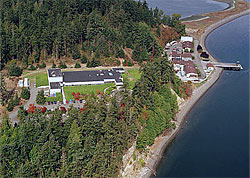
Marine Sciences Laboratory, Sequim, WA

No one seemed to know what was going on behind the fence. ”It’s top secret,” said the townspeople. No one I asked seemed to care. Our rental property was on the lagoon just around the corner on the other side of the sandbar in this photograph of the lab.I wondered then why a marine environmental research laboratory was under the Department of Energy rather than the Department of the Interior. I assumed it must have to do with the development of oceanic energy and sustainability, but wondered why such a facility would be under wraps as top-secret. I also wondered about the manager of the operation, Battelle. Clearly Battelle was one of vast network of private corporations under federal government contract, but what qualified it to manage this research center? What was Battelle?

This morning’s email about the whales and dolphins piqued my interest again. The website for the Pacific Northwest National Laboratory says the following about our Sequim next door neighbor . The bolded print is mine.

The Marine Sciences Laboratory (MSL), headquartered at the Pacific Northwest National Laboratory’s Sequim Marine Research Operations on Washington State’s Olympic Peninsula, is the Department of Energy’s only marine research laboratory. This unique facility and the capabilities of its researchers deliver science and technology that is critical to the nation’s energy, environmental and security future.

Building upon a history of research related to marine and coastal resources, environmental chemistry, water resources modeling, ecotoxicology and biotechnology—and more recently, national and homeland security—the MSL is emerging as a leader in these three areas:

  • Enabling sustainable development of ocean energy
  • Understanding and mitigating long-term impacts of human activities, including climate change, on marine resources
  • Protecting coastal environments from security threats”

There is no way to know whether MLS was part of the Navy own environmental impact study. The Navy is under the Department of Defense. MSL is under the Department of Energy. But the third area of MSL’s “research operations” – “protecting coastal environments from security threats” – and the use of the word “operations” make it a natural fit for such research.

The recent addition of national and homeland security as a third focus of MSL’s research operations increases the likelihood of its being a player in this debate.

Its three areas of emerging leadership lead me to imagine how vigorous the debate would be among the staff behind the fence next door at the end of Washington Harbor Road. Presumably those who work at a marine sciences lab are oceanographers who stake their lives on protecting Earth’s greatest treasure. Introduce national and homeland security – i.e., national defense operations – and one can imagine how hot the debates would be among the scientists weighing the respective mandates to protect the American coast (the Navy program) and to “mitigate long-term impacts of human activities, including climate change, on marine resources” (high decibel sonar signals and explosions that render whales and dolphins deaf, disoriented, dead).

The National Resources Defense Council (NRDC), a leader in the battle to regulate sonar use and protect marine life, reminds us that whales and other marine mammals rely on their hearing to find food, find a mate, and navigate their ocean habitat.

If you’ve ever seen a submarine movie, you probably came away with a basic understanding of how sonar works. Active sonar systems produce intense sound waves that sweep the ocean like a floodlight, revealing objects in their path.

Some systems operate at more than 235 decibels, producing sound waves that can travel across tens or even hundreds of miles of ocean. During testing off the California coast, noise from the Navy’s main low-frequency sonar system was detected across the breadth of the northern Pacific Ocean. …

Stranded whales are only the most visible symptom of a problem affecting much larger numbers of marine life. Naval sonar has been shown to disrupt feeding and other vital behavior and to cause a wide range of species to panic and flee. Scientists are concerned about the cumulative effect of all of these impacts on marine animals.

Even the Navy estimates that increased sonar training will significantly harm marine mammals more than 10 million times during the next five years off the U.S. coast alone.

Tillich Park - "Man & nature belong together..."

Tillich Park – “Man & nature belong together…”

“Man and nature belong together in their created glory, in their tragedy and in their salvation.” These words of theologian Paul Tillich greet visitors along the path of Tillich Park in New Harmony, Indiana where Tillich’s ashes are buried.

Tillich loved the ocean. It became for him, as it is for me, a symbol for God. The human attempt to conquer nature would not end in human glorification or to salvation. To the contrary, human arrogance regarding nature portended great tragedy.

A nation that defines its security in ways that kill the whales and the dolphins invites such a great tragedy, biting the hand that feeds us – the ocean on which the planetary “homeland” of every nation depends.

Verse – “What to preach?”

Preliminary notes from “the editor”: 1) “The Lectionary scriptures” to which Steve Shoemaker refers are suggested readings for each Sunday; 2) Douglas John Hall is emeritus Professor of Theology at McGill University in Montreal, Quebec and a prolific author on God and human suffering.

Verse —  What to Preach?

(With thanks to Douglas John Hall.)

The Lectionary scriptures are a start,

and in the newer testament, the word

of Jesus burns and leaves a scar:  the heart

is moved, the mind is taught.  The acts of God,

the miracles, may be hard to believe,

but are (in fast close-up) no stranger than

from vine to wine,  from seed to bread,  from eve

to dawn,  that I see every day.  And when

the older testament is read,  I hear

the call to love my foes, to greet the new,

the alien with cheer, to feed the poor:

all lessons good and clear–but hard to do…

….

The Preacher may well be afraid to say it,

but don’t blame failure of the Holy Spirit!

– Steve Shoemaker, Urbana, IL, July 6, 2012.

Steve is a classmate from McCormick Theological Seminary in Chicago, a retired Presbyterian minister, poet, and activist living on the prairie near the University of Illinois. Steve was Pastor and Director of the McKinley Presbyterian Church and  Foundation at the University of Illinois. He concluded his ministry as Executive Director of the University YMCA at the University of Illinois, a vigorous campus student center as big in heart and mind as Steve. His voice is heard every Sunday evening as host of “Keepin’ the Faith” – an interview show on Illinois Public Radio at the University of Illinois, WILL AM.

What is your name?

A sermon from Shepherd of the Hill in Chaska…with a humorous wrinkle.

Click What is your name?” to sit on the re-telling of the New Testament story of the man who was “occupied” by the Legion, living among the tombs. “My name is ‘Legion’,” he said, “for we are many” (Gospel of Mark 5:1-20).


Verse – “Bee”

To look once @ a BEE & see

what needs to be seen, will take me

all my days.  BEES & flowers are

near as a sting & scent–& far

beyond my ken as they can BE.

– Steve Shoemaker, Urbana, IL, July 5, 2012

“Love your neighbor” NOT unconstitutional

Rabbi Arthur Waskow of the Shalom Center in Philadelphia sent this email regarding the Supreme Court decision on the Affordable Care Act.

The Supremes have decided:

“Love your neighbor as your self”

is NOT unconstitutional. 

Mazeltov to them and to all of us that, when push came to shove, the Justices of the U.S. Supreme Court mostly reaffirmed the notion that fellow-human beings and fellow-citizens owe loving-kindness to each other.

That we owe each other food when we are hungry, a place to live when some bank takes our home away,  money to tide us over when some boss or some bank  takes away our job.  And health care when we are sick.

That notion is rooted, thanks be to God, in our ancient religious traditions.  But over and over, it’s up for grabs.

And I do mean “grabs” –-  grabs of the merely wealthy to be super-wealthy, grabs of the super-wealthy to invest hundreds of millions in campaign ads and lobbying,  to grab still more power…

Even this decision treated some neighbors as not quite worthy of the same respect and loving care as others. This one gave the states a way out of their Medicaid obligations  — to the very very poor. No surprise. If somebody’s gonna be left out, who else?

It’s also true that this Supreme Court has done some terrible damage — that ironically misnamed decision “Citizens United,” worst of all.  And yet I’m tickled that this time Chief Justice Roberts did what his appointer, President “W,”  would not have wanted. The history of Justices whose lives turn out to have a tiny taste of freedom tucked away —  it’s delicious.

So there is still more work to do.  In the New Declaration of Independence from Corporate Domination we sent yesterday in honor of July 4, we mention Medicare for All.  That’s still the fully decent answer.

But for now, take a deep breath, grab your sweethearts and dance a dance of joy.

In the Passover Seder, there is a really strange song. It says, “If we had reached the Red Sea but it had not split, Dayenu! – good enough! If we had reached Sinai but there had been no Revelation, Dayenu! – good enough!”

At one level, this makes no sense. At another, it makes EVERY sense. If we want to transform the world, then we must celebrate each step on the journey, even if it’s only half a step. We know there must be another step; the song has many verses. But if we refuse to celebrate, we will burn out before we can take another step.

Today, right now, rejoice. Tonight, tomorrow, on the FOURTH itself, begin to plan the steps we still must take.

Enjoy the fireworks. They are celebrating one small step of Independence from the Corporate King George.

And — fly the Flag of Freedom. It’s right here.

Blessings of justice and joy —  Arthur

Who is the poorest person you will meet today?

Written in honor of Dale Robb*.

Who is the poorest person you will meet today?

The senior or teenager who will hand you food

at the drive-through window?  Or tonight when you stay

in a motel, could you leave cash to make the maid

feel good for days?  A tip, gratuity, can let

a worker keep their dignity and pay a bill

as well.  (A teller in a bank, however, can’t

accept a tip–give them fruit, a sweet, they can sell

or eat.)  All folks who earn minimum wage are poor:

be generous, be kind, and share if you have more.

– Steve Shoemaker, Urbana, IL June 18, 2012

*I asked Steve about Dale. Here’s what he wrote:

“Dale Robb is a retired Presbyterian Pastor. For 25 years he served the First Presbyterian Church of Jacksonville, Illinois. Was a Campus Pastor at Miami of Ohio, & Presbyterian missionary in Asia.  McCormick Theological Seminay Alum of the year in the 1980s, University of Illinois grad (1943),attended McKinley Presbyterian Church, student officer in McKinley Foundation.  Retired to Urbana, he & wife, Arlene, attend First Presbyterian Church of Champaign…..  Member of the Reformed Round Table.

“The first question in the verse comes from Dale.”

An aphorism to chew on

“What faith you have in God is very unimportant compared with  the faith God has in you.”

– Steve Shoemaker, June 26, 2012

Hell has descended on Colorado

Friends gathering at StrongWinds, CO

This email arrived today from my classmate and friend Harry Strong from Ridgway, Colorado. His home – named “StrongWinds” – sits on the Continental Divide just a few miles northwest of Colorado Springs. In this photo of an annual gathering of friends at “StrongWinds” several years ago, Harry is on the left. He and Anna moved to Ridgeway, CO last fall. They put StrongWinds on the market and are scheduled to close on a sale July 9…..Here’s the email just as I received it..

“HELL has descended on Colorado!
‘StrongWinds’ is still standing for the time being. We’re scheduled to close on a sale July 9, assuming it’s still standing and the buyer doesn’t simply decide to forfeit his $5,000 earnest money & walk (or run).

“The entire area between Woodland Park and the Air Force Academy is ablaze.
Green Mountain Falls, where our little Church in the Wildwood is located, was evacuated Saturday. No services last Sunday. Many members’ homes are in danger.
Our former pastor, Dave, and his 4-year old son are in Woodland Park.
His wife, Stacey, and 2-year old daughter are with her parents in Colorado Springs.
Dave can’t get to them because Highway 24 is closed.

“Gasoline stations have run out of gas – grocery store shelves are bare. No trucks can get through with deliveries. Media teams keep having to move as well as evacuation centers, because the fires are spreading so quickly. Temperatures have been over 100 all week – higher winds are forecast for tomorrow. I fear the worst is yet to come.
Here in SW Colorado there are 2 other fires to the south of us – but so far we’re safe here in Ridgway.

“Prayers welcome – more later – Harry.

Colorado fire 2012

When the heart is awash in memory, it’s easy to get lost

Click HERE for the link to “When the heart is awash in memory, it’s easy to forget,” the humorous walk-down-memory-lane commentary published today by Minnesota Public Radio. Thank you, MPR

Here’s a photograph of the Andrews Casket Company mill and “trout stream” in Woodstock, ME, the homestead of the Andrews family where Pete was the last Andrews to make his home.

The Andrews Mill in Woodstock, Maine