Shabbat Bereishit – The Sound of Your Brothers’ Bloods Cry Out to Me From the Earth

Rabbi Eric Gurvis’s post on Cain and Abel and the debate about guns and mental health came to our attention this morning after posting “Non-Verbal Communication: Cain Looking at Us”.

Source: Shabbat Bereishit – The Sound of Your Brothers’ Bloods Cry Out to Me From the Earth

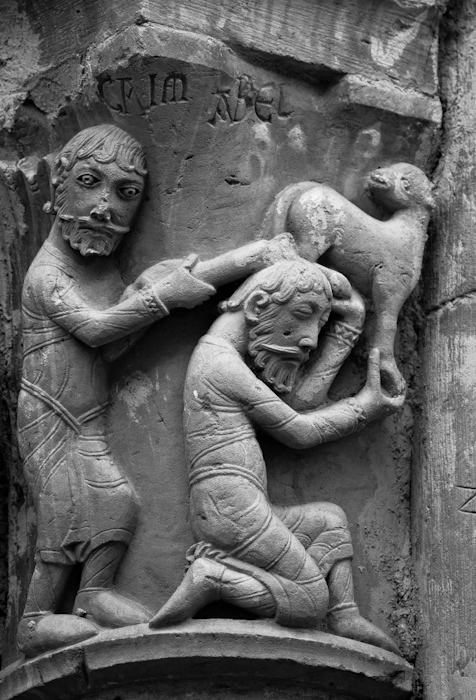
Non-verbal Communication: Cain looking at us

Cain and Abel – the mythical story of the first two children of humanity – in the Book of Genesis (Genesis 4:1-16) is about something that never happened way back when but about what is always happening with us: the inexplicable violence to which humankind turns against itself. It’s about the yawning abyss of violence into which we plunge when we can’t make sense out of life or when things don’t go our way.

Yesterday’s brief post on Via Lucis Photography of Religious Architecture focuses on a capital of Cain and Abel in a Romanesque church.

Photograph by Dennis Aubrey of Via Lucis Photography of Religious Architecture

Photograph by Dennis Aubrey of Via Lucis Photography of Religious Architecture

Like the Genesis writer, the Medieval artist whose hand crafted the story in stone many centuries later was doing theology and anthropology. The biblical author told the story with words; the Medieval sculptor told it with non-verbal communication.

The face of Cain on Via Lucis held my attention long after I’d gone on with the day. It kept returning to mind.

Cain’s head isn’t turned toward Abel whom he is pummeling to death with his stave. He’s looking away from Cain at someone or something else, as if to say the viewer, “So, you think I’m cruel. You think I’m different. You’re looking in the mirror.”

In the biblical story God tells Cain, “sin is crouching at the door; its desire is for you, but you must master it.” The Medieval sculptor’s art seems to be saying it in stone. Cain’s head is cocked, his eyes looking at us. At you. At me.  And, perhaps, at God, to whose failure to rescue Abel he shifts responsibility: “Am I my brother’s keeper?”  The capital seems to say Cain knows he owns us and the endless history of violence in which the blood of the silent victims cries out from the ground, unless and until we – persons, groups, religions, races, cultures, nations, a species – master the sin that’s forever crouching at our door.

  • Gordon C. Stewart, Chaska, MN, October 16, 2015


Verse – Why do you fly a kite?

Steve's kite

Steve’s kite

Why Do You Fly Kites?

You kid of 72,
Reliving your childhood?
Child-like, or childish?

Prairie winds are strong,
Annoying to some.
I choose to revel in them,
Let the wind lift my spirits,
Carry kite and me skyward.

But you can no longer run,
Cannot pull the kite aloft,
Cannot even trot…

A delta kite lifts itself
In even a mild breeze.
When high above,
I tie the line to a stake,
And sit with beer in hand,
And look up.

  • Steve Shoemaker, Urbana, IL, Oct. 26, 2015

The Presidential Debate

The pundits focused on Hillary and Bernie. They ignored a third candidate on the stage who fared well. His name is Martin O’Malley. He didn’t hit the home run the gurus said was required to bring him into the race, but he represented his record clearly with poise and with the dignity the American people have a right to expect of the person in the Oval Office. He had the stature of a President.

The Bernie-Hillary show was a media creation, a script which, to his great credit, Moderator Anderson Cooper did not follow. Cooper asked hard questions to every candidate with the first questions of the evening. Cooper was a professional journalist, working for the American people to flush out the inconsistencies and push for the truth of what a candidate really stands for. Bernie danced a jig on his poor record on gun control and his votes on the Brady Bill; Hillary danced on the email controversy, her Iraq War vote, and her change of opinion on the TPP trade agreement. Cooper was the consummate moderator, insisting that candidates answer the question they were asked, but respectful and fair.

Jim Webb and Lincoln Chafee were like minor leaguers on a Major League field in the early playoffs. There were five candidates on stage but only three major leaguers.

Webb performed poorly as the most conservative candidate who suffered from a shirt collar that made him look tight as a tic. He looked like the kid whose parents dressed him in a tux for the senior prom – very unnatural, ill at ease, unable to be his winsome self.  Chafee  stood by his progressive voting record and admirable credentials as a former U.S. Senator and Governor of Rhode Island, but his facial eccentricities and persona do not help his candidacy. Although he might make a great president, he’d be very hard to watch for four full years.

O’Malley, on the other hand, looked and sounded the part of a presidential candidate. Or, perhaps, Vice-Presidential. Like Joe Biden, O’Malley is both smart and tough, seasoned and fresh, just the kind of running mate Hillary or Bernie might choose, if either of them wins the Democratic Party nomination. The problem, of course, is that O’Malley is another Easterner, which all but eliminates him according to the prevailing wisdom that the best ticket is geographically balanced.

But, if in the debates ahead, Bernie and Hillary should falter, Martin O’Malley is someone to watch. If I were Bernie or Hillary, I’d sleep with one eye open. Remember the tortoise and the hare.

  • Gordon C. Stewart (Bernie supporter), Chaska, MN, October 14, 2015.


Hope from the Bowels of Forsakenness

Vulnerable. Weak. Lonely. Frightened. Anxious. Forlorn. Forsaken.

The hospitalized teenager suffering a sudden, undiagnosed illness of the bowels, wondering whether he’s dying, fearful there is no cure, came to my attention during the day. The consciousness of it remain through the night. Awakening in the morning, I look for something that will speak to the helpless feeling of his parents and grandparents.

Opening the Psalter, the opening verse of Psalm 22 leaps from the page — “My God, my God, why have you forsaken me?” — the tortured cry from the cross Jesus quoted many centuries after Psalm 22 had embedded itself in the collective consciousness of the Jewish people.

That the Newer Testament Gospels would put these words on Jesus’s lips is, it strikes me this morning, a Jewish code to look deeper for something much more complex, both tragically realistic and surprisingly hopeful in the psalm’s entirety. Though the forsakenness cry repeats itself immediately — “Why are You so far from helping me, and from the words of my groaning?” — Psalm 22 goes on to recall poetically the existential-spiritual history of Israel’s suffering at the hands of the nations and its deliverance from the same, ending with “They (i.e., our descendants) shall come and make known to a people yet unborn the saving deeds that He has done.”

Jesus’s cry from the cross strikes me as the kind of cry we might read or hear in the writings of Auschwitz survivor Elie Wiesel – honest yet faithful to the Jewish tradition because the tradition itself expresses the horror of god-forsakenness and faith in the absent God at the same time.

Jesus on the cross has this history in his bowels and his bones. The teenager in the hospital has no active faith community, no wisdom tradition or practice, except for the faith and prayers of his grandparents whose faith has been kept at a distance for many years.

The week before learning of the teenager’s plight I had been filled with questions about another young man: the 26 year-old who gunned down the nine students in Oregon who suffered a nano-second of god-forsakenness in the classrooms where they had presumed to be safe from death at the community college that became their execution chamber. The grizzly scene of the shooter asking people about their faith, telling those who rose that they were about to meet their Maker, chilled me to the bone, raising the question of what the shooter’s experience of Christians had been that would so fill him with anger at them and their religion. Was he one of the many in America who, for reasons explainable or inexplicable, feel forsaken and despised? Alone. Isolated. Scorned. Forlorn. Angry.

To be human is to be intrinsically vulnerable. We are all at risk; all headed inevitably toward death. We are not immortal, eternal, timeless, invulnerable. Was the young man turned executioner mocking his death row victim’s belief in an afterlife? Was he saying loudly that there is nothing on the other side of death – a message to the world that this is all there is and that religion is a cruel hoax?

Death is our common lot, but the irony is that it does not wait until the end; it takes hold of us in the middle – between birth and death – as much as at the end. The foreshadowing of it sends us running for cover, running for relief, for an escape. It appears under the guises of control, power, invulnerability. Sometimes its disguise is a pistol or an assault rifle. Other times its disguise is religion that entertains illusions of immortality, belief systems that include and exclude, like “are you a Christian?”

This morning I’m freshly struck by the entire Psalm whose first line has echoed through the centuries every Good Friday: “Eloi, Eloi, lama sabachtani?” —“My God, my God, why have your forsaken me?”. I’m wishing our bowels could hear it, feel it, digest it, weep it, and find the hope and trust that smiles the conviction that the forsakenness we feel is not the final word.

  • Gordon C. Stewart, Chaska, MN October 8, 2015

A Hopeful Prayer for Healing

A prayer for a sick person named “C______”:

Gracious God,

We know how to pray for sick C______, and, indeed, for anyone (including ourselves). Your child, Jesus, taught us to pray for daily bread, forgiveness, for You not to lead us into temptation, AND TO DELIVER US FROM EVIL!

Cancer is evil (as are heart attacks, brain tumors, diseases beyond number, and your last enemy, death.) Deliver C______, and us all. We pray for healing and full health.

We also know, however, even Jesus did not heal everyone, that not all His prayers were answered, even His prayer “If possible, may this cup pass from me.”

If healing is impossible, remind us of Psalm 23, and that in the shadow of death, we can know You are with us, fear no evil, and be comforted. Amen.

  • Steve Shoemaker, Urbana, IL, October 7, 2015

Verse – From Mid-West Farms

Verse — From Mid-West Farms

…In Sidney, Illinois, the Elevator
waits for grain. The corn, the beans,
arrive in wagons or in trucks the farmers
drive. The loaded truck is weighed.
…The boy was only nine when first he steered the Farmall tractor with the corn
in wagons from grand-daddy’s farm
to here. Now twenty-five tons fill
his semi-truck. The probe descends
to measure moisture in the beans–
13 point 3 percent, a little wet,
but very close.
…The operators flip the switch on side
of truck, the grain descends through grates, the augers twist, the fans begin
to dry soybeans until the days the trains
arrive. In 20 seconds each train car is filled.
…The empty truck is weighed, the receipt
given to the driver. Shift, accelerate, and steer…go get another load. From 6 a.m.
to 9 p.m., the harvest days are long,
but it is happy work.

  • Steve Shoemaker, Urbana, IL, October 6, 2015

Published with apologies to Steve for insertion of … in place of indentation.

The “Tragedy” of Sandy Hook

Ten (10) gun deaths at the community college in Oregon re-play Sandy Hook, Virginia Tech, and Columbine. What can be said that hasn’t been said? The best Views from the Edge can do is re-blog an earlier post and pray that America will find a way out of this morass.

Gordon C. Stewart's avatarViews from the Edge

macbethIf philosophical parsing of the meaning of Sandy Hook was inappropriate just a few days ago, it is mandatory now.

The slaughter of these dear little ones and their teachers was a moment of terrible and terrifying insanity. When Adam put on his body armor and turned his mother’s guns on his own mother and Sandy Hook, insanity broke out to bring grief that chilled the bones of everyone in America.

Today there are calls for gun control and mental health services, and those calls make perfect sense as practical responses, but they will not fix the problem.

There is a more profound collective insanity that pervades our culture and our nation. It’s a tragedy in the sense of the old Greek and Shakespearean theater: a fatal flaw that is doing us in.

Sandy Hook was the latest symptom of the American tragedy: our worship of safety – arming ourselves to…

View original post 265 more words

Daily Riches: Without Excuse or Defense Before God (Thomas Merton)

Pope Francis quoted Thomas Merton. Here’s more thought-provoking Merton.

Bill Britton's avatarRicher By Far

“ …we should let ourselves be brought naked and defenceless into the center of that dread where we stand alone before God in our nothingness, without explanation, without theories, completely dependent upon his providential care, in dire need of the gift of his grace, his mercy and the light of faith. …But when the time comes to enter the darkness in which we are naked and helpless and alone; in which we see the insufficiency of our greatest strength and the hollowness of our strongest virtues; in which we have nothing of our own to rely on, and nothing in our nature to support us, and nothing in the world to guide us or give us light – then we find out whether or not we live by faith.” Thomas Merton

“I saw the Lord, high and exalted, seated on a throne;
 and the train of his robe filled the…

View original post 318 more words

Professors and Jack-hammer Operators

Is there a difference between being retired and being dead?

Is there a difference between being employed and being dead?

It all depends, perhaps. Is your retirement deadly boring? Is your employment deadly meaningless? It all comes down to “calling” – the sense that one is called to something.

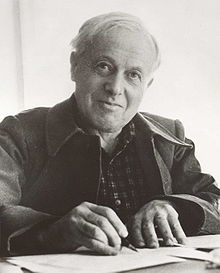
Eugen Rosenstock-Huessey

Eugen Rosenstock-Huessey

Social philosopher Eugen Rosenstock-Huessey noted how curious is was that in their leisure time professors read books and jack-hammer operators rode motorcycles. If it really was leisure, he said, the professors who worked with ideas would be riding motorcycles; the jackhammer operators whose ears were filled with noise all week would be reading philosophy, history or novels.

I think  need a motorcycle!

P.S. My audiologist said I have the ears of a 45 year old jack-hammer operator.

  • Gordon C. Stewart, Chaska, MN, Oct. 1, 2015