Mary Luti
A brief reflection for any day or time of the year. Click Noisy Advent to open the piece by Mary Luti, author of Teresa of Avila’s Way.
Gordon

Mary Luti
A brief reflection for any day or time of the year. Click Noisy Advent to open the piece by Mary Luti, author of Teresa of Avila’s Way.
Gordon
 Donald Trump dominated news coverage this week.
During a CNN interview, he acknowledged he hadn’t needed to spend a nickel for ads or PR, thanks to free media coverage.
Today Bernie Sanders noted the disparate coverage of the Trump and Sanders campaigns in an email to Sanders supporters. It reads as follows:
I’ve always been interested in media and have always been concerned that corporate media doesn’t really educate people in this country. They refuse to talk about the serious issues facing our country.
That’s why I wasn’t surprised yesterday when I saw this headline: “Report: ABC World News Tonight Has Devoted 81 Minutes To Trump, One Minute To Sanders.”
It’s no shock to me that big networks, which are controlled by a handful of large corporations, have barely discussed our campaign and the important issues we are bringing up. They’re just too busy covering Donald Trump.
We can’t allow the corporate media to set the agenda. We have got to get the real issues out there. And that’s why I’m asking you to join me in a major petition to the big networks.
This is what the corporate media is all about: more Americans support our campaign than Trump’s according to recent polls, but still ABC’s news program has spent 81 minutes on Trump and only 20 seconds talking about us. NBC Nightly News only spent 2.9 minutes covering our campaign. CBS? They spent six minutes.
The point is: our political revolution certainly will not be televised. It’s more important than ever for us to hold the large corporations that control the media accountable.
I know we can win this fight if we all work to get the message out there.
Views from the Edge readers support a variety of candidates. We post this Sanders material with links because the issues Sanders raises are real and disturbing, and because it provides opportunity to express our desire for fairer coverage.
There is no good reason for Sanders or any other presidential candidate to be Trumped by the corporate towers of Babel.
– Gordon C. Stewart, Chaska, MN, Dec. 12, 2015.
“In a time when hard actions and sharp words have been directed at our Muslim neighbors,” (see text below), The Minnesota Council of Churches issued this statement today:
Respect for Religious Freedom and Love of Neighbor: A Call to Offer These Christmas Gifts
As Christian leaders who serve as the board of the Minnesota Council of Churches, we want to speak to our communities of faith and to the larger community of people living in Minnesota.
To begin, we want to address the members of all our communities of faith. We call on people to speak with respect in a tender time when we all feel vulnerable and unsafe after acts of mass violence. “Be not afraid…” is an exhortation in the Bible, again and again. Let that be the deep value in which we rest. Courageously reaching out to our neighbors, learning more about their stories, and supporting our newest neighbors is a gift worth giving in this Advent and Christmas season.
Secondly, we express appreciation for and commend consideration of all candidates in our political process who are respectfully engaging the issues of how we best build up the life of our state and nation and serve the common good. We encourage people in political conversations in family, communities and work contexts to speak with care. Our words matter. Let us commit to refrain from using speech that reflects hatred of others and contributes to the division of our society.
We also ask media outlets to tell the stories of candidates, who in their campaigns, debates and addresses are offering constructive proposals for our shared life together. Your choice of stories matters and can build up or tear down the common good. When we focus only on the negative or inflammatory, we do not have time to hear the larger conversation and participate in discernment about our shared future together.
Most importantly, in a time when hard actions and sharp words have been directed at our Muslim neighbors, we want to speak a word of support and pledge to walk with them and support their freedom to practice their religion.
This country is built on that freedom. We pledge to walk respectfully and to learn from one another. The Islamic community in Minnesota is vibrant and diverse, contributing much to the state – as citizens, teachers, police officers, medical workers, tradespersons, community leaders, mothers and fathers. We stand in solidarity with the Muslim communities of Minnesota and are ready to denounce the vitriol that comes their way. As Christians, we are called to love all our neighbors. Muslims are our neighbors, and we love them.
Finally, we are committed to continuing our long experience of working with diverse faith communities and of welcoming refugees into our midst, without regard for religion or ethnicity. We are committed to building communities of respect. We call for respect, support and helpful curiosity, instead of critique and attack, in the days to come from all people as we seek to build the best Minnesota possible.
We invite the sharing of this statement
MCC Members – Minnesota Jurisdictions of the following:
African Methodist Episcopal Church
American Baptist Churches, USA
Christian Church (Disciples of Christ)
Church of God in Christ
Church of the Brethren
The Episcopal Church in Minnesota
Evangelical Lutheran Church in America
Greek Orthodox Archdiocese of America
Mennonite Church
Moravian Church
National Association of Congregational Christian Churches
National Baptist Convention
Pentecostal World Assemblies
Presbyterian Church (USA)
United Church of Christ
United Methodist Church
The wedding I’m remembering took place in August, 1972 at Shalom House, the ecumenical campus ministry center at the University of Wisconsin-Whitewater that housed a collaborative Roman Catholic and Protestant campus ministry.
The bride and broom were students active in the campus ministry. Max, we’ll call him, a counter-cultural jazz flutist with long hair down his back raised in the arch-conservative Wisconsin Synod Lutheran Church, had become involved in the progressive protestant campus ministry. The bride, whom we’ll call Elizabeth, was raised Roman Catholic and was active in the Catholic Campus Ministry.
Because it was a “mixed” marriage involving at least one Christian tradition that viewed the other as going to Hell, Father Charlie and I officiated together at the wedding. Charlie, a much loved priest known for his light touch and quick laugh, and I were colleagues and best of friends.
Imagine the scene in the small Shalom House living room.
Father Charlie and I take our places at one end of the living room, followed by Max, who has replaced his normal attire of blue jeans and a tie-dyed shirt with the light tan polyester suit purchased just for this occasion. Elizabeth enters wearing a lovely traditional white gown every bride still wears, forgetting the ancient meaning of the symbolism. They’ve “known” each other, as the Good Book puts it, for quite awhile.
The mid-afternoon temperature is in the high 90s. There is no air conditioning. Max is sopping wet, sweat pouring from his nose and chin onto the new polyester suit.
It seems he’s in danger of fainting. “Don’t lock your knees,” I whisper to Max, just hang loose.” The whole room feels more than a little uptight. Wisconsin Synod Lutherans and Roman Catholics don’t share the same space, except at the drug store.
Because the guests are from war traditions, Father Charlie and I have printed out every word of the service. The bride and groom, and each of the 50 guests has a copy of the service. Every word of it.
Father Charlie’s and my words are in regular type; responses by the bride, groom, or congregation are in bold type. Charlie and I had agreed to alternate leading. But we have also decided that whichever one of us is not leading will help prompt the congregation in the bold type responses.
All is well until we come to the consent questions, the “I will” questions.
Charlie, reading the regular type, asks Max the question. Max responds: I will.
I ask Elizabeth, “Will you have Max to be your wedded husband, to live with him and cherish him, in the holy bond of marriage?”
The bass voice from next to me answers I Will! before Elizabeth can respond. I look at Charlie, Charlie puts his hand to his mouth, opens his eyes wide and says, “Oops!”
Father Charlie and I worked together for four fun-filled years. The day of Max and Elizabeth’s celebration of Holy Matrimony was a Mr. Bean kind of day.
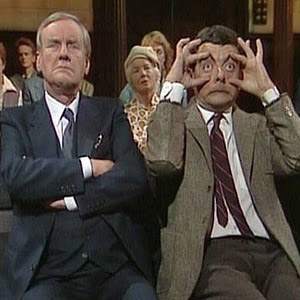
Mr. Bean, Rowan Atkinson
My preaching was very specific,
I was sure my words were terrific,
But the folks in the pew
Had a much different view:
“Your sermons were all soporific.”
ANECDOTE FROM GORDON:
While preaching a sermon I thought was at least passable, a worshiper with dementia let out an audible “Ho-Hum” during what was meant to be a pregnant pause. It has the makings of a Mr. Bean skit.
Protecting the Homeland by Donnie Trump (2nd grade)
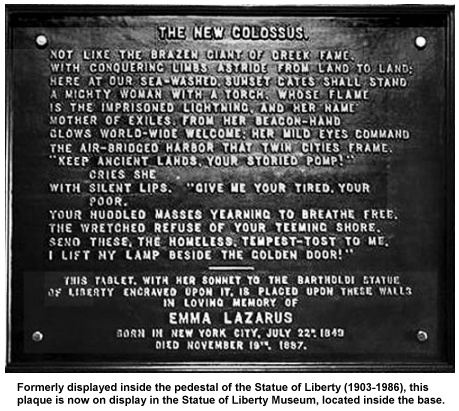
Statue of Liberty plaque with Emma Lazarus’ poem “The Colossus”
You don’t get to come here –
“you tired, you poor,
You huddled masses,
yearning to breath free,
you wretched refuse of
your teeming shore,
Stay home, you homeless,
tempest tossed,
my lamp’s blown out
beside the golden door.”
[Simpleton Press, NY, NY, Dec. 8, 2015.]
Click Cartoon a Day for cartoon by Bryant Arnold.
“Pack some heavy heat, Boys,”
said Jesus to the Apostles
on his way to pray in the
Garden of Gethsemane
and off again to the Mount
of Olives – that liberal
haunt with olive branches,
doves, and sh-t like that –
“Conceal and carry, Boys,”
he’d said, in the Upper Room
where that sissy John
laid against his breast –
“Get your guns, Boys,
the Fags, Commies, and
Mohammad-lovers are
comin’ to kill our faith.
“You have heard that it was
said, ‘love your neighbor’,
but I say, take ‘em out, Boys,
we’re ‘the home of the brave’.”
by J. Feelwell, Re-imagining Jesus, Crusaders Press, Lynchburg, VA, Dec. 9, 2015
INTRODUCTION: Every few years a sermon knocks my socks off. This unusual sermon by The Rev. Devon Anderson was heard last Sunday at Trinity Episcopal Church in Excelsior, Minnesota. The text is Luke 3:1-6. Disclaimer: the sources for the sermon are listed at the end; the text itself does not include footnotes and does not always include quotation marks.
___________________
A few weeks ago I was in Baltimore at a church meeting held at the Maritime Institute of Technology’s conference center. The institute teaches how to pilot everything from a tugboat to the biggest of seafaring barge. During our meeting my friend Ernesto discovered that the Maritime Institute boasts two “full mission, ship handling” simulators. With a bit of sweet talk, he finagled a tour.
The simulators are housed inside huge 80X30 feet curved projection screens (kind of like an iMax theater). Inside is constructed an actual bridge – the literal steering wheel, radar, and control panels that any barge of that magnitude would have. We stepped onto the bridge in darkness. But after our guide punched some buttons and threw a few switches, the lights came on and we were – in an instant – ship captains, navigating an industrial barge through Baltimore harbor. Ernesto and I took turns serving as captain and first mate.
At some point our tour guide started to mess with us. “Hmmm…,” he said, “it looks like it’s about to rain.” A few buttons, a few switches, and the sky began to darken, as virtual raindrops misted the windows. “Hmmmm…,” he said again, “I think we’re heading for a bit of a hurricane,” and all of a sudden we were in the open sea gazing back at the Maryland coastline, as the waves swelled, and the barge dipped and rocked deeper and deeper. “Oh no,” said our host, clearly enjoying himself in the face of our growing panic, “it looks like the hurricane knocked out power in Baltimore.” As he said it, the control panel, too, flashed and went cold as the sound of the engines cut out. In an instant everything went black. I mean, really black. Out of the darkness came the voice of our guide, “Hmmm…what are you going to do now?” We drove the barge around in the dark for a while – which was terrifying — as the hurricane subsided. Eventually the click click click of buttons and switches cleared the night sky, and from the darkness emerged a million sparkling stars. “When everything goes dark,” our guide told us, “a good pilot slows down and watches for what can help him.”
Hmmm….I’ve been thinking about that virtual darkness out on the virtual sea these past weeks. Advent always happens in the darkest of days, as our little place on the planet moves further and further away from the sun. This time of year, we know a lot about darkness. Our Advent scriptures reflect that. So much of what we read in Advent is about darkness and our thirst for light. “The Lord is my light and my salvation…(Ps 27:1)” writes the psalmist, “the fountain of life in whose light we see light (Ps 36.9). “The people who walked in darkness have seen a great light; those who lived in a land of deep darkness – on them light has shined.” (Is 9:2). And even today John the Baptist calls the people out into the cold, dark, desert night so they are ready for the light that will save them all. In so many of our Advent stories, the message is the same: the light of the world has come to put an end to darkness, to be a lamp in the hands of those who believe. Like myself, I know so many people whose lives depend on that promise – when we can’t see where we are going; when the bottom drops out; when our prayers go unanswered and we’re marooned in the kind of darkness that makes us afraid to move – we cling to the promise that if we can just keep our minds focused on the light of the world then sooner or later God will send us some bright angels to lead us out.
And yet – deep in our holy scriptures there lives an equal and opposite truth that almost never comes up in church: that God dwells in deep darkness. God comes to the people in dark clouds, dark nights, dark dreams and dark strangers in ways that sometimes scare them half to death but almost always for their good, or at least, for their transformation. God does some of God’s best work in the dark.
We have been conditioned to view darkness as a negative, symbolizing what’s sinister, or dismal, or tragic or wrong. It was a really dark film. We’re in a really dark place right now. He’s gone to the dark side. No one ever asks God for more darkness, please. Please God, come to me in a dark cloud. Give me a dark vision. Please eclipse the sun and throw life as I know it into complete shadow. Put out my lights so I can see what I need to see. Then, send me a dark angel on the worst night of my life, please.
And no one asks for darkness in the Bible, either, but it happens. Once you start noticing how many things happen at night in the Bible, the list grows fast. God comes to Abraham in the dark, instructing a series of desired sacrifices then sealing the covenant with the people Israel forever. God comes to Jacob in the dark not once, but twice – the first in a dream at the foot of a heavenly ladder, and the second on a riverbank where an angel wrestles him all night long. The exodus from Egypt happens at night; God parts the Red Sea at night; manna falls from the sky in the wilderness at night – and that’s just the beginning.
The cloud and the glory always seem to go together – not just in the Hebrew Scriptures, but in our Gospels, too. Ask Jesus’ disciples Peter, James, and John who entered another cloud on another mountain where they too were overshadowed by the glorious, terrifying darkness of God. Ask Saul the ferocious who was blinded on the road so he could be led by the hand to a hard bed in a rented room, where he finally became soft enough to welcome a dark angel named Ananias. Ask Mary how her life – and the life of the whole world – changed when the savior of the world was born in that scary, darkest hour just before dawn. Ask Mary Magdalene who, in her insurmountable grief, discovers the risen Christ. “Early on the first day of the week, while it was still dark…” the discovery of resurrection begins.
It’s not a popular truth, but there it is: God dwells in deep darkness. When we cannot see – when we are not sure where we are going and all our old landmarks have vanished inside the storm – then plenty of us can believe we are lost and forgotten. But what I am asking you to consider is an additional theology – that when we find ourselves in darkness, we may be the exact opposite of lost and forgotten. Based on the witness of those who have gone before, we know that darkness is where God most often restores us when our lives have broken apart. It is the cloud of unknowing where nothing we thought we knew about God can prepare us to meet the God who is. It is in darkness where new life, no matter how shattered, is born.
There are real benefits to this kind of faith, though they may not appeal to those for whom God can only be light (and in whom there is no darkness at all). The first benefit is that we have to slow way, way down when we find ourselves in the dark. When the kids were little we took them to visit Crystal Cave in western Wisconsin, right off I-94. It’s campy as all get-out, but it’s been around as a tourist attraction for a long time, first discovered in 1881. Just like any cave or mine tour, visitors must walk down flight after flight of industrial stairs, down, down, down – 70 feet in this case — into the damp, drippy earth. At some point the guide flips off the lights so everyone can get a feel for how dark the dark can be – like, can’t see your hand in front of your face dark. Anyone that’s been on one of these tours knows – the minute those lights go out, everyone freezes. There’s just no running around in dark like that. All the things we pride ourselves on in the light outside – our speed, our agility, our ability to talk fast and get things done – they don’t help us one single bit in that kind of darkness. Darkness forces us to slow down and use senses we don’t use when our eyes are working in the light of day. Darkness like that sharpens our senses, hones our awareness, makes us hyper-sensitive to God’s light touch.
Another benefit of faith in darkness is teaches that none of our outside navigational tools can, in the end, really help us. Just like when the power went out in the virtual Baltimore harbor – when we hit real darkness, external things we depend upon in the light of our normal lives to keep us safe and secure, no longer work. If it’s not already inside us, then it’s of limited use to us in the dark places. Once we enter darkness we find out what our primary resources are: love, hope, vulnerability, openness, and what insistent, sacred whisper we can learn to trust when we’re navigating by faith and not by sight. We learn in that place to trust more supremely what only God can do for us, over what we think we can do for ourselves.
And finally, inside darkness with everything slooooowed waaaay doooowwn, depending on what’s inside ourselves to feel our way forward, the good news is that God has room and time and enough of our attention to bring forth new life – an entirely new thing that didn’t exist before dark descended. One of my favorite paintings of all time is from Van Gogh’s olive tree series, housed in the permanent collection of the Minnesota Institute of Arts. A light, lavender punctuates the painting in rows between trees and in the background mountain scape. Apparently Van Gogh considered the lavender a color of “consolation” (his word) in that he felt the color was not its own entity, but created by the stormy confrontation of darkness weakened by light. The new creation only possible because of darkness.
I know my defense of darkness will never, ultimately, sell. Endarkenment is never going to appeal to anyone the way enlightenment does. But for those who are already sitting in the dark, and for those of us who know that at some point we’ll be there, too, to consider the possibility that God dwells there with us is Gospel Good News indeed. And, in the end, I do know this: the thing about the cloud of unknowing, which even the saints take on trust is that it’s not there to get through like a test or a fever. It is God’s home. It is the place where God dwells. To be invited in is a great honor, and to stay awhile? Better yet. When sitting in darkness, we never feel that it’s a great honor – it’s the last place any of us want to be. But I do know this: that for those who make it out the other side, while they may not have a lot of words to describe where they have been, and they’ll tell us they never would have chosen it in a million years – they do have a great story to tell and more than not it’s a story that includes redemption and healing, regeneration and a new wisdom. They might just tell us that now that it has happened they would never give it back. AMEN.
Sources:
The brilliant idea and direct quotes about God doing God’s best work in the dark are excerpted from Barbara Brown Taylor’s Learning to Walk in the Dark (2014), an excellent read that I highly recommend.
The Maritime Institute of Technology’s website (click HERE) has interesting information about its simulator-based training programs.
Van Gogh’s approach to the cover lavender is commented upon by Goethe in the book Goethe’s Way of Science by David Seamon: “…this reciprocity between darkness and light points to the ur-phenomenon of color: Color is the resolution of the tension between darkness and light. Thus darkness weakened by light leads to the darker colors of blue, indigo, and violet, while light dimmed by darkness creates the lighter colors of yellow, organize, and red. Unlike Newton, who theorized that colors are entities that have merely arisen out of light (as, for example, through refraction in a prism), Goethe came to believe that colors are new formations that develop through the dialectical action between darkness and light. Darkness is not a total, passive absence of light as Newton had suggested, but, rather, an active presence, opposing itself to light and interacting with it. Theory of Color presents a way to demonstrate firsthand this dialectical relationship and color as its result.”
As readers of Views from the Edge (VFTE) may know, Steve Shoemaker, my poet colleague on VFTE has been diagnosed with pancreatic cancer. His sense of humor remains strong. This verse recalls a moment with Steve and four other seminary classmates following a rare Cubs’ win at Wrigley Field in Wrigleyville, Chicago.

BENDING DOWN, LOOKING UP
A towering 69 year-old figure standing
six-feet-eight, Steve saunters slowly
through the post-game crowd outside
“the Friendly Confines” of Wrigleyville
like a watchtower on skates, looking
far and near for who knows what.
A very happy young woman as high
as he is tall pulls on his sleeve, asking
a question only he, bending far down,
can hear. He smiles but shakes his head
to whatever offer threatened to bring
him down to a lower happiness high.
Two years later at 72, he might be
looking again for the Wrigleyville fan
for something to ease the pain, settle
his stomach, give some relief from
the newly diagnosed cancer, a pill
or toke or two to raise him back up
to the watchtower, now six-feet-seven.
We who couldn’t hear the question
now smile, bend down low, and look up
beyond Steve’s lofty height with prayers
for courage, strength, whatever will keep
him tall in the game where everyone wins
and loses, and quite unexpectedly,
feels a gentle tug on an old shirtsleeve.
– Gordon C. Stewart, Dec. 8, 2015
Donald Trump proposes a travel ban on all Muslims. We invite Mr. Trump and those who applaud him to read the U.S. Constitution prohibiting the establishment of religion, and to pray for these things posted several weeks ago on FB from an anonymous source.