Verse – Jackie was the most kind

In 1969 I started Duke
to get a Ph.D. They gave me ten
long years to finish, but for me it took
a bit more time… I had a job, and then
two kids, and boy, could I procrastinate.
A great new novel to be read, a cause
to join, a film to see, a verse to write…

I hired two friends, good Joe, who failed because
he was too kind believing every lie.
But Jackie, who seemed sweet, looked in my eye
and gave me hell. And so I worked and wrote.
The Duke degree I finally earned, I note
four decades later, came because of two:
one nice, one mean–and finally I was through.

  • Steve Shoemaker, Urbana, IL, Dec. 7, 2015

Growing Mob Mentality

Click “If Unchecked, The Growing Mob Mentality in the United States Will Lead to Our Self-Destruction” to read Mark Karlin’s piece today on  Moyers & Company.

Two Universities: Liberty and Paris

When the president of “the largest Christian university in the world” in Lynchburg, Virginia urges every student to buy a gun and get a permit to carry a concealed weapon, for whatever reasons, it seems a little oxymoronic and moronic. It’s neither Christian nor smart. It’s not what people do in college. They buy books, not guns. It’s not consistent with the traditions and standards of higher learning. Real universities don’t talk like that.

At one of the world’s first universities, the University of Paris (the Sorbonne), way back in the 13th century, a young Thomas Aquinas was a student of philosophy and Christian theology. His professors introduced him to great critical thinkers like Aristotle, Plato, and Maimonides in their original Greek and Latin languages.

Lynchville, Virginia in the 21st Century is long way from Paris in the 13th Century, and that’s too bad for all of us in America where what Aquinas later called “willful ignorance” has become the order of the day.

 It is clear that not every kind of ignorance is the cause of a sin, but that alone which removes the knowledge which would prevent the sinful act. …This may happen on the part of the ignorance itself, because, to wit, this ignorance is voluntary. …  For such like negligence renders the ignorance itself voluntary and sinful, provided it be about matters one is *bound and able to know.” [Thomas Aquinas, Summa Theologica, I-II, q. 76, a. 1, a. 3.]

Today’s Catholic World, an online encyclopedia, adds these footnotes to Aquinas’s text:

*Catholics are bound (required) to learn and know their Faith. A sin against faith (often caused by willful ignorance) is the gravest of all sins according to St. Thomas Aquinas.

St. Augustine, cited by St. Thomas, characterizes sin against faith in these words: Hoc est peccatum quo tenentur cuncta peccata. “This is the sin which comprehends all other sins.”

Liberty University is not a Catholic university. It’s not big on Catholics. It’s fundamentalist protestant.  It prides itself on its knowledge of the Bible.

But don’t we have to suppose that somewhere in that auditorium in Lynchburg, there was a professor who cringed? Someone there who resonated with the old student at the University of Paris? Someone who thought that telling young professing Christians to arm themselves was a deliberate act of willful ignorance, a sin against faith, the sin that comprehends all others?

“Put away your sword. Those who live by the sword will perish by the sword” – Jesus of Nazareth to Peter after Peter had cult off the High Priest’s servant’s ear at Jesus’s arrest, 1st Century, according to The Gospel of Matthew 26:52.

Gordon C. Stewart, public theologian, author of Be Still! Departure from Collective Madness (2017 Wipf and Stock) host of Views from the Edge. Brooklyn Park, MN. Originally published 2015.  Re-posted here June 13, 2022.

Dueling Presidents: Obama and Falwell

President Obama speaks from the Oval Office during prime time, seeking to calm a jittery nation following terrorist attacks abroad and in California. I questioned the wisdom of devoting so much of a speech on national security to domestic relations with our own Muslim neighbors …until this morning I watched Jerry Falwell, Jr., President of Liberty University, urging his students to apply for conceal-and-carry permits so that they could “end those Muslims.”

http://www.stuff.co.nz/world/americas/74836735/us-college-president-tells-students-to-carry-guns-to-end-those-muslims

The media describe Liberty University as “a leading evangelical Christian college” in Virginia. It’s not. It’s a poor excuse for a university or college, a right-wing fundamentalist school led by the son of Jerry Falwell, founder of the Moral Majority, an arch-conservative fundamentalist religious-political movement to take back the country from liberals… you know…people like Jimmy Carter.

Three days after telling his students to buy guns and on the eve of President Obama’s Sunday evening address to the nation, Falwell tweeted that his reference to “those Muslims” was meant only for those Muslims who commit acts of terror. But Jerry, Jr. is not stupid. The deafening applause from the Liberty auditorium was still ringing in his ears.

President Obama and President Falwell both know we are shivering. Only the non-preacher President represented the spirit and ancient counsel of Baruch: “Take off the garment of your sorrow and affliction, O Jerusalem, and put on forever the beauty of the glory from God” [Baruch 5:1-9; 2nd Century BCE].

We can freeze ourselves to death wearing living in the garment of sorrow, affliction, and fear. Or we can take it off to put on the warm garment of beauty – the glory of God shining in mutual consolation, hope, and steadfast determination to live in peace with our neighbors.

If you can imagine Jesus telling his students (disciples) to apply for conceal-and-carry permits, pack some heat, and put an end to anyone, you’re making that Jesus up. You don’t get to make Jesus up in your own image.

“You have heard that it was said, ‘Love your neighbor and hate your enemies.’  But I say to you, love your enemies. Pray for those who hurt you. If you do this, you will be true children of your Father in heaven. He causes the sun to rise on good people and on evil people, and he sends rain to those who do right and to those who do wrong. If you love only the people who love you, you will get no reward. Even the tax collectors do that. And if you are nice only to your friends, you are no better than other people. Even those who don’t know God are nice to their friends. So you must be perfect, just as your Father in heaven is perfect.” – Jesus, Sermon on the Mount, Gospel According to Matthew 5:43-48, NCB.

  • Gordon C. Stewart, Presbyterian minister, would-be disciple of Jesus, Chaska, MN, Dec. 7, 2015


You are not entirely alone. Ever.

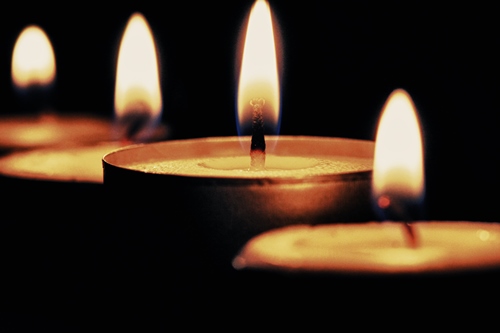
With votive candles lit in remembrance of loved ones, we entered the softly lit church at dusk. We sat in silence until the piano and violin soothed the gatherers with Fantasia on Greensleeves, arranged by Ralph Vaughan Williams. Imagine yourself there with a candle.

After readings from Frederick Buechner, Mary Oliver, Romans 8 and a brief homily, Arvo Pärt’s Spiegel im Spiegel provided the music for worshipers to come forward to place our candles on the altar.

As the teenage daughter and her 9 year-old brother returned to their pew in front of us, it was apparent they’d experienced a devastating loss. Perhaps a grandparent? A cousin? A pet? The brother, half her size, threw his arms around his sister with great tenderness, sharing a vulnerable moment of deep grief. The father’s hand stretched across the pew to hold them both.

I learned later the reason for their grief – the death of a close friend two months before in a murder suicide that killed her friend, classmate, and teammate, two other children, and their parents. They’d had a normal dinner together the night before the tragedy no one had anticipated or imagined.

votive-candlesTonight the friend was there to deal with her grief. There was something profoundly sacred about the church tonight – a community of the grieving like no other community. Real. Unvarnished. Reverent. Open. Prayerful. Tender. A healthy vulnerable community of mutual need and faith lighting candles, bearing witness to an inexplicable grace greater than the darkness that had fallen upon us.

Members of the Trinity Mental Health Initiative (MHI) Board of Trinity Episcopal Church, founded two years ago, hosted the service. The note in the bulletin read:

“MHI was birthed in the sorrow of personal loss, and with the intent that no one should have to be alone in the terrible helplessness and sadness that comes with some deaths. … We invite you to open yourselves today to both sadness and possibility, and to know that you are not entirely alone. Ever.”

I wish the sorrowing world could have been there.

  • Gordon C. Stewart, Chaska, MN, Dec. 6, 2015.


Grandma’s Miraculous Mood Change

In her old age – I know we don’t use that term anymore but she was old no matter whether you called her a “senior citizen” or the more current “older adult” – my 88 year-old Grandmother came to live with us. “Us” was my father, mother, two brothers and I, the five (5) of us and Grandma in a small three (3) bedroom home in Broomall, Pennsylvania.

Grandma also shuffled back and forth between two other places – my rich Uncle Harold’s palatial home on Long Island Sound in Greenwich, Connecticut, and Harold’s summer cottage in Rockport, Massachusetts, where Grandma and Pop (Grandpa’s children called him “Pop”) spent their summers.

Letitia Sophia Campbell Stewart (“Sophie”) felt welcome in our little home and would settle in during her stays with us. Everything  would be fine for a month or two. She sort of seemed to like my mother, although no woman would be quite good enough for her Kenneth or her Harold, and both daughters-in-law knew it.

My mother was more than gracious, much more attentive to her needs than Rene, and they got along just fine. But there were times when something like a boulder would come crashing through the picture window into our living room, hit Grandma in the head, and turn her into a whining old goat. She became self-absorbed, self-pitying, annoying and quite unlovely.

Grandma was attached at the hip to Harold, 15 years older than my father. She hated the separation. Harold was the family hero, the nationally recognized Washington insider, the wealthy provider. Aloof and cold as ice but kind…if that makes any sense. Which meant he didn’t pay attention to his mother when she was at our house. Out of sight, out of mind.

Grandma became morose. “Was there a letter from Harold?” “No, Mom. I’m sorry. No mail today.”

“Harold never writes. He hasn’t called. Harold doesn’t love me. I’m just a burden. Why doesn’t God just take me. I’m of no use to anybody anymore.”

One day my mother couldn’t take it anymore. “Ken,” she said, “we have to do something or she has to go to Harold’s.”

Dad suggested taking Grandma to the doctor. She liked the doctor in Broomall.

“Sophie, what’s going on?” asked the doctor, who’d already been briefed on the boulder. Grandma repeated the script. She was a burden to everyone. Pop was gone. She was alone. “I don’t know why God doesn’t just take me!”

“Well, that’s not a problem. WE can take care of that,” said the doctor. “Really?” asked Grandma. “You bet. We can take care of that right now. I have gun out back. We can just go out back and end your misery right now.”

“O, doctor, you wouldn’t do that!!!” said Grandma.

Grandma came home as though the boulder had never hit her. The whole world had been lifted from her shoulders. She flashed her beautiful smile again and told us how much she loved us. But she continued to leave her leave her mark in the living wherever she sat, leaving my mother to ask why God hadn’t taken either Grandma or her, and I asking when I could get my bedroom back.

  • Gordon C. Stewart, Chaska, MN, Dec. 5, 2015



My Visit to Grandma’s

When I was 13 my parents put me on a flight from Philadelphia to Boston. My paternal grandmother, recovering from a near fatal heart attack, needed a live-in caregiver at the summer cottage in Rockport, Massachusetts. My grandfather had died three years earlier.

When we learned of her need, there was an extended family discussion. The doctor said she needed someone with her for the next month.

Who would stay with Grandma? Who could go stay for a month?

Motif #1, Rockport Harbor

Motif #1, Rockport Harbor

Grandma insisted on going to Rockport when released from the hospital, and she did, all by herself, though she remained bed-ridden on doctor’s orders except for necessary short trips to the facility and the kitchen.

Shall we say Grandma was…just a tad stubborn, and her stubborn independence was a worry for the whole family. She wasn’t safe and shouldn’t be alone.

My cousin Gina would have been the most likely candidate, but Gina had married a MacDonald. Grandma – of the Campbell clan, the mortal enemy of the MacDonalds – had refused to bless Gina’s marriage to Norman, and would have nothing to do with either of them. Did I mention she was stubborn?

Partly by process of elimination and partly by reason of her grandson seizing the chance to live up the road from Old Garden Beach and the Headlands in my favorite place in the world, I boarded the plane and stayed the month in Rockport.

I took the train from Logan Airport to Rockport, suitcase in hand, walked the mile from the train station up Atlantic Avenue beside Rockport Harbor and turned left onto Harraden Avenue. It didn’t occur to me that it was odd for a 13 year-old to be on his own on his way to an onerous responsibility. Old Garden Beach, the Headlands, and nightly trips to Bearskin Neck and Tuck’s for ice cream were on my mind more than Grandma.

Grandma Stewart was in bed when I opened the picket fence gate and walked in the cottage’s unlocked door. We greeted each other with outspread arms, Grandma’s eyes big as saucers, flowing with tears.

“We’ll be safe,” she says. “I have a gun.” She points under the bed.

I pull out a revolutionary war rifle weighing about 10 pounds. There’s no ammunition. Just an old revolutionary war musket, like the ones the authors of the 2nd Amendment had in mind.

Revolutionary War rifle - requires only 13 steps to fire.

Revolutionary War rifle – requires only 13 steps to fire.

“Grandma,” I say, “I don’t see any bullets. Is it loaded?”

“I don’t think so,” she says. “It’s heavy. We’ll just hit ‘em with it!”

The rifle stayed under the bed long after my month playing long-distance nursemaid and body guard to Grandma from down at the beach during the day and from candy and ice cream shops on Bearskin Neck at night. I was the family hero.

Poor Grandma! Poor America! Wouldn’t the founding fathers be proud!

  • Gordon C. Stewart, Chaska, MN, December 5, 2015

?

Me: God, Why?
God: No, I ask the questions…
Me: Ok, what are your questions?
God: Don’t ask.

  • Steve Shoemaker, from Mayo Clinic, Rochester, MN, Dec. 5, 2015

Up in Arms

How many people have to die before we get it?  Howard Beale captures the feeling following the San Bernardino shooting and all the massacres that came before it:

Isn’t it time we had a reasonable conversation about what the Second Amendment meant by “arms”? The strictest constitutional interpretation would lead in one of two directions: 1) every citizen has a right to a single shot rifle, or 2) every citizen has a right to “arms” — as in the weapons of war, like the bombs that failed to detonate in San Bernadino.

How many people have to die before….?


A personal reflection in a mad time

I stood in front of the governor’s mansion in Saint Paul last night, its face lit up by thousands of glowing lights. My apartment isn’t all that far from the guv’s place, and I needed a walk after a long day inside, and suddenly, there I was.

The lights are gorgeous, both the governor’s and a number of nearby homes. No question about that. But last night, those lights did not light up my countenance, at least not in the way they are probably intended to do. Not in times like this. Not after yet two more mass shootings this week; not amidst the recent violence of Chicago and Colorado Springs, Syria and Nairobi, Beirut and Paris. and what continues in north Minneapolis. Not after a day-long barrage of social media opinions IN ALL CAPS — and the predictable defensive responses to those solutions, not to mention the downright nasty ones.

As I walked away from the governor’s house back into the dark of night, I found myself thinking about the advice a guy named Howard Beale had for people in times that seemed remarkably similar to today.

“I want you to get MAD! I don’t want you to protest. I don’t want you to riot — I don’t want you to write to your congressman, because I wouldn’t know what to tell you to write. I don’t know what to do about the depression and the inflation and the Russians and the crime in the street. All I know is that first you’ve got to get mad. You’ve got to say: ‘I’m a human being, god-dammit! My life has value!’ So, I want you to get up now. I want all of you to get up out of your chairs. I want you to get up right now and go to the window. Open it, and stick your head out, and yell: I’m mad as hell, and I’m not going to take it anymore.”

Howard Beale was, of course, the fictional deranged former-television anchor played by Peter Finch in the 1976 movie “Network,” that wildly cynical film from and for a battered time period in our history. His rant is legendary; the last line is considered one of the 20 most memorable movie quotes of all time.

But last night, I found myself wondering if Howard Beale’s colorful and so- oft-quoted last line has affected, and infected, us today in ways that have obscured another message from the movie, one more powerful but far less memorable: I’m a human being; my life has value!

Yes, we ought to get mad about what’s going on in the world today. Yes, the biblical call to justice requires us to raise our own voices to stand with the oppressed and challenge the powers of our world. But yesterday, as my social media feeds piled up, one-after-another, what struck me as self-righteous, power- coveting, fear-inducing I’m-not-going-to-take-this-anymore rants, all talk and no listen, I couldn’t help but wonder about the other part, too: the part about all being human. God’s own. And acting as if we believe it.

Advent begins in the shadows, where people are longing to see a great light. The prophets speak into a world much like our own, “where justice has gone missing and there is no safety in the city. The people are oppressed … the weak are trampled … the covenant with God is broken … there’s no peace in the land … nation rises up against nation … the future looks bleak. In other words, a world not all that different in many respects from our own, (that) seems to have come unhinged, to have lost its moral bearings. The prophet looks out on that world, caught up in war and violence and fear, desperately following ways that do not make for peace, and says, with confidence, The days are surely coming … ” (Thanks, Tim Hart-Andersen, for words that both describe and inspire.)

And so I’ve decided my Advent discipline can be this: to walk to the governor’s house every night I can for the duration of the season, not so the glittering lights might lift me out of the darkness of the season, but so they might remind me to listen more intently for the voice of light in the darkness; to ask intentionally how I might also act with the conviction of the prophet. It’s not enough, I know; not nearly enough. But it’s a start, and it starts here:

I’m a human being; my life has value.

  • Jeff Japinga

    Jeff Japinga

    Jeff Japinga, Transitional Executive Presbyter, Presbytery of the Twin Cities Area, published today, December 3, 2015, in the Presbytery’s online newsletter. Links have been added to the original text by Views from the Edge.