Verse – Caregiver

as teacher minded others children
and cared for her own
her spouse of forty years was sick ten
then left her alone
by dying way too young
…………………………….his special
brother needed aid
with meds and moving thinking mental
health have his bills paid
her mother needed visits daily
she was ninety-eight
all thought god treated her unfairly
she just smiled at fate

– Steve Shoemaker, Urbana, IL, December 19, 2013

Limerick on Heinlein’s Razor

My first thought was that he was horrid.
The language he used was quite florid.
Perhaps he was mean
or not very keen–
is it wrong just to say he was stupid?

Steve Shoemaker’s limerickized version of Heinlein’s razor (sometimes called Hanlon’s razor): “Never attribute to malice that which can be adequately explained by stupidity.”

God the Stranger

I “know” less and less of what I thought I knew. The world has driven me into the unknowing silence out of which James A. Whyte spoke at the funeral in Lockerbie, Scotland in 1989.

During his term as Moderator of the Church of Scotland, The Right Rev. Dr. Professor James A. Whyte , still grieving the death of his wife, was called upon to lead the memorial service after Pan Am Flight 103 was blown out of the sky over Lockerbie. Among the most quoted parts of the sermon is this excerpt:

“That such carnage of the young and of the innocent should have been willed by men in cold and calculated evil, is horror upon horror. What is our response to that?

The desire, the determination, that those who did this should be detected and, if possible, brought to justice, is natural and is right. The uncovering of the truth will not be easy, and evidence that would stand up in a court of law may be hard to obtain.

Justice is one thing. But already one hears in the media the word ‘retaliation’. As far as I know, no responsible politician has used that word, and I hope none ever will, except to disown it. For that way lies the endless cycle of violence upon violence, horror upon horror. And we may be tempted, indeed urged by some, to flex our muscles in response, to show that we are men. To show that we are what? To show that we are prepared to let more young and more innocent die, to let more rescue workers labour in more wreckage to find the grisly proof, not of our virility, but of our inhumanity. That is what retaliation means.”

For James Whyte God is often silent. We are called to enter the space of God’s silence, the silence of the cross, the confusion and horror of the suffering of God at the hands of a world filled with man-made gods: security, freedom, nationalism, religion, muscle, revenge and self-righteousness, cultural supremacy. In the Jesus of the cross, Whyte’s eyes saw not only a naked man but God’s nakedness – a naked God stripped of all power, his arms roped to a cross-beam paradoxically spread wide to embrace the whole world of human suffering and folly.

James Whyte took time out of his busy life in 1991 to act as a conversation partner and mentor for an American pastor whose congregation had granted its pastor a sabbatical leave in St. Andrews. They met twice weekly for two months in his flat over tea and scones, the young American absorbed in the vexations of Christian claims to Christ’s uniqueness and universality, on the one hand, and religious pluralism, on the other, the good Right Rev. Dr. Professor listening attentively, maintaining a poignant silence that respected his mentee’s process. When the pastor left Scotland, he asked his mentor for a copy of prayers James Whyte had offered during worship at the Hope Park Church in St. Andrews. Each of the prayers was as thing of beauty. Each began with a quotation from the Book of Psalms.

James Whyte’s spirituality echoes that of an old Hasidic Rabbi (Barukh of Medzebozh [1757-1811]) reflecting on Psalm 119.

“I live as an alien in the land;
do not hide your commandments from me”
– Psalm 119:19

Rabbi Barukh of Medzebozh said of this psalm:

“The one who life drives into exile and who comes to an alien land has nothing in common with the people there and has no one to talk to. But if a second stranger appears, even though that person may come from quite a different place, the two can confide in each other. And had they not both been strangers, they would never have known such a close relationship. That is what the psalmist means: ‘You, even as I, are a sojourner on earth and have no abiding place for your glory. So do not withdraw from me, but reveal your commandments, that I may become your friend.”
– Martin Buber, <a href="http://www.amazon.com/Tales-Hasidim-Early-Masters-Later/dp/0805209956(

” title=”Link to information on Tales of the Hassidim”>Tales of Hassidim – the Early Masters.

Thanks you, James Whyte, good and faithful servant and friend of God the Stranger. RIP.

The Countertenor’s Magnificat

Christopher Holman, Countertenor

strong>” A Blessing for Both”

He sings with flutes about the homeless poor
invited to the table of the rich
by God, by God! They eat their fill and more,
and not like dogs that lift their jaws and catch
the scraps, but guests with vintage wine
to match each course made by the Chef.
He sings
about the rich evicted from their fine
designer homes by God, by God! With rings
that flash and fancy shirts, they leave
their table before food is served! Instead
of feasting, they are empty and will have
no need for trainers, purging, before bed…

(Tonight, Sunday, December 15, 2013 A. D.,
at Holy Cross Catholic Church
In Champaign, Illinois, this ironic aria
will be sung as part of J. S. Bach’s
” Magnificat”– Mary’s song. Directed
by Chester Alwes.)

– Steve Shoemaker, Urbana, IL, December 14, 2013

Christopher Holman, Countertenor

Christopher Holman, Countertenor

Editor’s Note: Christopher Holman is an American organist, countertenor, and choral conductor, currently residing and studying in Urbana-Champaign at the University of Illinois, whose primary interests lie in the realm of historically-informed performance.

In Honor of Newtown, Nickel Mines, and Nelson Mandela

Verse – “Blessed Mary”

The CHOIR magnificently sang
Bach’s LOUD complex “Magnificat!”
The orchestra was small, but rang
Out BRASS and DRUMS and ORGEL that
Reverberated through the Hall.

That GOD was GREAT there was no doubt,
The fugue repeated that till all
Could not help but join in the SHOUT!

(but then the oboe d’amore stood
and quietly began with D
a tune of slave and poverty…
the cello cello cello droned

and high above soprano mild
sang about the coming child.)

– Steven R. Shoemaker & Margaret R. Grossman, December 13, 2013

The Palsied Man and Us

The family and friends of Susan Telander (b6.25.1947 – d.11.30.2013) gathered for her funeral at Shepherd of the Hill Church in Chaska. In her last days under hospice care in the memory care unit I had taken Barclay, the six-month old Cavalier King Charles Spaniel, on one of the visits. Susan loved dogs. Barclay licked her face. Susan’s face glowed with the joy of it, forgetting for a moment that she could not remember. Here is the homily shared with the congregation at her funeral.

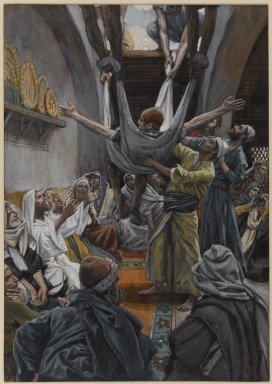
Thinking about Susan, both in the midst of her life in her strength and at the end of her life in her weakness, I couldn’t help but think of the story of the man who whose friends lowered him through the roof for healing (Luke 5:17-26).

"The palsied man let down through the roof" - James Tisot

“The palsied man let down through the roof” – James Tisot

The man was paralyzed, as each of us is, each in his or her own way. Not quite ourselves, not quite able to walk through life as fully as we might or as we ought. Burdened by some memory, some history, some bodily infirmity, some circumstance beyond our control, or of our own making. In that sense each of us is the person in the story who was lowered through the roof to Jesus.

Susan played two parts in this ongoing story of the Christian life.

In her strength she reached out to others when they needed her. She helped them. Like the “friends” of the paralytic in the Jesus story, she helped to lift others up to onto the stretcher. Then she navigated the stairs that ran up the side of the house, a treacherous feat on narrow steps with no siding, no banister, the steps that were necessary to climb in order to get up to the roof. Managing, with great care, to carry her charges up those stairs, she used her own hands to dig a hole in the roof to lower someone else into the presence of the Healer.

Susan kept the faith. She was a carrier of those less fortunate than herself, changing their diapers, rocking them in a rocking chair, coming to the rescue when a friend had died and her children needed someone to care for them in her home. ….

If Susan was a rescuer who took people and animals into her home during her years of strength, she also had come to know what it is to be on the stretcher, at the mercy of others. Her children, her friends, the people of this church who brought her to worship, who visited her at Auburn, who sang to her and the other residents of the Memory Care Center, the marvelous staff at Auburn who did for Susan what she had once done for her own children and for the other children who had fallen to her care, and the Deacons and others who took turns sitting with Susan in her last days so that she would not be alone.

They all carried Susan up the stairs and dug a hole through the roof with their bare hands until they lowered her down every so gently into the arms of her Lord.

During the days when she was being lowered through that roof, she relaxed when we would pray. “The Lord is my shepherd, I shall not want….” “Our Father who art in heaven, hallowed be Thy Name, Thy kingdom come on earth as it is in heaven. Give us this day our daily bread. Forgive us our debts as we forgive our debtors, and lead us not into temptation, but deliver us from evil, for Thine is the kingdom, and the power, and glory forever.”

Her eyes would close. Her face relaxed. He body at ease. Her trust intact. Her faith still strong. She kept the faith.

Her eyes are closed now. She is at rest in the peace of her Lord. For those of us whose days and years remain awhile, let the traditional graveside prayer be ours:

“O Lord, support us all the day long, until the shadows lengthen, and the fever of life is over, and the busy world is hushed and our work is done. Then, in Your mercy, grant us a safe lodging, a holy rest, and peace at the last.”

-Rev. Gordon C. Stewart

Warren, Mandela, and Truth

This morning’s Washington Post ran the story “Think tank’s criticism of Elizabeth Warren’s populist policies leads to Democratic feud”. Click HERE to read the story.

The story runs the day after the death of one of the world’s great leaders who turned his vision into reality in South Africa: Nelson Mandela. It was reading the likes of Martin Luther King, Jr. and biographies of Gandhi that Mandela became the voice that changed Apartheid.

Reading the online “comments” on today’s Washington Post article about Senator Warren led me to leave my own comment, as follows.

Elizabeth Warren rankles the feathers of all who have yet to see the insidious assault of crony capitalism on the integrity of a democratic Republic. Right, left, and center thinking people in this country recognize we have a VERY serious systemic problem that required redress. Think tanks, like political parties themselves, belong to the people who pay their bills. Senator Warren does not work for a think tank, and does not work for the Democratic Party. She represents the people with conscience, clarity, and boldness that cut to the quick. That’s to be applauded. Dismissing her as an unrealistic idealist is also to dismiss Abraham Lincoln, Sojourner Truth, Martin Luther King, Jr., Gandhi, and, particularly apt for today, Nelson Mandela and Desmond Tutu who saw something better for their societies.

Chime in with your views.

Nelson Mandela

Nelson Mandela

Nelson Mandela


Forever
A mandala
Mandela’s
Black Center
Radiated
Warm light
To the cold
Perimeter
Of the circle
Of White
Darkness

A Light
In the
Dark night
His light
Does not
Dim.

– Gordon C. Stewart, Chaska, MN, Dec. 5, 2013

Out from the caves of fear

Fear.

“There is no passion so contagious as that of fear,” wrote Michel de Montaigne.

During the five minute drive to Auburn Manor in downtown Chaska Monday morning, I turn on the radio to hear what they’re saying about the Vikings’ overtime victory over the Bears.

I turn to the ESPN sports channel. But it’s not about sports. It’s Glenn Beck advising listeners to buy food insurance. On the heels of the call to buy food insurance in preparation for catastrophe comes the advice on how to buy your first gun.

Passion. Contagion. Fear. They’re everywhere. Not just Glenn Beck and the far right, but on the left, in the middle, and among the apathetic and the cynical. Fear does not have one opinion. It is a contagious passion that has a thousand different voices. While the foundations of the familiar shake, we are infected by a pandemic of fear.

Fear does terrible things to a person and to a society. It is for this reason that the New Testament Gospels see fear as the root source of ill-will, self-absorption, greed, and war. The “Fear not” uttered by the heavenly messengers in Luke’s birth narrative is repeated in the middle and at the end of the Christ story. “Fear not, little flock.” “Fear not, for I am with you.” It is both invitation and command: “For you did not receive a spirit of slavery to fall back into fear…”.

We are always prone to fall back into fear. We fear because we are mortals. We die and we know it. We seek to secure ourselves against the threats, overt or covert, that cast death’s dark shadow over us.

In such times the psalmist comes to mind. “Yea, though I walk through the valley of the shadow of death, I will fear no evil.” I will buy no food insurance. I will buy no gun. To do so is to run straight into the arms of death as a living power that robs us of life’s goodness and meaning.

“Man’s self-absorption is the movement of our flight from death,” writes Sebastian Moore OSB. “This is what is meant by the scripture’s description of man as ‘under the shadow of death’. It does not mean ‘man knowing he will die’ but ‘what man does and becomes under this knowledge.’. It is not to our mortality, our animality, that scripture offers a remedy. It is to the death that we become in our self-absorption. It is to what we allow death to become in us by fleeing from it in the hopeless pride of man.” (The Crucified Jesus Is No Stranger, Paulist Press, 1977)

I turn off the radio. I dial back the passion. I interrupt the contagion of fear by repeating an old psalm, and drive over to the community food pantry to volunteer.