The Streets of Ferguson, Cleveland, NYC, Minneapolis

A 19 year-old African American walks into the Legal Rights Center (LRC). He insists on seeing the Executive Director.

He’s a large man, his speech is fast, his eyes are angry. He pulls up his shirt to show the swastika he alleges the police carved on his back while he lay on the street in North Minneapolis.

There are witnesses. Three women and a man who saw it happen  during another man’s arrest. “Raymond”, we’ll call him, was objecting to the arrest when two officers took him down to the pavement, face down, while one of the officers used his key to etch the Swastika into his flesh. He was not arrested.

Police abuse of power, racial profiling, the use of unreasonable force, shootings, and prosecutors and grand juries looking the other way always have been the way it is in America.  What’s new is the public outcry, the jarring of consciousness and conscience among those who do not live in places like North Minneapolis, Ferguson, or one of the poorer African-American neighborhoods in Cleveland or New York City.

After several years of the LRC Executive Director referring complainants to the Minneapolis Police Civilian Review Board without satisfaction of remedy, I proposed something out of the ordinary. We went directly to the commanding officer of the 4th Precinct of the Minneapolis Police Department.

The Commander’s attention seemed to wander as I introduced myself and Raymond until Raymond pulled up his shirt. The Commander asked if Raymond got the number of the squad car or remembered the badges of the officers. He didn’t. The Commander then, to my great surprise, named a number of officers, asking if Raymond recognized any of the names. Those officers were well-known for terrorizing the North Minneapolis African-American community.

“This is way beyond Internal Investigation,” he said. “You need to take this to the F.B.I.”

Raymond didn’t trust the F.B.I. any more than he trusted the Minneapolis Police Department. He decided to let it go.

Lots of people like Raymond have decided over the years to let it go. Until Michael Brown was shot and killed in Ferguson and a grand jury decided not to indict him. Until 12-year old Tamir Rice was killed by a police officer in Cleveland. Until Eric Garner died of a police officer’s choke hold saying, “I can’t breath!” The inferno of anger boiling over across the streets of America is new only in the breadth of consciousness and conscience.

It will take time. It will take a change of heart and mind. But, mostly, it will NOT change until America gets it straight that for most African-Americans being black is also an issue of class. Class is about power and powerlessness. Only when what we call “the middle class” understands that its interests lie with African-Americans in Ferguson, Cleveland, NYC, and Minneapolis will thing change in America.

Attorney General Eric Holder just released a Department of Justice Investigation report. Click HERE for the story.

It’s all about the economics: up or down. There really is no middle. “Hands up!” “I can’t breath!”
Father and Son – Bob and Alan

Bob Smith and his first-born child, my cousin Alan, never had what you and I would call a normal conversation. But I suspect they “talked”more deeply in their own father-son ways.

Alan’s tongue and body were held captive from birth by Cerebral Palsy. He never spoke a word that I could understand.

Each morning Alan’s mother, my Aunt Gertrude, and his father, my Uncle Bob, lifted Alan from his bed, cared for his morning needs with tender respectfulness, carried him downstairs to the kitchen for breakfast. Sitting on his father’s lap, the spoon and fork came to his mouth from the hand of his father. Uncle Bob would then carry Alan to the parlor, the back room on the first floor of the house on Porter Street, where Alan would lie until lunch. Uncle Bob came home from the Oxford County Court House for lunch every day  to be with Alan, Gertrude, and Alan’s young brother and sister, my cousins Dennis and Gwen. He would go to the den, lug Alan to the kitchen, feed him lunch…. Repeat, repeat, repeat at dinner. Carry Alan upstairs, prepare him for bed, and, as I imagine it, say a prayer that Alan could hear and understand but could not speak. He did that for 14 years.

My time with Uncle Bob and Alan dates back to my earliest years. Every summer I stayed at my uncle and aunt’s house for a week while the rest of my family stayed with my grandparents. My relationship with my cousin Dennis, only six months older than I, was special enough to separate me out for special time at the house on Porter Street.

Looking back on it now awakens me to the sense of heaviness that came over me watching Alan, seeing the joy in his eyes and the contorted smile that broke out on his face, and listening to the moans of greeting and sheer delight that came from his palsied vocal chords whenever he and I would see each other after the long year’s absences between my family’s vacations.

There was a bond deeper than words. The bond of eyes and smiles. The bond of kinship and shared joy, as well as sorrow. I always wondered what was going on in Alan’s head. Aunt Gertrude, an elementary school teacher, claimed he was very intelligent, but there was no way to measure it. Had he been born 40 years later Alan might have been a Stephen Hawking “talking” by other means, but he wasn’t. He was born in 1939. And if there was a silent bond of awkwardly expressed love between two cousins whose visits were annual, how much deeper and familiar was that bond between the father and his son?

I’ve often wondered what it was like being Alan. I’ve scolded myself in times of self-pity, and sought the deep courage and joy that emanated from Alan.

I’ve also marveled at Uncle Bob, a wrrior in the trenches, fighting despair over Alan’s plight, what might have been and would never be for him, rising to the daily-ness of it all, some days resenting it, some days wishing he could take his family of vacations like other families, some days finding comfort and courage playing a great sacred music piece on the organ of First Congregational Church of South Paris where he served as Organist and Choir Master for 40 years. Perhaps the familiar hymn tune “Serenity” set to John Greenleaf Whittier’s poem “Immortal Love, Forever Full”, encouraging the love he bore for his speechless son:

Im-mort-al Love, for-ev-er full,
For-ev-er flow-ing free,
For-ev-er shared, for-ev-er whole,
A nev-er ebb-ing sea!

The heal-ing of [Christ’s] seamless dress
Is by our beds in pain;
We touch Him in life’s throng and press,
And we are whole a-gain.

At the end of really good days when joy was high with thanksgiving for the father-son bond with Alan, I imagine him walking down Main Street to the darkened church, taking his seat on the organ bench with the lights out except for the organ light, his feet pumping the pedals, his fingers flying over the keyboards and reaching for the stops to play the Widor Toccata he played every Easter, a lush oasis “in life’s throng and press.”

Prayer in Public Schools – Letter to the Editor

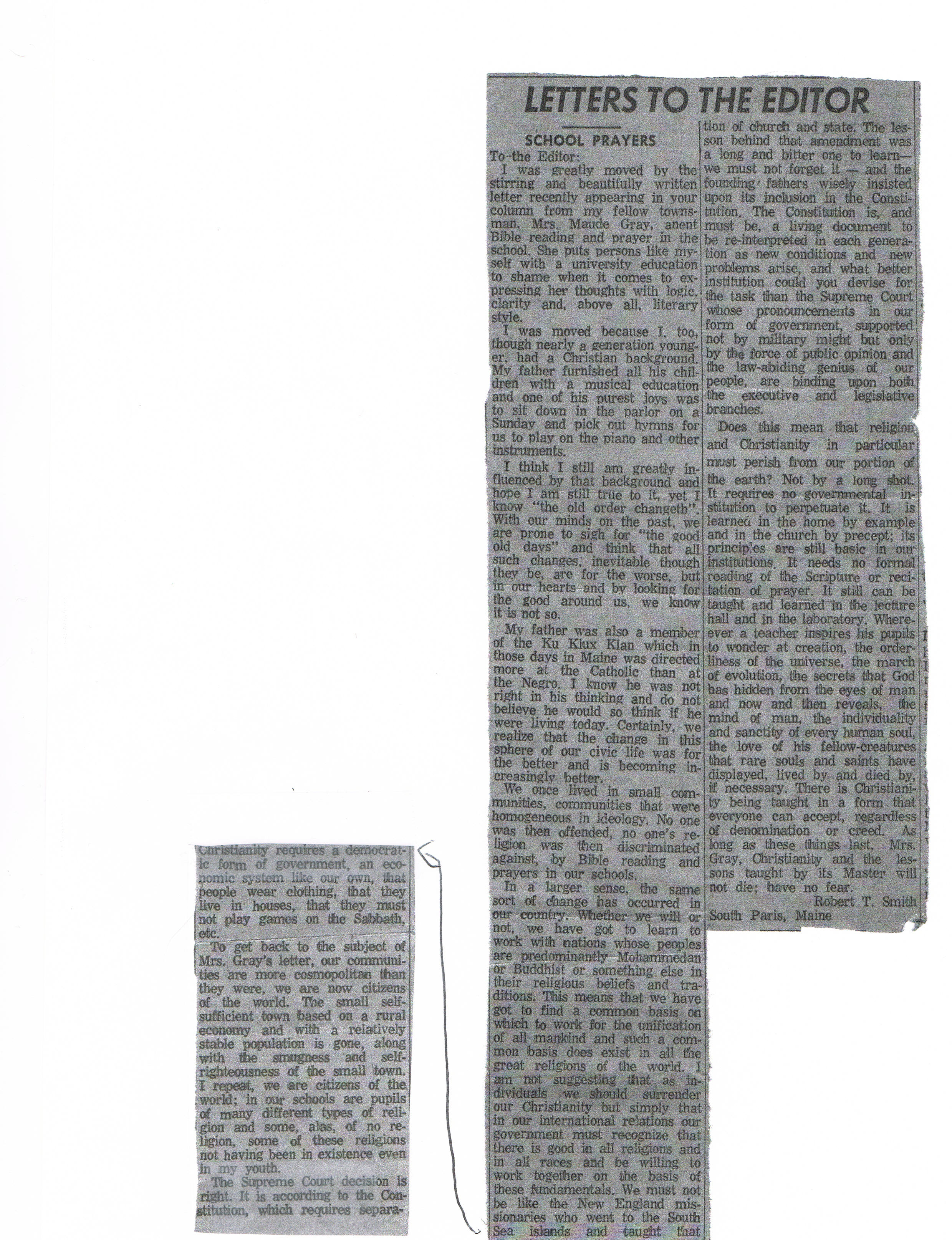
Uncle Bob's letter to the Editor - 1963

Uncle Bob’s Letter to the Editor – 1963

Does this look old? It is. Typed on a manual typewriter in 1963. Some things are worth their weight in gold. This Letter to the Editor is one of them.

Robert Smith, my Uncle Bob, sent this Letter to the Editor of the local paper in South Paris in Oxford County, the poorest county in the State of Maine.  A native of Kennebunk, Maine, he was a relative of John Smith of the legendary tale of Pocahontas, who  married my mother’s sister, Gertrude, after graduating first in his class at Harvard Law. He opened a law office in South Paris, met the love of his life and courageously raise a family: my first cousins Alan (who never spoke a word because of Cerebral Palsy), Dennis, and Gwen.

He became the District Attorney and then the Probate Judge in Oxford County. A Republican of the Nelson Rockefeller brand, he wrote his Letter to the Editor after the U.S. Supeme Court ruled that prayer in the public schools was unconstitutional. To the chagrin of many of his neighbors, he supported the Supreme Court decision.

His daughter, my cousin, Gwen, sent this to me. with a note:

“I am amazed at how ‘global’ his thinking was, especially when you think of South Paris! I couldn’t wait to get out as I saw it as being so insulated from the real world…knew there was something better out there. Dad would be drummed out of the Republican party he so strongly supported with this thinking, but all politicians could take a lesson in civility from this!”

Bob Smith died of a cerebral hemorrhage leading a congregational meeting of the First Congregational Church of South Paris where he was the President of the Congregation, Choir Master and Organist. He died the way he lived – with the courage of his convictions and a faith in Divine providence that does not depend upon or favor the tyranny of the majority.

You might not believe this

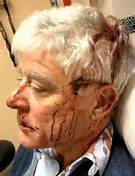
Mark Andrew after shopping at the Mall of America

Mark Andrew after shopping at the Mall of America

A year ago Mark Andrew was beaten within an inch of his life. We commented on the assault at the Mall of America at the time and are moved to comment now on the unusual sentence handed down yesterday in the case of his primary assailant.

Click “Young woman who beat Mark Andrews receives no jail time – at his request” – for the story aired yesterday by All Things Considered on Minnesota Public Radio.

Mark Andrew, man of compassionate wisdom

Mark Andrew, man of compassionate wisdom

There is judgment and there is mercy. Mark Andrew is a man of faith. He was taught and he believes that God’s judgment is always a function of God’s love, and, as Cornel West puts it, that “justice is what love looks like in public.”


Father and Son – the Pasternaks

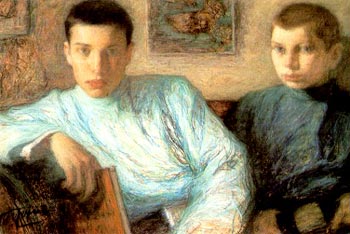
Leonid Pasternak painting of his sons Boris and Alex

Leonid Pasternak painting of his sons Boris and Alex

Thinking about father – son relationships led me to the Pasternaks, starting with the son, Boris.  Boris is seated to the left in this painting, done by his father. One wonders whether Boris and Alex were as angry as the father has painted them, or whether the father only imagined them to be resentful about sitting for the portrait. Father-son relationships are often hard to figure out. They’re about perceptions.

The name Boris Leonidovich Pasternak (1890-1960), the Nobel Laureate who declined the award in 1958, is etched in the annals of Russian literature.

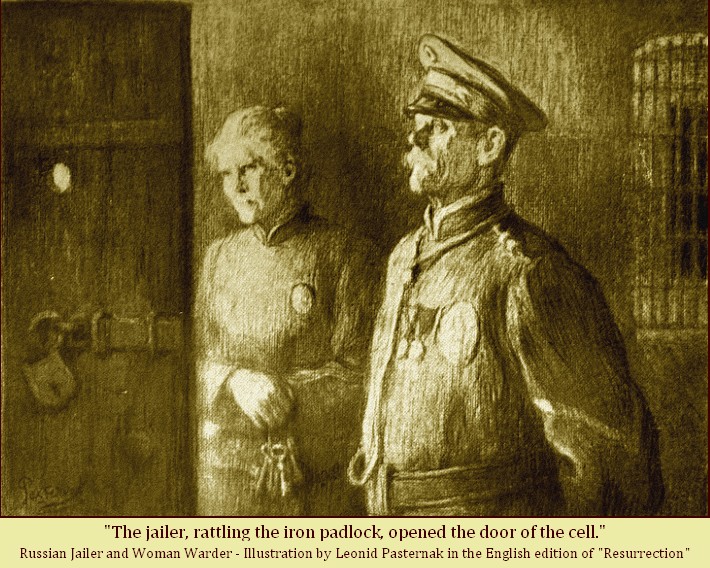
So is the name of his father, Leonid (1865-1945), the revered Russian painter and illustrator, friend of Rainer Maria Rilke and Leo Tolstoy, among others. Leonid’s drawings illustrated Tolstoy’s War and Peace and Resurrection.  

Can you see the father in the sons, and the sons in the father who painted them?

Photo of Leonid Pasternak, Russian painter.

Photo of Leonid Pasternak, Russian painter.

Why, then, would the sons’ father leave them behind?

In 1921 when Leonid Pasternak left Russia for eye surgery in Berlin, he took his wife and two daughters, Lydia and Josephine, leaving Boris and Alex behind in Russia. He never returned. He, his wife, and the girls remained in Berlin until 1938 when he fled from the Nazis to England. The sons remained in Russia.

According to the Pasternak Trust, “Leonid Pasternak was the friend and illustrator of Tolstoy.

Leonid Pasternak illustration in Tolstoy's Resurrection.

Leonid Pasternak illustration in Tolstoy’s Resurrection.

His portraits include studies from life of writers (Tolstoy, Gorky, Rilke, Remizov, Hauptmann); musicians in performance (Scriabin, Chaliapin, Busoni, Rachmaninov); other distinguished contemporaries including Einstein, Hoffman, Gordon Craig and Lenin.

“Sketches of family scenes – his wife at the piano, and their four children reading and playing – are among his most intimate and charming works. His landscapes stretch from the Black Sea to the Bavarian Alps and Palestine.” – Excerpt from The Pasternak Trust.

Although Leonid never returned to Russia, it was his brush that painted Boris into life as a painter whose brush was words, and one can imagine it was his mother’s music that lulled him to sleep even as an adult His mother was a concert pianist.

“‘What is history?” wrote Boris in Doctor Zhivago.

“Its beginning is that of the centuries of systematic work devoted to the solution of the enigma of death, so that death itself may eventually be overcome. That is why people write symphonies, and why they discover mathematical infinity and electromagnetic waves.”


Boris Pasternak, Doctor Zhivago (English translation by Nikolay Nicholayevich, 1957), Chapter 1, Section 5.

Sheep and Goats

Being without a pulpit doesn’t stop the yearning for study and communication. Today Dean Seal stood for the first time in the pulpit where I once stood. I rejoice with Dean and the dear people of Shepherd of the Hill as they begin this new ministry together.

But I also sense the loss of the community that has been Kay and my home for the past eight and a half years. So I do what I have always done. I look at the texts for the day, ponder their meaning, and write about them.

The Hebrew Bible text for today – the last Sunday in the Christian liturgical calendar, “the Reign of Christ” Sunday – is from Ezekiel 34. It reads, in part:

I myself  [i.e. God] will be the shepherd of my sheep, and I will make them lie down, says the Lord GOD.

I will seek the lost, and I will bring back the strayed, and I will bind up the injured, and I will strengthen the weak, but the fat and the strong I will destroy. I will feed them with justice.

Therefore, thus says the Lord GOD to them: I myself will judge between the fat sheep and the lean sheep.

Because you pushed with flank and shoulder, and butted at all the weak animals with your horns until you scattered them far and wide,

I will save my flock, and they shall no longer be ravaged; and I will judge between sheep and sheep.


– Ezekiel 34:15-22

Ezekiel is spoken to the exiles, the aliens in a strange land – you might call them “immigrants” or “exiles” or “refugees”. Or “undocumented workers” who labor for peanuts without the protection of the law.

Ezekiel’s 34th chapter looks to David, the leader of the nation, to be God’s agent to rescue them. Or maybe, in our time, a distant relative named Barack.

During the time I worked outside the church at the Legal Rights Center in Minneapolis, a group of undocumented workers came to the Center. The Hispanic/Latino Community Advocate had identified their need and had convinced them that the LRC was a safe place to bring their case.

Six Mexican “employees” of a cleaning service that sub-contracted for janitorial services at the Mall of America in Bloomington, Minnesota had not received their wages for the past six weeks. The company knew their workers had no recourse. The law was against them; deportation was always one step away. The employer was confident in its privileged position. Those who withheld their wages had not yet read Ezekiel’s proclamation: “I will seek the lost, and I will bring back the strayed, and I will bind up the injured, and I will strengthen the weak, but the fat and the strong I will destroy. I will feed them with justice.”

It took one phone call to the employer to get these men the wages they and their families had been wrongfully denied.

Let those who oppose Immigration reform legislation in the United States of America read Ezekiel, or sit in on the conversation at the Legal Rights Center. Then let them think again about President Obama’s compassionate speech on immigration policy reform and pass the bipartisan bill languishing the House of Representatives.


Verse – Invitations

Invitations once came in the post,
Now emails & voicemails are lost
Amid FaceBook & Twitter,
In Texts & e-clutter:
I can’t RSVP the host!

– Steve Shoemaker, Urbana, IL, Nov. 20, 2014

Finding Our Tree

We walk the rows of silent trees,
some smell of resin, some of lime
or lemon–six varieties.
Young families rush, we take our time,

enjoy the shades of green, the feel
of needles, sharp or soft into
our mittens. We will cut the real
tree with the saw, then shake a few

brown needles to the frozen ground.
At home the Christmas tree will light
the room and spread love all around
to neighbors who will catch the sight

of the one tree that spoke to you
and said, “It is for you I grew.”

– Steve Shoemaker, Urbana, IL, Nov. 18, 2014

Prayer

“She saw him standing in the parlor with his beautiful old head bowed down…praying looks just like grief. Like shame. Like regret.”
Lila, p. 95, Marilynne Robinson, 2014

Head bowed is the posture of humility, the position of a supplicant, petitioner, intercessor, or giver-of-thanks that looks to the eyes of the misinformed like grief or shame or regret. There is certainly all of that in those who pray, but it’s so much more, so much deeper, so much more reassuring.

We are often our own worst enemies. Every experience of the Beloved causes the head to bow and a tear to fall.

Via Lucis (way of light)

Funny how things slip away. Not really funny. Just strange and sad.

Dennis Aubrey’s posts on Via Lucis Photography have been meaningful to me over the past few year. But because i’m technically challenged and just a bit lazy, Via Lucis has slipped out of site. Until tonight. Wondered why Via Lucis was not popping up on my email notifications. I went to see what Dennis Aubrey and P.J McKay were saying, and there it was. Another thoughtful post , on Weeping for Zion, about which Views from the Edge recently published,

If you haven’t yet noticed Via Lucis Photography, it’s worth your time. Few other authors offer such deep insights into the human condition.

Thank you, Dennis Aubrey and P.J. McKay.