The Streets of Ferguson, Cleveland, NYC, Minneapolis

A 19 year-old African American walks into the Legal Rights Center (LRC). He insists on seeing the Executive Director.

He’s a large man, his speech is fast, his eyes are angry. He pulls up his shirt to show the swastika he alleges the police carved on his back while he lay on the street in North Minneapolis.

There are witnesses. Three women and a man who saw it happen  during another man’s arrest. “Raymond”, we’ll call him, was objecting to the arrest when two officers took him down to the pavement, face down, while one of the officers used his key to etch the Swastika into his flesh. He was not arrested.

Police abuse of power, racial profiling, the use of unreasonable force, shootings, and prosecutors and grand juries looking the other way always have been the way it is in America.  What’s new is the public outcry, the jarring of consciousness and conscience among those who do not live in places like North Minneapolis, Ferguson, or one of the poorer African-American neighborhoods in Cleveland or New York City.

After several years of the LRC Executive Director referring complainants to the Minneapolis Police Civilian Review Board without satisfaction of remedy, I proposed something out of the ordinary. We went directly to the commanding officer of the 4th Precinct of the Minneapolis Police Department.

The Commander’s attention seemed to wander as I introduced myself and Raymond until Raymond pulled up his shirt. The Commander asked if Raymond got the number of the squad car or remembered the badges of the officers. He didn’t. The Commander then, to my great surprise, named a number of officers, asking if Raymond recognized any of the names. Those officers were well-known for terrorizing the North Minneapolis African-American community.

“This is way beyond Internal Investigation,” he said. “You need to take this to the F.B.I.”

Raymond didn’t trust the F.B.I. any more than he trusted the Minneapolis Police Department. He decided to let it go.

Lots of people like Raymond have decided over the years to let it go. Until Michael Brown was shot and killed in Ferguson and a grand jury decided not to indict him. Until 12-year old Tamir Rice was killed by a police officer in Cleveland. Until Eric Garner died of a police officer’s choke hold saying, “I can’t breath!” The inferno of anger boiling over across the streets of America is new only in the breadth of consciousness and conscience.

It will take time. It will take a change of heart and mind. But, mostly, it will NOT change until America gets it straight that for most African-Americans being black is also an issue of class. Class is about power and powerlessness. Only when what we call “the middle class” understands that its interests lie with African-Americans in Ferguson, Cleveland, NYC, and Minneapolis will thing change in America.

Attorney General Eric Holder just released a Department of Justice Investigation report. Click HERE for the story.

It’s all about the economics: up or down. There really is no middle. “Hands up!” “I can’t breath!”


Father and Son – Bob and Alan

Bob Smith and his first-born child, my cousin Alan, never had what you and I would call a normal conversation. But I suspect they “talked”more deeply in their own father-son ways.

Alan’s tongue and body were held captive from birth by Cerebral Palsy. He never spoke a word that I could understand.

Each morning Alan’s mother, my Aunt Gertrude, and his father, my Uncle Bob, lifted Alan from his bed, cared for his morning needs with tender respectfulness, carried him downstairs to the kitchen for breakfast. Sitting on his father’s lap, the spoon and fork came to his mouth from the hand of his father. Uncle Bob would then carry Alan to the parlor, the back room on the first floor of the house on Porter Street, where Alan would lie until lunch. Uncle Bob came home from the Oxford County Court House for lunch every day  to be with Alan, Gertrude, and Alan’s young brother and sister, my cousins Dennis and Gwen. He would go to the den, lug Alan to the kitchen, feed him lunch…. Repeat, repeat, repeat at dinner. Carry Alan upstairs, prepare him for bed, and, as I imagine it, say a prayer that Alan could hear and understand but could not speak. He did that for 14 years.

My time with Uncle Bob and Alan dates back to my earliest years. Every summer I stayed at my uncle and aunt’s house for a week while the rest of my family stayed with my grandparents. My relationship with my cousin Dennis, only six months older than I, was special enough to separate me out for special time at the house on Porter Street.

Looking back on it now awakens me to the sense of heaviness that came over me watching Alan, seeing the joy in his eyes and the contorted smile that broke out on his face, and listening to the moans of greeting and sheer delight that came from his palsied vocal chords whenever he and I would see each other after the long year’s absences between my family’s vacations.

There was a bond deeper than words. The bond of eyes and smiles. The bond of kinship and shared joy, as well as sorrow. I always wondered what was going on in Alan’s head. Aunt Gertrude, an elementary school teacher, claimed he was very intelligent, but there was no way to measure it. Had he been born 40 years later Alan might have been a Stephen Hawking “talking” by other means, but he wasn’t. He was born in 1939. And if there was a silent bond of awkwardly expressed love between two cousins whose visits were annual, how much deeper and familiar was that bond between the father and his son?

I’ve often wondered what it was like being Alan. I’ve scolded myself in times of self-pity, and sought the deep courage and joy that emanated from Alan.

I’ve also marveled at Uncle Bob, a wrrior in the trenches, fighting despair over Alan’s plight, what might have been and would never be for him, rising to the daily-ness of it all, some days resenting it, some days wishing he could take his family of vacations like other families, some days finding comfort and courage playing a great sacred music piece on the organ of First Congregational Church of South Paris where he served as Organist and Choir Master for 40 years. Perhaps the familiar hymn tune “Serenity” set to John Greenleaf Whittier’s poem “Immortal Love, Forever Full”, encouraging the love he bore for his speechless son:

Im-mort-al Love, for-ev-er full,
For-ev-er flow-ing free,
For-ev-er shared, for-ev-er whole,
A nev-er ebb-ing sea!

The heal-ing of [Christ’s] seamless dress
Is by our beds in pain;
We touch Him in life’s throng and press,
And we are whole a-gain.

At the end of really good days when joy was high with thanksgiving for the father-son bond with Alan, I imagine him walking down Main Street to the darkened church, taking his seat on the organ bench with the lights out except for the organ light, his feet pumping the pedals, his fingers flying over the keyboards and reaching for the stops to play the Widor Toccata he played every Easter, a lush oasis “in life’s throng and press.”

Father and Son – the Audi

2005 Audio A4 2.0 AWD Quattro Wago

2005 Audio A4 2.0 AWD Quattro Wagon

Anxiety wears many masks. Sometimes it looks like a car shopper. Sometimes the car shopper is like his Dad.

I’m at a new stage in life. Our income will be cut by 40% in 27 days when we are both retired. We are excited by the freedom to enjoy life together without the obligations and distractions but are also anxious about finances and the unknown.

So what am I doing at a car dealership, trading the 11 year old Toyota Avalon for a nine year old Audi?

I rationalize laying out $9,000 with reasoning that I “know” is convoluted and self-defeating. It goes like this.

We’ll be on the road for two months. The Avalon has 120,000 miles on it. Can we trust it?

The Avalon needs $1,000 worth of body work to repair the damage done when it’s getting-older driver swiped the side of the garage.

But… we could leave the scrape the way it is and save the $1,000. After all, it’s 11 years old, and we don’t even know whether we will need two cars in retirement. We could sell the Avalon and pocket the $7,500 to add to our small nest egg.

The Audi has only 83,000 miles on it. It’s All Wheel Drive, great for driving in winter conditions. It gets better gas mileage. Sure it takes Premium fuel, but that’s only 30 – 40 cents more than regular.

But it is an Audi. I’ve never owned an Audi.

It’s confusing for a guy who loves cars, a guy addicted to car shopping. My brother does it too. It runs in the family.

Dad's 1983 Buick Skylark

Dad’s 1983 Buick Skylark

When my father could no longer walk without a walker and long after my mother had (sort of) prevailed to stop him from getting behind the wheel of the 12 year-old Buick Skylark, Dad continued to insist he could still drive. He suffered increasing dementia as the Parkinson’s wore on. He also continued to insist he could still play golf. “Ken,” Mom would say, “You can’t even stand up. How are you going to swing a golf club?” “Just take me over. I can still hit the ball.” He also never gave up his role as a Minister of Word and Sacrament, wanting to preach until a few months before he died.

Despite the very limited financial resources which my mother managed like a cookie-baker who hides the cookie jar from kids on sugar highs, Dad always wanted to buy a new car. “Skip, let’s run over and look at that new Buick. I saw it on TV. It’s a beauty!”

Dad dropped by car dealerships as naturally as a sex addict drops by the adult store. Maybe there’s a relationship. The both sell toys.

Tom, the Audi dealer, is a very nice guy. No pressure. “Take it home and show Kay. She’s going to love it. It’ll be the perfect fit for your retirement road trips. Keep it overnight. Just bring it back tomorrow. We can finish up the paper work in the morning.” I leave the Avalon with Tom and leave with the Audi.

Driving the Audi home I begin to notice that the suspension is sportier, which makes for a great driving machine – the Germans make the best – but also means that the ride is stiffer. I remember how I’ve always come back to an Avalon because of the seat and the soft ride. But this is an Audi. I’ve never owned an Audi, and it has all at the bells and whistles. Like the Audi guy says, “You’re retired; you deserve a great car! You goin’ to feel really good in this.”

On the way home, it dawns on me: “So…that’s what this is about.

As of November 10 I no longer have a position. I no longer have a public roll. I am no longer capable of confusing public standing with personhood. I’m anxious, unconsciously fearful. “Retirement” means old age. Loss. Hearing loss. Teeth in a cup. Memory loss. The road to the loss of everything.

The next morning, I take the Audi back to Tom.

Buying an Audi has its own kind of logic, but it makes no good sense, given our finances.  Even with an extended warranty. Because we, the drivers, don’t have “extended warranties”. Getting older can also mean getting wiser. Getting more comfortable being ourselves without status or position and their sex symbols. It’s time to practice what I’ve always preached: We don’t own a thing. We wear out beyond repairs and maintenance. It’s all about anxiety.

I chuckle and imagine a smile on Dad’s face. God doesn’t need an Audi or a Buick. Neither did Dad. Neither do I! I’ll ease on down the road in the Avalon.

– Gordon C. Stewart, Thanksgiving Day, Nov. 27, 2014

Every head was bowed

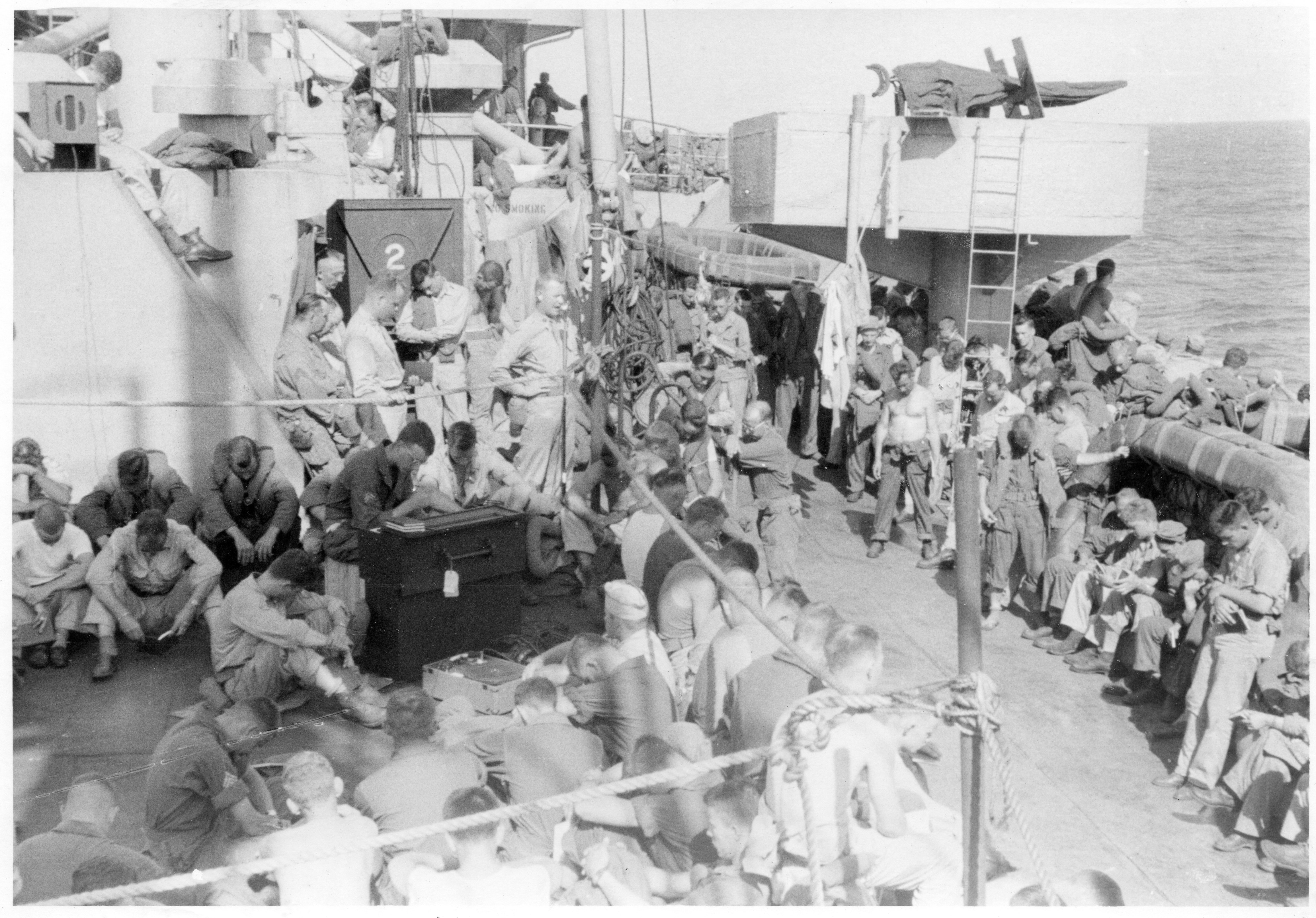
A reader of yesterday’s “On the Ship and on the Train” left a comment. The post featured this photograph of my father and his Army Air Force unit on board ship on the high seas on their way to Saipan in World War II.

My father, the Chaplain, on board ship to Saipan, WW!!.

My father, the Chaplain, on board ship to Saipan, WW!!.

Karin wrote:

“I clicked on the picture which made it large enough to fill my screen… I was amazed. Every man’s head was bowed. That brought a realization that they all knew what they were headed towards. Profound.”

My father was the Chaplain leading the prayer. Indeed, EVERY HEAD WAS BOWED.

Prayer came naturally to him. My brothers and I were blessed by his prayers every night at the dinner table. His head would bow. My mother’s head would bow. Our heads would bowed. There was a short, reverent silence – a time for centering, as we would call it today – followed by words. He addressed the Divine as “Thou”, not the familiar “you”. Antiquarian by contemporary standards, there was never any question that the “Thees” and “Thous” were not spoken to another one of us.

A remnant of his prayers – a sample of the kind of prayer by which he led the soldiers on the ship – was left in my possession in his old Bible.

God our Father, who hath commended thy love for us in that while we were yet sinners, Christ died for us: worthy was the Lamb that was slain to receive honor and glory and blessing.

Remembering once again him again whom we have pierced by our selfishness and folly, we acknowledge our sins and beseech thy forgiveness. We would learn of thee to forgive,  with thee to suffer, and in thee to overcome. Lord, in thy great mercy we ask that thou remember us now in thy kingdom – confirm our faith.

Forbid that we forget among our earthly comforts the mortal anguish our Lord Jesus endured for our salvation. As we behold him following the way of faith and duty even to the crown of thorns and the cross, grant us grace that we may learn the sterner lessons of life.

So endue us with power from on high that taking up our cross and following our Savior in his patience and humility we may enter in the fellowship of his sufferings and come at last to dwell with him in his eternal Kingdom.

I learned to pray at my father and mother’s table. Over time his theology changed in many ways, but his faith in Divine Goodness never waned.

In my last conversation with him before he died, I asked, “How are you doing with your faith?”

“Good,” he said with the heartiest smile his Parkinson’s would allow. He died two days later. His head was bowed.

Father and Son – the Pasternaks

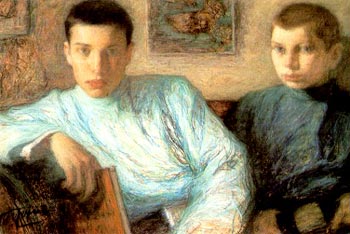
Leonid Pasternak painting of his sons Boris and Alex

Leonid Pasternak painting of his sons Boris and Alex

Thinking about father – son relationships led me to the Pasternaks, starting with the son, Boris.  Boris is seated to the left in this painting, done by his father. One wonders whether Boris and Alex were as angry as the father has painted them, or whether the father only imagined them to be resentful about sitting for the portrait. Father-son relationships are often hard to figure out. They’re about perceptions.

The name Boris Leonidovich Pasternak (1890-1960), the Nobel Laureate who declined the award in 1958, is etched in the annals of Russian literature.

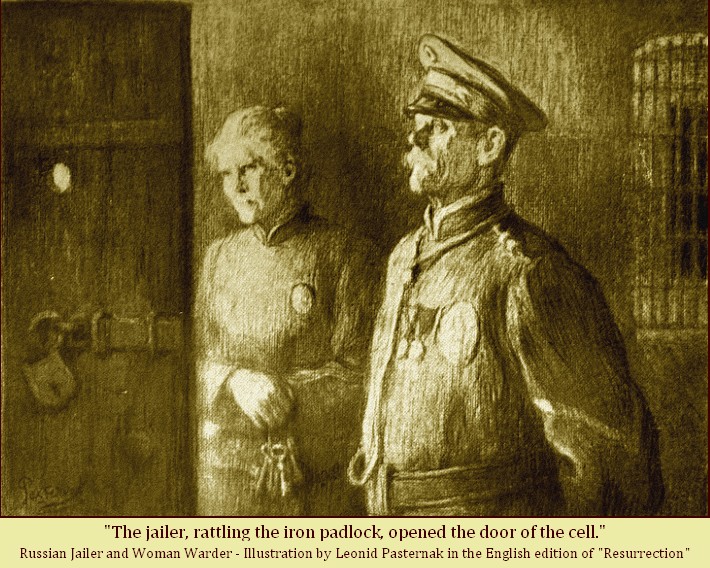
So is the name of his father, Leonid (1865-1945), the revered Russian painter and illustrator, friend of Rainer Maria Rilke and Leo Tolstoy, among others. Leonid’s drawings illustrated Tolstoy’s War and Peace and Resurrection.  

Can you see the father in the sons, and the sons in the father who painted them?

Photo of Leonid Pasternak, Russian painter.

Photo of Leonid Pasternak, Russian painter.

Why, then, would the sons’ father leave them behind?

In 1921 when Leonid Pasternak left Russia for eye surgery in Berlin, he took his wife and two daughters, Lydia and Josephine, leaving Boris and Alex behind in Russia. He never returned. He, his wife, and the girls remained in Berlin until 1938 when he fled from the Nazis to England. The sons remained in Russia.

According to the Pasternak Trust, “Leonid Pasternak was the friend and illustrator of Tolstoy.

Leonid Pasternak illustration in Tolstoy's Resurrection.

Leonid Pasternak illustration in Tolstoy’s Resurrection.

His portraits include studies from life of writers (Tolstoy, Gorky, Rilke, Remizov, Hauptmann); musicians in performance (Scriabin, Chaliapin, Busoni, Rachmaninov); other distinguished contemporaries including Einstein, Hoffman, Gordon Craig and Lenin.

“Sketches of family scenes – his wife at the piano, and their four children reading and playing – are among his most intimate and charming works. His landscapes stretch from the Black Sea to the Bavarian Alps and Palestine.” – Excerpt from The Pasternak Trust.

Although Leonid never returned to Russia, it was his brush that painted Boris into life as a painter whose brush was words, and one can imagine it was his mother’s music that lulled him to sleep even as an adult His mother was a concert pianist.

“‘What is history?” wrote Boris in Doctor Zhivago.

“Its beginning is that of the centuries of systematic work devoted to the solution of the enigma of death, so that death itself may eventually be overcome. That is why people write symphonies, and why they discover mathematical infinity and electromagnetic waves.”


Boris Pasternak, Doctor Zhivago (English translation by Nikolay Nicholayevich, 1957), Chapter 1, Section 5.

On the Ship and on the Train

I was 18 months old when my father shipped out for Saipan in the Mariana Islands of the South Pacific in WW II.

My father, the Chaplain, on board ship to Saipan, WW!!.

My father, the Chaplain, leading worship on board ship to Saipan, WW!!.

I don’t remember the ship. But I remember the emotional wake its departure left behind: the memory of my mother crying on a train. The sounds of the clicketty-clack of the wheels rolling down the track and the whistle blowing like a lost child in the night still plunge me into existential loneliness.

Late in her life, I shared with my mother the memory or her crying on the train.

Because I was so young when it happened, she was surprised that I remembered it, She confirmed it in great detail.

Dad felt “a call” to stand with the brave men who were risking their lives in the war against fascism and imperialism. With my mother’s blessing, he resigned his pastorate in Mechanicsburg, PA to enlist as an Army Air Force Chaplain. After six-months in the States, he left my mother and me behind.

While he was preaching on board ship, my mother and I were on a train from Los Angeles, his point of departure, to Boston, the home of my paternal grandparents.

I never saw the photo or thought of him aboard ship until a phone call and subsequent picture arrived by email from a researcher of my father’s unit on Saipan last month.  Dad was tending his “flock” on board ship. I never knew. Some things, like wine, take time.

Not everything is as it seems or feels. We do the best we can and pray it’s good enough.

The Throes of Creation – Tomorrow I write

http://en.wikipedia.org/wiki/Writer#mediaviewer/File:Leonid_Pasternak_001.jpg

The Throes of Creation – Leonid Pasternak

I’m newly retired.

Today was rough. All day.

Didn’t want to get up, semi-awake, my mind become a subatomic particle collider of memories, facts, people – confused, whirling, disoriented.

Got up, had coffee, but couldn’t write. Didn’t want to. Didn’t want to do anything.

Searched the emails, rummaged through the morning paper for something of interest. Nothing.

This house is dark in the morning. Not just at 5:00 a.m. It’s dark all morning. No sun. And the skies are cloudy. Gray. Like my spirit. Purposeless. Alone. Disinterested. Blah.

It’s the first taste of retirement. The congregation is gone, or, rather, I am gone from them. I miss them. I am without role. Without work. Without routine. No longer a shepherd. Nor am a sheep within a flock. Adrift. Aimless. Dead to what was. Unclear about what is or will be. I am alone.

Except for Barclay who doesn’t get it. He want’s to play. It’s just another day. Go out. Come in. Get the ball. Drop the ball at Dad’s feet. Play ball with Dad, eat food, play some more, go out, wonder why Dad isn’t paying attention and why we’re not getting exercise when there’s such nice snow outside.

Barclay drove me nuts today. Not his fault. He’s a dog. He knows nothing about retirement, nothing yet about aging, about hearing loss, about depression.

Barclay knows nothing about the Mayflower, the Pilgrims, the Puritans, the Congregationalists or the Presbyterians. He’s lucky. He carries no existential guilt, no multigenerational trauma, only the Now. Only the present. Sit. Roll Over. Get the ball. Heel. Treat. “Good Dog.”

I realize that today is Veterans Day and I think of my father, the Chaplain who shipped out for the South Pacific when I was a year-and-a-half old. I hear the train whistle near our house here in Chaska and remember being on the train with my mother after his ship left Los Angeles, the horror of being alone hearing and watching my mother’s inconsolable sobbing in the birth of the night train on the cross-country trip home to Boston. I hear the whistle and feel forlorn.

I remember years later being in the Lebanon Valley Hospital at the age of 14, two hours from home, and 15-minutes from losing a kidney from a football accident. It didn’t strike me as strange then that my parents weren’t there. Strange that their absence didn’t strike me as strange. I just thought they were busy. Now I wonder why they were not there. My mother didn’t drive. Why did my father not come until he arrived a week later with the ambulance driver to take me home? I was alone, forlorn, and thought it was normal. What could have been more important at the church or in the family than being there for their son who was in serious condition in a distant hospital?

The role – his robe – defined my father until the end of his life. It defined him. For most of my adult life it defined me. Until the sullying of the robe and the eight years without it at the Legal Rights Center. At LRC I learned to live without the robe among the criminal defendants and the lawyers and community advocates who pled their cases before the court. I lived the life of a “retired” pastor, a shepherd without a flock.

It’s that time again. I am not unprepared for this thing called retirement. But I realize tonight: I’ve been there. I need no robe to be the person I am and always was. A Stewart, a Titus, and an Andrews with a long ancestral history of dealing with life and death, flight and fight, denial and courage, faltering faith and faithfulness, cruelty and kindness, beheading blocks and pardons.

It’s time for the pardon. Time to let go of the past. Time to let go of the robe. Time to be open to the freshness of a life as it was at the beginning: naked and glorious, crying out for meaning and the wonder of anything at all.

Tomorrow I write!

Stillness on All Hallows’ Eve

Kay in the Boundary Water Canoe Wilderness Area

Kay in the Boundary Water Canoe Wilderness Area

Woke up this morning with a song singing in my head. It happens more often as I move toward retirement. Sometimes it’s a hymn. During the World Series it was “America the Beautiful”. The music comes uninvited. Sometimes it seems to come from nowhere.

This morning, October 31 – All Hallows’ Eve, Halloween – the tune (without lyrics) was “Still, Still, Still,” the Austrian Christmas carol! It’s also our 16th Wedding Anniversary when “Still, Still, Still” (“Calm, Calm, Calm”) must have known what I feel when I think of Kay.

Here’s “Still, Still, Still” played by child prodigy Akim Camara on his violin. Look for the joy on his face.

“Hello, NSA”

“Hello. NSA?” “Hello, CIA.“ “Hello, Homeland Security.” “Hello, whoever you are, listening in on my phone conversations.”

I’m on the phone with the Church Administrator of the little church I serve. A loud whining noise suddenly over-rides her voice. I try to talk with her; she keeps talking as though everything is fine. I hang up and call again. She wonders what happened. I tell her. “It’s the NSA,” she says. We both laugh.

But it’s no laughing matter.

The timing of the unexplained noise on the phone coincided with arrival of an email from a JFK assassination researcher who is providing overnight lodging for another critic of the Warren Commission Report, Judyth Vary Baker. Judyth is Lee Harvey Oswald’s former lover, controversial author of Me and Lee: How I Came to Love and Lose Lee Harvey Oswald. Ms. Baker makes the case that President Kennedy was assassinated by a right-wing, anti-Castro, Mafia-linked group within the CIA.

Judyth is in town this week promoting her latest book, David Ferrie: Mafia Pilot, Participant in Anti-Castro Bioweapon Plot, Friend of Lee Harvey Oswald and Key to the JFK Assassination. David Ferrie is the shadowy figure with whom Judyth worked in 1963 in a New Orleans cancer research lab she claims was a covert project of the CIA.

At the request of her publisher, my friend here in Chaska approached several bookstores, a church, and a senior citizens center. One of the bookstores, one of America’s largest, originally said yes, but the next day reported back that “it wouldn’t work out.” An event at a church was scheduled, but was cancelled at the last minute because of a scheduling conflict.

“Hello, NSA.” “Hello, CIA.” Hello, somebody. Someone is listening in. Someone who doesn’t want the rest of us listening to the likes of Judyth Vary Baker or reading the allegations about David Ferrie and the connection between the anti-Castro, Mafia-linked cabal within the CIA.

Or maybe no one is listening in and my friend and I are making it all up. Maybe there is some other reason for the noise I’d never heard before on my phone. It’s just a strange coincidence that the noise happened while the email was arriving on my MacBook Air. It’s coincidence that the phones of people I called the rest of the day did not ring but showed as voicemails without messages, a new wrinkle in their experience and mine. It’s coincidence that my computer and those of several others I had emailed or phoned began to behave as though they needed the Geek Squad or Prozac.

Although I’ve never asked to see it, I’m confident that the FBI has a file on me, and, if they do, I’m rather proud of it. Following the assassination of Martin Luther King, Jr., a group in Decatur, Illinois identifies a picture of King’s alleged assassin as the man who’d shown up out-of-the-blue while a crowd of youth was still on the church parking lot following the dismissal of that night’s youth outreach program.

The FBI shows each of us three photographs, asking if we can identify the man  we met. Each of us, interviewed separately, identifies one of the three. The picture matches the photograph of James Earl Ray on the cover of Life magazine.

A cub reporter who gets wind of the story publishes a column in The Decatur Herald. The Chicago Sun-Times publishes a story on its front page. Right-hand column. Right there in black and white. The headline reads something like “King Assassin Spotted in Decatur, Illinois.” Several of us are quoted in both articles.

Years later, researchers search the files of the Decatur Herald and the Chicago Sun-Times for the stories. They’re not there. There is no evidence that the stories were ever published.

“Good night, NSA.” “Good night, CIA.” “Good night, FBI.” “Good night, Judyth.”

“Hello, Patriot Act.”

“Good-bye Constitution; good-bye Republic.”

“Kyrie Eleison!”

Forgiveness 360 – Moving On

Moving on is hard and joyful at the same time.

Fourteen (14) days to retirement. Joyful announcement yesterday introducing Dean Seal, the next pastor of Shepherd of the Hill in Chaska. Dean is Executive Director and Founder of Spirit in the House and Forgiveness 360. A stand-up comedian, actor, director, producer, and event organizer, Dean is an ordained Presbyterian minister who teaches religion as part-time adjunct faculty at Augsburg College in St. Paul, Minnesota. Wonderful choice. I’m moving on more easily knowing that Dean is coming to Shepherd of the Hill.