The Man who Knew

He knows who he is! He is not ignorant; he’s smart. He knows the visiting rabbi is both “the Holy One of God” and the one who has “come to destroy us”.

It is because he knows this that he ends up shrieking. He knows better than those around him, all the others who have come at sundown to observe the Friday Shabbat and Torah study.

He takes his customary place among his neighbors in the Capernaum synogogue. He does not expect much to happen. Everyone, including he, knows that he’s a little strange. Off balance, as the kinder of them say.  Not the norm. Both they and he know his place. None of them yet knows Annie Dillard’s advice that worshipers “should wear crash helmets. Ushers should issue life preservers and signal flares; they should lash us to our pews. For the sleeping god may wake some day and take offense, or the waking god may draw us out to where we can never return.” [Teaching a Stone to Talk, Harper and Row, 1982, quoted here from Wikiquote.]

They have no need for crash helmets, life preservers, or signal flares. Like the ones who are better balanced, he likes his safety. He is safe in his customary place among the customary people expecting a customary teaching from a customary teacher who teaches like a copy-editor (a scribe). He expects to leave the same way he has come: bored and boring in the daily-ness of it all.

They look at him. He looks at them. They all yawn.  Until the guest rabbi takes his seat to teach and says nothing. Jesus just looks at them, reading their faces, reading their minds, looking into their hearts. They are uncomfortable with the long silence. He is reading them like a book he’s read too many times.

When finally the rabbi speaks, he astounds them. He reads the Torah and the prophets as living texts, not history. He is alive and expectant. He is not bored or boring. He teaches with authority. He commands the attention of everyone in the room. They want him, but do not want him. They haven’t brought crash helmets. They’ve come for safety.

He catches the eye of the man who’s a little off balance whose frequent uninvited outbursts   long ago placed him in the back row of the assigned seating.  Although the rabbi’s eyes are working the room from left to right and back again, seeing all the faces there, it is as though he is staring at him alone. They are all a bit on edge now, drawn to his voice and the content of his teaching, his unparalleled authority, but they are also becoming nervous that he is messing with them in ways they had not expected.

The man in the back senses this. He knows this, and he begins to twitch and make strange sounds. He is agitated, disturbed, out of his comfort zone, like everyone else.

His face twitching with the familiar tic, he struggles to his feet from his back row seat, shoving from his shoulders the hands of the ushers stationed on either side of him to prevent the man with Tourettes Syndrome from disturbing them and making a fool of himself.

He points at the rabbi and shrieks at him: “What have you to do with us, Jesus of Nazareth? Have you come to destroy us? I know who you are, the Holy One of God.”

Jesus moves from the center to the back row. He tells the body guards to leave him alone. He stands eye-to-eye with him. “Be silent,” he says, “Come out of him” as though speaking not to the man himself but to others who torment him from the inside.

The whole synagogue is on their feet watching. They know that the Tourettes man with the tic and uncontrollable speech has spoken for all of the normal ones as well. “Have you come to destroy us?”

The man screams and convulses, but it is not the man who is convulsing; it is the hostage-takers whose powers are being broken that are convulsing: the fear of losing one’s assigned place, the customary despair and despairing comfort that robs him and all of them of the joy of the extraordinary in ordinary life.

Perhaps the story of “the man with the evil spirit” comes so early in the Gospel of Mark because it is the story of us all. The Holy One of God does come to destroy us as well as heal us. The next time you go to the synagogue for Sabbath rest or to church on a Sunday morning, take a crash helmet and expect something great to happen!

Click Gospel of Mark 1:21-28 for the story on which this sermonic reflection is based.

– Gordon C. Stewart, St. Augustine, FL, February 2, 2015.


My Soul Waits in Silence

A contemplative reflection on Psalm 62 at Saint Augustine Beach, Saint Augustine, FL.

For God alone my soul waits in silence, for my hope is from him. I wait in silence. [Psalm 62:5 NRSV]

I wait in silence.

Withdrawing from the noisy men next door in Saint Augustine, I am like the Hermit Crab crawling into the borrowed snail shell on Saint Augustine Beach.

This is the same beach brave souls dared to integrate in 1964, a place where then there was no place to hide, the public white beach where the Hermit Crabs refused to hide when the billy clubs swing to drive them from the white man’s beach. There are no billy clubs on the beach today but the shouting of the world we call civilized still hurts by ears.

How long will you assail a person,
will you batter your victim, all of you,
as you would a leaning wall, a tottering fence? [Ps. 62:3 NRSV]

The world is noisy. Loud. Cacophonous. Bellowing blasts, bewailing, and bedlam in Beirut, Baghdad, and Boston hurt my ears. Hoping to leave it, I come to the beach where the tides know nothing of the color of my skin, my income, my worries or fears.

For God alone my soul waits in silence,
for my hope is from him.
He alone is my rock and my salvation,
my fortress; I shall not be shaken.
On God rests my deliverance and my honour;
my mighty rock, my refuge is in God.  [Ps. 62: 5-7 NRSV]

Hermit Crab crawling into abaondoned snail shell

Hermit Crab crawling into abaondoned snail shell

At low tide I crawl inside the borrowed shell looking for a respite from the noonday heat, my deliverance, my refuge, my fortress. But, even here, the noise follows me.

The blasts, buzzes, and bellowing echo inside the shell. Silence eludes me. Even here, I am a poor man, a mere breath, walking among the vendors and hawkers, resentful, angry, beset, a man of low estate.

Those of low estate are but a breath,
those of high estate are a delusion;
in the balances they go up;
they are together lighter than a breath.
Put no confidence in extortion,
and set no vain hopes on robbery;
if riches increase, do not set your heart on them. [Ps. 62:9-10 NRSV]

Here I am a breath stripped from the delusions of high estates indulged on the other side of the sand dunes that separate the beach from the street.

I wait in silence.

I ponder the speed outside the Hermit Crab’s temporary home, the abandoned snail shell, the speed that is itself an illusion, a flight of hubris washed away by the tides of time. I remember the race to nowhere, the myths of ownership, invulnerability, control, and superiority that race through the minds of low and high estates alike.

I hear the distant shouts and screams from the integration of Saint Augustine Beach that still plunge the despondent men next door into the oblivion of cheap booze, dope, and, maybe, crack. But the longer I wait and listen, my heart grows strangely calmer. Quieter. More at peace.

I come into the deeper Silence of the Breath once heard by the psalmist.

Once God has spoken;
twice have I heard this:
that power belongs to God,
and steadfast love belongs to you, O Lord.
For you repay to all
according to their work. [Ps. 62: 11-12 NRSV]

In the wordless silence I hear the Word I’ve come to the beach to hear:

“Be still, and know that I am God.” [Ps. 46:10 NRSV]

– Gordon C. Stewart, Saint Augustine, Florida, January 31, 2015


Verse – The Laundromat – Pittsboro, N.C., 1969

She was young, white, and pregnant

when they moved

south. She had worked for Civil

Rights for blacks

up north. So seeing two doors

as she faced

the laundromat obscured

the sordid facts

of legal segregation

just before.

“Oh please, Ma’am, take your clothes

over next door,”

the old black woman said.

“Will you have trouble

if I stay?” “Please, Ma’am,

do as I say…”

The young woman had not

heard “Ma’am” before

from someone older, so

she turned her face —

embarrassed for her race –

and went next door.

– Steve Shoemaker, Urbana, IL, Jan. 27, 2015

NOTE: While working on a Ph.D. in Religion at Duke University, Steve pastored two yoked Presbyterian Churches: the 88 member Pittsboro, N.C., (pop. 1,500 then), and Mt. Vernon Springs (55? members) 30 miles west in rural Chatham County. Nadja drove from the Manse in Pittsboro 30 miles north to do Microbiology research at Duke. Son Daniel was born in March, 1970.

Remembering Ernie Banks

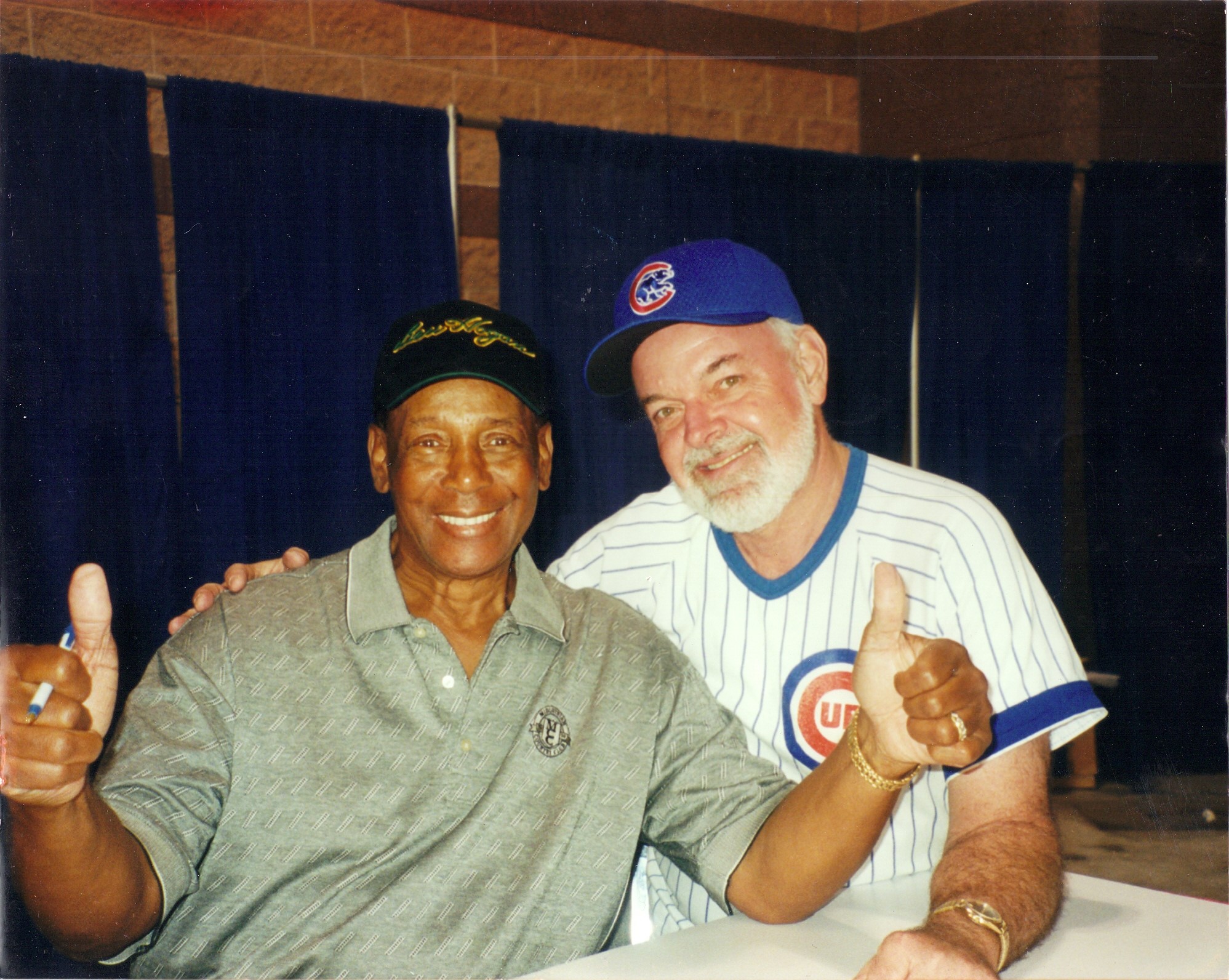
There is no bigger Cub’s fan than Harry Strong. Ernie Banks – “Mr. Cub” – who died Friday night, was his hero. And Harry KNOWS baseball.  So much so that the editor of American Sports: A History of Icons, Idols, and Ideas [published by ABC-CLIO, LLC in 2013], invited Harry to write the entry on Ernie Banks.

Harry sent the following photograph and email to six close friends who gather annually:

I only met him once, but it’s a day I’ll never forget. In July 2004, while I was serving as interim pastor at the Morrisville Presbyterian Church in Morrisville, Pennsylvania, just across the river from Trenton, I learned that Ernie would be appearing at a Baseball Card Show in Atlantic City about two hours away and signing autographs from 1:00 – 3:00 p.m. I informed Anna [Harry’s wife] that WE WERE DEFINITELY DRIVING TO ATLANTIC CITY immediately following the benediction at the 11:00 a.m. service since this might be my only chance to meet this hero whom I’d idolized since I was 10!

Traffic was heavy. The trip took longer than I’d hoped, so we did not arrive at the Card Show in Atlantic City until 2:45 p.m. I hoped and prayed Ernie would still be there, but our late arrival proved to be most fortunate if not providential. When we found Ernie and his agent in a large room behind a table, they were the only ones in the room. Apparently, all the other attendees hoping to meet him had come early and moved on to other baseball celebrities and exhibits. Apparently, all the other attendees hoping to meet him had come early and moved on to other baseball celebrities and exhibits.

Ernie and his agent greeted us warmly. I told Ernie I had grown up in the shadow of Wrigley Field before moving to Glen Ellyn in 1951. I told him that Phil Cavarretta, Cub first baseman and later Ernie’s first manager, had moved into the apartment in which my parents and I had lived after our move. I confessed that I had idolized Ernie as a child and that I owned all of his baseball cards from 1954 until his retirement in 1971. I had brought along several items of memorabilia hoping that Ernie would sign them. There was an established signing fee for each individual piece, but Ernie signed a card, ball, cap, poster, and several other items all for the price of one item.

Mr. Cub (L) & Mr. Strong (R)

Mr. Cub (L) & Mr. Strong (R)

He also consented to pose with me for a picture, which Anna snapped.

About that time, Louis Armstrong’s “Hello Dolly” began playing over the sound system in the room. Ernie and I began singing along with “Satchmo,” while Ernie’s agent took Anna by the arm and they began to waltz around the room together.

By the end of the dance it was after 3:00 p.m., so Anna and I offered our sincere thanks for their gracious welcome, their time, and Ernie’s generous signatures. As they bid us farewell, I noticed that Ernie was limping badly. I asked if the pain was in his knees and he acknowledged indeed it was. Then I told him that by age 53 I had been walking with a cane because of the pain in my right knee due to the loss of cartilage, so that I was hobbling around “bone-on bone.” BUT – I had found an orthopedic surgeon in Trenton who was willing to perform knee-replacement surgery for me at a relatively young age for such a procedure.  I told him I had been pain-free for 8 years and demonstrated for him my ability to jump up and down and squat like Jody Davis behind home plate. I urged him to give serious consideration to having the knee(s) replaced (which he later did). I’m sure he received all kinds of solicited (and unsolicited) advice regarding the procedure – but I was thrilled to learn later that indeed he had had both knees replaced and that he enjoyed many more years of more comfortable mobility on the golf course and elsewhere.

After that memorable afternoon in Atlantic City, Anna met him twice, at HoHoKam Park, the Cubs former Spring Training home in Mesa, Arizona. Both times I was too busy attempting to secure autographs from present and future Cub “stars” along the right field line before the start of the Cactus League game. (My loss.)

The first time, Anna waited patiently while Mr. Cub spent time talking with an older woman so she could greet Ernie again and remind him of our meeting a few years before in Atlantic City, when he and I had performed while she and Ernie’s agent danced to “Hello Dolly.” Ernie greeted Anna warmly, seemed to recall their earlier meeting, and signed her Cubs cap, which I am wearing as I type.

Anna’s later encounter with Ernie came a few years later when she saw him beneath the stands at HoHoKam Park. Unfortunately, that was a less pleasant meeting. Anna found Ernie disoriented and confused, attempting to make his way to the press box for an interview. After speaking with Ernie briefly, she quickly grabbed the attention of an usher who was able to assist Ernie in getting to the press box.

As a lifelong Cub fan, I will forever cherish the opportunity I had to spend a few minutes with this gifted ball player and remarkable man!

P.S. As I reread my article just now, I was struck by this quote from Ernie I’d included [in the American Sports entry]:

“When I die, I want my ashes to be spread over Wrigley Field with the wind blowing out!”

— Rev. Harry Lee Strong, H.R.  Prescott, AZ 

EDITOR”S NOTE: The Cubs have a real shot at going to the World Series this year. Perhaps, in honor of Mr. Cub, they’ll win it all in “the Friendly Confines” of Wrigley Field “with the wind blowing out”.

Marcus Borg Up Close and Personal

Marcus Borg

Marcus Borg

Marcus Borg (1942-2015), renowned scholar, teacher, and theologian of progressive Christianity, died January 21, 2015. (Click HERE for information on Dr. Borg.) When Don Dempsey learned of his death, he wrote to six close friends. Views from the Edge publishes it here with permission:

This morning I received notice of Marcus Borg’s death.

Marcus was one of my favorites – he spoke to me.  His “The Heart of Christianity” was one of the most meaningful books I’ve ever read!  I also used his book “Speaking Christian” for several adult ed classes.

When I served as an interim pastor at the First Presbyterian Church of Lake Forest, I coordinated and arranged for Marcus to be present for a weekend visit.  It began with a Friday night presentation, followed by a Saturday workshop, and preaching at both services on Sunday.  He was controversial to some, but I loved it all.  Saturday was standing room only with the majority who were present not from FPC.  He had quite a Chicagoland following. 

It was my honor and privilege to be his guide and host the whole weekend.  It began on Thursday as Meg and I picked him up at O’Hare airport.  We told him we’d meet him at the baggage claim.  As Meg was getting out to go in and find Marcus, she asked, “how will I recognize him?”  She found him right away. 

After picking him up on Thursday we had a delightful conversation driving him to his hotel in Lake Forest.  As we dropped him off we asked, what are your dinner plans?

He said, “What do you suggest?”  We looked at each other and quickly said “Why don’t you get settled in and we’ll be back and pick you up for dinner at our house.”

What a great evening!  Marcus was such a warm and engaging person, he wanted to know all about us, he listened so intently to our stories.  That evening sitting on our deck sharing conversation, beaking bread, and sharing wine was indeed a celebration of communion that Meg and I shall never ever forget.

He inscribed my copy of “The Heart of Christianity” on 9/16/06:

To Don and Meg,
With rich memories, gratitude for your hospitality, and best wishes.
Marcus Borg

Rest in peace my friend, your voice and your presence will be greatly missed!

Don and Meg Dempsey

Don and Meg Dempsey, gracious hosts of Marcus Borg

Don and Meg Dempsey, gracious hosts of Marcus Borg

The Rev. Dr. Donald Dempsey and and Meg live in Fort Sheridan, Highland Park, IL. Don is one of six McCormick Theological Seminary friends who gather annually for renewal of friendship and theological inquiry.


Water is NOT a Commodity

Video

Nine (9) year-old Luke Sekera-Flanders of Fryeburg in Maine’s poorest county, Oxford County, took on the Nestle company, one of the world’s largest bottled water-for-profit producers, which was seeking a 45 year contract with the Public Utilities Commission. Nestle’s CEO has declared there is no human right to water and that the way to preserve water is to put a price on it. Nestle sees water as a commodity.

“I get my water from the Fryeburg Water Company,” said Luke. “In school we learn about being a good neighbor….”

Sometimes we live on different planets, one public and poor; the other private and getting richer. Or different sides of an aisle as at last night’s State of the Union Address. Score one for the Psalmist: “Out of the mouths of babes and suckling…” (Ps. 8:2)  Click the link below to hear Fryeburg’s little David, Luke Sekera-Flanders.

Boy testifying against Nestle contract in Fryeburg, Maine

This video won a special place in my heart. Oxford County is my maternal ancestral home. My mother and the rest of the Titus and Andrews family would be so proud of Luke.

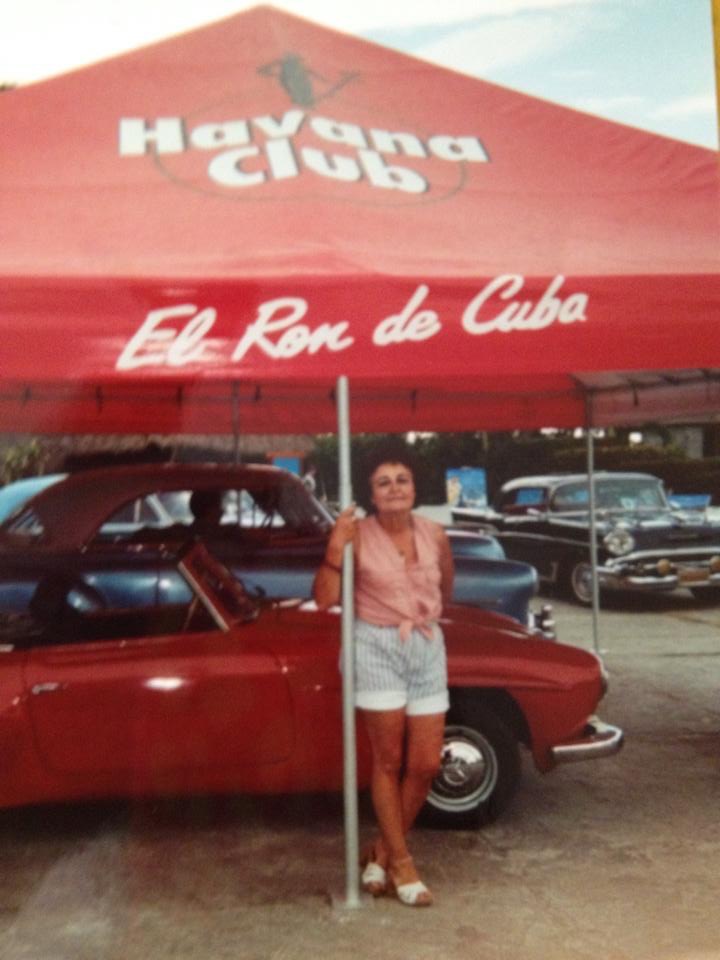
She mowed the lawn in high heels!

Joan Copeland in Cubs

Joan Copeland in Cuba

We LOVE interesting people!

Joan Copeland was one of a kind. She was a complete stranger to Views from the Edge before Steve Shoemaker read the unique obituary the led us to post The Foster Child who Succeeded at Fostering.  Family members caught eye of the posting and sent comments worth sharing.  The bolded print is added for those who don’t read entire blog posts! -:)

First family comment: I’m her granddaughter…. She was amazing… Growing up she kept me smiling and giggling…she was a free soul… Cubans and Martinis…when I would stay the night she used to pour me ginger ale in a fancy glass cup so we could have woman time lol she never let her past define her…And her family was her life…Sophie her cat lol…meanest thang ever…but she loved her….I’m glad you all enjoyed reading the smallest excerpt of her life…if only you knew the stories of Cuba…her first tattoo at age 75….her passion for dancing…how dolled up she loved to get…my granny was a true diva…an amazing woman….inside and out…- Seylon

Views from the Edge replies: Seylon, WHAT AN UNEXPECTED TREAT to hear from you. I never know who reads the blog, so to hear from you means a lot. Please say more about the Cuban references. Was she Cuban? Had she spent time in Cuba? Smoked Cuban cigars, drank Cuban rum?

At the helm on suitor's boat on the way to Cuba..

At the helm on suitor’s boat on the way to Cuba..

Seylon responds: I googled her name just to see if old real estate photos would pop up and stumbled across your blog. I called my mom she thought it was pretty cool. My grandma was Romanian….but she loved Cuba…she traveled there twice on a friend’s sailboat….I believe ’92 was either her first trip or second…I told her if they ever dropped the embargo and allow all the US citizens not being able to travel there I would take her there on vacation again. 🙂 I wish I could post pictures for you. I have plenty of them from when she was there. [NOTE: the photos on this page were sent later.]

She used to talk about the dolphins that would swim along the sailboat. Her first tattoo the family took her to get was of Dolphins and the word Cuba 🙂 She was 75. She would talk about how she brought a roll of shiny new pennies to give out to the kids there because she knew the country was poor and she thought it would be a cool gift to them. I guess a little boy she had met was not thrilled with the pennies…she used to say he expected more money then her little pennies.

Joan Coleman cigar

Joan Copeland smoking Cuban something or other

But she also loved cigars and used to smoke them. I am in the military and tried getting her cigars made from every place I’ve been…my last trip I got her a while box of Cubans…I told her we could crack the box open once I had my baby. She laughed, she said she didn’t even know if she could smoke one anymore. She mostly collected the boxes…. she collected a lot of stuff… antiques, paintings, everything 🙂 It’s crazy that her obituary got all the way to Minnesota. It’s pretty neat how someone who means so much to you can be a small part of a stranger’s life.

Another granddaugher responds: Hi, I am her oldest granddaughter, Summer. My gran would have loved this!! My gran never left her house without looking like a movie star from her big up-do to her fur coats. She went to the top of a mountain on a dirt bike and mowed the yard in heals. Always had a cocktail and ready for some fun. We always had a project to do together from making jewelry, beading necklaces, sorting jewelry or gemstones. We even made picture frames with jewelry. My mom and I took her to get her tattoo. All three of us got one that day. Three generations getting a tattoo coolest thing ever.

Great grandma singing "Itsy bits spider" to Seylon's newborn child.

Great grandma singing “Itsy bits spider” to Seylon’s newborn child.

She loved her family more than anything else. She wrote notes on everything she ever gave me. She made a tote box for all her grandkids and when I opened mine it has every Christmas card, valentine , letter, picture I drew and my baby clothes. She kept everything I ever gave her my whole life was in this box. She treasured me as much as I did her. Thank you for taking the time to write about my amazing grandma.

Joan’s oldest daughter comments: Hi Gordon. This is Joan’s oldest daughter, Rebecca. My niece, Seylon, called her mother from Germany this afternoon just as my sis and I were sorting thru “the goods.” (There’s a packed house.) I cried as she read your column to us. I’ll have you know that I went all out when writing the obituary because my mother did not want a funeral. She said, “I don’t want a bunch of people strolling by my dead body pretending that they liked me. I know who my friends are.” To be led to your column was an amazing stroke of synchronicity, and I’m sure my mother would think you did right by her. My mother was not Cuban. Her father was a Romanian immigrant who came here as a child. Her mother was from Illinois, and we don’t know much more because the family split up when Joan was young.

Joan Copeland on suitor's yacht sailing illegally to Cuba.

Joan Copeland on suitor’s yacht sailing illegally to Cuba.

Her sailing trips to Cuba were with one of the prospects she finally told to go away. She was in her mid-60’s at the time, and wouldn’t hesitate to smoke a good cigar w/ you.

Here’s just one more little tidbit I thought you might like. My mother enjoyed her martinis and for years she collected antique pewter. At my sister’s suggestion, we had her ashes put into a pewter cocktail shaker from her collection. When Seylon gets to come home on leave in July, we will scatter Joan’s ashes over her mother’s grave as per her wishes. – Rebecca.

I wish we were all that interesting!

The Road to Civil Rights in America’s Oldest City

INTRODUCTION: Views from the Edges earlier post from 40th ACCORD referred the KKK kidnapping of four civil rights activists in St. Augustine, FL. Yesterday Francis (“Tate”) Floyd said otherwise.

“No,” said Tate,  who was visiting next door, “they weren’t kidnapped. They got caught at a KKK rally downtown and got their asses kicked.”

Below is more complete information posted by The St. Augustine Record on May 17 , 2014 by Matt Soerge. “Views from the Edge” has added the bolded print and photographs to the text.

Civil rights: 50 years later, the memory is still clear
Purcell Maurice Conway

Purcell Maurice Conway

In 1964 St. Augustine, Purcell Conway, a black 15-year-old, held hands with a white nun during a civil-rights demonstration that drew the angry attention of a white mob from the Ancient City and beyond.

The mob surged forward. Conway was attacked, and so was the nun. They tore off her headdress. They dragged her to the ground by her hair. They kicked her.

Fifty years later, the memory is still clear: How can people be so cruel, so petty? he asks, How silly, he says, that there is so much hate over the color of one’s skin.

Conway traveled Wednesday to Tallahassee, where he reunited with other activists from what he calls the “teenage rebellion” — the civil rights demonstrations that rocked St. Augustine from 1963 until the summer of 1964, when the Civil Rights Act became law.

They went to the Capitol building to see Robert B. Hayling inducted into the Florida Civil Rights Hall of Fame. His portrait will go up there along with those of the other inductees, the late James Weldon Johnson and A. Philip Randolph, both of whom grew up in Jacksonville.

Hayling, 84, still sharp and witty, was a dentist who inspired and led the youthful demonstrators in St. Augustine.

Now in their late 60s and early 70s, most of them grew up together in the largely black neighborhoods of Lincolnville and West Augustine.

Asked to describe the St. Augustine of his youth, Shed Dawson, who was arrested nine times, gave a long pause before speaking.

“Scary. Very challenging. Dangerous. Sad.”

Dr. Robert B. Hayling and Mr. James Jackson

Dr. Robert B. Hayling and Mr. James Jackson

You had to be careful, said James Jackson, who was captured and beaten by the Ku Klux Klan.

“You didn’t want to go and get caught out alone at night, especially outside of your comfort zone, outside of Lincolnville.”

Jackson knew many of the Klansmen by sight. He’d see them going about their business during the day, on the streets downtown.

And as the Civil Rights Act moved through Congress, the Klan rallied, openly, on St. Augustine’s quaint downtown streets, in robes that exposed their faces for all to see.

Houses were firebombed. Grenades were thrown at juke joints. Shots were fired.

One white man, with a loaded shotgun on his lap, was shot and killed as the car he was in cruised through a black neighborhood one night. In his death convulsion, he fired shots of his own through the floor of the car.

Young blacks from St. Augustine picketed outside stores, sat at lunch counters where they could not be served. And they marched through the city’s streets, past churches that would not admit them.

One sign asked: “Are you proud of your 400 yrs history of slavery & segregation.”

Demonstrators were threatened and beaten. They were arrested and jailed for attempting to integrate the beaches, lunch counters, hotels.

Many of the black demonstrators were trained in nonviolent ways of protesting and pledged to never strike back.

Others made it clear that they were armed and would defend themselves, their families and their community if called to do so.

Conway says two things united the young black demonstrators: They were fed up with the status quo, where they were permanent second-class citizens. And they were inspired by the civil-rights struggles elsewhere.

Why not St. Augustine too?

“It gets to a point in your life that you’ve been stepped on, mistreated, seen your family members mistreated,” he said. “Forget about the fear — you will die to see this changed.”

‘A mean lady’

At 12, Conway had a white friend, a fellow paperboy, and when they each ordered milk shakes at the lunch counter at the McCrory’s store, he couldn’t understand why the woman there let his friend eat inside, but insisted he go outside.

His friend joined him on the sidewalk. “She’s a mean lady,” he said.

At 14, Conway was mowing the lawn of a white woman who offered him a sandwich and a drink. She left it for him on her garage floor, next to the dog’s bowl.

As a child, he’d been naive. But now his eyes were open — and he chafed as he saw how his parents had to call white people “Mister” or “Miss,” while they were simply called by their first names, George and Julia.

So he was ready, at 14, to join the Movement. That’s what he and his friends called it.

Conway recalled that black teenagers would go the swimming pool at Florida Memorial College, a black Baptist school that moved to Miami a few years later.

College students would tell the teenagers about the Movement. They’d talk about what was happening around the South, about why action was needed in St. Augustine.

By 1964, the Movement drew Martin Luther King Jr. and other prominent black leaders to the city.

It drew the support of many white college students from elsewhere, who were beaten and threatened alongside the young black demonstrators.

It drew the support of rabbis and priests and nuns and 72-year-old Mary Elizabeth Peabody, mother of the governor of Massachusetts, who was jailed after supporting the demonstrators.

And it drew national and international coverage to a tourist city preparing for its 400th anniversary.

Tourists stayed away. In 1965, a state legislative report on the unpleasantness in St. Augustine would note that the city lost $5 million in tourism, which meant the state lost taxes, too.

“Which means that all citizens of Florida indirectly paid for Martin Luther King’s visitation to America’s oldest city,” the report said, before fretting about the “devastating barrage of unfavorable publicity” from “purported” news accounts.

“Despite massive propaganda to the contrary,” the state report said, “Negroes and whites have lived together amicably in St. Augustine for centuries.”

‘I was afraid’
Maude Burrows Jackso

Maude Burrows Jackso

Maude Burroughs Jackson knew unfairness as she grew up in the small black community of Hill Top in Middleburg. Still, she was relatively sheltered, there in the country.

She came to St. Augustine in 1960 to go to Florida Memorial College. The city, she said, felt hostile. Discrimination was open.

“It seemed like a mean place,” she said. “Things have really changed over the years. But I was afraid many times.”

She got involved in the Movement after going to Hayling’s dental office with a toothache.

She went to wade-ins at segregated beaches, and between classes she sat at lunch counters or picketed. She was jailed three times.

One night, in Hayling’s office, she made dinner for King — steak and toast and salad. “He’d come in late that night, and with the situation being the way it was, you couldn’t just go outside and eat.”

‘All right, that’s enough’

KKK rally, St. Augustine, FL

KKK rally, St. Augustine, FL

James Jackson said he tries to find the humor in every situation. So he laughs, still, about the night the Ku Klux Klan caught him, Hayling and two other black men, James Hauser and Clyde Jenkins.

He said he stayed calm through talk about getting killed, about getting set on fire. But when the Klan got to talking about castration? “I said, ‘I got to get out of here.’”

Jackson and his companions had gone to eavesdrop on a Klan rally that drew hundreds to St. Augustine, and figured they could spy safely from a back road. That was almost a fatal error. They were beaten, severely.

Jackson shows off a scar on his forehead, courtesy of a lug wrench. And the Klansmen paid particular attention, he said, to the hands of Hayling, a dentist: How could he practice his profession with broken hands?

“We were lucky as hell to get out of their with out lives,” Jackson said.

The story he heard later was that a preacher in the crowd sneaked away to alert police. Sometime later, an officer walked up to the rally. “He said, ‘All right, that’s enough,’” Jackson recounted.

He took them to the hospital, and then to the sheriff’s office. There, bloodied and bruised, they were charged with assault.

After the Civil Rights Act was signed, Jackson remembers coming out of a hardware store and running into Halstead “Hoss” Manucy, one of the prominent white segregationists in town. Manucy had hurled many insults at Jackson, but apparently didn’t recognize him when they bumped into each other.

“Now I’m not a tall man, but he was shorter than me, and he looked up at me and said, ‘Excuse me sir.’”

Jackson laughed. “Excuse me sir! The biggest smile came over my face.”

‘Shell shock’

Shed Dawson, St. Augustine Movement

Shed Dawson, St. Augustine Movement

 Dawson graduated from R.J. Murray High School just a few weeks before the Civil Rights Act was passed. But he was already a civil-rights veteran; he was arrested nine times and spent at least 90 days in jail.

So within a day or two of the act’s passage, he and three other black teens went to a barbecue place on U.S. 1 to “test” the bill.

They squeezed their car into a tight space at the front door. As they approached the door, a group of 25 to 30 men and women came from behind the building, almost as if they were waiting for them.

They had bricks and beer bottles and baseball bats — “their own little personal weapons,” Dawson said.

The four friends split up and ran. Dawson made it to some nearby woods. “Because I was 18 and they were half-drunk, they couldn’t catch me.”

Frustrated, the mob returned to their truck. Perhaps 15 minutes later, Dawson came out of the woods and saw the truck approaching, with people crowded into the back of it — still looking for him.

He ran back in the woods, hiding there for more than two hours. Finally, he crept out and saw a highway patrol car parked in front of another restaurant. Now, he thought, he would be safe.

Dawson went into the restaurant, where the manager stopped him brusquely: “What do you want?”

Dawson’s shirt and tie were filthy, his best pants were muddy and his good shoes were caked with mud. He said he needed to talk to the trooper, who sat, just a few feet away, ignoring him.

“He’s eating lunch,” the manager said.

Dawson insisted. Eventually the trooper got up, locked Dawson in his car, and resumed his meal.

As he ate, a crowd of whites assembled around the car, rocking it back and forth, pounding on the windshield, calling Dawson names.

The trooper, frustrated, came out, started the engine, and got on the radio. “I found the n—– y’all are looking for,” he said.

At the station, they took Dawson’s mug shot, took his fingerprints, but eventually didn’t charge him. The trooper then took him to the headquarters of the Movement, where Dawson’s disappearance was big news.

“He (the trooper) was a hero,” Dawson said. “Everybody was cheering — yeah yeah yeah — and shaking his hands. He was soaking it up.”

King spoke that night at a church, and invited Dawson to sit with him at the pulpit. So he did, still in his filthy clothes.

Dawson ended up traveling the world as a civil servant for the Navy, working on aircraft carriers — a life that would have seemed impossible to him as a teenager. Before things changed, he might have been a cook or a yard man. If lucky, he could perhaps have been a brick mason or a plumber’s helper.

The struggle was worth it, he said, although when he returns to his hometown, the past sometimes feels far too close.

“I’ve been all around the world and I’m OK,” he said. “But when I got back to St. Augustine, to a restaurant, I feel fear, like flashbacks, like the soldiers had. Shell shock. I guess it will never go away.”

Views from the Edge Note: Click HERE for hour-long Library of Congress interview with Purcell Conway.


MLK Day 2015 – the house next door

94 South Street, St. Augustine, FL

94 South Street, St. Augustine, FL

On Martin Luther King Day 2015 the historic house next door to us on The Freedom Trail here in St. Augustine is a faint shadow of its former self. A weathered sign by the rear entry reads:

“NO TRESPASSING by order of the City of St. Augustine. Violators will be prosecuted to the full extent of the law.”

Some of the louvered glass windows on the back porch are broken out. Sheets and blankets cover the windows.

The White family paid the price for their courage. James and Hattie were leaders in the Civil Rights Movement, as was their son Samuel. But, as Isaac Watts (1674–1748) reminds us in his poem and hymn “O God, Our Help in Ages Past”:

Time, like an ever-rolling stream,
Bears all its sons away;
They fly forgotten, as a dream
Dies at the opening day.

Time has a way of placing brackets around even the best historic moments. James, Hattie, and Samuel, their 14 year-old son, who was sent to reform school for sitting in at the downtown St. Augustine Woolworth’s, have been borne away by time. The three of them are deceased; their story and the dream is still alive.

When young Samuel and his three friends later known as “the St. Augustine Four” were arrested at Woolworth’s, the authorities agreed to release them to their parents’ custody on one condition: that they sign a statement that their children would not violate the law again. The four young men pleaded with their parents not to sign the pledge, assuring their parents that they, the sons, could make no such pledge. Mr. and Mrs. White refused to sign. Fourteen year-old Samuel was sent to reform school for a year. He served six months of the sentence before Dr. Martin Luther King, Jr., Jackie Robinson and other civil rights movement leaders came to St. Augustine to shine the national spotlight on St. Augustine. Samuel and the other incarcerated member of The St. Augustine Four were released by order of the Governor of Florida. The Civil Rights Act followed.

For all the saints, who from their labours rest,
Who Thee by faith before the world confessed,
Thy Name, O Jesus, be forever blessed.
Alleluia, Alleluia!

And when the strife is fierce, the warfare long,
Steals on the ear the distant triumph song,
And hearts are brave, again, and arms are strong.
Alleluia, Alleluia!

– William Walsham How  (1823 – 1897) 

Martin Luther King Day in St. Augustine

The car dealer here in St. Augustine will be open on Martin Luther King Day. No holiday for its workers.

I learn this while waiting for my car to be serviced. I read the local paper, The St. Augustine Record, Wednesday, January 14, 2015. Tucked away page A6 under “News and Notes” is a small headline:

“Commemorative Breakfast Planned”

Commemorative of what? Martin Luther King, Jr., Monday, January 19 at First Coastal Technical College.

I put down the paper and walk through the show room to look at the new models. A white sales manager sees me get into one of the cars and points angrily to a 20-something African-American salesman to get with the program. The young man greets me through the passenger window. I tell him I’m just killing time during a routine oil change and that I’m from Minnesota. We exchange pleasantries.

I get a cup of coffee and go out to look at the used cars – it’s my thing, checking out used cars – and run into the young salesman again. I ask whether Martin Luther King Day is a big deal here in St. Augustine. He smiles. I tell him I’ve just read the newspaper and the small announcement. “Is the dealership closed for Martin Luther King Day?” I ask. “No, Sir. We’re open,” he says. “I’ll be working.”

“Do you know about The St. Augustine Four?” I ask. He doesn’t. I tell him we’re staying next door to the home of James and Hattie White whose 14 year-old son Samuel was sent to reform school in 1963 for sitting in at the Woolworth’s lunch counter, and that the case of the four teenagers was responsible for Dr. King and Jackie Robinson joining the cause in St. Augustine.

Before I leave the dealership, he finds me in the waiting area. “I asked the boss,” he says. “He said I can have the day off if I want it.”

I tell him there’s a “Hands Up!” workshop Saturday morning at the St. Paul African Methodist Episcopal Church (A.M.E.) where MLK and Jackie Robinson joined the local the Civil Rights Movement in St. Augustine. It’s just around the corner from where we’re staying in Lincolnville. “Come if you can!” “Thanks,” he says, “Maybe I’ll see you there.”