Father and Son – Bob and Alan

Bob Smith and his first-born child, my cousin Alan, never had what you and I would call a normal conversation. But I suspect they “talked”more deeply in their own father-son ways.

Alan’s tongue and body were held captive from birth by Cerebral Palsy. He never spoke a word that I could understand.

Each morning Alan’s mother, my Aunt Gertrude, and his father, my Uncle Bob, lifted Alan from his bed, cared for his morning needs with tender respectfulness, carried him downstairs to the kitchen for breakfast. Sitting on his father’s lap, the spoon and fork came to his mouth from the hand of his father. Uncle Bob would then carry Alan to the parlor, the back room on the first floor of the house on Porter Street, where Alan would lie until lunch. Uncle Bob came home from the Oxford County Court House for lunch every day  to be with Alan, Gertrude, and Alan’s young brother and sister, my cousins Dennis and Gwen. He would go to the den, lug Alan to the kitchen, feed him lunch…. Repeat, repeat, repeat at dinner. Carry Alan upstairs, prepare him for bed, and, as I imagine it, say a prayer that Alan could hear and understand but could not speak. He did that for 14 years.

My time with Uncle Bob and Alan dates back to my earliest years. Every summer I stayed at my uncle and aunt’s house for a week while the rest of my family stayed with my grandparents. My relationship with my cousin Dennis, only six months older than I, was special enough to separate me out for special time at the house on Porter Street.

Looking back on it now awakens me to the sense of heaviness that came over me watching Alan, seeing the joy in his eyes and the contorted smile that broke out on his face, and listening to the moans of greeting and sheer delight that came from his palsied vocal chords whenever he and I would see each other after the long year’s absences between my family’s vacations.

There was a bond deeper than words. The bond of eyes and smiles. The bond of kinship and shared joy, as well as sorrow. I always wondered what was going on in Alan’s head. Aunt Gertrude, an elementary school teacher, claimed he was very intelligent, but there was no way to measure it. Had he been born 40 years later Alan might have been a Stephen Hawking “talking” by other means, but he wasn’t. He was born in 1939. And if there was a silent bond of awkwardly expressed love between two cousins whose visits were annual, how much deeper and familiar was that bond between the father and his son?

I’ve often wondered what it was like being Alan. I’ve scolded myself in times of self-pity, and sought the deep courage and joy that emanated from Alan.

I’ve also marveled at Uncle Bob, a wrrior in the trenches, fighting despair over Alan’s plight, what might have been and would never be for him, rising to the daily-ness of it all, some days resenting it, some days wishing he could take his family of vacations like other families, some days finding comfort and courage playing a great sacred music piece on the organ of First Congregational Church of South Paris where he served as Organist and Choir Master for 40 years. Perhaps the familiar hymn tune “Serenity” set to John Greenleaf Whittier’s poem “Immortal Love, Forever Full”, encouraging the love he bore for his speechless son:

Im-mort-al Love, for-ev-er full,
For-ev-er flow-ing free,
For-ev-er shared, for-ev-er whole,
A nev-er ebb-ing sea!

The heal-ing of [Christ’s] seamless dress
Is by our beds in pain;
We touch Him in life’s throng and press,
And we are whole a-gain.

At the end of really good days when joy was high with thanksgiving for the father-son bond with Alan, I imagine him walking down Main Street to the darkened church, taking his seat on the organ bench with the lights out except for the organ light, his feet pumping the pedals, his fingers flying over the keyboards and reaching for the stops to play the Widor Toccata he played every Easter, a lush oasis “in life’s throng and press.”
On the Ship and on the Train

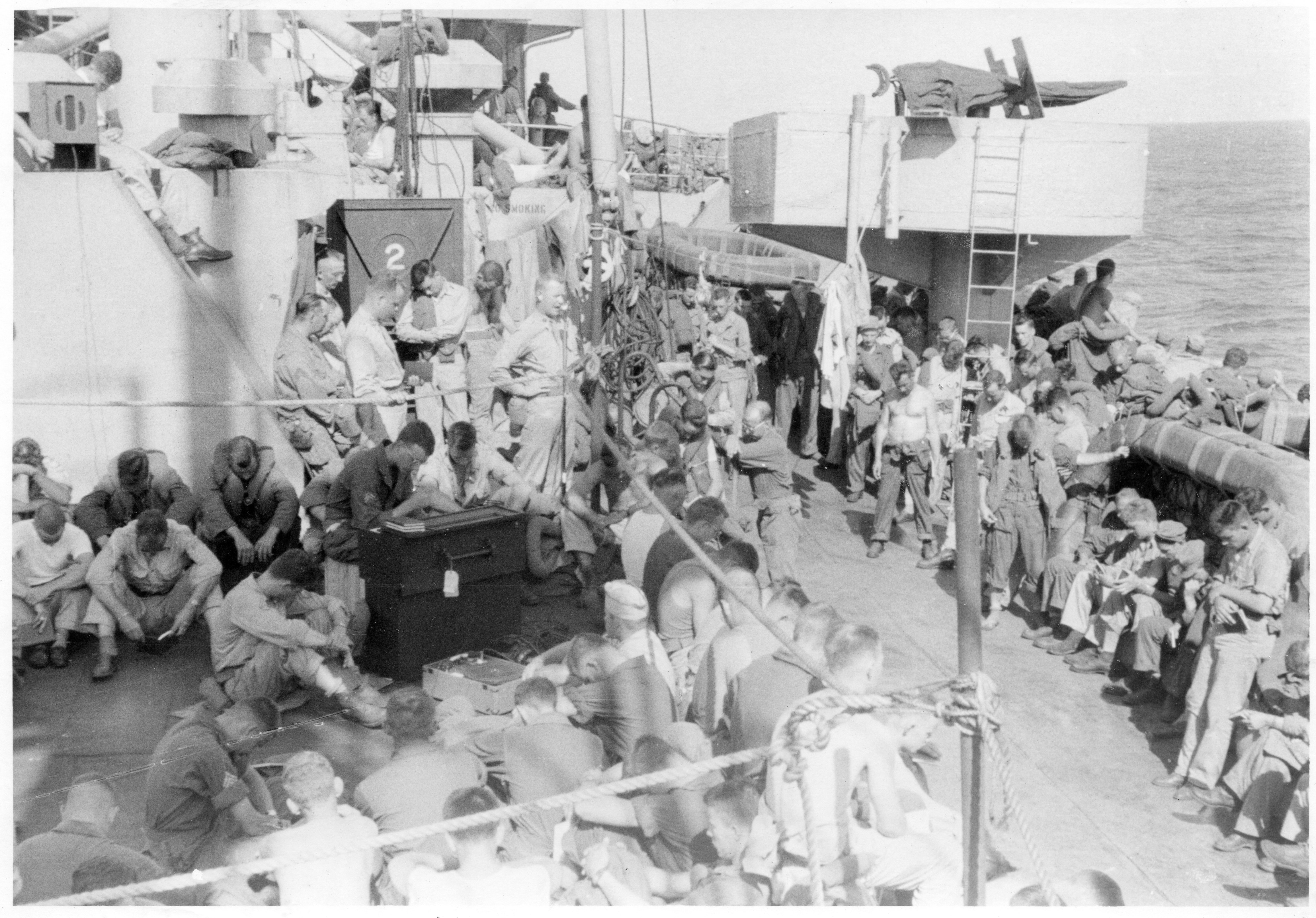
I was 18 months old when my father shipped out for Saipan in the Mariana Islands of the South Pacific in WW II.

My father, the Chaplain, on board ship to Saipan, WW!!.

My father, the Chaplain, leading worship on board ship to Saipan, WW!!.

I don’t remember the ship. But I remember the emotional wake its departure left behind: the memory of my mother crying on a train. The sounds of the clicketty-clack of the wheels rolling down the track and the whistle blowing like a lost child in the night still plunge me into existential loneliness.

Late in her life, I shared with my mother the memory or her crying on the train.

Because I was so young when it happened, she was surprised that I remembered it, She confirmed it in great detail.

Dad felt “a call” to stand with the brave men who were risking their lives in the war against fascism and imperialism. With my mother’s blessing, he resigned his pastorate in Mechanicsburg, PA to enlist as an Army Air Force Chaplain. After six-months in the States, he left my mother and me behind.

While he was preaching on board ship, my mother and I were on a train from Los Angeles, his point of departure, to Boston, the home of my paternal grandparents.

I never saw the photo or thought of him aboard ship until a phone call and subsequent picture arrived by email from a researcher of my father’s unit on Saipan last month.  Dad was tending his “flock” on board ship. I never knew. Some things, like wine, take time.

Not everything is as it seems or feels. We do the best we can and pray it’s good enough.

The Throes of Creation – Tomorrow I write

http://en.wikipedia.org/wiki/Writer#mediaviewer/File:Leonid_Pasternak_001.jpg

The Throes of Creation – Leonid Pasternak

I’m newly retired.

Today was rough. All day.

Didn’t want to get up, semi-awake, my mind become a subatomic particle collider of memories, facts, people – confused, whirling, disoriented.

Got up, had coffee, but couldn’t write. Didn’t want to. Didn’t want to do anything.

Searched the emails, rummaged through the morning paper for something of interest. Nothing.

This house is dark in the morning. Not just at 5:00 a.m. It’s dark all morning. No sun. And the skies are cloudy. Gray. Like my spirit. Purposeless. Alone. Disinterested. Blah.

It’s the first taste of retirement. The congregation is gone, or, rather, I am gone from them. I miss them. I am without role. Without work. Without routine. No longer a shepherd. Nor am a sheep within a flock. Adrift. Aimless. Dead to what was. Unclear about what is or will be. I am alone.

Except for Barclay who doesn’t get it. He want’s to play. It’s just another day. Go out. Come in. Get the ball. Drop the ball at Dad’s feet. Play ball with Dad, eat food, play some more, go out, wonder why Dad isn’t paying attention and why we’re not getting exercise when there’s such nice snow outside.

Barclay drove me nuts today. Not his fault. He’s a dog. He knows nothing about retirement, nothing yet about aging, about hearing loss, about depression.

Barclay knows nothing about the Mayflower, the Pilgrims, the Puritans, the Congregationalists or the Presbyterians. He’s lucky. He carries no existential guilt, no multigenerational trauma, only the Now. Only the present. Sit. Roll Over. Get the ball. Heel. Treat. “Good Dog.”

I realize that today is Veterans Day and I think of my father, the Chaplain who shipped out for the South Pacific when I was a year-and-a-half old. I hear the train whistle near our house here in Chaska and remember being on the train with my mother after his ship left Los Angeles, the horror of being alone hearing and watching my mother’s inconsolable sobbing in the birth of the night train on the cross-country trip home to Boston. I hear the whistle and feel forlorn.

I remember years later being in the Lebanon Valley Hospital at the age of 14, two hours from home, and 15-minutes from losing a kidney from a football accident. It didn’t strike me as strange then that my parents weren’t there. Strange that their absence didn’t strike me as strange. I just thought they were busy. Now I wonder why they were not there. My mother didn’t drive. Why did my father not come until he arrived a week later with the ambulance driver to take me home? I was alone, forlorn, and thought it was normal. What could have been more important at the church or in the family than being there for their son who was in serious condition in a distant hospital?

The role – his robe – defined my father until the end of his life. It defined him. For most of my adult life it defined me. Until the sullying of the robe and the eight years without it at the Legal Rights Center. At LRC I learned to live without the robe among the criminal defendants and the lawyers and community advocates who pled their cases before the court. I lived the life of a “retired” pastor, a shepherd without a flock.

It’s that time again. I am not unprepared for this thing called retirement. But I realize tonight: I’ve been there. I need no robe to be the person I am and always was. A Stewart, a Titus, and an Andrews with a long ancestral history of dealing with life and death, flight and fight, denial and courage, faltering faith and faithfulness, cruelty and kindness, beheading blocks and pardons.

It’s time for the pardon. Time to let go of the past. Time to let go of the robe. Time to be open to the freshness of a life as it was at the beginning: naked and glorious, crying out for meaning and the wonder of anything at all.

Tomorrow I write!

Stillness on All Hallows’ Eve

Kay in the Boundary Water Canoe Wilderness Area

Kay in the Boundary Water Canoe Wilderness Area

Woke up this morning with a song singing in my head. It happens more often as I move toward retirement. Sometimes it’s a hymn. During the World Series it was “America the Beautiful”. The music comes uninvited. Sometimes it seems to come from nowhere.

This morning, October 31 – All Hallows’ Eve, Halloween – the tune (without lyrics) was “Still, Still, Still,” the Austrian Christmas carol! It’s also our 16th Wedding Anniversary when “Still, Still, Still” (“Calm, Calm, Calm”) must have known what I feel when I think of Kay.

Here’s “Still, Still, Still” played by child prodigy Akim Camara on his violin. Look for the joy on his face.

“Hello, NSA”

“Hello. NSA?” “Hello, CIA.“ “Hello, Homeland Security.” “Hello, whoever you are, listening in on my phone conversations.”

I’m on the phone with the Church Administrator of the little church I serve. A loud whining noise suddenly over-rides her voice. I try to talk with her; she keeps talking as though everything is fine. I hang up and call again. She wonders what happened. I tell her. “It’s the NSA,” she says. We both laugh.

But it’s no laughing matter.

The timing of the unexplained noise on the phone coincided with arrival of an email from a JFK assassination researcher who is providing overnight lodging for another critic of the Warren Commission Report, Judyth Vary Baker. Judyth is Lee Harvey Oswald’s former lover, controversial author of Me and Lee: How I Came to Love and Lose Lee Harvey Oswald. Ms. Baker makes the case that President Kennedy was assassinated by a right-wing, anti-Castro, Mafia-linked group within the CIA.

Judyth is in town this week promoting her latest book, David Ferrie: Mafia Pilot, Participant in Anti-Castro Bioweapon Plot, Friend of Lee Harvey Oswald and Key to the JFK Assassination. David Ferrie is the shadowy figure with whom Judyth worked in 1963 in a New Orleans cancer research lab she claims was a covert project of the CIA.

At the request of her publisher, my friend here in Chaska approached several bookstores, a church, and a senior citizens center. One of the bookstores, one of America’s largest, originally said yes, but the next day reported back that “it wouldn’t work out.” An event at a church was scheduled, but was cancelled at the last minute because of a scheduling conflict.

“Hello, NSA.” “Hello, CIA.” Hello, somebody. Someone is listening in. Someone who doesn’t want the rest of us listening to the likes of Judyth Vary Baker or reading the allegations about David Ferrie and the connection between the anti-Castro, Mafia-linked cabal within the CIA.

Or maybe no one is listening in and my friend and I are making it all up. Maybe there is some other reason for the noise I’d never heard before on my phone. It’s just a strange coincidence that the noise happened while the email was arriving on my MacBook Air. It’s coincidence that the phones of people I called the rest of the day did not ring but showed as voicemails without messages, a new wrinkle in their experience and mine. It’s coincidence that my computer and those of several others I had emailed or phoned began to behave as though they needed the Geek Squad or Prozac.

Although I’ve never asked to see it, I’m confident that the FBI has a file on me, and, if they do, I’m rather proud of it. Following the assassination of Martin Luther King, Jr., a group in Decatur, Illinois identifies a picture of King’s alleged assassin as the man who’d shown up out-of-the-blue while a crowd of youth was still on the church parking lot following the dismissal of that night’s youth outreach program.

The FBI shows each of us three photographs, asking if we can identify the man  we met. Each of us, interviewed separately, identifies one of the three. The picture matches the photograph of James Earl Ray on the cover of Life magazine.

A cub reporter who gets wind of the story publishes a column in The Decatur Herald. The Chicago Sun-Times publishes a story on its front page. Right-hand column. Right there in black and white. The headline reads something like “King Assassin Spotted in Decatur, Illinois.” Several of us are quoted in both articles.

Years later, researchers search the files of the Decatur Herald and the Chicago Sun-Times for the stories. They’re not there. There is no evidence that the stories were ever published.

“Good night, NSA.” “Good night, CIA.” “Good night, FBI.” “Good night, Judyth.”

“Hello, Patriot Act.”

“Good-bye Constitution; good-bye Republic.”

“Kyrie Eleison!”

Plunging into Life: William Stringfellow

Jacket of "My People Is the Enemy"

Jacket of “An Ethic For Christians and Other Aliens in a Strange Land”

As I look at the structural violence symbolized by today’s funeral for Michael Brown in Ferguson and consider the Blackhawk helicopters from Fort Campbell, KY that turned Minneapolis and St. Paul, MN into an Army urban training ground last week, I’m remembering William Stringfellow with thanksgiving.

Bill Stringfellow was a thorn in the side of both church and state, a predictably  unpredictable, lovable, hatable, tenacious, brilliant street lawyer, constitutional lawyer, and Episcopal lay theologian. The great Swiss theologian Karl Barth observed, during a speaking tour across the United States, that Stringfellow was the person who most captured his attention. If he were an American, he would listen to Bill.  My copy of his most poignant work on the subject of what he called “principalities and powers” – An Ethic for Christians and Other Aliens in a Strange Land – was water-logged and mildewed because of a flood in the church basement, but his earliest book, My People Is the Enemy, sits prominently on my book shelf.  He wrote the following from the one room, rat- and cockroach-infested tenement apartment in East Harlem where he had chosen to live and work among the poorest of the poor instead of accepting one of the New York law firm offers following graduation from Harvard Law School.

 To become and to be a Christian is not at all an escape from the world as it is, nor is it a wistful longing for a “better” world, nor a commitment to generous charity, nor fondness for “moral and spiritual values” (whatever that may mean), nor self- serving positive thoughts, nor persuasion to splendid abstractions about God. It is, instead, the knowledge that there is no pain or privation, no humiliation or disaster, no scourge or distress or destitution or hunger, no striving or temptation, no wile or sickness or suffering or poverty which God has not known and borne for [humanity] in Jesus Christ. He has borne death itself on behalf of [humanity], and in that event he has broken the power of death once and for all.


That is the event which Christians confess and celebrate and witness in their daily work and worship for the sake of all [humanity].
To become to be a Christian is, therefore, to have the extraordinary freedom to share the burdens of the daily, common, ambiguous, transient, perishing existence of [humans beings], even to the point of actually taking the place of another [person], whether he be powerful or weak, in health or in sickness, clothed or naked, educated or illiterate, secure or persecuted, complacent or despondent, proud or forgotten, housed or homeless, fed or hungry, at liberty or in prison, young or old, white or [black], rich or poor.
For a Christian to be poor and to work among the poor is not a conventional charity, but a use of the freedom for which Christ has set [humanity] free.
~ William Stringfellow – 1964,  My People is the Enemy [Anchor Book edition, p. 32.]


Thank you, Bill, for your wisdom, courage, and witness. We need it now as much as when you wrote it. “Lux aeterna luceat eis, Domine, cum sanctis tuis in aeternum, quia pius es. Requiem aeternam dona eis, Domine; et lux perpetua luceat eis” (“May everlasting light shine upon them, O Lord, with thy saints in eternity, for thou art merciful. Grant them eternal rest, O Lord, and may everlasting light shine upon them.)”


“Homeland” Militarization

Thanks to MinnPost for publishing Views fro the Edge‘s submission this morning.

Click Homeland militarization — tanks in Ferguson, Blackhawks in Minneapolis — must be stopped to read, like, or comment on MinnPost’s site.

One of the more informed responses to this piece came in a personal email rather than through the MinnPost site. It’s worth sharing here.

“About 15 years ago, there were articles in the NYT about new, non-lethal, technologies for subduing criminals and quelling riots. They were clever, stuff like a slime-cannon that basically lobbed a ball of K-Y jelly into a crowd, making it impossible to walk, run, or even get up off the ground. Or sticky webs that wrap around the target with tenacity enough to immobilize an All-Star wrestler. But why mess with all that when you can really send a message?

“The six shots that murdered Michael Brown were an act of terror; and so is all the police combat drag, including the assault rifles and armored personnel carriers. H.L. Mencken once said about a Baltimore cop, with a wink, “He loved a long, hard chase almost as much as a quick, brisk, clubbing.” These are different times. They still love clubbings, and a little pepper spray in the face while your hands are zip-tied, but the number of police killings using insanely unnecessary levels of force these days broadcasts notice that, no matter what they’re doing to you at this moment, anything less than complete submission could cost you your life. Everybody should know by now that you could cross a cop in your birthday suit and have your birthday taken away by six rounds from a 9-millimeter.

“Do you know much about the 1967 riots on Plymouth Avenue in Minneapolis? I don’t really know what set it all off. Stores were burned and looted, and yet it all hardly drew mention in the national press, overshadowed, maybe, by the really angry riots in Watts and Detroit and on the East Coast. There was a war on then, too, but it’s said the National Guardsmen who were called in carried rifles with empty magazines.

“Today, everybody who complains that Americans never had to give up their domestic comforts during more than a decade of war should get some grim satisfaction out of the black helicopters and armored personnel carriers in the cops’ garages. Isn’t it ironic, when we remember how everybody likes to praise the warriors who fought and died in Iraq and Afghanistan ‘to keep us free’?”

The Song in My Head

Sometimes I can’t get it out of my head. I go to sleep with it. Wake up with it. Walk the dog with it. It’s been over a month now.

“We are climbing Jacob’s ladder” seems to be begging for my attention. So this morning I surrender. What will come out on the page is a mystery until it’s written.

I ask myself, Why this song?

This stretch of time has been anxious. Unsettling. I’ve been restless, down, bored, and struggling with my own inner demons and the bigger demons of human madness around the world. Jacob’s Ladder has been with me my whole life, like an old friend who shows up when I need her. Like her cousins Sometimes I Feel Like a Motherless Child and Swing Low, Sweet Chariot, there’s something about the tune that brings me comfort, placing me in the good company of the slaves whose faith and hope are timeless though they are long gone.

It’s the melody, the music – the language of the soul – that gets me. But it’s also the words. Words like ‘climbing, ‘higher’, ‘soldier’, ‘cross’, ’sinner’, ‘love’, ‘Jesus’, ‘serve’. Words that have stuck in my throat at different times in my life journey as either highly objectionable or as deeply expressive of what I know and feel to be ‘true’. Jacob’s Ladder feels like a summary of where I’ve been, where I am now, and a strange kind of invitation to resolve the contradictions as i move forward in this precarious time.

So this morning and in the days to come I will have a conversation with Jacob’s Ladder, stopping at each stanza and each phrase to dig deeper into what is crying out in my soul.

“Listen to your life,” wrote Frederick Buechner in Now and Then: A Memoir of Vocation. “See it for the fathomless mystery that it is. In the boredom and pain of it no less than in the excitement and gladness: touch, taste, smell your way to the holy and hidden heart of it because in the last analysis all moments are key moments, and life itself is grace.”

Anne Lamott reflects on Robin Williams

Click the link below for the best thing I’ve read since Robin Williams’ death. Anne Lamott’s hastily written words about her dear friend are in a class by themselves. Anne and Robin grew up in the same place, suffered in similar ways, and have brought great pleasure and meaning to so many.

Anne Lamott and Robin Williams

Two Polyps Next

Under the Knife
14 times in 71 years

1.  In the 1940s
little boys
all were circumcised.
No waiting for day eight,
purely for health,
snip–did I mind?
Who knows.  Now?
I still like
the little fellow.
2.  Most kids then
had their tonsils out.
About two, I spoke little:
the promised ice cream
I called “hobledy,”
but my throat hurt
too much to eat it.
3.  At seminary, married,
worked a summer on
construction, needed
hernia repair.  Kind doc
charged only what
insurance paid.
Two days in hospital then:
passed out trying to pee.
It took three nurses to get me
from floor to bed.
4.  More grad school,
second hernia repair,
used the bedpan.
5. 6, 7, 8, 9, 10.
Back to home town,
middle-age:  back surgery,
heart surgery, belly button
hernia repair, remove malignant
polyp from colon,
remove cyst on inside
of eardrum, prostate biopsy
that led to sepsis.
11, 12, 13.  Old age:
right knee replacement,
cataracts removed
from both eyes,
14.  Coming up:
remove two polyps
from nostrils.

Not counting
colonoscopies…

-Steve Shoemaker, Urbana, IL, August 15, 2014