“I am the way, the truth, and the life; no one comes to the Father but through me [Jesus]” is sometimes used as a billy club, as in, “if you believe, you’re ‘in’ – if you don’t, you’re ‘out’.” According to Matthew Myer Boulton, the statement has nothing to do with belief. Read in context, this line in the Gospel According to John is the opposite: an assurance of divine comfort and inclusion.
Matthew (“Matt”) Myer Boulton, President of Christian Theological Seminary in Indianapolis, is the son of Wayne and Vicki Boulton, friends of Gordon and Steve for 51 years. Matthew’s leadership is a source of great joy. He is the author of God Against Religion and Life in God.
“The characteristic place to find Christians is among their enemies. The first place to look for Christ is in Hell.” – William Stringfellow (1928–1985), author, My People Is the Enemy.
These aren’t just words. After Harvard Law School, Constitutional attorney Bill Stringfellow moved into an East Harlem tenement apartment on the block the New York Times then called the “worst” in the city, turning down lucrative NYC corporate law firm job offers. The first of his many books, My People Is the Enemy – a theological reflection on racism and poverty in America- opens with an unusual sentence:
“The stairway smelled of piss.”
All these years later, Stringfellow’s words sound strange to many Christians and non-Christians alike who see the Christian life as the search for moral purity and the climb into a Hell-free afterlife. You want to meet Christ? According to the author of An Ethic for Christians and Other Aliens in a Strange Land, Christ will meet you from among your enemies and in the Hell of human suffering racism and wealth create.
A BIBLICAL FATHER-SON STORY: ZECHARIAH & JOHN THE BAPTIST
John the Baptist
Ever wondered why John comes out of nowhere with a fiery message?
He has a bone to pick. Why? With whom? What’s his story?
The Eastern Orthodox Christian tradition preserves a story about John’s father, Zechariah, a Temple priest, sending his wife, Elizabeth, and their son, John, into hiding. Zechariah hides his son to protect him from Herod’s “Slaughter of the Innocents” by which all males below the age of two were to be killed following rumors of a newly-born king, a threat to Herod’s rule.
According to the story told by The Infancy Gospel of James [the mid-Second Century C.E.], John and Elizabeth remain in hiding – far away from their husband and father, Zechariah – until John is five or six years old when Zechariah risks visiting their hiding place. The result is the brutal murder of Zechariah by Herod’s soldiers.
As the son of a Temple priest, John descended from the priestly lineage of Aaron. John was destined to be a Temple priest. Father-son dynamics become more difficult when the father is a public religious figure. Zechariah’s son sounds like an angry preacher’s kid.
When [John] saw the Pharisees and Sadducees coming to be baptized, he said to them, "You brood of vipers, who warned you to flee from the wrath to come? Bear fruit that befits repentance, and do not presume to say to yourselves 'We have Abraham as our father ....'" (Mt. 3:7-9a).
The Pharisees were lay people with a more liberal religious bent than the Sadducees. The Sadducees were Temple authorities and Temple supporters, the folks who aligned themselves with John’s father Zechariah and a conservative reading of the Torah. The Pharisees and the Sadducees were in conflict during the time of John and Jesus. Only the Pharisees survived the later destruction of Jerusalem and the Temple in the Roman-Jewish War of 70 C.E.
By the time the Gospels are written, the Temple had been destroyed. So we have the Temple priests and their supporters, the Sadducees, and John the Baptist in the Gospel of Matthew scolding both the Pharisees, who will carry on their tradition without accepting one of their likely members, Jesus of Nazareth, as the awaited Anointed One (Messiah), and the Sadducees who have disappeared into history.
Whether the Orthodox tradition and The Infancy Gospel of James are taken as historical fact or mythic truth, John’s real fight was with his father and the Sadducees who had compromised Jewish identity and integrity by their accommodations to Rome.
John is certain, bold, and in-your-face. His father, Zechariah, according to Matthew’s Gospel, had doubted the news of John’s conception. As a result of his doubt, Zechariah was struck dumb. He remained unable to speak until Elizabeth had named their son ‘John’, at which point his mouth was opened. “Yes,” said Zecahariah, “his name is John.”
Zechariah had been a doubter; John was no doubter. Zechariah sent John into hiding. The John who returned from safety was no hider. John became a shouter who minced no words. Far from Jerusalem and the Temple, out in untamed space by the Jordan River, he took his stand for the return of his people from the false choice of the pious laity (the Pharisees) and his father’s priestly class (the Sadducees): “You brood of vipers!”
Baby vipers were said to eat their mother’s stomachs. Israel was the Mother whom the Pharisees and Sadducees were eating from the inside out.
John wanted nothing to do with the killing of his Mother or with those who had killed his father. In the interest of protecting his Mother from the vipers, he had run from the Temple into the wilderness, returning to the place where his Mother, Israel, had been born after the Exodus. He did not go into the wilderness to hide. He went out to rescue his Mother from being eaten by her children. When the vipers arrived, he shouted in ways his mute father never did. Yet, in the end he died by the same hands as his father when Herod delivered his head to Salome on a platter.
Like father, like son. His younger cousin Jesus carried on.
Talking openly about death is a rare thing. We don’t like talking about it. We prefer it go away and stay away, like rain: “Rain, rain, go away. Come again some other day.”
When someone dies, it’s often said they’ve passed, passed away, or passed on, a sentiment dating back to a Greek idea of the immortality of the soul. It was/is assumed the soul at death is set free from its mortal cage to live forevermore.
The likes of Barbara Brown Taylor, of whom I consider myself one, have different idea. “Matter matters,” she says. Flesh and blood matter. Flesh, blood, and matter matter. Christians, following the older view of the Hebrew Bible, do not share the belief in a part of us – a soul – that survives our mortal frame. Instead, we profess a curious hope that affirms the essential goodness of corporal existence. Belief or hope in the resurrection of the body may seem even stranger than the immortality of the soul.
I have no more reason to believe in the resurrection of the body than I do to believe in an immortal soul. Watching the life go out of my dogs, I did not imagine some invulnerable part of them leaving their bodies to pass on to some other state of being. They were dead. I cried. I grieved. I mourned their loss. I never thought I would see them again. If they, or we, had a future, it seems more natural, so to speak, to think of them in their bodies all over again.
But which body would it be? Would Maggie, our West Highland White Terrier-Bichon Frise, be the playful pup or the one with the tumor on her hip? Would I be the 73 year-old me, the new-born me, or the teenager with the raging hormones?
Passing away has always made more sense to me than passing or passing on. “You are dust and to dust you shall return” makes better sense to me. The Earth will go on, as will those I love … for a time … but not forever, so far as any of us really knows. I say the Nicene creed on Sundays and ponder what it means to say “I look for the resurrection of the body and the life of the world to come.” The world to come, so far as I can tell, is the Earth where Cecil the lion doesn’t get killed by a dentist, and the lion and the lamb…and the dentist…lie down together in peace and hurt one other no more.
My friend Steve talks openly about death and dying. “I’m dying,” he says, not with a morose or maudlin sensibility but as a fact. It’s not a great surprise to him. Would he and we prefer the rain to go way and come back some later day? You bet. But it won’t, and even it if would, it would be back some other day. There’s great grace in the acceptance of death and the maturity to speak of it aloud, enjoy old friends when one can, laugh and cry and hug and kiss those one loves.
That we would want something more or fear death as the end is part of being human. The time of death is not time to debate philosophy or theology. It’s time for compassion, and for grace and courage to recognize our creatureliness – the distinction between every creature and the Creator, mortal life and the Immortality, the finite and the Eternal.
When the president of “the largest Christian university in the world” in Lynchburg, Virginia urges every student to buy a gun and get a permit to carry a concealed weapon, for whatever reasons, it seems a little oxymoronic and moronic. It’s neither Christian nor smart. It’s not what people do in college. They buy books, not guns. It’s not consistent with the traditions and standards of higher learning. Real universities don’t talk like that.
At one of the world’s first universities, the University of Paris (the Sorbonne), way back in the 13th century, a young Thomas Aquinas was a student of philosophy and Christian theology. His professors introduced him to great critical thinkers like Aristotle, Plato, and Maimonides in their original Greek and Latin languages.
Lynchville, Virginia in the 21st Century is long way from Paris in the 13th Century, and that’s too bad for all of us in America where what Aquinas later called “willful ignorance” has become the order of the day.
It is clear that not every kind of ignorance is the cause of a sin, but that alone which removes the knowledge which would prevent the sinful act. …This may happen on the part of the ignorance itself, because, to wit, this ignorance is voluntary. … For such like negligence renders the ignorance itself voluntary and sinful, provided it be about matters one is *bound and able to know.” [Thomas Aquinas, Summa Theologica, I-II, q. 76, a. 1, a. 3.]
Today’s Catholic World, an online encyclopedia, adds these footnotes to Aquinas’s text:
*Catholics are bound (required) to learn and know their Faith. A sin against faith (often caused by willful ignorance) is the gravest of all sins according to St. Thomas Aquinas.
St. Augustine, cited by St. Thomas, characterizes sin against faith in these words: Hoc est peccatum quo tenentur cuncta peccata. “This is the sin which comprehends all other sins.”
Liberty University is not a Catholic university. It’s not big on Catholics. It’s fundamentalist protestant. It prides itself on its knowledge of the Bible.
But don’t we have to suppose that somewhere in that auditorium in Lynchburg, there was a professor who cringed? Someone there who resonated with the old student at the University of Paris? Someone who thought that telling young professing Christians to arm themselves was a deliberate act of willful ignorance, a sin against faith, the sin that comprehends all others?
“Put away your sword. Those who live by the sword will perish by the sword” – Jesus of Nazareth to Peter after Peter had cult off the High Priest’s servant’s ear at Jesus’s arrest, 1st Century, according to The Gospel of Matthew 26:52.
Gordon C. Stewart, public theologian, author of Be Still! Departure from Collective Madness (2017 Wipf and Stock) host of Views from the Edge. Brooklyn Park, MN. Originally published 2015. Re-posted here June 13, 2022.
“Our Call to Support Refugees from Syria and the World”
NOTE: Views from the Edge has added colored highlights to the text.
Presbyterian Church (U.S.A.) congregations have supported refugee resettlement since the refugee crisis created by World War II. The 160th General Assembly (1948) of the Presbyterian Church in the United States of America stated, “The United States should pass legislation to bring in at least four hundred thousand displaced persons during the next four years. … As they arrive, our church people should stand ready to open their homes and provide work for these unfortunate victims of war” (Minutes, PCUSA, 1948, Part I, p. 204). The people from the pews who approved that policy did so because they knew that scripture calls us to shelter the homeless (Isaiah 58:6–12) and welcome the stranger (Matthew 25:31–46).
The call is no less necessary today. Nearly 60 million people are displaced by war and persecution; 30 million of those displaced are children (UNHCR). The crisis in Syria alone has displaced 11 million (UNHCR). Families are risking their lives and fleeing their homes to seek safety. They are spending months journeying, sleeping outside, paying smugglers for safe passage, and praying for a future for their families in a place that is safe from conflict.
They fear and flee many of the organizations that we also fear: ISIS, Boko Haram, Mara 18, Los Zetas. Right now governors are attempting to block the resettlement of Syrian refugees into their states because members of ISIS are sometimes Syrian. Ask yourself, should a victim’s shared nationality with perpetrators of violence exclude them from protection in this country?
Entering the U.S. as a refugee is not a quick or easy process. Refugees are the single-most scrutinized migrant group to enter the U.S. They undergo rigorous screening by multiple security agencies at multiple times during their pre-arrival processing (U.S. Committee for Refugees and Immigrants). This process can take more than two years. Once they arrive in the United States, they continue to be screened every time they leave and reenter the country and when they apply for employment cards, green cards, or naturalization.
The risk is low and the humanitarian need is great. While, technically, governors cannot dictate where the federal government resettles refugees, the State Department only resettles refugees in areas where they know communities will thrive (USA Today). Governors are saying for their states, “No room at this inn.” Now is the time for the faith community to speak up on behalf of refugees, from all countries. Do not let the noise of a fearful few drown out compassion, facts, and logic. Answer the call to act prayerfully and recommit as an individual, congregation, or mid council through co-sponsorship, volunteer hours, and donations through your local resettlement agencies. Then send or personally deliver a letter, like the one at pcusa.org/immigration, to your governor about the kind of society we should be. If you personally deliver your letter, please take photos and post on Facebook and Twitter using the hashtags #ChooseWelcome and #RefugeesWelcome. …. Thank you!
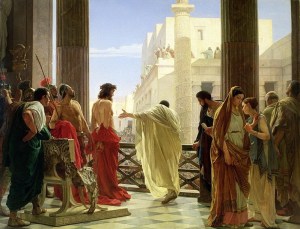
Pilate and Jesus are an odd couple. We usually meet them in Holy Week when their conversation is part of Jesus’ journey to his crucifixion. Because Good Friday and the cross are looming closer and larger, we pause only briefly in Pilate’s headquarters. But today is Christ the King Sunday and we encounter this odd couple under different circumstances. We are on the cusp of the Church year – the end of 52 Sundays facing into Sunday, Advent I, awaiting God’s move to enter human flesh as Jesus, beginning his life in birth like us, and ending his life in death like us.
Yet, before our church year begins, tradition asks us to pause and hold on to the bigger story of Jesus. There is a larger and more eternal back-story to the one that opens with shepherds, a star, some straw in a manger and even Mary. There is another birth story in John’s gospel and we enter toward the end as Pilate and Jesus talk. What an unlikely conversation it is. Pilate, Pontius Pilate, the 5th prefect of the Roman province of Judaea calls – no, “summons” – an accused religious heretic to his headquarters. Pilate has already questioned the Jewish leaders and could be done with the matter. Undoubtedly, he has more important issues awaiting his attention than dealing with the process leading to a crucifixion. They happen all the time and aren’t on his radar.
So, they are an odd couple. A man with impeccable Roman familial and political credentials, Pilate stands in expensive robes, perfumed and fresh from his morning bath. Jesus’ home address is Nazareth. His profession listed as carpenter. His clothing hardly deserve the name – practically rags after the torture and stripping, smelly from sweat and blood. But Jesus is no country bumpkin. He knows at least 4 languages – Aramaic, Hebrew, Greek and the Latin he uses with Pilate. However, Jesus’ linguistic skills don’t make him a king. Yet, that is the direction the conversation goes.
“Are you the king of the Jews?”, Pilate begins, a question Jesus later returns to. “My kingdom is not from this world.”, Jesus answers. “So you are a king?”, Pilate inquires. With that question, Pilate introduces what makes him and Jesus the oddest pair. They are both “kings”, but the descriptions are polar opposites: Power-Love, Higher-Lower, Divided-One, Hold on-Give away, Boundaried-Open, Petty-Generous, Unjust-Just, Manipulating- Embracing, Triumphant-Humble.
Yet, Jesus, without actually answering, takes the title of “king” in a whole different direction. “For this I was born, and for this I came into the world, to testify to the truth.” Here Jesus tells his own “nativity” story, but remember, this is John’s gospel. To understand what Jesus is saying to Pilate as his earthly life is about to end, we have to go back to the beginning, way back to the beginning to understand Jesus’ kind of king.
“In the beginning was the Word and the Word was with God, and the Word was God. He was in the beginning with God. All things came into being through him, and without him, not one thing came into being. What has come into being in him was life, and the life was the light of all people….. And the Word became flesh and lived among us…”
Jesus understands himself as king and where his kingdom is from radically different. Pilate doesn’t get it. The crowds don’t get it. Even Jesus’ close disciples haven’t gotten it yet. In that humble peasant, from the virgin womb of Mary, God entered the world, breaking through all categories, possibilities and imaginings. The Word of God who first spoke all creation and universes into being now has spoken again. A second holy Word took form but this time the birth came as God was and is willing to become empty. The apostle Paul captures it in the mystical hymn in Philippians: “…thought he was in the form of God, did not regard equality with God… but emptied himself, … being born in human likeness.” Jesus’ kingdom is not from this world, but in this world, grounded in and flowing from the eternal God, what we now call the Trinity: God, Creator, God, Christ, and God, Spirit.
It’s like when God birthed the created worlds, God already had another birth in mind. God’s Word would speak another creation. The Spirit Breath who give human life and form from the dust was not finished. The Trinity was not complete until the human experience could join in the circle, the abundant, ever-flowing Love. And now God’s experience in human form nears the end, the pain and suffering of crucifixion.
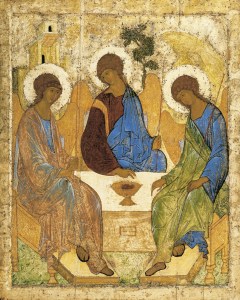
But, ponder this thought by a contemporary mystic, Bernadette Roberts. Maybe the hardest thing for Jesus was not the crucifixion, but the incarnation – to leave the circle and connection of Love to learn and teach how to hold on to and live in that flow of Love caught in bodily form. And we can picture that Circle, can’t we, the world of Christ the King, the kingdom Jesus is from. It’s the picture we see on the icon of the Trinity by Rublev.
Angels at Mamre Trinity, Rublev
We all know it – the beloved the one we take with us on vacation and hold up for photos on Facebook. I brought my personal one this morning and it’s on the altar. It was “written” in 2000, (the verb used when making an icon) by Eugenia. At that time, she was imprisoned in the largest women’s prison in Europe, outside of St Petersburg, Russia. Her crime was counterfeiting. However, Father Nicolai, pastor to the prison, thought her counterfeiting skills could be redeemed. Released under Father Nicolai’s watch, Eugenia was taught icon “writing” to help support her 3 daughters. Before she paints the copy of an icon, Eugenia goes through all the traditional rituals, including prayer and fasting.
Through the vision of a monk on Mount Athos, Greece, around 1260, and the hand and heart of an alcoholic felon, we see the “dance of the Trinity” – gathering in communion, gazing in a circle of love, pouring out within and beyond that Love to all creation. Given the three figures dominating the scene in their bright robes and adoring gazes, perhaps you have missed a small detail in the icon. I have. It was just pointed out to me recently. It’s under the table, a small brown box.
An ancient story about the the Rublev icon is that originally there was a mirror on top of the box. So, as one sits in front the icon and ponders the kingdom of God, the Trinity, one is able to see oneself as the fourth figure in the circle, at the table, in the flowing love always moving, expanding, tumbling out to all creation, in all time. From the beginning, God envisioned a fourth place in the Love.
Jesus said, “For this I was born, and for this I came into the world, to testify to the truth.” “Pilate asked him, ‘What is truth?'” Jesus spoke no answer that day. His life was and is the answer. The truth Jesus lived and died is that each of us, Eugenia, Pilate, all people have a place at God’s Table, in God’s heart, in Christ the King’s kingdom. Our response is to see ourselves in the mirror and claim our place. Amen.
While the world holds its breath after the attacks in Paris, we’ve searched for hymns that express in music a word worth hearing.
“O God of Earth and Altar” expresses a sense of prayerful resilience and supplication.The lyrics, written by G.K. Chesterton in 1906, were revised, in part, by Jane Parker Huber to address global terrorism:
“From all that terror teaches, From lies of pen and voice, From all the easy speeches That make our hearts rejoice, From sale and profanation of honor and the sword, from sleep and from damnation, deliver us, good Lord.”
Already U.S. governors have made “easy speeches” about not accepting any Syrian refugees in their states, although it is not within their jurisdiction to decide. And, while we pray, the arms industry is preying on war’s alarms to increase production, sales and profits in the name of our safety and security.
Here’s “O God of Earth and Altar” sung to Chesterton’s original lyrics.
The ISIL fundamentalist extremists who terrorized Paris, San Bernardino, Beirut, and elsewhere in the name of God believe in an eternal reward for sacrificing themselves for a holy cause. Though it may seem strange to many of us in the West, they share two beliefs widely held by others who are not terrorists:
God (Allah, in Arabic) is a being — the Supreme Being, but ‘a being’ nonetheless.
Death is not the end of mortal life; we are destined for immortality – Heaven or Hell, eternal states of bliss or punishment.
It’s not just the jihadists who deny our mortality, our perishable nature within the order of Nature.
In Man Before Chaos: Philosophy Is Born in a Cry, philosopher of religion Willem Zuurdeeg wrote:
“Threatened by nonbeing, by chaos, and meaninglessness, man looks for a foothold in the Imperishable.”
The “soldiers of the caliphate” are young. Paradoxically, as hideous, grotesque, and deranged as their thinking is, their massacres are performed in the name of an ideal. They are idealists claiming “a foothold in the Imperishable”.
Seeking to rid the world of evil, they succumb to evil. In the name of heaven and the Imperishable, they create hell on earth.
But what if God is not a being? What if, as Paul Tillich argued, God does not “exist” as a thing or person exists, but instead is Being-Itself or the Ground of Being or the God above god?
What if we are mortal? What if death is the end, not a doorway to heavenly reward or eternal punishment? What if no St. Peter stands at the pearly gates to separate sheep and goats? What if no vestal virgins are waiting? What if life and death are what they seem?
John Lennon’s “Imagine” strikes a chord in the aftermath of the attacks in Paris, Beirut, and Mali. Imagine there’s no religion. But imagining won’t erase the problem of religion or the anxiety endemic to the human condition. We are suckers for certainty desiring the end of complexity and ambiguity.
“Finitude,” wrote Paul Tillich, “means having no definite place; it means having to lose every place finally, and with it, to lose being itself.” [Systematic Theology, Vol. I., p. 195, University of Chicago Press]
The appeal of fundamentalist certainty, whatever its form, is the promise of a secure foothold, place in immortality – a purpose bigger than life itself, the escape from ambiguity.
When faith is ill-conceived as acting to end the ambiguities represented by the enemies of God, instead of as coping with life’s inherent ambiguities, we create what we seeks to escape. We create a foothold in what will not hold.
What if to be human is not to escape mortality, but to embrace it thankfully and to live courageously within the boundaries of time, of mortal flesh filled with the Eternal in the midst of time?
“Being holy . . . does not mean being perfect but being whole; it does not mean being exceptionally religious or being religious at all; it means being liberated from religiosity and religious pietism of any sort; it does not mean being morally better, it means being exemplary; it does not mean being godly, but rather being truly human.” ― William Stringfellow, A Keeper of the Word: Selected Writings.
No matter what your religion or politics, this is worth a look. Click “Beyond Any Singing” below to tune in to the video of an evangelical Christian pastor’s reflections on how his mind has changed on gun violence.

 These aren’t just words. After Harvard Law School, Constitutional attorney Bill Stringfellow moved into an East Harlem tenement apartment on the block the New York Times then called the “worst” in the city, turning down lucrative NYC corporate law firm job offers. The first of his many books, My People Is the Enemy – a theological reflection on racism and poverty in America- opens with an unusual sentence: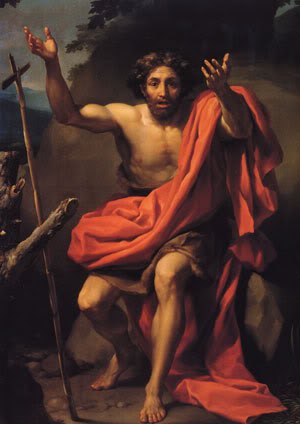
 Views from the Edge