Sojourners publishes “Just Leave Me Alone”

This afternoon Sojourners published “Just Leave Me Alone” as a Lenten Reflection. Jim Wallis, founder and CEO of Sojourners, is one of the nation’s outstanding social justice theologians and best-selling author.

Click Just Leave Me Alone to read the piece on Sojourners and leave a comment there.

Just leave me alone!

JESUS CHRIST!
(An Acrostic Conversation
for Holy Week, 2013 A.D.)

Just leave me alone!
Enough already!
Stay out of my life!
Useless you! I have
Success on my own!

Come unto me all you
Heavy burdened.
Receive my peace.
I give you life,
Salvation…
Then love one another.

– Steve Shoemaker, Urbana, IL, March 26, 2013

FURTHER REFLECTION (gcs)

In the tradition of Nietzsche’s parable of The Mad Man who enters the public square at midnight to cry out “God is dead! God is dead! And we have killed him, you and I,” Willem Zuurdeeg (author of An Analytical Philosophy of Religion, and Man Before Chaos: Philosophy Is Born in a Cry), declared that

Christ has been crucified by an Order which refused to be disturbed by him (Dostoevsky’s legend of the Grand Inquisitor). Christ historically was killed by the justifying Order of the Law. We establish similar Orders!

Zuurdeeg was part of the compassionate underground in The Netherlands that provided refuge for Jews fleeing the horrors of the Order of the German Third Reich. He spent his life in search for an answer to the question of how such a proud and sophisticated culture could become the perpetrator of unthinkable evil. During his years in the United States, he saw once more a social, economic, political, religious Order (Western Democracy and Capitalism) that muzzles the shameless crying out for what we so desperately need (Freud).”Contrasted to modern man (sic) who cannot cry, primitive man (sic) was not ashamed to cry, and his culture provided him with living, vital forms of crying out.”

We are offered a significant choice, namely between two ways of being human. The difference between logical necessities or physical necessities and vital necessities is made clear in that in the latter we have the possibility of refusing ‘to turn away from a disaster’ – we can in fact choose a lesser way of being human over a fuller way. What is at stake in the necessity of cry is one’s own humanity, the meaning of one’s own existence, and to turn away from crying is to turn away from decision and responsibility. This is to deny the very possibility of becoming genuinely human.

Man Before Chaos , published after Zuurdeeg’s untimely death at the age of 57, ends with the unedited notes from the sermon he preached to his students and faculty colleagues in the McGaw Chapel of McCormick Theological Seminary. Here is the conclusion of his sermon.

God is dead (II). This is now turned around. In principle the man gods, of the Primitive Order, the Law, of the Founding Fathers, o9f Democracy, of Reason, of Being (Necessary Being, Being-Itself), of a moral World Order – these are the gods who are dead. They are “idols in the sense that they exist only because we believe in them. They are dead, in principle, in hope, though the present reality is different…. And the God who is alive is Jesus Christ.

Students of Jesus

We’ve learned always to call them Disciples–
that special class of more-than-human ones
who followed Jesus long ago. Apples
to cumquats, them to us. Even with flaws,
are far beyond what we could ever be.
They all would end as martyrs–be called Saints–
all holy men of God, who faithfully
would spread the word through all the continents.

The Bible called them “students,” and the name
for Jesus, “Teacher” — “Rabbi.” Could we learn
to be like them if we would take the same
more modest title? In first grade could earn
a star for listening, for playing fair,
for cleaning up our messes, learn to share.

– Steve Shoemaker, Urbana, IL, March 25, 2013

A Poem for Palm Sunday

The Hick from the Sticks

My Uncle says that little Nazareth
has only about 300 poor folks
and maybe 20 buildings made of stone…

This guy from there with healing hands, worked with
his dad with wood. His neighbors there make jokes
he’s no account–he always lived alone–

no girl would have him. But then just a year
or so ago he left home and began
to walk around Judea with a band

of followers, just fishermen. We’d hear
wild tales of miracles, of food and wine
he multiplied, of wise things that he said…

And now here in Jerusalem today
he comes with crowds who think that he may lead
a revolution. Even I will have

a palm branch I can wave, though I must say
I doubt that from that hick town any good
can come. We city folks are hard to save…

-Steve Shoemaker, Urbana, IL, March 24, 2013

✚ Lessons in Stone (Dennis Aubrey) ✚

✚ Lessons in Stone (Dennis Aubrey) ✚.

Dennis Aubrey’s “Lessons in Stone” took me back three years ago.

I’m sitting in a small room with a Benedictine monk at St. John’s Abbey in Collegeville, MN. It’s the first of six private meetings over a three day silent retreat.

“What brings you here?” asks the spiritual guide. “My step-daughter is dying of cancer.” “What is her name?” “Katherine.” How old is Katherine?” “Thirty-three. She was diagnosed four years ago with Leiomyosarcoma, a rare incurable sarcoma, and is now in her last months in hospice care.”

“So what troubles you? Are you afraid for the state of her soul?” “No,” I respond quickly. “Not at all. It’s not about that. God is Love. I don’t believe in hell.”

“Hmmm,” said the monk. “I see. Interesting. Our tradition says that there is a hell, but that the likelihood is that there’s nobody in it.”

The centerpiece of the tympanum that captured the attention of the little Danish boy in Dennis’ “Lessons in Stone” is the scene of God’s hand reaching to pull Saint Foy toward heaven.

You don’t have to believe in hell as an eternal state to cry out for release from its torments here and now, or to pray for a peace that passes all understanding.

Verse – Habemus Papam

Bishop of Rome? Why him? Hot head!
Remember how he swore and cursed
when he thought no one was around?
Who could be more stubborn? “Rock head,”

was what we called him (when he was
not anywhere near by–he has
a temper and he always wears
a sword.) He should stick with his boats

and nets. Remember how he sank
when he looked down? How could he walk
on water with his size and bulk?
Yes, Jesus said he was a rock–

how we all laughed–a pile of sand
perhaps, just blowing in the wind…
a braggart till a serving maid
caused him to deny our Lord.

No one in school could ever teach
him how to talk right. Can he preach?
He will not ever help the Church–
Peter will not amount to much…

– Steve Shoemaker, Urbana, IL, March 14, 2013

Old Friends

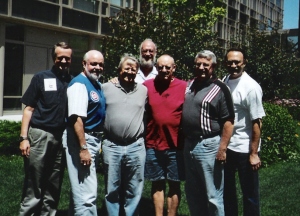
Dale Hartwig (red shirt) and the Chicago Seven Gathering, McCormick Theological Seminary, 2004.

Dale Hartwig (red shirt) and the Chicago Seven Gathering, McCormick Theological Seminary, 2004.

This morning news arrived of the passing of an old friend. Dale is a classmate, one of seven who call ourselves The Chicago Seven. The Seven met annually until 2004 when the gathering was reduced to Six because of Dale’s advancing Parkinson’s. The gatherings have continued to be powerful bonds of friendship, but never again so meaningful as when there were Seven.

MEMORIAL TRIBUTE to be shared at the Celebration of Life & Victory over Death for DALE HARTWIG

Dale was such a joy for all of the Chicago Seven (now Six). His quiet spirituality brought a stillness to the room, or tears, and so much reality and the tenderness of a poet. The last time all seven of us McCormick alums gathered in Chicago, we sat around a long table sharing our thoughts and work. Dale and I were sitting next to each other, as we often did, at one end of the table. When it came his turn, Dale moved some papers in front of me and asked that his words be read. His contribution, as I recall it, was a Greek exegesis from a New Testament text that reminded us of his love for biblical exegesis, he being the only one of us who left seminary to become more proficient in NT Greek than when we left. His sharing also included a poem he had written. As I read it aloud on his behalf – his surrogate voice – he began to weep because his words had been heard! Here’s the poem in memory of that sacred Hartwig moment – one of many – that the rest of us will forever cherish.

“THE SURROGATE VOICE” – GORDON C. STEWART (WRITTEN IN THANKSGIVING FOR THE CHICAGO GATHERING ’04)

As the surrogate voice reads on,
the author sits and sobs
his wrenching tears from primal depth;
from some abyss of joy
or nothingness…or both.

The author’s sighs and piercing sobs-
arrest routine,
invoke a hush,
dumb-found the wordy room.

He cannot speak,
his Parkinson’s tongue tied,
his voice is mute, in solitude confined,
all but sobs too deep for words.
Another now has become
his voice, offering aloud with dummy voice
the muted contribution
in poetic verse the ventriloquist’s voice has penned.

The abyss of muted isolation ope’d,
his words, re-voiced aloud,
hush the seven to sacred silence, all…
except from him, their author.

Whence comes this primal cry:
From depths of deep despair and death,
from loneliness, or depths of joy
We do not know.

The surrogate voice reads on
through author’s sobs and sighs,
through his uncertain gasps for air
and our uncertain care.

The iron prison gates – the guards
of his despair – unlock and open out
to turn his tears from prison’s hole
to tears of comrade joy.

His word is spoken, his voice is heard,
a word expressed
in depth and Primal Blessing,
pardoned from the voiceless hell.

The stone rolls back,
rolls back, rolls back,
from the brother’s prison’s tomb,
the chains of sadness snap and break!

At one, at one, we seven stand,
in Primal Silence before the open tomb,
as tears of loss, of gain, of tongues released
re-Voice unbroken chords of brotherhood.

Rizpah and her children

As the snowstorm cancelled schools in Minnesota last week, 90 year-old Lorraine Garrison was surrounded by family and friends who celebrated her life.

Lorraine’s grandson, Jeff, reminded the minister of the story of Rizpah, the diligent mother who perched her body on the rock after two of her children were hanged by the Gibeonites, and stayed there for five months to keep the birds and animals of prey away. Lorraine was a Rizpah, watching over her adult children and her grandchildren from her room in the nursing home in Chaska.

“Rizpah” – Alfred, Lord Tennyson (1809–1892)

Sin? O, yes, we are sinners, I know—let all that be, 60
And read me a Bible verse of the Lord’s goodwill toward men—
“Full of compassion and mercy, the Lord”—let me hear it again;
“Full of compassion and mercy—long-suffering.” Yes, O, yes!
For the lawyer is born but to murder—the Saviour lives but to bless.

He’ll never put on the black cap except for the worst of the worst, 65
And the first may be last—I have heard it in church—and the last may be first.
Suffering—O, long-suffering—yes, as the Lord must know,
Year after year in the mist and the wind and the shower and the snow.

Heard, have you? what? they have told you he never repented his sin.
How do they know it? are they his mother? are you of his kin? 70
Heard! have you ever heard, when the storm on the downs began,
The wind that’ll wail like a child and the sea that’ll moan like a man?

Election, Election, and Reprobation—it’s all very well.
But I go to-night to my boy, and I shall not find him in Hell.
For I cared so much for my boy that the Lord has look’d into my care, 75
And He means me I’m sure to be happy with Willy, I know not where.

The story comes from Second Book Samuel 21:10-11: “And Rizpah the daughter of Aiah took sackcloth, and spread it for her upon the rock, from the beginning of harvest until water dropped upon them out of heaven, and suffered neither the birds of the air to rest on them by day, nor the beasts of the field by night. And it was told David what Rizpah the daughter of Aiah, the concubine of Saul, had done.”

Thank God for the Rizpahs of this world who will never let Willy get lost.

I look in the mirror and what do I see?

“I look in the mirror and what do I see? A toothless wonder comin’ after me. I want to be young again” I’m thinking after the tooth extraction. It’s my rendition of Swing low, sweet chariot’s “I looked over Jordan and what did I see….”

Who is this older me and the Me that’s comin’ after me? Has God ever lost a tooth? Has God ever looked in the mirror and protested the reflection? Has God ever stepped on the scale in the morning, counted the days on the calendar, googled the weather channel, picked up the dog’s poop, poured Mirilax in the coffee to stay “regular”? Taken three Ibuprofen to keep the swelling down? Has God ever come to the end of a day and wondered why the dentist said “Good Morning!”

Jazz – the language of love and awe

“Who is your favorite jazz pianist?”

“Bill Evans,” came the quick reply from Ted Godbout, the jazz pianist who came to us out of the blue as a candidate for the music position at the little church in Chaska, MN where jazz is the language of love and awe.

In the news Michael Jordan is defending himself against a young man’s claim that he is Air Jordan’s “love child” who deserves more of Michael’s time. Listening to Ted Godbout at his audition, I wondered….

We sent Ted’s DNA to the lab for testing :-). He’s that good. And only 29! Ted leads the music at Shepherd of the Hill for the first this Sunday, March 10.

Extracts from the Visitors page of the church website speak of the language of jazz.

Imagine a place…

a church, actually, your church,……

where it is a safe place to land, for a bit of time

while you marvel….

and wonder, and revel in

love…..

and justice…..

and mercy….

where the questions get clearer and

better questions replace them….

where your heart burns to return

Again and again……

where jazz is the language of love……

and love, the language of

Awe…….

where God is a three letter word again….

spoken to soothe your tired feet…

On your journey of becoming

more of who Love intended you to be,

(since you have heard it said, “fear not….”)