Father and Son – the Audi

2005 Audio A4 2.0 AWD Quattro Wago

2005 Audio A4 2.0 AWD Quattro Wagon

Anxiety wears many masks. Sometimes it looks like a car shopper. Sometimes the car shopper is like his Dad.

I’m at a new stage in life. Our income will be cut by 40% in 27 days when we are both retired. We are excited by the freedom to enjoy life together without the obligations and distractions but are also anxious about finances and the unknown.

So what am I doing at a car dealership, trading the 11 year old Toyota Avalon for a nine year old Audi?

I rationalize laying out $9,000 with reasoning that I “know” is convoluted and self-defeating. It goes like this.

We’ll be on the road for two months. The Avalon has 120,000 miles on it. Can we trust it?

The Avalon needs $1,000 worth of body work to repair the damage done when it’s getting-older driver swiped the side of the garage.

But… we could leave the scrape the way it is and save the $1,000. After all, it’s 11 years old, and we don’t even know whether we will need two cars in retirement. We could sell the Avalon and pocket the $7,500 to add to our small nest egg.

The Audi has only 83,000 miles on it. It’s All Wheel Drive, great for driving in winter conditions. It gets better gas mileage. Sure it takes Premium fuel, but that’s only 30 – 40 cents more than regular.

But it is an Audi. I’ve never owned an Audi.

It’s confusing for a guy who loves cars, a guy addicted to car shopping. My brother does it too. It runs in the family.

Dad's 1983 Buick Skylark

Dad’s 1983 Buick Skylark

When my father could no longer walk without a walker and long after my mother had (sort of) prevailed to stop him from getting behind the wheel of the 12 year-old Buick Skylark, Dad continued to insist he could still drive. He suffered increasing dementia as the Parkinson’s wore on. He also continued to insist he could still play golf. “Ken,” Mom would say, “You can’t even stand up. How are you going to swing a golf club?” “Just take me over. I can still hit the ball.” He also never gave up his role as a Minister of Word and Sacrament, wanting to preach until a few months before he died.

Despite the very limited financial resources which my mother managed like a cookie-baker who hides the cookie jar from kids on sugar highs, Dad always wanted to buy a new car. “Skip, let’s run over and look at that new Buick. I saw it on TV. It’s a beauty!”

Dad dropped by car dealerships as naturally as a sex addict drops by the adult store. Maybe there’s a relationship. The both sell toys.

Tom, the Audi dealer, is a very nice guy. No pressure. “Take it home and show Kay. She’s going to love it. It’ll be the perfect fit for your retirement road trips. Keep it overnight. Just bring it back tomorrow. We can finish up the paper work in the morning.” I leave the Avalon with Tom and leave with the Audi.

Driving the Audi home I begin to notice that the suspension is sportier, which makes for a great driving machine – the Germans make the best – but also means that the ride is stiffer. I remember how I’ve always come back to an Avalon because of the seat and the soft ride. But this is an Audi. I’ve never owned an Audi, and it has all at the bells and whistles. Like the Audi guy says, “You’re retired; you deserve a great car! You goin’ to feel really good in this.”

On the way home, it dawns on me: “So…that’s what this is about.

As of November 10 I no longer have a position. I no longer have a public roll. I am no longer capable of confusing public standing with personhood. I’m anxious, unconsciously fearful. “Retirement” means old age. Loss. Hearing loss. Teeth in a cup. Memory loss. The road to the loss of everything.

The next morning, I take the Audi back to Tom.

Buying an Audi has its own kind of logic, but it makes no good sense, given our finances.  Even with an extended warranty. Because we, the drivers, don’t have “extended warranties”. Getting older can also mean getting wiser. Getting more comfortable being ourselves without status or position and their sex symbols. It’s time to practice what I’ve always preached: We don’t own a thing. We wear out beyond repairs and maintenance. It’s all about anxiety.

I chuckle and imagine a smile on Dad’s face. God doesn’t need an Audi or a Buick. Neither did Dad. Neither do I! I’ll ease on down the road in the Avalon.

– Gordon C. Stewart, Thanksgiving Day, Nov. 27, 2014
You might not believe this

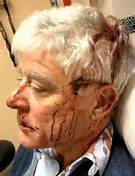
Mark Andrew after shopping at the Mall of America

Mark Andrew after shopping at the Mall of America

A year ago Mark Andrew was beaten within an inch of his life. We commented on the assault at the Mall of America at the time and are moved to comment now on the unusual sentence handed down yesterday in the case of his primary assailant.

Click “Young woman who beat Mark Andrews receives no jail time – at his request” – for the story aired yesterday by All Things Considered on Minnesota Public Radio.

Mark Andrew, man of compassionate wisdom

Mark Andrew, man of compassionate wisdom

There is judgment and there is mercy. Mark Andrew is a man of faith. He was taught and he believes that God’s judgment is always a function of God’s love, and, as Cornel West puts it, that “justice is what love looks like in public.”


Every head was bowed

A reader of yesterday’s “On the Ship and on the Train” left a comment. The post featured this photograph of my father and his Army Air Force unit on board ship on the high seas on their way to Saipan in World War II.

My father, the Chaplain, on board ship to Saipan, WW!!.

My father, the Chaplain, on board ship to Saipan, WW!!.

Karin wrote:

“I clicked on the picture which made it large enough to fill my screen… I was amazed. Every man’s head was bowed. That brought a realization that they all knew what they were headed towards. Profound.”

My father was the Chaplain leading the prayer. Indeed, EVERY HEAD WAS BOWED.

Prayer came naturally to him. My brothers and I were blessed by his prayers every night at the dinner table. His head would bow. My mother’s head would bow. Our heads would bowed. There was a short, reverent silence – a time for centering, as we would call it today – followed by words. He addressed the Divine as “Thou”, not the familiar “you”. Antiquarian by contemporary standards, there was never any question that the “Thees” and “Thous” were not spoken to another one of us.

A remnant of his prayers – a sample of the kind of prayer by which he led the soldiers on the ship – was left in my possession in his old Bible.

God our Father, who hath commended thy love for us in that while we were yet sinners, Christ died for us: worthy was the Lamb that was slain to receive honor and glory and blessing.

Remembering once again him again whom we have pierced by our selfishness and folly, we acknowledge our sins and beseech thy forgiveness. We would learn of thee to forgive,  with thee to suffer, and in thee to overcome. Lord, in thy great mercy we ask that thou remember us now in thy kingdom – confirm our faith.

Forbid that we forget among our earthly comforts the mortal anguish our Lord Jesus endured for our salvation. As we behold him following the way of faith and duty even to the crown of thorns and the cross, grant us grace that we may learn the sterner lessons of life.

So endue us with power from on high that taking up our cross and following our Savior in his patience and humility we may enter in the fellowship of his sufferings and come at last to dwell with him in his eternal Kingdom.

I learned to pray at my father and mother’s table. Over time his theology changed in many ways, but his faith in Divine Goodness never waned.

In my last conversation with him before he died, I asked, “How are you doing with your faith?”

“Good,” he said with the heartiest smile his Parkinson’s would allow. He died two days later. His head was bowed.

The Reign of Christ

I’ve often wondered
why he included
me

in parables of goat
and sheep, of tare and
wheat

of a woman on a floor
to find her one
lost coin

of a manly crowd
with stones to throw at
“her”

of ramming rams and
bleating ewes and one
little lamb

of pride and loathing
of specks and logs in
eyes

of sight and light
of day and sleepless
nights

of father running to
greet his son from
empty sty

of water and wine
and miracles that healed
the sick and

called forth Lazarus
from the tomb, unwrapping
him and me

– GCS, Nov. 24, 2014 – early Monday morning the day following Christ the King (Reign of Christ) Sunday.

Sheep and Goats

Being without a pulpit doesn’t stop the yearning for study and communication. Today Dean Seal stood for the first time in the pulpit where I once stood. I rejoice with Dean and the dear people of Shepherd of the Hill as they begin this new ministry together.

But I also sense the loss of the community that has been Kay and my home for the past eight and a half years. So I do what I have always done. I look at the texts for the day, ponder their meaning, and write about them.

The Hebrew Bible text for today – the last Sunday in the Christian liturgical calendar, “the Reign of Christ” Sunday – is from Ezekiel 34. It reads, in part:

I myself  [i.e. God] will be the shepherd of my sheep, and I will make them lie down, says the Lord GOD.

I will seek the lost, and I will bring back the strayed, and I will bind up the injured, and I will strengthen the weak, but the fat and the strong I will destroy. I will feed them with justice.

Therefore, thus says the Lord GOD to them: I myself will judge between the fat sheep and the lean sheep.

Because you pushed with flank and shoulder, and butted at all the weak animals with your horns until you scattered them far and wide,

I will save my flock, and they shall no longer be ravaged; and I will judge between sheep and sheep.


– Ezekiel 34:15-22

Ezekiel is spoken to the exiles, the aliens in a strange land – you might call them “immigrants” or “exiles” or “refugees”. Or “undocumented workers” who labor for peanuts without the protection of the law.

Ezekiel’s 34th chapter looks to David, the leader of the nation, to be God’s agent to rescue them. Or maybe, in our time, a distant relative named Barack.

During the time I worked outside the church at the Legal Rights Center in Minneapolis, a group of undocumented workers came to the Center. The Hispanic/Latino Community Advocate had identified their need and had convinced them that the LRC was a safe place to bring their case.

Six Mexican “employees” of a cleaning service that sub-contracted for janitorial services at the Mall of America in Bloomington, Minnesota had not received their wages for the past six weeks. The company knew their workers had no recourse. The law was against them; deportation was always one step away. The employer was confident in its privileged position. Those who withheld their wages had not yet read Ezekiel’s proclamation: “I will seek the lost, and I will bring back the strayed, and I will bind up the injured, and I will strengthen the weak, but the fat and the strong I will destroy. I will feed them with justice.”

It took one phone call to the employer to get these men the wages they and their families had been wrongfully denied.

Let those who oppose Immigration reform legislation in the United States of America read Ezekiel, or sit in on the conversation at the Legal Rights Center. Then let them think again about President Obama’s compassionate speech on immigration policy reform and pass the bipartisan bill languishing the House of Representatives.


The Distant Murmurs of Prayer

“In our imaginations, we listen for the distant murmurs of prayer,” wrote Dennis Aubrey in his post “In Seclusio at Thines” posted on Via Lucis Photography.

Listening for the distant murmurs immediately brought to mind a hymn composed by Anne Quigley in 1992. The tune is LONGING. The textual refrain is:

“There is a longing in our hearts, O Lord, for you to reveal yourself to us. There is a longing in our hearts for love we only find in you, O God.”

It was the recollection of the text that drew me to LONGING. I searched YouTube for possible videos for this post but found that the lightness of the tune, like so much contemporary Christian music, left me longing for “the distant murmur of prayers” that echo down the ages in the Gregorian Chants once sung in the now empty or mostly empty monasteries and churches that inspired Dennis to conclude “In Seclusio in Thines”:

“[PJ and I] … hear the echoes of sandaled footsteps in lonely churches long deprived of their monastic communities. And in our imaginations, we listen for the distant murmurs of prayer.”

I long for gravitas awakened by the beauty of silence.

Two Presidents – November 22, 2014

Today is the anniversary of the assassination of President John Fitzgerald Kennedy (JFK), 35th President of the United States of America.

Who killed JFK remains a question for the ages. Someday, perhaps, we will learn the truth of why and by whom he died, but for now the story must be told again, remembered for what it was and for what might have been.

Some things are,
or, so it seems,
“not meant
to be”

Things like
Jack and us
that almost
were

Yet some things,
I repose,
never fade
or die away

Some things not
“meant to be”
like Jack and me,
live on

As things that are,
I surmise,
not meant
to die

For love is not
a thing,
an object that
can die

It hangs around,
like time,
in spaces all
its own

– GCS, Nov. 22, 2014


It must be remembered and mourned afresh today when hatred for his successor runs rampant and “lapses” in White House security inexplicably abound. One theory of President Kennedy’s assassination includes not only a rogue element of the CIA but also the Secret Service, charged to protect the President. Prayers are in order for the President who stood tall this week in his speech on immigration reform.

For our President, Barack, for the leaders of the nations, and for all in authority, let us pray to the Lord. Lord have mercy.

For the poor and the oppressed, for the unemployed and the destitute, for prisoners and captives, and for all who remember and care for them, let us pray to the Lord. Lord have mercy.

Defend us, deliver us, and in Thy compassion protect us, O Lord, by Thy grace. Lord have mercy.

[Excerpts from The Book of Common Prayer, Form I, 1979 Pew Edition, page 384.]

Verse – How and Why?

Some say “God has a
plan for you.” But I say,
“There is no plan. There is
no meaning we find;
only the meaning we make.”

But how do 12 Bald Eagles circle
overhead during simultaneous
memorial services for the slain
children of Red Lake – six over
Red Lake; six over Saint Paul?

Why does the Egret wading in
the pond suddenly stop its fishing
and fly across to the window on
the other side where a mother
grieves her daughter’s death?

Are you and I the only makers
of meaning or is there Another
outside or inside of nature,
a Meaning-Maker inside, between
and among everything that is?

– Gordon C. Stewart, November 22, 2014


The President’s Speech

President Obama rang the bell last night in his speech on immigration. The President is a Constitutional lawyer. He is also a man of faith, a thoughtful Christian who interprets the Bible the way Abraham Lincoln did, and, like Lincoln before him, the President preached to a divided nation from the White House.

He used the bully pulpit to stop the bullying.

“Scripture tells us, we shall not oppress a stranger, for we know the heart of a stranger — we were strangers once, too. My fellow Americans, we are and always will be a nation of immigrants. We were strangers once, too.”

This morning Speaker of the House John Boehner, who for the past year-and-a-half has personally blocked a vote in the House on the bipartisan Senate immigration reform bill, filed a lawsuit, alleging the President has exceeded his authority. Mr. Boehner and others also threaten impeachment.

Very few of us understand the Constitutional separation of powers well enough to assess knowledgeably whether the President has or has not exceeded his executive authority, but given similar actions by every recent President, both Democrat and Republican, the Las Vegas odds-makers would surely lay heavy odds in favor of the Constitutional lawyer in the White House.

Catholic, Protestant, Jewish, Muslim and secular humanist leaders have led the fight for immigration reform for many years. They have commended the President’s actions and have renewed the call for Congress to pass bipartisan reform.

Because they’re not bomb-throwing religious extremists, there likely will be little media coverage of these religious leaders support for the President’s speech and actions. Like Mr. Obama, their faith, and the faith of the people and congregations they represent, are thoughtful and fairly quiet in demeanor. They don’t make headlines. But once in a while, one of gets to preach from the White House.

In the habit of some preachers who invite response from the pews following prayers or a sermon, “Let all the people say ‘Amen!’

Idealism and Terror

When one thinks of idealism, Martin Luther King, Jr. or Gandhi comes to mind. Moral and spiritual giants who stand for ideals that make the world a better place. We think of Idealism as good in the face of evil, or of ideals lifting us up from the dirt of reality, purifying life from its toxins. Ah, but there lies the fatal flaw in idealism itself.

George Will’s Washington Post opinion piece “A Murderer’s Warped Idealism” looks afresh at idealism and evil, not just evil masquerading as idealism, but idealism as a source and form of evil itself.

Will’s commentary zooms in on Adolf Eichmann, executed at midnight 1961 for his role in the German State’s systematic extermination of 6,000,000 Jews. During the trial in Jerusalem Eichmann minimized his role in the Holocaust, presenting himself as a thoughtless functionary carrying out the orders of his superiors.

Referring to newly discovered writings by Eichmann which form the backbone of a new book by German philosopher Bettina Stangneth, Will writes:

Before he donned his miniaturizing mask in Jerusalem, Eichmann proclaimed that he did what he did in the service of idealism. This supposedly “thoughtless” man’s devotion to ideas was such that, Stangneth says, he “was still composing his last lines when they came to take him to the gallows.” (Bolding added by Views from the Edge)

Eichmann and Hitler were not without ideas or ideals. They were not thoughtless. Nor were they irrational, as those who believe that reason can sea us believe. They were idealists who sought to lift up a super race, burning away the world’s impurities as their deranged hearts conceived of them.

The late Dom Sebastian Moore, O.S.B. shone a different light on idealism and the remedy for human madness. He put it this way in The Crucified Jesus Is No Stranger:

“We have to think of a God closer to our evil than we ever dare to be. We have to think of [God] not as standing at the end of the we way take when we run away from our evil in the search for good, but as taking hold of us in our evil, at the sore point which the whole idealistic thrust of man is concerned to avoid.”

We are, says Moore, “conscious animals scared of our animality and seeking to ennoble ourselves.”

Eichmann, Himmler, and Hitler were idealists. Nationalist extremists are idealists. Racial and religious extremists are idealists. ISIL is idealist. American exceptionalism is idealist. Whether behind the banner of the State, or of religion, gender, ideology, scientism, or rationalism – idealistic terrorism lives to rid the world of evil as its adherents understand it, projecting evil as “the other” while fleeing “the sore point” that we conscious animals seek to avoid.

Only the God who meets us at the sore point of our shared animality can save us from fantasies. In his last book, Remembered Bliss ((Lapwing Publications: 2014), Dom Sebastian told the reader, “I’m ninety-six, and for most of my life I’ve been a monk. My life as a monk has been, for the most part, the search for God as real.” RIP.