Just a bunch of hypocrites

“It is a poor sermon that gives no offense; that neither makes the hearer displeased with himself nor with the preacher.” – George Whitefield (1714-1770)

Many folks who remain in the churches have learned to live with poor sermons. Others have heard them and moved on.

William Sloane Coffin memorial photo

William Sloane Coffin memorial photo

One of those who had given up met one of America’s great preachers one day in a casual encounter.

“I don’t go to church any more.” he said, “They’re just a bunch of hypocrites!” To which William Sloane Coffin replied, “You bet. We are! And there’s always room for one more.”

William Sloan Coffin’s sermons always gave offense. As Chaplain at Yale, it was his pulpit that sparked and led the campus civil rights movement and protests against the Vietnam War. It was Coffin who presiding at the burning of draft cards. It was this offensive preacher who co-founded Clergy and Laity Concerned about Vietnam and served as leader of SANE/FREEZE, America’s largest movement for global nuclear disarmament. Coffin became Senior Minister of Riverside Church in NYC, one of the nation’s great preaching churches built for Harry Emerson Fosdick, the pacifist preacher thrown out of his previous congregation for sermons that status quo maintainers found offensive.

In the parlance of William Sloane Coffin, the well known statement that “the church is a hospital for sinners; not a museum for saints” [variously attributed to Augustine of Hippo, St. John Chrysostom, Abigail van Buren, and others] might be re-rendered “the church is a hospital for hypocrites; not a museum or a mutual congratulations society for the sinless.”

In a future post Views from the Edge will reflect on the American religious landscape in light of Whitefield’s observation and this retired preacher’s search for a new church home.

– Gordon C. Stewart, Chaska, MN, March 7, 2015.

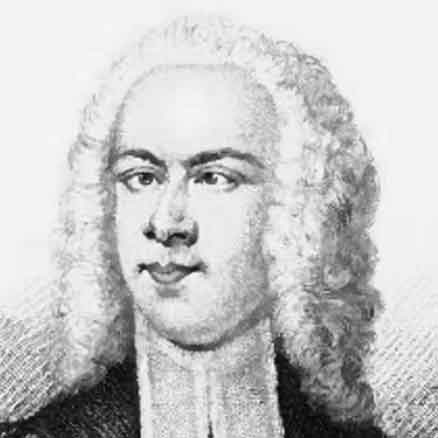
Slender, cross-eyed, and handsome

The Rev'd George Whitefield

The Rev’d George Whitefield

“It is a poor sermon that gives no offense; that neither makes the hearer displeased with himself nor with the preacher.” – George Whitefield (1714-1770)

A preacher’s search for a new church home following retirement is often an exercise in sin, a prolonged, prideful discontent with the state of the churches one visits.

George Whitefield seems to have spent his whole ministry offending and displeasing, although the huge crowds he drew outside the church walls lead me question how offensive or displeasing his sermons were.

An honest word from a real human being 

Perhaps the photograph of this heralded Anglican priest, “the Father of the Great Awakening,” and this PBS documentary description of him illuminate why the preacher who offended and made his hearers displeased with themselves drew the crowds.

“Slender, cross-eyed and handsome, George Whitefield was an Anglican priest and powerful orator with charismatic appeal.”

While others were reading their sermons from prepared manuscripts, George knew that good preaching is different from a public reading at the book store. He memorized his sermons or spoke extemporaneously with gestures considered too dramatic by the more stoic New England preachers. But one suspects there may have been something more to his success. Perhaps his eyes communicated a real human being, someone unable to hide behind being merely slender or handsome, a man whom frail and vulnerable human beings didn’t mind hearing an honest word that offended and or made them displeased with their own posturing games of pretense.

In honor of George Whitefield, a recently retired pretentious Presbyterian preacher worshiped at a nearby Episcopal Church. The word from the pulpit was deliciously real. He didn’t commit the preacher’s sin. He’s going back next Sunday.

Verse – The Trinity?

One form, but multiplicity…
Motion, immutability…
Can we glimpse God.
So weird, so odd,
In limerick theology?!

Is the Divine One one or three?
Is He a he or She a she?
A comedy!
A mystery!
One was and is and Three will be!

Steve Shoemaker, Urbana, IL, Sunday, Feb. 22, 2015

Magic Wars

There’s no record the wars of the Bible
Found in Exodus are that reliable
Historically.
Fortunately
Hebrews found Holy Land bloodlessly…

(This written as a FaceBook comment in response to a comment protesting a post by the brilliant & perverse Nina Paley about her newest feature length animated movie, “Seder Masochism“–retelling the Exodus story, like she retold the Hindu tales in “Sita Sings the Blues”, portions of the latest, and all of the former can be seen FREE many places on line!)

– Steve Shoemaker,  Urbana, IL, Feb. 22, 2015

Twins

We know that seeing never can
be believing. We fool the eye
of all who look at us and see
the other. Mother left the band
upon our wrist that gave our name
for weeks after our birth, but then
began always to dress Brian
in blue. One day we switched–I came
out in his shirt–she called him Chris!
St. Thomas was a twin and so
when he heard that his friends were sure
they’d seen the risen Lord, of course
he doubted that was true. But then
he heard the word…although a twin.

Steven Shoemaker
Urbana, Illinois, Feb. 21, 2015

[These poems may be used, copied, or published as you will. It would be nice
if you included my name, city, and State]

NOTE: Readers unfamiliar with Christian Scripture will find it helpful to know the biblical text behind Steve’s poem. Click Jesus and Thomas, the Twin for the story in the Gospel of John.

The prayer from hell

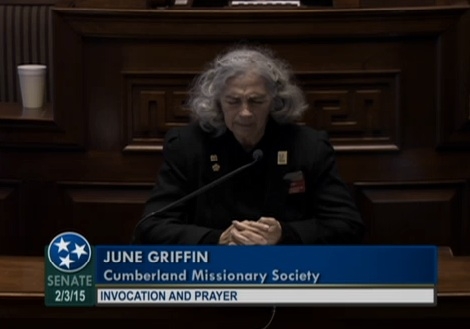
June Griffin, Cumberland Missionary Society, praying      invocation opening Tennessee Senate session, 2015.

June Griffin, Cumberland Missionary Society, praying invocation opening Tennessee Senate session, 2015.

Not even Saturday Night Live or Bill Maher could make up.

Open the Link to Christian minister opens Tennessee Senate with prayer and SCROLL DOWN to watch the video of June Griffin’s anti-government Prayer of Invocation opening a session of the Tennessee Senate.

There used to institutions for people like this.  I used to visit the patients there, but those state hospitals were closed years ago. Today they’re sitting legislators or offering the invocation praying for a Christian-American version of ISIL.


Life begins on the other side of despair

It was Jean-Paul Sartre, the French existentialist novelist, philosopher, and playwright, who declined the Nobel Peace Price for Literature in 1964, who said it. “Life begins on the other side of despair.”

Sartre’s statement resonates with those who have stood at the edge of the abyss of the loss of life’s meaning. Some don’t make it to the other side. Some move to the other side of the abyss with no faith but faith in themselves to create meaning they once ascribed to God or some objective moral order. Others arrive on the other side with their inherited faith not only deconstructed, but re-constructed. I am one of the latter.

Reading of the shooting suicide of a 27-year-old Iraq War veteran philosophy student in the library at Mankato State University takes me back to Sartre’s statement about life and despair. Timothy Lee Anderson was an honorably discharged U.S. Army gunner in Iraq. His picture in The Daily Mail shows him in an Iraqi combat zone with his weapon. In the background of the photo, Iraqi women in traditional Muslim dress appear to be crossing the street. How, I ask, does a guy who served as a gunner in the Iraq War choose philosophy as his major when he comes home to the U.S.A.?

Philosophy is not a popular choice these days. Unlike computer science, it’s not job- related. The word ‘philosophy’ derives from two Greek words meaning love (philo) and wisdom (sophia). Philosophy is the love of, and the search for, wisdom.

Wisdom is born of experience, not inheritance. It’s not hard to imagine the dashed, unexamined, inherited convictions of a young Army recruit: a world dependent on American goodness and might; an America with a manifest destiny in the global order; an exceptional nation privileged and responsible, whether by religious or political creed, to bring its blessings to the rest of an ignorant, unenlightened, uncivilized, and sometimes terroristic and defiant world.

Nor is it hard to imagine a soldier’s despair upon return, reflecting on his experience in search of greater wisdom among the philosophers. The early reports of Timothy Lee Anderson’s life experience point to a less than comfortable homecoming with arrests for marijuana and violation of an order for protection. The gun shot he fired at himself on the second floor of the Mankato State University library was a shot of despair, whatever the immediate reasons or circumstances.

The great sorrow is a life that ended too early on the despair side of the yawning abyss of collapsed meaning. It remains to the survivors and the rest of us who look with sadness on Timothy’s tragic departure to learn that claims to religious-national exceptionalism and wisdom go together about as well as bombs and day-care, guns and libraries.

– Gordon C. Stewart, February 3, 2015.


In Memoriam: the MSU Philosophy Student

“The life of the dead is placed in the memory of the living.” – Cicero

The philosophy student who shot himself in the library at Mankato State University yesterday could have been me many years ago. Or is it “could have been ‘I’”? I or me is a question of grammar without much consequence. Philosophy is a question of meaning. Grammarians don’t shoot themselves. Some philosophers do.

I know nothing about the 27-year-old philosophy major at MSU. I don’t need to know more for tears to fall while reading the Star Tribune news report over morning coffee.

A Minnesota State University Mankato student shot and killed himself Monday afternoon in the campus library.

Police were called about 4 p.m. to the library after receiving a report of a suicidal man. After searching Memorial Library, police found the 27-year-old man, a junior philosophy student, on the second floor. Police said he turned the gun on himself and shot.

Police said no one else was in any danger during the incident.

The library was open Monday evening but with access only to the lower level, first and third floors.

I feel sick. It’s sad enough when anyone takes his or her life. It’s sadder still, at least for me, to learn that he was studying philosophy and that he appears to have found a solitary place on the second floor, perhaps among the stacks in the philosophy section of the library, as I imagine it.

He was a junior, as I was when the course in contemporary philosophy plunged me into deep despair. Psychology majors might have called it depression because it looked like that on my face. But there’s a difference between depression and existential despair.

Jean-Paul Sartre’s Being and Nothingness, No Exit and The Flies, and Franz Kafka’s Metamorphosis and The Trial were like nothing I had ever read or heard. They blew my mind to smithereens, leaving me very much alone with the sense of nothingness.

By the time I hit the books in the library that junior year, I ate, drank, and slept philosophy. Of the 18 hours of courses I had decided to carry, only the philosophy course seemed important. Raised in a Christian home, I had always prayed, more or less, giving thanks and asking for blessings on those I loved and the less fortunate. But now prayer seemed a cruel hoax, “bad faith” as Jean-Paul Sartre put it. Why I would return from class and kneel down beside my bed not for “now I lay me down to sleep” but to tell God to go to hell is one of the great ironies, a question grammarians cannot answer.  Had I had a gun that afternoon, my roommate might have found me on the floor in Room 301 of Carnegie Hall.

I know nothing of the circumstances or state of mind of the 27-year-old MSU philosophy student. Perhaps no one will ever know for sure. It may be that his experience bears little or no resemblance to mine all those years ago. It’s not for me to know.

I don’t even know your name, but I sure do feel you! And I feel for those who mourn your loss. “That God does not exist, I cannot deny,” wrote Sartre, “That my whole being cries out for God, I cannot forget” – Jean-Paul Sartre.

Almighty God, Father of mercies and giver of comfort: deal graciously, we pray, with all who mourn; that, casting all their care on You, they may know the consolation of Your love. [The Book of Common Prayer]

Rest in Peace

– Rev. Gordon C. Stewart, Chaska, Minnesota (an hour from Mankato), Feb. 3, 2015.

The Man who Knew

He knows who he is! He is not ignorant; he’s smart. He knows the visiting rabbi is both “the Holy One of God” and the one who has “come to destroy us”.

It is because he knows this that he ends up shrieking. He knows better than those around him, all the others who have come at sundown to observe the Friday Shabbat and Torah study.

He takes his customary place among his neighbors in the Capernaum synogogue. He does not expect much to happen. Everyone, including he, knows that he’s a little strange. Off balance, as the kinder of them say.  Not the norm. Both they and he know his place. None of them yet knows Annie Dillard’s advice that worshipers “should wear crash helmets. Ushers should issue life preservers and signal flares; they should lash us to our pews. For the sleeping god may wake some day and take offense, or the waking god may draw us out to where we can never return.” [Teaching a Stone to Talk, Harper and Row, 1982, quoted here from Wikiquote.]

They have no need for crash helmets, life preservers, or signal flares. Like the ones who are better balanced, he likes his safety. He is safe in his customary place among the customary people expecting a customary teaching from a customary teacher who teaches like a copy-editor (a scribe). He expects to leave the same way he has come: bored and boring in the daily-ness of it all.

They look at him. He looks at them. They all yawn.  Until the guest rabbi takes his seat to teach and says nothing. Jesus just looks at them, reading their faces, reading their minds, looking into their hearts. They are uncomfortable with the long silence. He is reading them like a book he’s read too many times.

When finally the rabbi speaks, he astounds them. He reads the Torah and the prophets as living texts, not history. He is alive and expectant. He is not bored or boring. He teaches with authority. He commands the attention of everyone in the room. They want him, but do not want him. They haven’t brought crash helmets. They’ve come for safety.

He catches the eye of the man who’s a little off balance whose frequent uninvited outbursts   long ago placed him in the back row of the assigned seating.  Although the rabbi’s eyes are working the room from left to right and back again, seeing all the faces there, it is as though he is staring at him alone. They are all a bit on edge now, drawn to his voice and the content of his teaching, his unparalleled authority, but they are also becoming nervous that he is messing with them in ways they had not expected.

The man in the back senses this. He knows this, and he begins to twitch and make strange sounds. He is agitated, disturbed, out of his comfort zone, like everyone else.

His face twitching with the familiar tic, he struggles to his feet from his back row seat, shoving from his shoulders the hands of the ushers stationed on either side of him to prevent the man with Tourettes Syndrome from disturbing them and making a fool of himself.

He points at the rabbi and shrieks at him: “What have you to do with us, Jesus of Nazareth? Have you come to destroy us? I know who you are, the Holy One of God.”

Jesus moves from the center to the back row. He tells the body guards to leave him alone. He stands eye-to-eye with him. “Be silent,” he says, “Come out of him” as though speaking not to the man himself but to others who torment him from the inside.

The whole synagogue is on their feet watching. They know that the Tourettes man with the tic and uncontrollable speech has spoken for all of the normal ones as well. “Have you come to destroy us?”

The man screams and convulses, but it is not the man who is convulsing; it is the hostage-takers whose powers are being broken that are convulsing: the fear of losing one’s assigned place, the customary despair and despairing comfort that robs him and all of them of the joy of the extraordinary in ordinary life.

Perhaps the story of “the man with the evil spirit” comes so early in the Gospel of Mark because it is the story of us all. The Holy One of God does come to destroy us as well as heal us. The next time you go to the synagogue for Sabbath rest or to church on a Sunday morning, take a crash helmet and expect something great to happen!

Click Gospel of Mark 1:21-28 for the story on which this sermonic reflection is based.

– Gordon C. Stewart, St. Augustine, FL, February 2, 2015.


Preaching to Myself

The longer I live, the less I know. The less I have lived, the more I think I know.

“Knowledge puffs up; but love builds up.”(I Cor. 8:1b)

These words seem strange to those of us who value education. But peeking into the internal squabble within the First Century CE Corinthian church (First Corinthians 8:1-13) may also give us an unexpected peek into ourselves in 2015.

There is a tension between knowledge and love. The better educated among us see the relation between knowledge and love as complimentary. Love and knowledge grow together into ever expanding circles of freedom, like snakes shedding their skins and lobsters shedding their shells for bigger skins and shells that can hold their more mature selves.

Yet we are sometimes scornful of the less educated, the concrete thinkers, the legalists who are certain about what little knowledge they have. We are quick to join Paul’s opinion that “Anyone who claims to know something does not yet have the necessary knowledge ….” (I Corinthians 8:2). A little knowledge is a very dangerous thing. True education leads not only to increasing knowledge but to increasing awareness of one’s own vast ignorance.

We think of Copernicus and Galileo who challenged the prevailing knowledge, and those who judged them for their unbelief, a new “knowledge” that has changed the human view of our place in a vast, expanding universe. Or we think of Darwin and the Scopes Trial – the showdown between the knowledge of evolution and the ignorance of the creationists. We think of the difference between enlightened biblical scholarship that interprets Scripture through the eyes of love’s expansion and the biblical inerrantists who insist that the Bible be taken literally, such that the book is closed on matters of human sexuality.

“‘All of us possess knowledge.’ Knowledge puffs up; but love builds up.” 

Paul makes a masterful move here in the chess game of the knowers. He says that all the “knowers” know little, and that those who know more – the stronger in faith – are in greater danger than those who know less – the weaker in faith.

He is writing to the strong, the ones who are more advanced in the knowledge of the liberty to which Christ has set them free. “But take care that this liberty of yours does not somehow become a stumbling block to the weak.” Knowledge itself puts us on trial, the trial of humility, the trial of love. Paul calls for the stronger to be humble lest what they assume to know become the new idolatry that places Christ’s weaker followers on the cross of educated privilege.

The Christian claim of faith is not our knowledge, no matter how great or small. The claim of the disciples of Jesus is God’s knowledge of us. It is God’s knowing us that is the heart of faith for followers of the crucified, risen Christ. It is God’s knowledge -the wisdom of love – into which we are baptized as novices. One might even say, we die to every claim but love.

We are saved by grace through faith, not by works. For the likes of me and my progressive friends and colleagues in the Presbyterian Church (USA) and for members of the church who are choosing to leave the PC(USA) because of what they regard as excessive liberty, knowledge sometimes becomes the new “works” that substitute for justification by grace.

To be justified (i.e. made “right” with God) by grace through faith, as Paul understood it, represents a 180 degree repentance, a reversal of the direction and flow of the human-divine encounter from us to God to from God to us. Paul later speaks of the practical implications of love with respect to all claims of knowledge:

“And if I ….understand all mysteries and all knowledge, and if I have all faith, so as to remove mountains, but have not love, I am nothing.” (I. Co. 13:2)

“Love is patient and kind; love does not envy or boast; it his not arrogant or rude. It does not insist on its own way; it is not irritable or resentful; it does not rejoice at wrongdoing, but rejoices with the truth. Love bears all things, believes all things, hopes all things, endures all things.” (I Corinthians 4-7)

I am among those who remain puzzled by what to do. It’s far from simple. Paul’s description of the Christ-like life is centered, but it’s not simple. The patience and kindness come hard when faced with what I am sure are the weaker, more homophobic folks whose view of Scripture supports their opposition to the full inclusion of LGBTQ members. I boast of a greater knowledge based on love. In the name of love, I become arrogant. I am rude. I have a short fuse. I want to separate myself and the more enlightened from the less enlightened, the weaker, as Paul might say. In their presence I quickly become irritable, resentful of their presence in the Body of Christ. I do not bear all things. I do not believe all things, hope all things, endure all things. I do not believe that if I understand all mysteries and have all knowledge but have not love, I am nothing.

Though Paul was writing his letter to the tumultuous church at Corinth in the middle of the First Century CE, his words still speak. They arrive unexpectedly like a surgeon’s scalpel removing a cancer for the sake of the Body of Christ. The gospel cuts with a knife, but it is always for the sake of healing, a dying to ego for the sake of the resurrected Body of Christ.

Gracious Lord, by your healing mercy, keep me in the knowledge of Your love.

– Gordon C. Stewart, Sunday, Feb. 1, 2015.