Whoo-woo! I hear a rumblin’

Some days, when I’m weary, I hear the rumblin’ wheels of the gospel train rolling through the land. The song of the American slaves speaks its hope to me in this later age of collective madness.

The Gospel train’s comin’
I hear it just at hand
I hear the car wheel rumblin’
And rollin’ thro’ the land

Get on board little children
There’s room for many more

I hear the train a-comin’
She’s comin’ round the curve
She’s loosened all her steam and brakes
And strainin’ ev’ry nerve

The fare is cheap and all can go
The rich and poor are there
No second class aboard this train
No difference in the fare

  • Gordon C. Stewart, Whoo-wooing for the fairer train from Chaska, MN, May 11, 2017.


The 101st Day – What to do?

Today, following the first 100 days of President Trump’s inauguration, we offer a non-partisan invitation to focus on a phrase from a familiar prayer:

deliver us from evil“and lead us not into temptation,

but deliver us from evil.” 

Most days we pray the prayer without much reflection. Like many other things we repeat by rote memory, we give little thought to temptation or the need to be delivered from evil. But today the phrase calls out for deeper self-examination and reflection about the world in which we live.

“This was the most divisive speech I’ve ever heard from a sitting American president,” said Republican former advisor to four presidents David Gergen in response to President Trump’s speech celebrating his first 100 days in office in Harrisburg, Pennsylvania.

“He treated [those who are disturbed about him or oppose him] basically as ‘I don’t care, I don’t give a damn what you think, because you’re frankly like the enemy,'” said Gergen. “I think it was a deeply disturbing speech.”

The Lord’s Prayer (aka “the Our Father” and “the Jesus Prayer”) will be prayed in churches throughout the world today.

“Thy will be done on Earth as it is in heaven…”

“Forgive us our sins (the acts and states of mind that separate/divide us from/ hurt others) as we forgive those who sin against us.” 

“Lead us not into temptation (or “the time of testing”/”time of trial”), but deliver us from evil.”

Amen. May it be so! Lord, save us, and the world You love, from our worst selves.

  • Gordon C. Stewart, Chaska, MN, April 30, 2017.


Last TGIF of April – Day One

day1 logo

Day1.org logo

The best advertisements are the ones that aren’t paid for. Thanks to Day1 for featuring a chapter from “Be Still!” Departure from Collective Madness” today. Click THIS LINK to read “Homeland Militarization” on Day1.

spare-change-lg-300x199Then, If you like it . . . . buy it and let me know. I’ll gladly send a rebate of 99 cents to complete the purchase of the kindle edition, or 98 for the paperback.

coffeeBetter yet, next time we see each other, I’ll spring for a cheap cup of coffee and a rich conversation.

Wishing you a happy Day1 this last Friday of April!

Gordon C. Stewart, Chaska, MN, April 28, 2017.

Vive la France?

French soldier & GOne year ago the French soldier in Paris said, “I love America. Very patriotic!” I wondered what he meant. You Americans love your country? Or something else?

Today’s French election offers a moment to reflect more philosophically about the social, cultural and political dynamics that divide the French and Americans alike.

For starters, there is the age old question of the relation of the part to the whole. In this case, the part is a particular, and often unique, culture: French! French culture shares many similarities with its European neighbors, but the old joke about Hell – “Hell is a place where the police are German, the chefs are English, the car mechanics are French, the lovers are Swiss and it’s all organized by the Italians” – has some grounding in the real differences in the distinctive history and culture of each national culture.

The European Union is the sum of its distinctive parts; the parts make up the whole. The European Union created a common currency, relaxed the borders, and eliminated trade barriers among the member states of the E.U., a thing to celebrate in a world where it becomes increasingly clear that the planet itself is our home.

But what happens when the distinctiveness of the parts – the French in this case – are morphing quickly into something unrecognizable? What happens to the psyche of the traditional French citizen when the languages in the cafe, on the Metro, and in the apartment next door are not French – or the visiting German, Italian, English, and Spanish of tourists on holiday at the Louvre or on the beaches of Nice – but Arabic, Parsi, or Urdu spoken by Syrians, Moroccans, Indians, or Pakistanis?

A culture is a home, a kind of safe nesting place. A cardinal is not a robin, a wren, or flicker, and it’s not easy for any of them when they perceive their nests as under threat by the European Starling that would rousts them from their nests.

“I love America. Very patriotic!” said the Parisian French soldier guarding the Jewish synagogue against a terrorist attack while the headlines from America featured Donald Trump’s rise in the polls in May 2016. “Make America great again!” was the word from the  across the pond. “Which America?” I wondered then, as I wonder now what “Make France great again” means today in the French election.

Was the patriotic America in the mind of the French soldier the America that speaks Spanish, Parsi, Urdu, and Arabic as well as English or the one that speaks only English? The one that is white European in origin? The one where African-Americans take their seats again in the back of the bus? The America where there are no mosques; no sombreros; no anti-American leftists or immigrants – only starlings?  The America where being “very patriotic” means returning the U.S.A. to what it was before the starlings raided its nest?

Philosophically, the issues are not as simple as they sometimes seem. The question of the relation of the parts to the whole is as vexing today as at time in the course of human development. A year ago the world celebrated the signing of the Paris Accord on climate change in recognition that the whole is bigger than its parts and that every part depends on the well-being of the whole.

A parable of Jesus holds together the relation between the part and the whole: distinctive nests (cultures) in the the branches same shrub (world):

“The kingdom of heaven [the whole] is like a mustard seed that someone took and sowed in his field; it is the smallest of all the seeds, but when it has grown it is the greatest of shrubs and becomes a tree, so that the birds of the air come and make nests in its branches.” – Gospel of Matthew 13: 31-32.

Gordon C. Stewart, Chaska, MN, April 23, 2017.

Earth Day 2017 in France and the USA

Today on Earth Day 2017 it’s hard to believe it was just one year ago today (April 22, 2016) that the world celebrated 195 nations signing of the Paris Accord on climate change.

Marine Le PenExactly one year later to the day, it is both Earth Day and Election Day in Paris, where the French go to the polls following another chilling terrorist attack that boosts the candidacy of far right nationalist candidate Marine Le Pen who would “Make France great again!”

Here on the other side of the Atlantic and across the world, scientists and supporters of science are casting their votes with their feet, signs, and speeches in the wake of the 2016 American election of a climate change-denying President and Congress unravelling the Paris Accord while concentrating of erection of a border wall.

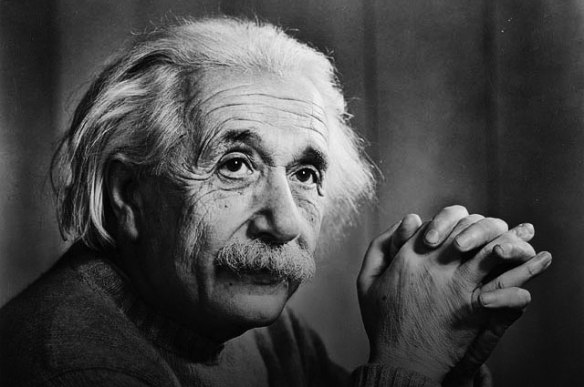
March for ScienceThe March for Science stands with Albert Einstein. “We cannot,” said Einstein, “solve our problems with the same thinking by which we created them.”

The thinking that has led to our problems includes bad religion, fake science, bad politics, and bad economics that ignore reality, shrink reality to the size of the human will to power, and sacrifice creative imagination beyond the boundaries of worn out thinking.

Today it will take prayerful people on both sides of the Atlantic to vote for the Earth in whatever way we can. Good science, good religion, good politics, and good economics go hand-in-hand.

On Earth Day 2017 pray for the Earth. Pray for yourself, for others, and for all creatures great and small. The Planet has no borders. It’s all the same house.

Albert Einstein

  • Gordon C. Stewart, Chaska, MN, Earth Day 2017.

Jesus’s Last Wish

As Kay and I walked through the passion narrative in the Gospel according to John Friday night in the quiet of our living room, we paused a number of times to share questions or observations about what we were reading.

Few of the church’s traditional “seven last words” from the cross appear in John, the last written of the New Testament Four Gospels. Four of the “words” we expect to hear from having read Matthew, Mark, and Luke are missing in John:

  1. Father, forgive them, for they do not know what they do. (Luke 23:34)
  2. Truly, I say to you, today you will be with me in paradise. (Luke 23:43)
  3. My God, My God, why have you forsaken me? (Matthew 27:46 & Mark 15:34)
  4. Father, into Your hands I commit my spirit. (Luke 23:46)

The first three are altogether missing. A fourth “word” – the seventh of the traditional last words, becomes a third person description by the narrator, as it had been in Mark and Matthew: “. . .  he bowed his head and gave up his spirit.”

Brooklyn_Museum_-_What_Our_Lord_Saw_from_the_Cross_(Ce_que_voyait_Notre-Seigneur_sur_la_Croix)_-_James_Tissot

“What Jesus saw from the cross” – James Tissot

But while John’s Gospel offers less of what we have come to expect in light of the earlier Synoptic Gospels, it adds three words:

1.”I thirst,”

2.”It is finished,” and

3. this strikingly intimate conversation with his mother and an un-named “disciple whom he loved” within the hearing of “his mother’s sister, Mary the wife of Clopas (i.e. Jesus’s aunt), and Mary Magdalene:

“‘Woman, behold, your son!’ Then he said to the un-named disciple, ‘Behold, your mother!’ And from that hour the disciple took her to his own home.” (John. 19:27-28)

This startling exchange – this strangely intimate “last wish” normally reserved for the bedside of a dying patient – shifts the focus of John’s crucifixion narrative from the horror of Jesus’s torment to the primacy of the community: the familial bond between his mother and the beloved disciple which would survive him.

It is this beloved and loving community which carries forward the teaching and ministry of the Logos, the Word made flesh in him and in us, by the creative working of the Spirit of the Living God. “Woman, behold your son!” “Disciple, Behold your mother!”

The Good Friday conversation in our living room shifted from the anticipated tears of torment to the hope that rises whenever the invitation from the cross becomes reality, whenever we, in our time, become the beloved community of the un-named disciple: the transformed and transforming home for Mary and all her un-named children.

  • Gordon C. Stewart, Chaska, MN, April 18, 2017.


Easter

Aside

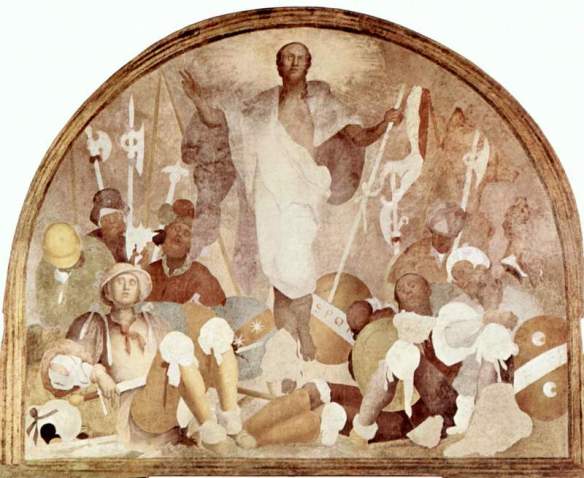
Artists often say it best. Jacopo da Pontormo‘s painting of the peaceful Christ rising above “the guards who shook and became like dead men” (see text below) invites us this Easter to ponder afresh Christ’s hidden reign in the world in which violence, militarism, and imperial ambitions still feign to rule.

Jacopo_Pontormo_026-medium

Jacopo da Pontormo (1494-1556)

For fear of him the guards shook and became like dead men. But the angel said to the women, “Do not be afraid; I know that you are looking for Jesus who was crucified. He is not here; for he has been raised, as he said. Come, see the place where he lay. Then go quickly and tell his disciples, ‘He has been raised from the dead,and indeed he is going ahead of you to Galilee; there you will see him.’ This is my message for you.” So they left the tomb quickly with fear and great joy, and ran to tell his disciples. Suddenly Jesus met them and said, “Greetings!” And they came to him, took hold of his feet, and worshiped him. Then Jesus said to them, “Do not be afraid; go and tell my brothers to go to Galilee; there they will see me”  [Gospel according to Matthew 28:4-10]

Jacopo da Pontormo helps me see what the mind cannot fathom. Christ is Risen! In spite of all appearances to the contary, Christ is Risen! Alleluia! He is risen, indeed!

Gordon C. Stewart, in Galilee of Chaska, MN, Easter, April 16, 2017.

A world holding its breath

Today the world is holding its breath, waiting in helpless silence as we’ve done many times before.

Last year we published a reflection following news of the terror in Brussels, Belgium. Today the darkness that clouds our hearts and minds comes from the madness of a two little boys playing with nuclear toys. (See “North Korea hits back at Trump ahead of Day of the Sun“.)

Nuclear-explosionNot since Hiroshima and Nagasaki has a nuclear bomb been used, but, today, Holy Saturday, the people of Japan are living in the memory of that holocaust, holding their breath as the bellicose standoff between Kim Jong-un and the man who promises to take care of him plunges them again under the nuclear cloud of post-traumatic stress of 1945, their peculiar Friday and Holy Saturday.

On Holy Saturday, the day between Good Friday and Easter, we experience the silence of nothingness.

The sounds of hammers, taunts, and screams, and the sight of three dead men very different in life but equal now in death leave us face-to-face with all that is cruel, hopeless, meaningless – the darkness of despair.

This Holy Saturday the world is on full alert. Dread and fear spread. We who live in the aftermath of the latest terror in Brussels experience Holy Saturday – the day between Good Friday and Easter, knowing that only a resurrection can redeem a Good Friday world. – Views from the Edge, Holy Saturday, 2016

One short year ago on Holy Saturday the world knew of one little boy playing with nuclear toys. This year there are two. And the Easter story of the empty tomb remains either a fanciful illusion or the good news of a deeper reality beneath the silence: the descent from the cross by a Word greater than every reason for dark despair.

Pontormo, Jacopo da, 1494-1556. Descent from the Cross,

Descent from the Cross – Jacopo da Pontormo (1494-1556)

  • Gordon C. Stewart, Chaska, MN, Holy Saturday, April 15, 2017.


Good Friday 2017 in light of 1553

In his Ten Rules for Writing author Elmore Leonard advised,

“Try to leave out the parts that readers tend to skip.”

Good Friday is one of those parts in the Christian story. Who wouldn’t want to skip over betrayal, denial, abandonment, and brutality, the opposite of happiness? But we don’t get to joy without going through them. Steve Martin’s Happy Feet offers a memorable parody of faux happiness. You don’t get to Easter with happy feet.

In a sermon preached on Good Friday, 1553, the Rev. John Bradford asked his hearers to draw close to the cross, inviting them to look upon the death of Christ as the very presence of God, the part “that we people want to skip”.

As the very pledge of God’s love toward thee,
whosoever thou art, how deep so ever thou hast sinned,
See, God’s hands are nailed, they cannot strike thee;
his feet also, he cannot run from thee.
His arms are wide open to embrace thee.

Happy feet are no remedy for sore feet. Whatever view one takes of the classical Christian formula of Christ’s full humanity and divinity, John Bradford, Elmore Leonard, and Steve Martin’s Happy Feet invite the imagination to stop and pay attention to the God who embraces humankind in the very darkness we deny.

  • Gordon C. Stewart, Chaska, MN, Good Friday, April 14, 2017.

Mom’s Handkerchief – Good Friday

Mom

Muriel Titus Stewart

As a child, I wondered why they called Good Friday ‘good’. It wasn’t. It was awful.

At the annual Good Friday service my mother’s cheeks were wet. She’d hold her handkerchief in one hand and, without drawing attention to herself — Mom was shy and shunned attention — she would dab the tears, hoping no one would notice.

A soloist would sing:

Were you there when they crucified my Lord?

Were you there when the crucified my Lord? Oh……

Sometimes it causes me to tremble, tremble, tremble.

Were you there when they crucified my Lord?

Mom would dab her cheeks and eyes.

As I grew older I began to understand why they called the Friday of the crucifixion ‘good’. It wasn’t good because they nailed him to the tree, or because they took him down and laid him in a borrowed tomb. It was good because, in that deep darkness, tears fall in grief and in hopes of something else. Tears that recognize both the betrayal, denial, flight — our  own and others’ – and the steadfast love, courage, and magnanimity of the man on the cross.

Both sides of the human condition are front and center on Good Friday. So is the sense of god-forsakenness – the wrenching cry from the cross, “Eloi, Eloi, lama sabachthani?” (“My God, my God, why have you forsaken me?”) — the gnawing feeling of senselessness, meaninglessness, and helplessness, hanging alone, tortured and mocked, over the abyss of nothingness.

Over the years, I’ve learned that a healthy sense of denial is sometimes a good thing. So is truth-telling. Good Friday brings me face-to-face with myself at my worst and my best. And at the heart of it all is a man with arms spread wide, looking out at us who still crucify him — ours is a Good Friday world — with eyes that reach my soul. “Father, forgive them, for they know not what they do. Into Your hands I commit my spirit.”

On Easter Mom would dab her eyes for joy because she’d brought her handkerchief with her from Good Friday.

— Gordon C. Stewart. Chaska. MN, April 14, 2017. Originally published April 3, 2015.