Who’s taking the pictures? Who’s singing?

Re-blogging Dennis Aubrey’s photographic essay today (see previous post) took me back to the sermon Dennis inspired years ago with his experience in the basilica dedicated to Mary Magdalene in Vizelay, France.

At the end of a week in Chaska when my cup has been overflowing with reasons to touch again the power of the non-rational that is deeper than what goes on in my spinning head, we republish “The Stones Are Singing” in thanksgiving for Dennis’s and PJ McKee’s influence on me and Dom Angelico’s influence on them.

Gordon C. Stewart, Chaska, MN, June 11, 2017.

The Monk in the Morvan Forest (Dennis Aubrey)

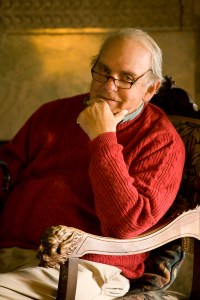
We post Dennis Aubrey’s latest epistle for a number of reasons. Readers of Views from the Edge may recall that the Via Lucis photographic essay on the stones singing at Vizelay inspired a sermon on the stones singing. Here the monk who wrote the history of these Romanesque churches comes out from the shadows in a lovely tribute by Dennis, complete with pictures of PC and Dom Angelico Surchamp.

Dennis Aubrey's avatar

We are finally home again after two months photographing in France, Spain, and even a little bit of Italy. We drove 6,960 kilometers during that time at an arrive speed of 51 kilometers an hour, which translates to 4,344 miles and a dazzling 32 miles per hour. This demonstrates the narrowness of the country roads where we drive and the amount of time we spent in the Pyrénées and Alps. Until we hit the highway returning to Paris, the average speed was 48 kilometers per hour!

The trip ended in Vézelay at the Crispol hotel, which is almost like home to us. The Schori family is always so welcoming and the addition of the two children Max and Clémence makes it even brighter. It is always bittersweet leaving France. We love it there but we are always anxious to return home, this time to our new house amidst the Amish

View original post 521 more words

Who will you stand with today?

Dear Folks,

There is a custom at a little church in the Midwest that goes like this. Whenever a person is about to be baptized, the minister calls out to the congregation, “Who stands with this child?” and the extended family or close friends rise from their seats and offer an outward and visible testimony of their inward commitment.  They stand, hearts brimming and knees shaking, even though they know sometimes their love might seem compromised or limited or unreciprocated.  They rise to pledge that they’ll do the best they can. These are the folks in the child’s life who know that growing up has never been easy, the people who know that being a parent is hard work in the best of circumstances.

And this custom of folks popping up here and there in the pews at a baptism makes the church feel cozy and warm and like a family, but I want to warn us from easy sentimentality, from striving to build a church in which it would be simple to guess who might stand for whom.  The community of faith is more than a family.  The measure of our vibrancy is not when we gather amiable people to stand with their neighbors… rather the church is created when enemies break bread together, when one broken-hearted outcast stands up for another, when a queen kneels before a poor, unwed mother or a recovering addict, and calls her sister.

That is the society that we are trying to create here and beyond, at home and at work and at play.  The community of saints is both more welcoming and more challenging than most of our biological families.  Our litmus test is not blood, but the spirit, and when we are at our best, the spirit of God is breathing through us wherever we go.

A child named Matthew was presented for baptism at an Episcopal church a few years back, and I imagine a group of folks stood to support him and his family as they gathered around the font.  But that same Matthew, child of God, was beaten and left for dead as a young man, tied to a fence post like yesterday’s garbage, because his way of being challenged some people’s idea of family values.  He loved “the wrong person,” another man, and that made some of his neighbors mad.  So one dark night, two very scared and confused young people, also God’s children, acted out of their own brokenness, and their fear turned murderous.

It would not have surprised me if Matthew’s parents had settled into their own murderous rage, mirroring the worst of their son’s killers, looking for vengeance, an eye for an eye.  But his parents did something extraordinary.  They asked for their son’s killers to be forgiven.  They stepped beyond the narrow circle of family of blood into the family of the spirit, and saw another son staring back at them through the eyes of their enemy.

Our true brothers and sisters are as likely to be our so-called enemies as our friends.  Jesus says, blessed are the poor in spirit, those who mourn, those who hunger and thirst for what is right and merciful, because that is what the human family looks like and feels like and hurts like.  Jesus is describing us.  We belong to each other.  Any walls we build between us, of race and class and gender, of sexuality and nationality and ethnicity, of political party and religious tribe, are walls of fear.  Each of us has been a wanderer and a stranger, and our call is to make the world feel more like home for all.

Who will you stand with today?

Conversation with Elijah #1

Elijah and GordonElijah is 10 today. That would be 10 DAYS old. Just the right age for a good conversation like the one with my fiancée years ago. When that one finished, I said “that was one of the best conversations I’ve ever had!”

“Do you know I haven’t spoke a word for the last three hours?” she said with a forgiving smile.

I enjoy “talking” with Elijah. He asks the questions. I give the answers.

“Grandpa, you look really old! Were you ever born?

“Yes, Elijah, I was born too, a long time ago.”

“And you’re a Christian, too, right Grandpa?”

“Yes, Elijah, I was born, and yes, I’m a Christian.”

“So . . .  that means you got born twice?”

“Well, Elijah, not quite.”

“Grandpa, am I a Christian?”

“Well, Elijah, no, not yet. But you are a child of God.”

“Whew!”

“But, Grandpa, if I want to be a Christian like you, do I have to get born all over again? I hated that!!!”

“No, Elijah. You won’t ever have to do that ever again. That’s behind you now.”

“But, Grandpa . . .  what about being born again? What about being saved? Don’t I have to get saved?”

“No, Elijah. The second ‘birth’ doesn’t change the first one. It just makes you thankful for it and makes you responsible for other children of God like you.”

“Whew! So, like when I’m falling asleep at Mom’s breast, I’m like ‘born again’? I’m already a Christian, just like you, Grandpa! I’m getting kinda hungry, Grandpa.

Where’s Mom?”

  • Gordon C. Stewart, Chaska, MN, June 1, 2017.

Boundary-breaking God

Kosuke Koyama - RIP

Kosuke Koyama (1929-2009) R.I.P.

INTRODUCTION: The Japanese theologian to whom Be Still! Departure from Collective Madness is dedicated delivered these words a decade ago from the pulpit of House of Hope Presbyterian Church in St Paul, Minnesota. Contrary to popular misconception, the biblical prophets did not fore-tell the future; they rather forth-told a word greater than their own. Kosuke Koyama‘s experience led him to hear something quite clearly – a word he could not have known would be more important in 2017 than the day he spoke it.

THE SERMON, June 6, 2006. Texts: Leviticus 19:33, Psalm 139: 7-10, and Luke 14: 1-6. [Bold type added by Views from the Edge.]

Dear Sisters and Brothers in Jesus Christ,

When an alien resides with you in your land, you shall not oppress the alien. The alien who resides with you shall be to you as the citizen among you; you shall love the alien as yourself, for you were aliens in the land of Egypt: I am the Lord your God. – Lev. 19:33.

This is a challenging suggestion for the immigration and naturalization policy of any nation. God does not discriminate between citizens and aliens. The God of the Bible is more concerned about the welfare of the aliens, the weak, than of citizens, the strong.

Remember your own experience in Egypt! “Love the alien as yourself!” Jesus is even more emphatic when he says, “Love your enemies!” We think of aliens and enemies as potential threats to our community. They must be kept outside of our boundaries.

“Something there is that doesn’t love a wall,” observes the New England poet, with sharp insight. Something there is in the gospel of Christ that dismantles walls. Jesus “has broken down the dividing walls,” we read in the Epistle to the Ephesians. (2:14)
+++
“In the beginning was the Word” (John 1:1) – This Word, the truthful Word, “breaks down the dividing walls” by making honest dialogue possible. When communication breaks down peace breaks down. It takes a great deal of dialogue to come to mutual understanding between peoples of different language, religions, racial and cultural practice. Often the choice is between dialogue and mutual destruction, between diplomacy and war. The alternative to dialogue is taking the sword. Jesus says; “all who take the sword will perish by the sword” (Mt.26:52). Our “sword” today is incredibly destructive! Our fear, today, is of nuclear proliferation. We fear it because we started it! “Choose life so that you and your descendants may live”! (Dt.30:19)
+++
The brief gospel text for this morning is a record of a profound dialogue. The story is honest and transparent. We can understand it very well. The dumfounded lawyers and Pharisees only reveal the sincere quality of the story. In conversation with Jesus, the man of total honesty, human hypocrisy is exposed and expelled.

On one occasion when Jesus was going to the house of a leader of the Pharisees to eat a meal on the Sabbath, they were watching him closely. Just then, in front of him, there was a man who had dropsy. Jesus asked the lawyers and Pharisees, “Is it lawful to cure people on the sabbath, or not?” but they were silent. So Jesus took him and healed him, and sent him away. Then he said to them, “If one of you has a child or an ox that has fallen into a well, will you not immediately pull it out on a Sabbath day?” And they could not reply to this (Luke 14:1-6).

How boldly Jesus simplifies and zeroes-in on the central issue! “Is it lawful to cure people on the Sabbath, or not?” This is the question that distinguishes the gospel from religion. This story is only one of a number of “Sabbath controversies” told in the gospels. The gospel breaks boundaries. Religion often insists on boundaries. The gospel opens windows in hope. Religion may shut windows in fear. The gospel is “scandalously” inclusive. Religion often is piously exclusive. “You shall love the alien as yourself” expresses the spirit of the gospel. Religion tends to question whether everyone deserves to be loved.

The Sabbath is a holy institution commemorating the holy rest God has taken after creating “heaven and earth.” Sabbath is mentioned as one of the Ten Commandments:

“Remember the sabbath day, and keep it holy. Six days you shall labor and do all your work. But the seventh day is a Sabbath to the Lord your God; you shall not do any work – you, your son or your daughter, your male or female slave, your livestock, or the alien resident in your towns. For in six days the Lord made heaven and earth, the sea, all that is in them, but rested the seventh day; therefore the Lord blessed the Sabbath day and consecrated it” (Ex.20: 8-11).

“On another Sabbath he entered the synagogue and taught, and there was a man there whose right hand was withered” (Lk. 6:6) “Now he was teaching in one of the synagogues on the Sabbath. And just then there appeared a woman with a spirit that had crippled her for eighteen years. She was bent over and was quite unable to stand up straight” (13:10,11).

“On one occasion when Jesus was going to the house of a leader of the Pharisees to eat a meal on the Sabbath, … Just then, in front of him, there was a man who had dropsy” (the disease of the swelling from abnormal fluid retention ). A man of withered hand, a woman who is bent over, and a man with dropsy appear “on the Sabbath in front of him.”

Jesus cures them. Jesus “works” on the Sabbath! Some for whom it is important to “keep” the sabbath complain, “There are six days on which work ought to be done; come on those days and be cured, and not on the sabbath day”(Lk.13:14). Jesus, for whom the persons with need are more important than the rule, responds, “If one of you has a child or an ox that has fallen into a well, will you not immediately pull it out on a Sabbath day?”

Jesus comes to heal the broken human community. He is the embodiment of direct love-action and action-love. He cures sick people publicly on the Sabbath with unassailable authority and freedom. The people are amazed – ecstatic – and praise God. Representing the God of compassion, Jesus breaks the boundary attached to the sacred Sabbath tradition. In his “boundary breaking” he restores the authentic purpose of the sabbath – that is, to bring health to human community. The Sabbath is for healing. “The Sabbath was made for humankind, and not humankind for the Sabbath,” says Jesus (Mk.2:27). What a freedom he exhibits!

+++

The gospel of Jesus Christ is “scandalous,” says the apostle Paul in his letter to the Corinthians (1 Cor. 1: 18-25) for he is “the man who fits no formula” (Eduard Schweizer, (Jesus, chap. 2). Creeds, doctrine, theology, or tradition cannot domesticate Jesus. No one can confine Jesus within walls. Let me quote from a Swiss New Testament scholar:

“…teaching in itself does not convey the living God. It may even hinder his coming, though it (the teaching) may be totally correct. It is exactly the most correct and orthodox teaching that would suggest that we had got hold of God. Then he can no longer come in his surprising ways” (Eduard Schweizer, Luke: A Challenge to Present Theology p.58)

We feel uneasy when Jesus breaks the boundaries we make, because boundaries are a part of our accepted culture. “Good fences make good neighbors.” Yet, fences can never be the final word. Tragically in our real lives fences work more in the direction of mutual alienation than mutual embrace. “Before I build a wall I’d ask to know what I was walling in or walling out” – says the poet. That is a good question!

When I was in my early teens, Japan followed her gods who were rather poorly educated in international relations. They were parochial. They spoke only Japanese. They did not criticize Japanese militarism. They endorsed the inflated idea that Japan is a righteous empire. Trusting these parochial gods, the people recited, to paraphrase: “If I take the wings of the morning and settle at the farthest limits of the sea, behold the glory of the divine emperor of Japan is there!” Japan broke international boundaries in pursuit of self-glorification and aggrandizement. Without any threat from her Asian neighbors, Japan attacked and invaded them. The Japanese gods approved and Japan ruined herself. Blessed are nations that have a God who criticize what they do! The God of Israel said to God’s own people: “You are a stiff-necked people!”

+++

The infant Jesus “was placed in a manger – “for there was no place for them in the inn” (Luke 2:7). Being thus edged out even from a human birth place, Jesus breaks a boundary. When he “eats with sinners and tax collectors” (Mk.2:16) he breaks a boundary. Crucified, nailed to the cross, – completely immobilized – he breaks a boundary. Dying between two criminals, becoming a member of this community of three crosses, he breaks a boundary. Being “numbered with the transgressors”, to quote from the Book of Isaiah (53:12), he breaks boundaries. This is an amazing story. The one who is totally vulnerable, disarmed, non-violent, and immobilized and humiliated has broken all the boundaries, which threaten the health of human community.

With our geopolitical realities, we may think that the way of Christ is romantic and not realistic. Then we must know that the alternative is the historical fact of 5000 years of human civilization replete with constant warfare. Should we continue this state of endless destruction for another 5000 years? Gandhi’s practice of non-violence has done more to increase the welfare of humanity upon the earth than many wars put together. Martin Luther King Jr. says: “Far from being the pious injunction of a Utopian dreamer, the command to love one’s enemy is an absolute necessity for our survival”! (Strength to Love, p.47) “For God’s foolishness is wiser than human wisdom, and God‘s weakness is stronger than human strength” cries the apostle Paul (1 Cor.1:25).

+++

“Look at the birds of the air,” Jesus says. “They neither sow nor reap nor gather into barns, and yet your heavenly Father feeds them. Are you not of more value than they?” (Matt. 6:26). The birds of the air and the Father who feeds them are free from all boundaries. Climate change – global warming – has no boundaries. The light of the sun and the air that sustain all living beings know no boundaries. The Berlin Wall of 96 miles was there for 28 years up to 1989. The racial wall of the South African Apartheid existed for 46 years and ended in 1994. In their limited existence, these walls have done immeasurable damage to humanity on the both sides of the wall. The Orthodox Church of the East and the Catholic Church of the West did not speak to each other for 911 years from 1054 to 1965. The Great Wall of China and Check Point Charlie in Berlin are tourist spots today. “One cannot dehumanize others without dehumanizing oneself” says James Baldwin. “Forgive us our debts as we forgive our debtors,” we pray. It is this prayer that breaks the boundaries in a way that is pleasing to God.

 

Elijah’s face

Elijah calm

Five day old Elijah

Looking at the contentment on Elijah’s face, do you suppose he’s already read grandpa’s Be Still! Departure from Collective Madness or has memorized grandpa’s favorite psalm, Psalm 46? I wish I could be this calm, this cool, this collected, this still.

God is our refuge and strength,
    a very present help in trouble.
 Therefore we will not fear, though the earth should change,
    though the mountains shake in the heart of the sea;
    though its waters roar and foam,
    though the mountains tremble with its tumult.Selah

There is a river whose streams make glad the city of God,
    the holy habitation of the Most High.
God is in the midst of the city; it shall not be moved;
    God will help it when the morning dawns.
The nations are in an uproar, the kingdoms totter;
    he utters his voice, the earth melts.
The Lord of hosts is with us;
    the God of Jacob is our refuge.

Come, behold the works of the Lord;
    see what desolations he has brought on the earth.
He makes wars cease to the end of the earth;
    he breaks the bow, and shatters the spear;
    he burns the shields with fire.
“Be still, and know that I am God!
    I am exalted among the nations,
    I am exalted in the earth.”
 The Lord of hosts is with us;
    the God of Jacob is our refuge.

[Psalm 46, NRSV]

  • Gordon C. Stewart, Chaska, MN, May 26, 2017

A very sad little man

A video is worth a thousand words. A push. A “get outta my way” shove. The quickly changing facial expression. The peacock fanning his tail. So much for the conversation with Pope Francis: “The first shall be last, and the last shall be first.” It stuck like silly putty. Or…like water off the back of a very sad little man. The President misunderstood the Pope’s quotation from John 14. “In my Father’s house there’s only enough room for me.”

  • Gordon C. Stewart, Chaska, MN, May 26, 2017.

Memorial Day and the Soldier’s Helmet

“Memorial Day and the Soldier’s Helmet” is read aloud here from Be Still! Departure from Collective Madness (p. 10f.). This recording is not as professional as it will be this weekend when it airs on Minnesota Public Radio’s “All Things Considered.” This practice run starts out a little mushy! But it’s good enough that Day1.org posted it yesterday on their site.

Many thanks to Chuck Lieber for making it possible to turn “Be Still!” into a podcast.

  • Gordon C. Stewart, Chaska, MN, May 24, 2017.

Thank you, Frederick Buechner

Today Day1.org features “The Seagull and the Rainbow” right beside Frederick Buechner, whose writings influenced me as a young preacher and pastor.

Frederick Buechner

Frederick Buechner

Thanks to Peter Wallace of Day1 for putting the student next to a man he unconsciously aspired to be. I’m older now . . .  and the distant iconic mentor who had no reason to know his mentee’s name is older still but no less alive to faith and life!

Years ago the Council of Churches in Cincinnati invited a Canadian publisher to publish “The Cincinnati Prayer Book,” a collection of prayers for the year by Cincinnati religious leaders. I was Pastor of Knox Presbyterian Church at the time. The publisher asked whether I would be interested in publishing a collection of sermons.

I recall the conversation in my office as if it were yesterday. I thought I smelled a rat.

“Are you a vanity press?” I asked.

They assurance me they were not. “The Startling Kindness of God” moved forward, including an endorsement from Frederick Buechner. But Fred’s letter to me included a private comment that changed how I preached and wrote. The sermons were good, he said, followed by a devastating “but”: “but I find them rather bloodless. I want to see some of your blood in them.”

Listening to your lifeI learned laster that he was working on Listening to Your Life. Reading my sermons, he seemed to sense I was not listening to mine. I wasn’t.

When the final contract appeared, the publisher required that I sell 300 copies of the sermon collection. I tore up the contract. The bloodless sermons are in a box in my closet, wondering why they were never published.

I have no reason to believe Fred Buechner has any recollection of that or that he remembers my name. But his combination of affirmation and warning began to change the way I preach and write. To appear next to Frederick Buechner today is a serendipitous occasion of joy and thanks. Thank you, Fred. I’m holding out a goldfish after all these years.

Thank you, Peter, for posting “The Seagull and the Rainbow” on Day1.

  • Gordon C. Stewart, May 20, 2017, Chaska, MN.


Hammer-strokes against the darkness

We are living in what J. C. Blumhardt called “the wasted fields of mankind.” The fields of humankind are being laid waste in our time, as they were in his (1805 – 1880). What to do?

I’ve made phone calls. I’ve written. I’ve posted here and on FaceBook. I’ve written a book on collective madness. I’ve even tweeted! But none of it seems to have mattered much until I remembered the words of Johann Christoph Blumhardt, the German pastor who pioneered in the field of religion and mental illness at Bad Boll.

Our prayers are hammer-strokes against the princes of darkness; they must be oft repeated. Many years can pass by, even a number of generations die away, before a breakthrough occurs. However, not a single hit is wasted; and if they are continued, then even the most secure wall will fall. Then the glory of God will have a clear path upon which to stride forth with healing and blessing for the wasted fields of mankind.

Write. Write, Write. Make phone calls to congressional representatives, the White House, the princes who exercise public power and authority. Phone again if the voicemail box is full. Write again. But sustain all the activity with the hammer-strokes of prayer against the princes of darkness for the healing and blessing of the wasted fields of humankind. Live by the hope that not a single hit is wasted and that even the most secure wall will fall.

Thank you, Mom, for the faith to hammer on. RIP.

  • Gordon C. Stewart, Chaska, MN, Mother’s Day, May 14, 2017