Lying in State – “I will pray for you” – Hon. Elijah Cummings

The Honorable Elijah Cummings, the first African American to lie in State in the U.S. Capitol, was the son of sharecroppers. However courageous his parents and grandparents were, they knew that the lynching tree was just a breath away. They would have seen white nationalism up close. Neither they nor their son nor any other black man, woman, or child spoke of lynchings metaphorically. A lynching was a lynching; the body hanging from the tree was always black. The lynchers were always white.

NOT A LYNCHING

Elijah Cummings knew the difference between an impeachment inquiry and a lynching. As Chair of the powerful U. S. House Oversight and Reform Committee, he oversaw his committee’s impeachment inquiry with great care and due respect, as an honorable man who knew the difference between a bi-partisan investigation of facts and a one-party lynch mob. He was a Democrat committed to the truth, due process, and justice.

CONDOLENCES TWEET: VERY HARD TO REPLACE

Shortly after the Congressman’s death was announced, the president did a very presidential thing. He paid his respects:

  My warmest condolences to the family and many friends of Congressman Elijah Cummings. I got to see first hand the strength, passion and wisdom of this highly respected political leader. His work and voice on so many fronts will be very hard, if not impossible, to replace!”

BEFORE CONDOLENCE TWEET


@realDonaldTrump
· Jul 27, 2019
Rep, Elijah Cummings has been a brutal bully, shouting and screaming at the great men & women of Border Patrol about conditions at the Southern Border, when actually his Baltimore district is FAR WORSE and more dangerous. His district is considered the Worst in the USA……

@realDonaldTrump
….As proven last week during a Congressional tour, the Border is clean, efficient & well run, just very crowded. Cumming District is a disgusting, rat and rodent infested mess. If he spent more time in Baltimore, maybe he could help clean up this very dangerous & filthy place.

AFTER CONDOLENCES: WHITE PRIVILEGE, LYNCHINGS, AND TIT FOR TAT

Donald J. Trump
(@realDonaldTrump)
So some day, if a Democrat becomes President and the Republicans win the House, even by a tiny margin, they can impeach the President, without due process or fairness or any legal rights. All Republicans must remember what they are witnessing here – a lynching. But we will WIN! (1 day ago).

MAKING SENSE OUT OF WHAT DOES NOT MAKE SENSE

With the exception of the group of psychiatric professionals who have expressed their diagnoses about the President’s mental health, most professionals adhere to the strict protocol resisting diagnosing a person the practitioner does not know. If a professional in the field cannot and should not diagnose, neither should we. Yet we know Donald Trump better than many people know their own families. I’m a retired clergyman, not a psychiatrist, but I recognize the behavioral signs of mental illness.

ANTISOCIAL PERSONALITY DISORDER (ASPD)

Common signs to be aware of include:

  • socially irresponsible behavior
  • disregarding or violating the rights of others
  • inability to distinguish between right and wrong
  • difficulty with showing remorse or empathy
  • tendency to lie often
  • manipulating and hurting others
  • recurring problems with the law
  • general disregard towards safety and responsibility
  • a tendency to take risks,
  • reckless behavior,
  • being deceitful with frequent lying.

Someone exhibiting this behavior may also:

  • lack deep emotional connections,
  • have a superficial charm about them,
  • be very aggressive,
  • and get very angry sometimes.

Other behaviors that may be signs of ASPD include:

  • don’t care if they have hurt someone,
  • are impulsive and abusive and lack remorse.
  • In the case of ASPD, abusive doesn’t necessarily mean violent.

“I WILL PRAY FOR YOU”

To call a Congressional impeachment inquiry a “lynching” insults Elijah Cummings, all descendants of chattel slavery, and the U.S. Constitution’s provision for removal of a president from office after a public trial. An impeachment trial is not a lynching. Few people know that better than the Congressman who lies in State while the President lies.

Elijah Cummings was a man of character who practiced his faith, an exception to the rule of retaliation. The beloved Congressman from Baltimore is one of only two people on “the Hill” I’ve heard say of the president, “I will pray for you.”

— Gordon C. Stewart, author, Be Still! Departure from Collective Madness (2017, Wipf and Stock), Chaska, MN, Oct. 23, 2019

The Vegetable Prayer

Max Coots was our family’s John Muir, Robert Frost, and Wendell Berry. He was a naturalist and poet whose whimsy and wit lifted people from the doldrums of the harsh winters of the New York North Country. Max’s Seasons of the Self spoke to me years ago. His poem “A Harvest of People” — found during an internet search — put me again in the presence of his wit, wisdom, and gentle spirit.

Let us give thanks for a bounty of people:

For generous friends, with smiles as bright as their blossoms.
For feisty friends as tart as apples;
For continuous friends who, like scallions and cucumbers, keep reminding us that we’ve had them.
For crotchety friends, as sour as rhubarb and as indestructible;
For handsome friends, who are as gorgeous as eggplants and as elegant as a row of corn; and the others as plain as potatoes and as good for you.
For friends as unpretentious as cabbages, as subtle as summer squash, as persistent as parsley, as endless as zucchini, and who, like parsnips, can be counted on to see you through the winter.
For old friends, nodding like sunflowers in the evening-time.
For young friends, who wind around like tendrils and hold us.

We give thanks for friends now gone, like gardens past that have been harvested, but who fed us in their times that we might live.


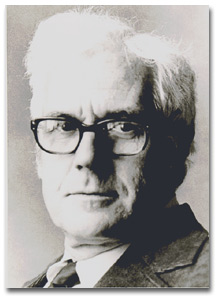
Rev’d Max Coots (1927-2009) “A Harvest of People” Canton, New York

Max Coots was Minister of the Unitarian-Universalist Church in Canton, New York for thirty-five years. Every August, he found solitude along the Grasse River in the barn board retreat he’d built with materials he’d rescued from the dump. Max had a solar shower in 1973.

The other twelve months, Max was an old beech tree, providing shade in summertime and dropping beech nuts from the pulpit that kept alive a host of chipmunks and squirrels in wintertime.

— Gordon C. Stewart, Chaska, MN, October 22, 2019.

The Riddle in the Mirror

It’s 4:02 A.M. I should be asleep. I’m wrestling with an enigma, the one that looks back from the mirror. Shortly before calling it a day last night, I came upon the enigma, and having found it, couldn’t let it go, or it could be said that finding me, it wouldn’t let me go.

Looking at the clock next to the bed moments ago brought to mind the line from Chaim Potok about the “four-o’clock-in-the-morning questions.” Potok’s four-o’clock-in-the-morning questions arose from the dissonance of a traditional Hasidic Jew in a modern culture that does not know the Torah and the Talmud.

I brew a pot of coffee, pour a cup, sit down with my MacBook Air, and return to the enigma I met last night.

The riddle in my mirror

For now [in our immaturity] we see in a mirror [an αίνιγμα — ‘enigma/riddle’], but then [when we come to maturity] we will see face to face. Now I know in part [in fragments], but then I will know fully, just as I have been fully known [by God].

First Corinthians 13:12, GCS Greek to English translation

The Greek word αίνιγμα has nothing to do with dimness or poor eyesight (“now we see in a mirror dimly“). It’s deeper than that. It’s vexation. We are puzzles to ourselves, knowing some pieces of ourselves, but not having all the pieces of the puzzle(s). And the Greek text is better translated as ‘mature’ rather than ‘perfect’.

No question is more puzzling than the ancient question of who we are. Who am I, the man who cuts himself shaving in the mirror? Who are we, this evolving species changing day by day in this time of climate departure when the future of life on the planet is uncertain? Who and what are we becoming?

Sixteenth Century reformer John Calvin began his theological opus with these laser-like sentences at the tender age of 27 years old:

Our wisdom, in so far as it ought to be deemed true and solid Wisdom, consists almost entirely of two parts: the knowledge of God and of ourselves. But as these are connected together by many ties, it is not easy to determine which of the two precedes and gives birth to the other.

Jean Calvin, Institutes of the Christian Religion

How I came to see life is rooted in this theological tradition. Like the characters of Potok’s novels who feel alone wrestling with the ancient Hebrew texts (Torah and Talmud), in one hand, and the culture of a very different time and place, those of us who still get up early in the morning with excitement of exploring an ancient Greek text highjacked by the Christian Right often feel placeless. Vexation is not popular, but, like Chaim Potok, I tell myself that wrestling with the riddle is who we are.

The face of my father

Looking in the mirror, I know less than I once thought, about the huge vexing questions of 2019. I’ll never have all the pieces or solve the enigma, but I do have some guiding fragments. I see my father’s kindly face looking back at me and reach up to the bookshelf to fetch the Bible which contains a pearl of great price: the prayer written by his own hand in pencil:

photo of prayer by Kenneth Campbell Stewart (my father) written in his Bible in pencil.

O Thou before whom ages pass away like minutes and in whose sight the mighty hosts of men are like a sparrow in the hand, keep our faith strong in Thee, confidence unshaken — Give clear insight as [we] face the days ahead. Help us so to entrust ourselves to Thy hands that in the awareness of Thy faithfulness we find all the security we need and in Thy service all our peace.

Elijah Cummings

Then the news broke in that Elijah Cummings died at approximately 2:45 A.M. this morning at Johns Hopkins Medical Center in Baltimore. Congressman Cummings was a man of deep faith, a beacon of compassion and integrity who spoke kindly words of hope to Michael Cohen about the power of forgiving grace while chairing a House of Representatives Oversight Committee hearing. Elijah Cummings died in the city he loved and served as a public servant in service to his Lord.

First Corinthians 13 concludes with words of consolation and hope, the clue to living the riddle. “So faith, hope, and love abide, but the greatest of these is love.”

— Gordon C. Stewart, Chaska, MN, October 17, 2019

Collective Delusion

AN UNLIKELY COINCIDENCE

“What’s the book about?” asked friends while preparing Be Still! for publication. I would scratch my head and answered as best I could: “It’s about a certain kind of calm and resistance in a world gone mad.” The release of Be Still! Departure from Collective Madness, through no intention of the publisher or the author, coincided with the inauguration of a new president (January 2017).

QUIET! BE STILL!

The title “Be Still!” is taken from Psalm 46 — “Be still, and know that I am God” — and from the Gospel according to Mark story of the command to the storm-tossed sea: “Quiet! Be still!” Both the psalm and “the stilling of the storm” address our plight — the mass dehumanization which Holocaust surviver Elie Wiesel called “collective madness”.

How to explain the Holocaust is a life-long question for my generation. Elie Wiesel‘s “collective madness” comes as close as any other to the daunting question of why the German people fell for a madman and stayed quiet.

COLLECTIVE SELF-DELUSION

[F]ew Germans after the war would confess having given any loyalty to the Nazi movement. This was not a lie in the soul of the German nation; it was a part of a collective delusion that all the fascist movements brought upon their followings. It was as if the movements themselves, as things independent of the men that embodied them, were responsible for the things that happened.

Gilbert Allardyce, The Place of Fascism in European History (Englewood Cliffs, NJ: Prentice-Hall, 1971)

SOMEDAY THEY WILL SAY, “WE DID NOT KNOW”

Well-publicized among Germans, already before Hitler came to power and during a period when he still depended on their consent rather than coercion, were the many actual deeds of butchery…. Some day the same Germans, now cheering Hitler’s strut into Paris, will say to their American friends and to their brave German anti-Nazi friends: “We did not know what went on, we did not know” and when that day of know-nothing comes, there will be laughter in hell.

Peter Viereck, German-American Scholar, Metapolitics: The Roots of the Nazi Mind, rev. ed. (1941; New York: Capricorn, 1965), 318

PRINCIPALITIES AND POWERS

For we wrestle not against flesh and blood, but against principalities, against powers, against the rulers of the darkness of this world, against spiritual wickedness in high places.

Epistle to the Ephesians 6:12 (KJV)

The language of the Bible regarding principalities – the ruling authorities, the angelic powers, the demons, and the like – sounds, I suppose, strange in modern society, but these words in fact refer to familiar realities in contemporary life. The principalities refer to those entities in creation which nowadays are called institutions, ideologies, and images. Thus a nation is a principality. Or the Communist ideology is a principality. Or the public image of a human being, say a movie star or a politician, is a principality. The image or legend of Marilyn Monroe or Franklin Roosevelt is a reality, distinguishable from the person bearing the same name, which survives and has its own existence apart from the existence of the person.

William Stringfellow, Instead of Death (Expanded version)

THIRTY-THREE MONTHS AND COUNTING

Thirty-three months after the release of Be Still!, many of my generation hear echos from 1933. Though the “enemies” are different, the tactics and the language of national purification are the same, defying rational explanation. The principalities and powers which survive have their own existence apart from the persons who come under the spell of collective delusion and collective madness.

DISARMING THE PRINCIPALITIES AND POWERS

We humans are social creatures. but we are do not do well when herds become the substitute for self-critical community. The still, small Voice is heard away from the clamor. The life of a nation and every other principality and power is a spiritual matter before and after it is a political matter.

“Be still! Shut up! and know that I am God. I am exalted among the nations” (Psalm 46).

In Search of Rest

“To rest is to give up on the already exhausted will as the prime motivator of endeavor, with its endless outward need to reward itself with established goals. … To rest is to give up on worrying and fretting and the sense that there is something wrong with the world unless we are there top put it right.” - David Whyte, Consolations: the Solace, Nourishment, and Underlying Meaning of Everyday Words.
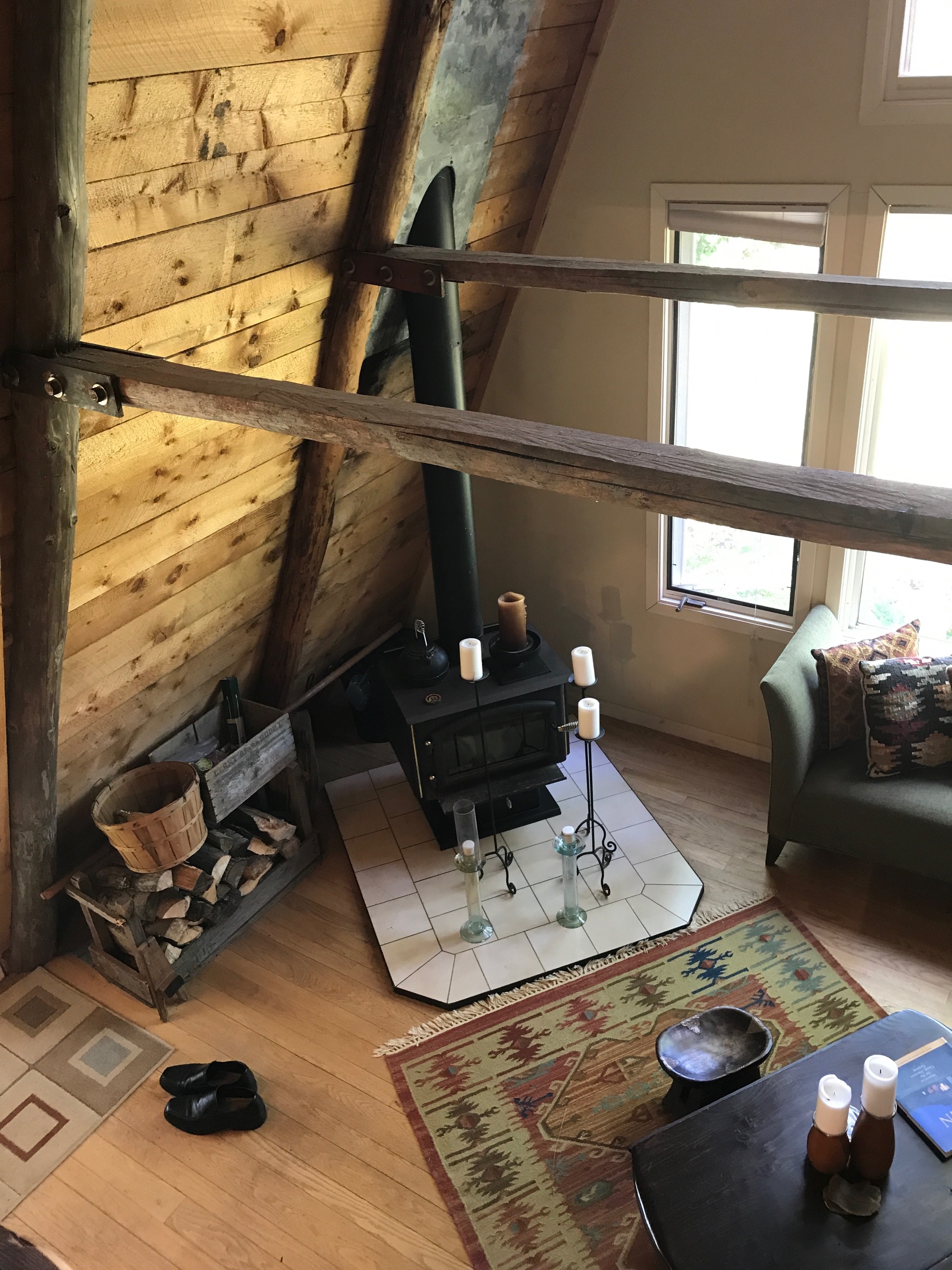
photograph of cabin by the wetland showing orange wall with morning light.

In search of rest, I retreat from the world of 2019 and my “already exhausted will”. The walls inside the cabin by the wilderness are rough-cut pine, the natural color of the president’s orange hair. Alas! The world comes with me, even by the wetland: I cannot rest from comparisons and disdaining thoughts of orange hair and Greenland.

I’m worrying and fretting, wanting to put the world right: rescue the English language from the words that paint the world orange: words like ‘bad’…’good’ … ’nasty’ … ‘nice’ …’not nice’ … ‘loyal’ … ‘disloyal’, that divide, blame, simplify, stereotype, scapegoat, and choke the best in us. Words do matter. The unexamined underlying meaning of words matters most.

First thing in the morning, while Barclay is still asleep in his kennel, I do what I once disdained as flight from action. The word ‘devotional’ has a different meaning now. A ‘devotional’ is not an escape from responsibility. The half-hour devotional is what it says: to devote attention to the Source of consolation and solace in the world that makes my head hurt. Here at the cabin, I devote my attention to the Psalm before checking the mouse trap.

Sometimes the Psalm consoles; other days it does not. When something in the Psalm whets my appetite for the underlying meaning of the words, I turn to the Paraphrases of the Church of Scotland. The Paraphrases, like scripture itself, take me to an earlier time that knew nothing of the United States, Greenland, Denmark, or Mexico, orange hair, or the “summer camps” for migrant children along the border.  I read the Paraphrase of Psalm 146:

The stranger’s shield, the widow’s stay,
     the orphan’s help is he:
  But yet by him the wicked’s way
     turned upside down shall be. 
  — Psalm 146:9, Paraphrases

Consoled and nearly comforted by David Whyte and the old Scot paraphrase of the ancient Psalm, I put down the Paraphrases to fill Barclay’s bowl with fresh dog food before freeing him from his kennel, remembering the One,

Who righteous judgment executes
   for those oppress’d that be,
 Who the hungry giveth food;
   God sets the pris’ners free.
-- Ps. 146:7

But first I free from the trap the orange mouse my dog shall never see.

– Gordon C. Stewart, by the Minnesota wetland, August 22, 2019.

Who owns Greenland?

The Song in My Head

Have you ever found yourself humming a tune when you wake up in the morning? Sometimes the tune reaches back to childhood. My small church in the small town west of Philadelphia sang hymns that became childhood favorites. As I grew into adulthood, some of them drop away as childish.

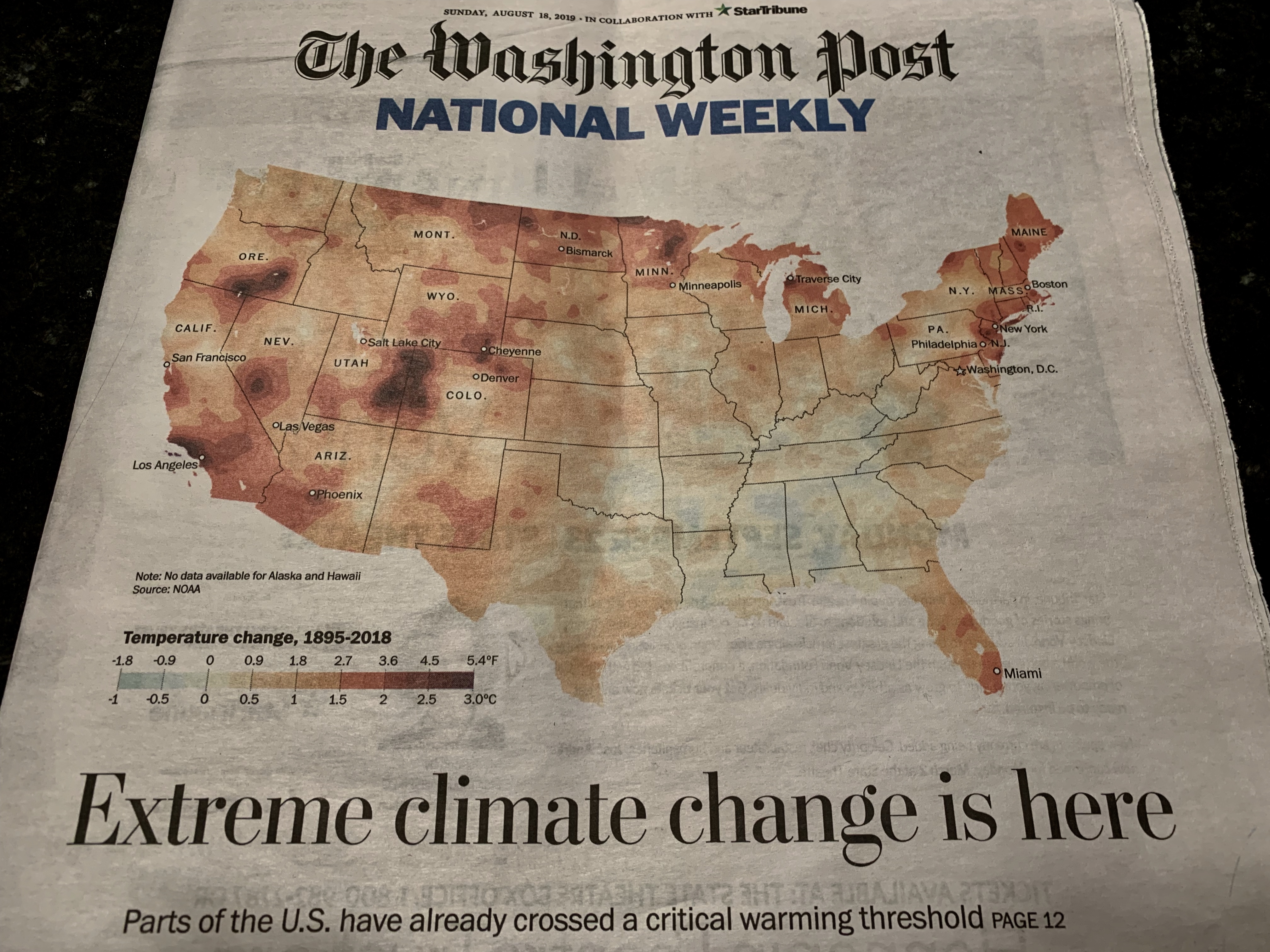
One answer to why I would hum “This Is my Father’s world” all these years later suggested itself over coffee. The featured story of The Washington Post’s National Weekly: “Extreme climate change is here” accompanied by a map of rising temperatures across the United States.

front page, Washington Post National Weekly in collaboration with Star Tribune, 8/18/19

Climate Change and the Illusion of Property

While the planet’s oceans warm, the glaciers of Glacier National Park, polar ice caps melt beyond the tipping point, fires ravage the redwood forests, hundred year floods have become frequent, and the pale blue dot turns brown, “our listening ears” hear talk of buying Greenland. The Greenlanders and the Danes are too occupied with the melting ice and rising sea levels to be distracted by a foolish real estate offer.

The simple childhood hymn no longer sounds childish. It feels more child-like, full of the wonder that is the antidote to adult presumptions of property ownership. “This is my Father’s world, and to my listening ears all nature rings the music of the spheres. This is my Father’s world: I rest me in the thought of rocks and trees, of skies and seas, his hand the wonders wrought.”

Faith, Nature, and God

Climate change is the challenge of our time. Not just one of many challenges. It is both the most urgent, i.e., it cries out for action NOW, and the most important to the future of all that lives on this planet hanging among the spheres. Believing that Earth is a divine gift placed in our hands as stewards of nature, and wanting to remember the words of “This is my Father’s world,” I took out the Presbyterian hymnal of my childhood and the 1982 hymnal of the Episcopal Church.

From Wonder to Responsible Action

The last stanza in both hymnals ends with our responsibility, as though a century ago Maltbie Babcock (1858-1901), the lyric’s author, had anticipated the island of trash the size of Texas floating in the Pacific Ocean. This hymn on which my childhood friends and I were raised moves from wonder (awe) through recognition that “the wrong is great and strong” toward responsibility for the planet. “This is my Father’s world, oh let us not forget that though the wrong is great and strong, God is our Father yet. He trusts us with his world, to keep it clean and fair, all earth and trees, all skies and seas, all creatures everywhere.”

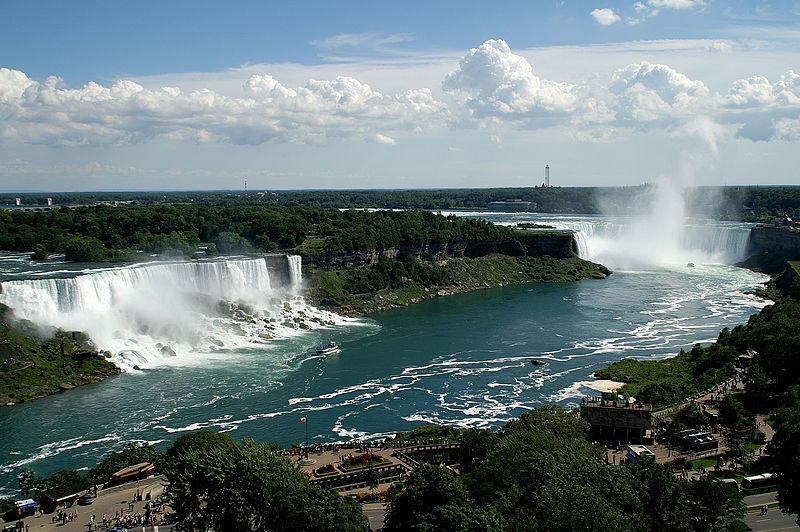
It is likely that Maltbie Babcock did not think what he wrote overlooking Niagara Falls was worthy of dissemination. It remained private until published by his wife after his death. Maltbie Babcock seems to have viewed “This is my Father’s world” as a personal expression of wonder beneath the literary standards of good poetry. But ”This is my Father’s world” strikes a chord at the tipping point of climate departure.

photo of Niagara Falls

It is likely that Maltbie Babcock did not think what he wrote overlooking Niagara Falls was worthy of dissemination. It remained private until his wife published it after his death. Maltbie Babcock seems to have viewed “This is my Father’s world” as a personal expression of wonder beneath the literary standards of good poetry. But ”This is my Father’s world” strikes a child-like chord standing at the tipping point of climate departure in 2019.

No one owns Niagara Falls. No one owns Greenland. No one owns the world.

— Gordon C. Stewart, heading north to the wilderness retreat, August 19, 2019.

The River of Consciousness

How and why the mind works the way it does came to mind these past few days. My mind has been like a river pouring over rapids and waterfalls, splitting into two or three paths around the islets that still rise from the riverbed, and then returning from two or three to one river with a single flow.

Niagara Falls

Integrating one’s plunges over the falls, side trips around the islets, and tumbling over rapids is what the mind does as it looks back upstream from down river. More often than not, one’s life is a blur. We move with the flow downstream. But once in while, what happened upstream invites or demands reflection.

No moment in the river’s journey is superfluous. Daily routines in periods of calm dull our awareness of the river itself and lay aside questions of its whence and whither until another event, or a memory, moves us to clear the blur. One event or memory leads to others we thought we had forgotten, pushed aside, or left behind.

The path of descent is the path of transformation. Darkness, failure, relapse, death, and woundedness are our primary teachers, rather than ideas or doctrines.

Richard Rohr, Yes

Think a moment of all the events and encounters that have shaped you most deeply and lastingly. How many did you see coming? How many did you engineer, manufacture, chase down? How many were interruptions? . . . The span between life as we intend it and life as we receive it is vast. Our true purpose is worked out in that gap. It is fashioned in the crucible of interruptions.

Mark Buchanan, The Rest of God: Restoring Your Soul by Restoring Sabbath.
Aerial view: confluence of the Yukon River (lighter color) and the Koyukuk River (darker), Alaska

All moments are part of the river of whence that flows over rocks and waterfalls, splits, and returns to one on its way to a whither beyond our knowing.

Gordon C. Stewart, by the wetland, Minnesota, August 12, 2019.

‘Trouble’ is God’s middle name

Robert McAfee Brown is not a household name for most folks, but it is for a dwindling multitude shaped by his life and teaching. Few of us sat in his classes at Macalester College, Union Theological Seminary in New York, or at Stanford, and few of us marched with him for civil rights or an end to the Vietnam War. Although we never met him, he seemed to know who were, and spoke of God in ways that struck a chord with adolescent ears itching to change the world.

One of the people who did know him personally was Jo Bede. Jo knew him up close as his student assistant at Macalester College, typing the manuscripts for the books he published. All these years later, Jo is in a Memory Care Center here in Minnesota. Like many other members of the multitude, she no longer remembers his name or the name of her alma mater.

Unlike many members of the Robert McAfee Brown multitude, Jo remembered everything until Alzheimer’s stole’s her powers of recognition. Many other members remain unaware of their membership, though they read (or didn’t read) Brown’s book used in Presbyterian confirmation classes all across the United States. Like most kids that age, we didn’t pay attention to the author. We didn’t want to be ‘churchy’. But if The Bible Speaks to You sounds ‘churchy’ to you today, it’s likely because ‘church’, as Robert McAfee Brown understood it, bore no resemblance to the churches that decades later would replace intelligent faith with platitudes in the era of Donald Trump.

Some things are stranger than strange. In 2019 few things feel as strange as the likelihood that a young Donald Trump had become part of the multitude as a member of the confirmation class at First Presbyterian Church of Jamaica Heights, NYC. He was just another kid who didn’t give a thought to Robert McAfee Brown or crack the book we were supposed to read.

“We can be sure that ‘Trouble’ is God’s middle name,” he wrote, “and that such a God will be alongside us in the midst of trouble rather than off in a remote heaven practicing neutrality. And if we begin to make that most difficult switch of all — away from the gods of middle-class values and upward mobility, and gilt-edged retirement plans — and if we can explore, even tentatively and gingerly, what it would be like to think and act for those who are the victims, we just might uncover ‘the most unexpected news’ of all: that God got there before we did.”

All these years later, I imagine Bob Brown inviting all of us to his home in Palo Alto for a reunion of the crowd we didn’t know. Jo, Donald, and I are in the Browns’ living room. He begins the welcome by turning to Jo, whose head is down and who appears to be asleep. “Jo, it’s so good to see you after all these years! Do you still have that typewriter?” Jo lifts her head and smiles at the sound of her old teacher’s voice. “And, Donald and Gordon, Carolyn, Woody, Ted, Bob, Dottie, and David, I can’t wait to hear what you’ve done with your lives.” We go around the circle, introducing ourselves to each other from across the country. After the last of introduction, there is a silence while all eyes return to our host.

“So . . .,” he begins with a kindly smile, “how are all of you doing with the God whose middle name is ‘Trouble?'” All eyes lower into a deafening silence. Before any of us speak, he asks the second question for which he has brought us together:

“‘How are you doing with the switch?”

  • Gordon C. Stewart, from the wilderness, August 10, 2019.

The “invaders” — a psalmic reflection

The Power of Language for good and for evil

According to the New York Times, the Trump 2020 re-election campaign has run 2,000+ Facebook ads framing the national conversation by calling the migration at our southern border “an invasion”.

Introducing an exercise

It gets harder every day. The carnage is in full sight. So are the tweets. It’s depressing. In times like this a Psalm sometimes comes along that expresses the emotions. They laments. The anger at cruelty. Hope for something better beyond what we can see as possible.

Psalm 79: How Long, O Lord?

 O God, the nations have come into Your inheritance;
    they have defiled your holy temple;
    they have laid Jerusalem in ruins.

America today is not the sweet land of liberty of whom we sing. We grieve amid the latest ruins in El Paso and Dayton. We lament the human sacrifice that defile the good green Earth,Your holy temple, the inheritance of global grace.

  They have given the bodies of your servants
    to the birds of the heavens for food,
    the flesh of your faithful to the beasts of the earth.

They trade doves for vultures, and olive branches for military materiele on the streets of Baghdad and Kabul, El Paso, and Dayton, Virginia Beach, Aurora, Thousand Oaks, Pittsburgh, Annapolis, Santa Fe, Parkland, Sutherland Springs, Las Vegas, Orlando, Fort Lauderdale, Burlington, Orlando, San Bernardino, Roseburg, Chattanooga, Charleston, Sandy Hook . . . . Mankato and Wounded Knee.

They have poured out their blood like water
    all around Jerusalem,
    and there was no one to bury them.

  We have become a taunt to our neighbors,
    mocked and derided by those around us.

The invaders call the tired and the poor, yearning to breathe free; the homeless, and tempest-tossed “invaders” — caravans of an invasion crossing the southern border. The vultures prey on fathers and daughters drowned and lying face-down on the Texas bank of the Rio Grande. In the name of national security they take nursing children far from their mothers’ breasts, separate families, and forget where they have placed the invaders’ children, while the authorities retreat to golf courses and sent their children to fancy summer camps.

Let the groans of the prisoners come before You;
    according to Your great power, preserve those doomed to die!

May the groans that hurt Your ears rouse the nation’s conscience to close the prisons and preserve all those White Nationalism dooms to die.

“National extremists are idealists. Racial and religious extremists are idealists. ISIL is idealist. American exceptionalism is idealist. . . . Idealistic terrorism lives to rid the world of evil as its adherents understand it, projecting evil as ‘the other’ while flying ‘the sore point’ in ourselves that we conscious animals seek to avoid.”

“Idealism and Terror,” Be Still! Departure from Collective Madness (2017 Wipf and Stock), p. 33-39

Return sevenfold into the lap of [their captors]
    the taunts with which they have taunted You, O Lord!
But we Your people, the sheep of your pasture,
    will give thanks to You forever;
    from generation to generation we will recount Your praise.

“I’m ninety-six,” wrote Benedictine monk Sebastian Moore of Downside Abbey, introducing his last book, “and for most of my life I’ve been a monk. My life as a monk has been, for the most part, a search for God as real.”

Dom Sebastian Moore, OSB, Remembered Bliss (2014, Lapwing Publications)
  • Gordon C. Stewart, Chaska, MN, August 6, 2019

Silence and Faith

Views from the Edge is pleased to share this recording of Max Picard’s The World of Silence read aloud by David Juda of Voetica Poetry Spoken.

Here’s a taste of Picard:

The silence of God is different from the silence of men. It is not opposed to the word: word and silence are one in God. Just as language constitutes the nature of man, so silence is the nature of God; but in that nature every- thing is clear, everything is word and silence at the same time.

Excerpt from Silence and Faith of Max Picard, read by David Juda on Voetica Poetry Spoken

Click Silence and Faith and turn up the volume.

Thank you, David!

Gordon C. Stewart, Chaska, MN, July 29, 2019