i used to run through fields laughing, blowing bubbles floating up, up, away off to Who-knows-where … now I watch the bubbles burst, burst, burst – dreams, illusions, hopes, bursting into air … time and death bursting all our bubbles for we are puffs of air but for a time … till some child runs again through fields of green, blowing bubbles that float … up and up … swelling, rising, not yet bursting each bubble its own never to be repeated self precious beyond belief … while we in our old age move toward the end of time evaporating into eternity Whence we came.
In times like these, it helps to step outside the box.
My canine friend Barclay and his predecessors, Maggie and Sebastian (RIP), offered an opportunity to see ourselves and others differently.
REFLECTIONS OF AN ALPHA DOG
I love dogs. No one loves dogs more than I, except for Mark, and he and his latest golden retriever are in Maine. Like Mark, I have to have a dog! Living with Barclay, I’ve noticed the same thing I saw with Maggie and Sebastian.
Barclay is calmest when the Alpha Dog establishes and maintains authority: Heel Sit! Stay. Down. Off. Leave it. Fetch. Get the ball! Drop it.
Barclay loves his human Alpha Dog. It’s in his nature to submit to the pack’s Alpha Dog.
Without an Alpha Dog, Barclay is a mess.
We tell ourselves we’re not canines; we’re human beings. We’re not members of a pack, and we don’t have Alpha Dogs. We arethe Alpha Dogs who give the commands that house-train Maggie not to look you in the eye and squat on the Persian rug, and Sebastian and Barclay to lift their legs on fire hydrants instead of the legs of the dining room table. The Alpha Dog’s house is not their ‘loo‘, as the British say.
Dogs seem happiest when the pack’s Alpha Dog has established clear limits and boundaries.
HUMANS, PACKS, AND ALPHA DOGS
Living with Maggie, Sebastian, and Barclay while obsessing over events in the U.S.A. recently lead me to wonder: Is there much difference between canines and humans? Are we also pack animals in need of an Alpha Dog?
Members of 12-Step groups answer yes. They join anonymous packs whose participants recognize that an addiction has taken over their lives — “My name is Bob/Harriet, and I’m an alcoholic/heroin addict” — and encourage each other in their shared day-by-day surrender to a higher power, however each member defines it.
Twelve-Step programs do not have a theology, but they do have an anthropology and a philosophy that runs counter to a dominant culture which, if is certain about anything, it’s that we’re not members of a dog pack. We don’t submit to anything; we’re the Alpha Dogs!
PARTS TWO and THREE
Part Two will look through the eyes of Paul Tillich, Willem Zuurdeeg, and Karl Barth as their wisdom applies the American scene in 2019.
Thanks for dropping by. Leave a comment, if you wish, to widen and deepen the conversation.
From the pulpit I could see him in the last pew. He always arrived late — usually during the first hymn — and left early, during the last hymn. Some people prefer to be anonymous, for all kinds of reasons.
For months, I wondered who he was.
Then, one day, he stayed through the closing hymn, the benediction, and what we Presbyterians call “The Charge” to follow in the way of Christ that begins, “Go into the world in peace; have courage . . . .”
“Go into the world in peace; have courage; hold to what is good; do not return evil for evil; strengthen the faint-hearted; support the weak; help the suffering; honor all people; love and serve the Lord rejoicing in the presence and power of the Holy Spirit.”
He heard the words but left as quickly as before.
Then, one day, he found the courage to introduce himself at the door. As best I can recall, he said with a smile, “You may have wondered who I am. “My name is Sam. I’m dying of AIDS.”
Sam was my up-close-and-personal introduction to AIDS and the HIV/AIDS community. Months later, he became the first and only patient to offer me the Charge and Benediction.
Thank you, Sam, for your courage, for keeping the light of faith burning where others sought to blow it out, and for your gracious Charge and Benediction. Rest in peace.
“Blessed are the poor in spirit, for theirs is the kingdom of heaven.”
“Blessed are those who mourn, for they shall be comforted.”
This sermon was written for a congregation of one the first Sunday after stepping out of the pulpit five years ago.
STAY AWAKE!
First Sunday in Advent, 2014 Texts: Isaiah 64:1-9 Mark 13:24-37
“And what I say to you I say to all: Keep awake.” [attributed to Jesus, Gospel of Mark 13:37].
It’s hard to stay awake in times like these. To be conscious includes grief, helplessness, anger at the state of the nation and world, and the stupidity of the human race.
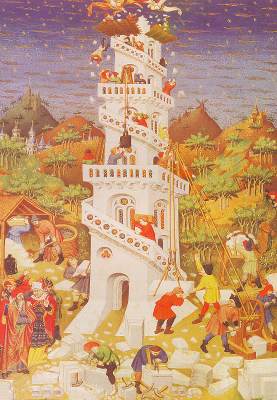
“Heaven and earth will pass away, but my words will not pass away” is supposed to bring comfort but it doesn’t, unless the heaven and earth of which Jesus speaks are the ones our pride has created. The imaginary ones. The heavenly and earthly projects that rise out of human insecurity as in the Genesis story of Babel, the story of what never was but always is, according to which the building of the ideal city is interrupted and the tower “with its top in the heavens” is “left off”. But the Word – the story about it – has not passed away. It endures. As fresh today as it was when first shared around a campfire as a way of telling each generation the respective places of God and man (humankind).
Fourteen years after the World Trade Towers collapsed in NYC, a new tower, “One World Trade Center” – taller, stronger, bolder – stands where the old towers fell on 9/11. One World Trade Center, symbolizes a resurrection of the crashed myth. Standing a few blocks from Wall Street, where the global economy is reconstructed every day, One World Trade Center resurrects the myth of national supremacy, benign goodness, and virtue of the American economic system.
We could have left Ground Zero empty of monoliths. Turned it into a memorial and monument to the error of pride, a turning away from global arrogance. A repentance from the economic-military-religious complex that has expropriated the oil fields in the Middle East, assassinated the elected President of Iran in 1958, installed the Shah in his place, ignored the human rights of Palestinians, supported and installed western-friendly oligarchies and strong men in Saudi Arabia, Iraq (Saddam Hussein), Libya (Muammar Gaddafi), and Egypt (Hosni Mubarak) until, except for Saudi Arabia, they turned against us.
Instead of listening to the word that does not pass away, we Americans, to the sorrow of New Yorkers like Michael Kimmelman (NY Times, Nov. 29, 2014), opted for the old words and worn-out scripts that had failed us. The Democratic Spring in Libya, Egypt, and Tunisia did not do what the NeoCon exporters of Western democracy had imagined. It unleashed a seething volcano of anti-American resentment. Meanwhile, Afghanistan, Iraq, and Syria, have become desert quagmires – Vietnams without the jungles.
Eisenhower’s last speech to the nation warning of an emerging military-industrial complex is all but forgotten as One World Trade Center stands like a phoenix raised up…and up…and up from the ashes, symbol of global dominance resurrected from the horrifying deadly collapse of 9/11.
Words and symbols are everything in this world.
Mr. Kimmelman opines, “But it [i.e. the World Trade Center] never really connected with the rest of Lower Manhattan. There had been talk after Sept. 11 about the World Trade Center re-development including housing, culture and retail, capitalizing on urban trends and the growing desire for a truer neighborhood, at a human scale, where the windswept plaza at the foot of the twin towers had been.”
It’s all about human scale. A plaza. Not a tower with its top in the heavens.
Staying awake is hard. Being attuned to what is not passing away takes faith. It takes hope. Maybe even love.
“From the fig tree learn its lesson: as soon as its branch becomes tender and puts forth its leaves, you know that summer is near.” [Mark 13:28]
Jesus often seems to have said that the word we need to hear is spoken by nature. Learn from the fig tree. It waits through the dormant season to become tender again, to put forth its leaves toward summer and the production of figs. Nature is calling. Nature is our home. Nature is what is – the real heaven and earth – the word that will not pass away, the word that will survive when we are gone. We need to love nature again. Awaken to nature. Re-imagine ourselves as part of nature, “creatures” among the multitude of creatures. Our words will pass away, even the best of them. Our Creator’s will not.
During this most puzzling of seasons – the Season of Advent, the season of wakeful, wait-ful anticipation of a Coming in fullness – I find myself crying out like Isaiah. It feels something as though “you have hidden your face from us, and have delivered us into the hand of our iniquity.” [Isaiah 64:7]
“O that you would tear open the heavens and come down, so that the mountains would quake at your presence—as when fire kindles brushwood and the fire causes water to boil– to make your name known to your adversaries, so that the nations [the ethnoi in NT Greek, i.e. the peoples] might tremble at your presence!” [Isaiah 64:1-2]
The “nations” have always been God’s adversaries, closed in on themselves, puffed up, defensive against intruders foreign and domestic, plunderers of nature and other nations, hostile to the foreigner, both human and Divine.
In this season of “economic recovery” when the poor continue to get poorer, the rich get richer, and the middle class shrinks, and the climate change clock ticks closer to midnight, deliver us, Good Lord, from “the hand of our own iniquity”.
Remember, “O LORD, you are our Father; we are the clay, and you are our potter; we are all the work of your hand.” [Isaiah 64:8]
This word is the only word that lasts. Stay awake, my soul. Stay awake to the whole of it – all of it: the sorrow and the grief of it, the loneliness of it, the anger of it, the guilt of it, the finger pointing out and away and the finger pointing back at me, a nation to myself, and the presence of the Potter – and my soul will be well, new and fresh every morning.
Gordon C. Stewart, Be Still! Departure from Collective Madness (Wipf and Stock, 2017) available on Amazon in kindle and paperback, Chaska, MN, First Sunday of Advent, November 30, 2019.
Guys don’t do sleepovers. Or so I thought reading A Plan this morning . . . until I stopped to think.
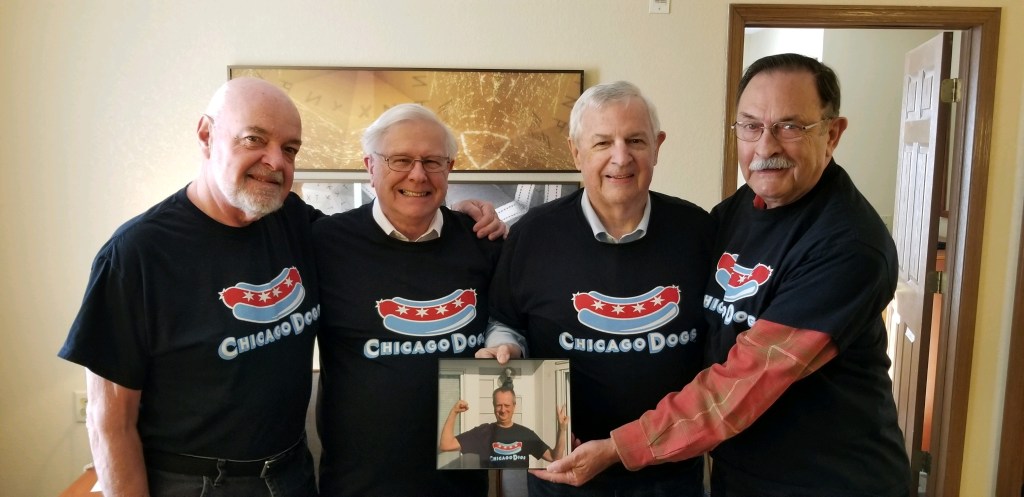
Four (4) ‘Old Dogs’ (seminary classmates who have maintained friendship through the years) do five-night sleepovers every year. Once there were seven (7). Now there are four (4).
Four ‘Old Dogs’ (L to R): Harry, Gordon, Don, Bob, with photograph of Wayne (RIP).
THE ‘GATHERINGS’
We arrive at the annual ‘Gatherings’ limping on replaced knees with hips and memories in need of repair, bearing matches to light the fire, a Book of Common Prayer, and a Fifth or two . . . to make four equal seven again.
There’s nothing like a sleepover celebration with old friends. Some are confident that the departed — Wayne, Steve, and Dale — are still with us around the fire. Others need the help of a Fifth or a few Seven-and-Sevens to get four to equal seven.
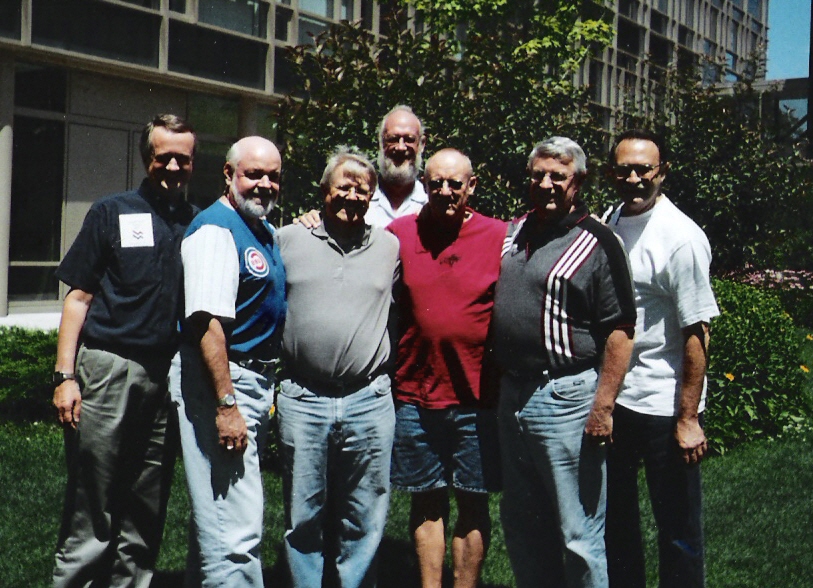
Original ‘Chicago Seven’ Gathering (L to R): Old Dogs Wayne Boulton, Harry Strong, Yours Truly, Steve Shoemaker, Dale Hartwig, Don Dempsey, Bob Young.
What I had come to know (by feeling only) was that the [GATHERING]’s true being, you might say, was a sort of current, like an underground flow of water, except that the flowing was in all directions and yet did not flow away. When it rose into your heart and throat, you felt joy and sorrow at the same time, and the joining of times and lives. To come into the presence of the [Gathering] was to know life and death, and to be near in all your thoughts to laughter and to tears.
Wendell Berry, “A Gathering,” Jayber Crow, p. 205-206.
A lifelong aversion to anything ‘orthodox’ kept me away from G.K. Chesterton’s Orthodoxy before inheriting a copy from the library of my late friend Wayne. Wayne was neither orthodox nor Orthodox, but there it was — Orthodoxy — with passages he had marked and indecipherable comments he had written in the margins.
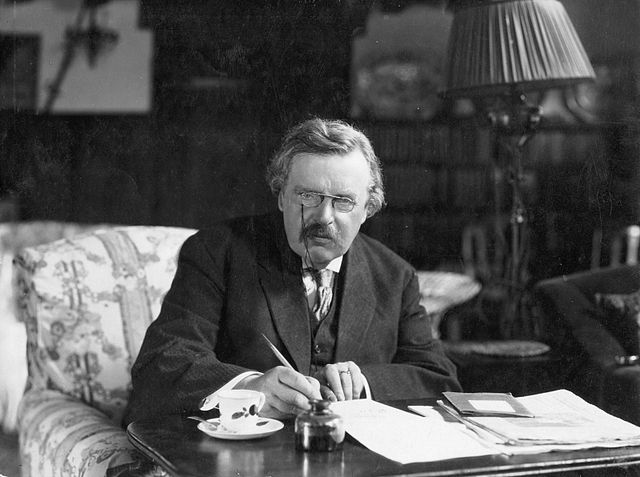
G. K. Chesterton at work
The Arrogant Oligarchy of the Living
“Tradition means giving votes to the most obscure of all classes, our ancestors,” wrote G.K.Chesterton in a book I’d never read until my friend Wayne died. “It is the democracy of the dead. Tradition refuses to submit to the small and arrogant oligarchy of those who merely happen to be walking around.” — G.K. Chesterton, “The Ethics of Elfland,”Orthodoxy (1908).
I’ve often had the sense of this oligarchy and find it treacherous. Not only because it’s arrogant and oligarchical, but because it is foolish and destructive. Tradition is not the enemy of vitality. Nor is it the enemy of free thought nor science.
Without tradition we are like by-the-wind sailors, the jellyfish who have no way to propel themselves, thrown this way and that by the tides and storms. Jellyfish go with the flow without conscience, memory, or agency to create a better future.
Collecting the Fragments: Egoism and Altruism
“There is a huge and heroic sanity in which moderns can only collect the fragments. There is a giant of whom we see only the lopped arms and legs walking about. They have torn the soul of Christ into silly strips, labeled egoism and altruism, and they are equally puzzled by His insane magnificence and His insane meekness. They have parted His garments among them, and for his vesture they have cast lots; though the coat was without seam woven from the top throughout.” — G.K. Chesterton, “The Ethics of Elfland,” Orthodoxy.
The Seamless Coat Woven from the Top
“Lopped arms and legs walking about.” What an image! The soul of Christ torn into silly separate strips of egoism and altruism. Chesterton had a way with words — images that jar the senses of what is real, pushing the by-the-sea sailors in a direction we did not expect.
The Democracy of the Living and the Dead
“All democrats object to [anyone] being disqualified by the accident of birth; tradition objects to their being disqualified by the accident of death. Democracy tells us not to neglect a good man’s opinion, even if he is our groom; tradition asks us not to neglect a good person’s opinion, even if he is our father. I, at any rate, cannot separate the two ideas of democracy and tradition; it seems evident to me that they are the same idea.” — Chesterton, “The Ethics of Elfland,” Orthodoxy.
Honoring the Great Ancestors and Great Grandchildren
My seven years at the Legal Rights Center — a public defense corporation founded in 1970 by the American Indian Movement and African-American civil rights activists — moved this by-the-sea sailor to think again about freedom and tradition.
We inherit a tradition from the ancestors and are responsible for passing the treasure (i.e., the tradition) to the next generation. In times of decision-making, American-Indian culture universally calls us to consider the previous seven generations and the seven generations that will follow: the democracy of the dead, the living, and those who come after us. This tradition of America’s First Nations, like the Reformed Christian tradition, looks back, looks ahead, and looks up for the re-weaving of the strips. The coat without seam was, is, and always will be woven from the top.
Wayne’s name is scribbled in pencil at the top of the title page of Orthodoxy. This year Wayne no longer lives to protest and resists the arrogant oligarchy of those who happen to be walking around. He has joined the blessed democracy of the dead.
North American culture of 2019 is like a house on fire. Words like ‘holy’ and holiness’ are . . . well… relics of tradition. We’re free thinkers, not … not like that!
It was, I suppose, a coincidence that this post caught my eye while reading G.K. Chesterton’s view of democracy and tradition, yet the two readings strike me leading upstream to the same source.
“Tradition means giving votes to the most obscure of all classes, our ancestors. It is the democracy of the dead,” wrote 34 year-old Chesterton nearly a century ago in a book with an arcane title (Orthodoxy) that sends us free thinkers running from a house fire.
Although it seemed outdated at the time, I now remember with nostalgia the rest I knew as a child on Sundays when the noise and distractions were stilled. We opened the windows, breathed fresh air, gave thanks we were still breathing, and went down for a long afternoon nap.
Thursday’s New York Times (Oct. 31) reported that “Paula White, a televangelist based in Florida and personal pastor to President Trump whom he has known since 2002, has joined the Trump administration in an official capacity.” The White House announced the news the same day the House authorized its impeachment procedures.
If you’re an embattled president about to be impeached for betraying your oath of office to “preserve, protect, and defend the Constitution,” you might welcome a spiritual advisor who, though lacking theological education credentials, confirms your view that you are engaged in spiritual warfare.
As one observer put it, “If you’re wealthy like Donald Trump is, and you have a preacher who says your wealth is a sign God approves of you, you’re probably going to like that preacher. And if there is one major element in Donald Trump’s religious beliefs, it would be this prosperity gospel.” — Tom Gjelten.
PAULA WHITE’S MESSAGE OF SPIRITUAL WARFARE
THE PROSPERITY GOSPEL IS NOT THE GOSPEL OF JESUS
Whatever the differences between evangelical Christians and progressive Christians on Biblical interpretation, there is general agreement that the gospel of Jesus and the “prosperity gospel” are very different gospels.
The Book of Amos and the Letter of James scorn the worship of wealth and privilege, and the teaching of Jesus consistently calls people to make friends with their enemies rather than seek their defeat. “You have heard it was said ‘you shall love your neighbor and hate your enemies’. But I say to you ‘love your enemies and do good to those who persecute you.'”
CREDENTIALS
Furthermore, there is the matter of credentials. The majority of American Christian churches — progressive, orthodox, or evangelical — require three years of theological education beyond a Bachelor of Arts/Science as qualification for ordination. My denomination — Presbyterian Church (U.S.A) requires courses in Hebrew and Greek, the languages in which the Hebrew Bible and New Testament were written, as a qualification for ordination. Why? Because the people in the pews deserve preachers and teachers who know what they’re talking about before they set foot in the pulpit — or step on stage.
Paula White has no such credentials. She falsely claims to have a doctorate. Not even close. She never finished college, let alone graduate school. She’s an entertainer and a fraud whose performances belong on The Apprentice. “You’re fired!”
PAULA WHITE QUOTATIONS
There are many different ways that people get licensed or ordained through different ministries, denominations, etc. So – but for myself, there was no formal seminary.
I have nothing to be sorry about.
God takes what the enemy meant for your bad and turns it for your good! It wasn’t a set back but a set up! Wait and see what God is getting ready to do for you!
Some people left you for dead. They thought it was over. They said you’re hopeless, you’re helpless. You can’t be used. You’re not ministry material. You’re going to be poor. You’re going to be messed up. But guess what? Tell the devil, go to hell. You’re a liar.
YOU are on the verge of a complete breakthrough in every area of your life. Spiritually, Financially, and Relationally God has shown me that this is a season of victory for His people. As I went deeper in the Spirit the Lord revealed that before the breakthrough comes, certain things must be dealt with. Specifically, there must be a complete defeat of your enemies!
I don’t go where I’m tolerated. I go where I’m celebrated.
What I might have considered good, good doesn’t mean every day is going to be perfect, you’re going to have bad breath, your hair is not going to be in perfect place.
THE WAR ON THE CONSTITUTION
By most indications, the American constitutional crisis will only get worse as the White House continues to stonewall Congress and publicly whitewash itself with the likes of the appointment of Paula White. It could be worse. It could be Ms. White’s dear friend, Benny Hinn. It remains to be seen whether the American people will fall for it.
New Jersey is not the first place one expects to hear a public confession of slavery with an action plan to make reparations for institutional racism. It may, therefore, come as a surprise that Princeton Theological Seminary, the nation’s second oldest graduate school (1812), has put New Jersey on the map of the national debate about reparations.
Princeton Theological Seminary’s Board of Trustees has unanimously approved a plan that commits $27,000,000 for a five-year Reparations Action Plan and $1,000,000 each year thereafter in perpetuity.
EXCERPTS FROM PRINCETON THEOLOGICAL SEMINARY NEWS RELEASE
“’The Seminary’s ties to slavery are a part of our story. It is important to acknowledge that our founders were entangled with slavery and could not envision a fully integrated society,’ says Princeton Seminary President M. Craig Barnes. ‘We are committed to telling the truth. We did not want to shy away from the uncomfortable part of our history and the difficult conversations that revealing the truth would produce.
“The historical audit uncovered that the Seminary did not own slaves and its buildings were not constructed with slave labor. Yet, the Seminary benefited from the slave economy, both through investments in Southern banks in the mid-19th century and from donors who profited from slavery. Also, founding faculty and leaders used slave labor at some point in their lives. Several of the first professors and board members were deeply involved in the American Colonization Society, which advocated sending free blacks to Liberia.
“’Our response to the historical audit is the beginning of our community’s journey of repair as we seek to redress historic wrongs and to help the Seminary be more faithful to our mission as a school of the church, both now and in the years to come,’ says Barnes. ‘We are taking tangible action to write a new chapter in our story.’”
— Princeton Theological Seminary, PRINCETON, NEW JERSEY, October 18, 2019
Princeton is the oldest seminary of the Presbyterian Church (USA). Its announcement gives meaning to the prayer of confession and acts of repentance, strengthening hope that all religious communities and the nation itself will take responsibility for systemic institutional racism and move toward a just and equitable society.
Rev’d Gordon C. Stewart, Presbyterian Minister (HR), author of Be Still! Departure from Collective Madness (click HERE for a look), Chaska, MN, October 29, 2019.
Today a rare mixture of people momentarily lay aside their differences to gather in Baltimore’s New Psalmist Baptist Church to give thanks to God for the life of Elijah Cummings. This is a community like few others — members of Congressman’s home church, constituents of his Congressional District, colleagues in the U.S. House of Representatives and the U.S. Senate, the powerless and the powerful, the homeless and and the well-housed, the hungry and the well-fed; elected officials and career civil servants, maids and nannies and those who employ, red and yellow, back and white, all precious in God’s sight — convened at this most awkward moment when the Congressional impeachment inquiry, led by the deceased, has been called a ‘lynching’ by a child of white privilege.
James Cone — The Cross and the Lynching Tree
In The Cross and the Lynching Tree, the late Professor and author James Cone of Union Theological Seminary in NYC elucidates the blindness of white Christians who see no relation between the cross of Jesus and the lynching tree.
“In the “lynching era,” between 1880 to 1940, white Christians lynched nearly five thousand black men and women in a manner with obvious echoes of the Roman crucifixion of Jesus. Yet these “Christians” did not see the irony or contradiction in their actions.”
“The cross can heal and hurt; it can be empowering and liberating but also enslaving and oppressive. There is no one way in which the cross can be interpreted. I offer my reflections because I believe that the cross placed alongside the lynching tree can help us to see Jesus in America in a new light, and thereby empower people who claim to follow him to take a stand against white supremacy and every kind of injustice.”
Is it too much to hope and pray that today’s awkward moment in Baltimore help white Christians see the cross in the lynching tree, understand the sordid history of lynched (black) and lynchers (white), lay aside glib talk of a lynching, whether ignorant or intentional, and find our way beyond the collective sin of white supremacy.
Thank you, Elijah and James, for your witness and wisdom. The chariot has come to take you home. RIP.








 Views from the Edge