Heeding the dream in 2017

Today is a day of searching for wisdom. This period between the November 2016 American election and January 20 presidential inauguration is what Carl Jung called a pause moment. An interruption of the normal to seek a deeper wisdom.

This year two calendars converge. It’s the first day of a new year on the secular calendar, which coincides this year with the First Sunday after Christmas on the Christian liturgical calendar.  This coalescence invites the kind of pause of which Jung spoke. Here’s an excerpt from the assigned Gospel reading for today from the Gospel of Matthew.


Now after [the Wise men] had left, an angel of the Lord appeared to Joseph in a dream and said, “Get up, take the child and his mother, and flee to Egypt, and remain there until I tell you; for Herod is about to search for the child, to destroy him.”

Then Joseph got up, took the child and his mother by night, and went to Egypt, and remained there until the death of Herod. This was to fulfill what had been spoken by the Lord through the prophet, “Out of Egypt I have called my son.”

When Herod saw that he had been tricked by the wise men, he was infuriated, and he sent and killed all the children in and around Bethlehem who were two years old or under, according to the time that he had learned from the wise men. – Matthew 2:13-16

Several things leaped out from the text this year:

  1. The wise men “tricked” Herod. The Greek word translated here as “tricked” derives from sports – the wise men sported, played, mocked, or made a fool of Herod. Whenever Herod sends out agents for the children, wise people find a way to play him.
  2. These “wise men” – magoi in the Greek text – are foreigners from the East. These foreign visitors with a different religious tradition (astrology) are outsiders to the myths of religious and national exceptionalism. They bring gifts for the Christ child before “returned to their own country by another way,” side-stepping Herod and his agenda.
  3. Joseph’s dream and flight into Egypt reverses every expectation. It was from Egypt that Moses and the Hebrew laborers had fled. Now it to Egypt that they flee from Herod, the puppet king of Roman occupation, who had made a mockery of Passover and Exodus. In this pause of 2017, perhaps the angels will forgive updating the text:”Get up, take the child and his mother, and flee to Canada (or) Mexico, and remain there until I tell you; for Herod is about to search for the children to deport them.”
  4. The Holy Family become refugees.

Interpreting biblical texts is a dangerous thing, and sometimes the interpretations go a bit to far! Though that be the case, this Gospel of Matthew text for the First Sunday after Christmas and January 1, 2017 offers an interesting opportunity to do what Carl Jung suggested. Engage the pause. Join the wise. Refuse cooperation with agendas that mock the good news. Take time out from the collective madness to be found again by what is holy and sane.

Grace, Peace, and a Blessed New Year,

Gordon


“Though the cause of evil prosper”

During a moment bordering on lunacy, the group of narcissistic McCormick Theological Seminary friends who call ourselves “The Old Dogs” considered a letter to President Obama suggesting he consider whether he might be called to the pulpit at the end of his second term as President.

Barack Obama shares our theological-ethical tradition which understands Christian faith and practice as intrinsically related to the health of public life. Faith is not a private thing. It’s individual but never private. Every form of faith and practice has implications for the neighbor(s) — the wellbeing of the general public.

“Once to Every Man and Nation” is a hymn on which my seminary friends and I grew up. President Obama learned of it after Rev. Jeremiah Wright took him under his wing at Trinity United Church of Christ while the young Barack was working as a community organizer in Chicago’s impoverished south side.

On this New Year’s Eve, James Russell Lowell‘s hymn strikes me as the hymn of choice for facing 2017 and the post-Obama era in Washington, D.C.  Lowell published this poem — originally 90 line long — under the title “The Present Crisis” in the December 11, 1845 issue of The Boston Courier in protest of America’s War with Mexico. We share here one stanza of Lowell’s poem, adapted for the hymnal, in hopes it might bring some small measure of good cheer for folks who, like us Old Dogs, are concerned  about public life and the world itself of the Eve of 2017:

Though the cause of evil prosper,
Yet the truth alone is strong;
Though her portion be the scaffold,
And upon the throne be wrong;
Yet that scaffold sways the future,
And behind the dim unknown,
Standeth God within the shadow,
Keeping watch above His own.

Faith does not promise a rose garden. It calls us to behold the thrones of wrong and honor truth at all costs.

Grace and Peace to you this New Year’s Eve,

Gordon


Prayer for the New Year

I invite you to consider lighting a candle and offer a prayer this New Year’s Eve and New Year’s Day in the quiet style of the Friends (Quakers) or by using a format such as the one below, slightly adapted from the U.S. Conference of Catholic Bishops.

Prayer For The New Year

On New Year’s Eve or New Year’s Day, the household gathers at the table or at the Christmas tree or manger scene. Many people make New Year’s Day a day of prayer for peace.

Leader: Let us praise the Lord of days and seasons and years, saying:
Glory to God in the highest!
Response: And peace to his people on earth!

The leader may use these or similar words to introduce the blessing:

Our lives are made of days and nights, of seasons and years,
for we are part of a universe of suns and moons and planets.
We mark ends and we make beginnings and, in all, we
praise God for the grace and mercy that fill our days.

Then read the the Scripture from the Book of Genesis 1:14-19:

God said: “Let there be lights in the dome of the sky, to separate day from night. Let them mark the fixed times, the days and the years, and serve as luminaries in the dome of the sky, to shed light upon the earth.” And so it happened: God made the two great lights, the greater one to govern the day, and the lesser one to govern the night; and he made the stars. God set them in the dome of the sky, to shed light upon the earth, to govern the day and the night, and to separate the light from the darkness. God saw how good it was. Evening came, and morning followed—the fourth day.

(The family’s Bible may be used for an alternate reading such as Psalm 90:1-4.)

Reader: The Word of the Lord.
Response: Thanks be to God.

After a time of silence, members of the household offer prayers of thanksgiving for the past year, and of intercession for the year to come …. In conclusion, all join hands for the Lord’s Prayer.

Then the leader continues: “Let us now pray for God’s blessing in the new year.”

After a short silence, parents may place their hands on their children in blessing as the leader says:

Remember us, O God;
from age to age be our comforter.
You have given us the wonder of time,
blessings in days and nights, seasons and years.
Bless your children at the turning of the year
and fill the months ahead with the bright hope
that is ours in the coming of Christ.
You are our God, living and reigning, forever and ever.
R/. Amen.

Another prayer for peace may be said:

Lord, make me an instrument of your peace:
where there is hatred, let me sow love;
where there is injury, pardon;
where there is doubt, faith;
where there is despair, hope;
where there is darkness, light;
where there is sadness, joy.
O divine Master, grant that I may not so much seek
to be consoled as to console,
to be understood as to understand,
to be loved as to love.
For it is in giving that we receive,
it is in pardoning that we are pardoned,
it is in dying that we are born to eternal life.
Response: Amen.

—Attributed to St. Francis of Assisi

Leader: Let us bless the Lord.

All respond: Thanks be to God.

The prayer may conclude with the singing of a Christmas carol.

Whether or not you choose to light a candle and no matter how you do it, if you do, my old friend Steve Shoemaker and his surviving Views from the Edge seminary friend wish you peace of heart and mind as we enter the storm tossed-sea of 2017.

Gordon C. Stewart, Chaska, MN, December 30, 2016.

Why a Manger?

“This will be a sign for you: you will find a child wrapped in bands of cloth and lying in a manger.” [Gospel of Luke]

mfa_46-1430-medium

Tintoretto, 1518-1594. The Nativity from Art in the Christian Tradition, a project of the Vanderbilt Divinity Library, Nashville, TN.

Why a manger, the animals’ feeding trough? Why does Tintoretto’s babe seem to be so interested in the animals? Why are the animals so comfortable around him?

Luke is doing theology, which is not everyone’s cup of tea! But we all engage in it. It’s about Reality and what we believe most deeply about it.

“Good” theology — if we may be permitted to use the word in a world which is of the opinion that one opinion is just as “good” as another — seeks to connect the dots between the past, the present, and the future. Traditional Christian theology arcs back to the “goodness” of the beginning (creation) and anticipates the redemption of all things in light of the Christ-event – the birth, death, and resurrection of Jesus.

As often happens, I heard Luke’s birth narrative this year in ways I had yet to put into words.

Could Luke himself have been arguing for what we now know in light of climate change: that we humans are of the same order as the cows, the chickens, goats, and sheep among whom Jesus of Nazareth was born? That is, we are not a superior species. We are not the exception to nature. And the redemption of reality itself includes the entirety of nature — the rescuing of nature from its despair and destruction by human hands.

So it was to poor shepherds, tending their flocks by night that the angel said,

“Do not be afraid; for see -I am bringing you good news of great joy for all the people: to you is born this day in the city of David a Savior, who is the Messiah, the Lord.This will be a sign for you: you will find a child wrapped in bands of cloth and lying in a manger.”

Joyous Nowell, Merry Christmas, Happy Earth Day,

Gordon C. Stewart, Chaska, MN, Christas Day, Dec. 25, 2016.


Lazarus and “the rich man”

gustave_dore_lazarus_and_the_rich_man

Gustave Dore print of Lazarus and the rich man. (1890)

Jesus told a parable about a man with a name ‘Lazarus’ – a poor man – and a man who has no name – “a rich man”. The parable begins like this:

“There was a rich man who was dressed in purple and fine linen and who feasted sumptuously every day. And at his gate lay a poor man named Lazarus, covered with sores, who longed to satisfy his hunger with what fell from the rich man’s table; even the dogs would come and lick his sores.” [Luke 16:19-20 NRSV]

The scene then shifts from the difference between their earthly circumstances to the imagined differences between their circumstances in an afterlife. Lazarus is soothed in the bosom of Abraham. The rich man is in torment, pleading that if only he had known, he would have lived differently. He asks Abraham to send Lazarus to his five brothers to warn them. tell his living relatives. If he can come back to them from the dead, they will understand, change their ways, and avoid the coming judgment.

Abraham’s reply?

“‘They have Moses and the prophets; they should listen to them.’ [The rich man said, ‘No, father Abraham; but if someone goes to them from the dead, they will repent.’ [Abraham] said to him, ‘If they do not listen to Moses and the prophets, neither will they be convinced even if someone rises from the dead.’” [Lk. 16:29-31].

Jesus’ parable is not about the dead. It’s about the living. About how are to live together as neighbors. It’s about waking up to destitution and privilege and heeding the parable’s calling to a society beyond these extremes, a society known for its compassion.

Ask your friends to discuss the news in light of Moses’ response to the rich man. Ask your pastor, priest, or minister how she or he connects the dots with the news in 2016. Ask yourself the question as you listen to the morning and evening news. Ask yourself whether you’re getting the parable or whether the parable got you. Ask God for guidance, for mercy, for change, for transformation of a world of us and them. And give thanks for Jesus, Moses, and the prophets.

Peace and Hope after the Election

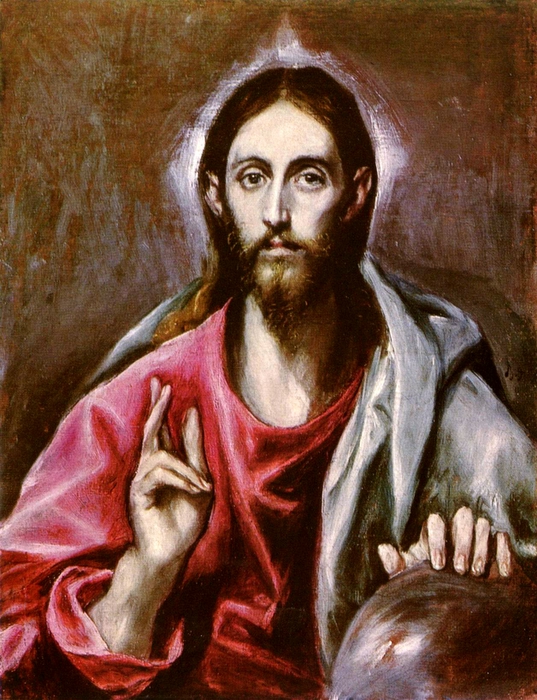
el_greco_021-medium

El Greco‘s “Pantocrator – Christ” feeds my anxious soul in a way words do not this Sunday after the American national election.

Christ’s eyes are knowing, sorrowful yet composed, searching deep within me. The right hand offers the blessing of peace while the left hand rests gently on the globe, the assurance that he is still the pantocrator (“all-ruler”) whose reign, though hidden, is trustworthy and real.

We republish El Greco‘s “Pantocrator – Christ” with thanks to the Vanderbilt Divinity School Library with the following attribution:

Greco, 1541?-1614. Pantocrator – Christ, from Art in the Christian Tradition, a project of the Vanderbilt Divinity Library, Nashville, TN. http://diglib.library.vanderbilt.edu/act-imagelink.pl?RC=48051 [retrieved November 13, 2016]. Original source: http://www.yorckproject.de.

I didn’t attend worship this morning. I didn’t want any more words. I stayed home with El Greco and a brief word from Isaiah (Is. 65:19).

  • Gordon C. Stewart, Chaska, MN, November 13, 2016.

Be Still! Departing from Collective Madness

Writing Be Still! Departure from Collective Madness (scheduled for release by Wipf and Stock Publishers in January), I had a growing sense of its prescience. The subtitle “departure from collective  madness” is anchored in the works of Elie Wiesel and Old Testament scholar Walter Brueggemann, and the Gospel of Matthew’s story of the Wise Men (sic) who “departed” for their own country by another way.

As the date for final submission of the Be Still! manuscript drew near, I saw a madman running for the highest office of the land but underestimated the extent of the collective madness that would be drawn like iron to a magnet. The billionaire television personality who puts his name on everything his hands have touched, gave voice to people who have felt groped by the system.

Michael Moore, a champion of America’s forgotten working class, saw this coming. He was in touch with the many sources of anger that found a voice in Donald Trump, and he warned the Democratic Party to get in touch with it before it was too late.

Now it is history. I felt sick Wednesday morning. By yesterday evening, I was able to calm down. Today’s sense of nausea is worse than yesterday’s after reading “Meet Trump’s Cabinet-in-Waiting” – a cabinet which will put the country back into the hands Wall Street, big oil, climate change-deniers, and the likes of Chris Christie, Jeff Sessions (R-AL), Rudy Gulliani (Attorney General candidate), loose-talking groper Newt Gingrich (Secretary of State candidate), and CEOs.

President Obama and Secretary Clinton have called for the country to unite for an orderly transition. I believe in orderly transitions. I applaud them. A democratic republic depends upon such transitions. I support that. But I will not be united behind a madman or absorbed into a collective madness that bodes evil. I will not turn over cars. I will not stop traffic. I will not burn things. I will write. And write. And write knowing, as this election has reaffirmed, that words DO matter.

I will do my best to be still. I will follow the example the biblical Wise Men (sic) who “being warned of God in a dream that they should not return to Herod, . . . departed into their own country another way”[Matthew 2:12 KJV]. Herod was a strongman in whom there was no refuge. There was and is another way.

God is our refuge and strength,
a very present help in trouble.
Therefore we will not fear, though the earth should change,
though the mountains shake in the heart of the sea;
though its waters roar and foam,
though the mountains tremble with its tumult.

There is a river whose streams make glad the city of God,
the holy habitation of the Most High.
God is in the midst of the city; it shall not be moved;
God will help it when the morning dawns.

The nations are in an uproar, the kingdoms totter;
he utters his voice, the earth melts.

The Lord of hosts is with us;
the God of Jacob is our refuge.

Come, behold the works of the Lord;
see what desolations he has brought on the earth.
He makes wars cease to the end of the earth;
he breaks the bow, and shatters the spear;
he burns the shields with fire.

“Be still, and know that I am God!
I am exalted among the nations,
I am exalted in the earth.”

The Lord of hosts is with us;
the God of Jacob is our refuge.

[Psalm 46]

Amen. May it be so.

  • Gordon C. Stewart, Chaska, MN, November 10, 2016


Walter Brueggemann on Idolatry

Walter Brueggemann is one of the world’s great Biblical scholars. Consider Election Day as you listen.


  • Gordon C. Stewart, Chaska, MN 55318


All Saints Day

This  All Saints Day —the first without Steve Shoemaker, a lifelong Chicago Cubs fan whose life ambition was to see the Cubs win the World Series –I took the liberty of re-writing a stanza of the signature hymn sung on All Saints Day, Sine Nomine, “For All the Saints Who from their Labors Rest”. Tonight the Cubs try to even the World Series at 3-3 in Cleveland, OH.

Oh, may Thy Cub-bies, faithful, true and bold,
Fight as the saints who nobly fought of old
And win with them the victor’s crown of gold.
Alleluia! Alleluia!

With apologies. Go Cubs! Do it for Steve on All Saints Day.

Gordon C. Stewart, Nov. 1, 2016

A gentle pastor faces death

Next Monday five old friends will visit Steve Shoemaker at the rehab center in Champaign-Urbana. Steve’s humor remains in top form despite the cancer that has limited his mobility and chunk the weight of his 6’8″ frame from 240 to 187 pounds.

Thinking about Monday’s visit, originally planned around the first presidential debate, I recalled a story about Steve jumping into a swimming pool dressed in a tuxedo after a wedding. It was locked in the Views from the Edge “draft” folder because we couldn’t convert the original piece from tpyepad to this platform. Today, in honor of Steve, we “converted it” for posting. The words belong to Bill Tammaeus, former columnist at the Kansas City Star.

The first time I boarded an airplane after the 9/11 terrorist attacks, it was to fly to Champaign-Urbana, Ill., at the invitation of the Rev. Steve Shoemaker to speak to a YMCA gathering at the University of Illinois.

I knew I needed not to avoid planes after experiencing the death of my nephew Karleton, a passenger on the first plane to hit the World Trade Center on 9/11, and Steve’s invitation to speak made it necessary to get back on one.

I’ve been thinking about Steve a lot recently after learning that he has developed pancreatic cancer, which is expected to kill him within a few months. I follow his almost daily thoughts about that now on the CaringBridge.org website. Which is where I learned that the newspaper for Champaign-Urbana, The News-Gazette, just published this terrific story about Steve. [Aside: VFTE republished the News-Gazette story]

You can get a good sense of the kind of sweet, thoughtful man he is, a man whose Christian faith issues in much concern for life’s downtrodden people.

Steve first got connected to my family through my North Carolina sister, Barbara, and her husband, Jim, who are my late nephew’s parents. They became friends with Steve and his wife Nadja when they were neighbors in the Raleigh-Durham area.

Later Steve performed the wedding ceremony for some of Barb and Jim’s children, including Karleton.

I still laugh at the memory of Steve and Jim — fully dressed in tuxedos — diving into a swimming pool in joy at the wedding reception when Barb’s and Jim’s daughter Tiffany was married. It helps to know that Steve stands about 6-foot-8 and made quite a splash.

From that News-Gazette story, here’s a taste of Steve’s theology: “God has his eyes on the sparrow and not the eagle, on the people who are hurting. That’s the God that makes sense to me.”

God’s eye is on the sparrow.


  • Gordon C. Stewart, Chaska, MN, March 9, 2016