Easter

Aside

Artists often say it best. Jacopo da Pontormo‘s painting of the peaceful Christ rising above “the guards who shook and became like dead men” (see text below) invites us this Easter to ponder afresh Christ’s hidden reign in the world in which violence, militarism, and imperial ambitions still feign to rule.
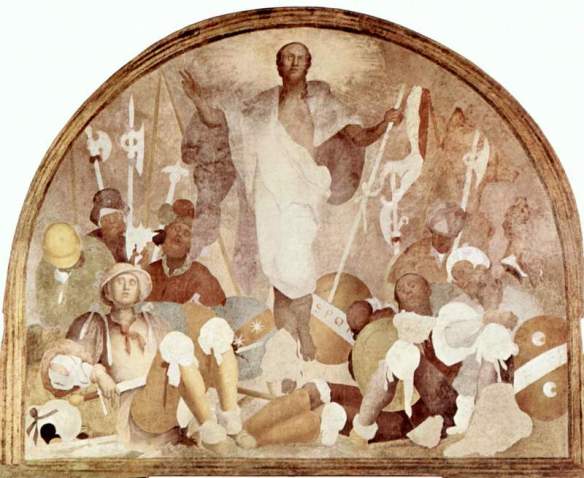
Jacopo_Pontormo_026-medium

Jacopo da Pontormo (1494-1556)

For fear of him the guards shook and became like dead men. But the angel said to the women, “Do not be afraid; I know that you are looking for Jesus who was crucified. He is not here; for he has been raised, as he said. Come, see the place where he lay. Then go quickly and tell his disciples, ‘He has been raised from the dead,and indeed he is going ahead of you to Galilee; there you will see him.’ This is my message for you.” So they left the tomb quickly with fear and great joy, and ran to tell his disciples. Suddenly Jesus met them and said, “Greetings!” And they came to him, took hold of his feet, and worshiped him. Then Jesus said to them, “Do not be afraid; go and tell my brothers to go to Galilee; there they will see me”  [Gospel according to Matthew 28:4-10]

Jacopo da Pontormo helps me see what the mind cannot fathom. Christ is Risen! In spite of all appearances to the contary, Christ is Risen! Alleluia! He is risen, indeed!

Gordon C. Stewart, in Galilee of Chaska, MN, Easter, April 16, 2017.

Good Friday 2017 in light of 1553

In his Ten Rules for Writing author Elmore Leonard advised,

“Try to leave out the parts that readers tend to skip.”

Good Friday is one of those parts in the Christian story. Who wouldn’t want to skip over betrayal, denial, abandonment, and brutality, the opposite of happiness? But we don’t get to joy without going through them. Steve Martin’s Happy Feet offers a memorable parody of faux happiness. You don’t get to Easter with happy feet.

In a sermon preached on Good Friday, 1553, the Rev. John Bradford asked his hearers to draw close to the cross, inviting them to look upon the death of Christ as the very presence of God, the part “that we people want to skip”.

As the very pledge of God’s love toward thee,
whosoever thou art, how deep so ever thou hast sinned,
See, God’s hands are nailed, they cannot strike thee;
his feet also, he cannot run from thee.
His arms are wide open to embrace thee.

Happy feet are no remedy for sore feet. Whatever view one takes of the classical Christian formula of Christ’s full humanity and divinity, John Bradford, Elmore Leonard, and Steve Martin’s Happy Feet invite the imagination to stop and pay attention to the God who embraces humankind in the very darkness we deny.

  • Gordon C. Stewart, Chaska, MN, Good Friday, April 14, 2017.

Mom’s Handkerchief – Good Friday

Mom

Muriel Titus Stewart

As a child, I wondered why they called Good Friday ‘good’. It wasn’t. It was awful.

At the annual Good Friday service my mother’s cheeks were wet. She’d hold her handkerchief in one hand and, without drawing attention to herself — Mom was shy and shunned attention — she would dab the tears, hoping no one would notice.

A soloist would sing:

Were you there when they crucified my Lord?

Were you there when the crucified my Lord? Oh……

Sometimes it causes me to tremble, tremble, tremble.

Were you there when they crucified my Lord?

Mom would dab her cheeks and eyes.

As I grew older I began to understand why they called the Friday of the crucifixion ‘good’. It wasn’t good because they nailed him to the tree, or because they took him down and laid him in a borrowed tomb. It was good because, in that deep darkness, tears fall in grief and in hopes of something else. Tears that recognize both the betrayal, denial, flight — our  own and others’ – and the steadfast love, courage, and magnanimity of the man on the cross.

Both sides of the human condition are front and center on Good Friday. So is the sense of god-forsakenness – the wrenching cry from the cross, “Eloi, Eloi, lama sabachthani?” (“My God, my God, why have you forsaken me?”) — the gnawing feeling of senselessness, meaninglessness, and helplessness, hanging alone, tortured and mocked, over the abyss of nothingness.

Over the years, I’ve learned that a healthy sense of denial is sometimes a good thing. So is truth-telling. Good Friday brings me face-to-face with myself at my worst and my best. And at the heart of it all is a man with arms spread wide, looking out at us who still crucify him — ours is a Good Friday world — with eyes that reach my soul. “Father, forgive them, for they know not what they do. Into Your hands I commit my spirit.”

On Easter Mom would dab her eyes for joy because she’d brought her handkerchief with her from Good Friday.

— Gordon C. Stewart. Chaska. MN, April 14, 2017. Originally published April 3, 2015.

The Stubborn Donkey and the Asses

“[T]hey brought the donkey and the colt, and put their cloaks on them, and he sat on them.” – Matthew 21:7

In advance of today’s annual Palm Sunday parade through downtown Excelsior, Trinity Episcopal‘s e-newsletter issued the sad, tongue-in-cheek announcement:

Between services the Trinity community will come together in a joyful parade, with music, laughter, and bubbles! Unfortunately, the donkey that was going to lead us is being a bit stubborn so he will not be with us.

Jesus on two donkey’s – Jean de Limbourg (c. 1385-1416)

Perhaps today’s cancellation serves as a reminder that the donkey is stubborn by nature, and that, if you manage to tame one, there will always be another nearby waiting to take its place.

Some churches today celebrate only Palm Sunday – “the Triumphal Entry” into Jerusalem. It’s all about palm-waving and “Hosannas!” shouted and sung to the victorious King of kings and Lord of lords.

Other churches honor the paradox of palms and fists, stubborness and spears, appearance and reality: the king who refused to be King who rode an ass (or two) into the city that wanted something more than the mortal it could raise on a cross.

Today there will be no donkey on the streets of Excelsior. The donkey is just being stubborn. Or perhaps it refuses to participate in this year’s re-enactment when palms and hosannas take her rider to the cross again in a world where asses still rule.

  • Gordon C. Stewart, Chaska, MN, Passion/Palm Sunday, April 9, 2017.


The walls of gold entomb us!

The lyrics of G. K. Chesterton are set to the Welsh tune Llangloffan in this YouTube from Lincoln, Nebraska. God help us all in the first year of A.T. 1 (Anno Trump) when we are face with the threat that “the walls of gold [will] entomb us”.

Early Morning Shape Notes

I wake up with a tune in my head. It’s lovely. It’s simple. It’s familiar. But I can’t remember the words except for something about going through deep waters. Grinding the coffee beans, more of the line comes to consciousness.

“When through the deep waters I cause thee to go, the rivers of sorrow shall not overflow; for I will be with thee thy troubles to bless, and sanctify to thee thy deepest distress.”

It’s an American “shape notes” folk tune that voices lyrics written earlier by an unidentified author named ‘K-‘ in a collection by John Rippon from 1787.

The subconscious knows better than the conscious mind. It deals with deep waters. It knows better our deep sorrows threatening to overflow the banks. It knows about troubles and deepest distress. It also knows something else: a kind of unreasonable assurance, a hope against every reason to hope that something deeper than our fears and anxiety will shape the notes, will shift the shape of things to come.

Shape notes, sometimes called ‘character notes’ and ‘patent notes’, reflect our deeper character, but none of us holds the patent-right.

  • Gordon C. Stewart, Chaska, MN, March 16, 2017, 5:34 a.m.


Somebody has my ashes!

Gordon C. Stewart's avatarViews from the Edge

It’s Ash Wednesday. I put on my ministerial robe 15 minutes before the traditional Service that marks the beginning of Lent with the imposition of ashes and go the drawer of the credenza.

Ash Wednesday“They’re missing! Where are the ashes?!” 

Every year I store the ashes in the credenza in my office. I’ve forgotten that we’d moved the credenza from my office last fall. I rush downstairs to look for it. No credenza anywhere. Then…I remember. We sold it at the Annual Fall Festival!

“Somebody has our ashes!”

What to do with no ashes? Burn some newspapers? Smoke a cigar and use the ashes? No time.

I grab a pitcher and pour water into the baptism font.

We begin the Service with the story of the missing ashes. Smiles break out everywhere. Maybe even with signs of relief. “Instead of the imposition of ashes this year, we will go to the…

View original post 245 more words

A Time to Weep

Faith and hope come hard sometimes. Four days living next to the abyss brought the wisdom of Ecclesiastes came to mind:

“For everything there is a season and a time for every matter under heaven . . .  a time to weep, and the time to laugh. A time to mourn, and a time to dance . . . .” – Ecclesiastes 3:3-4

I’m not laughing or dancing. I’m weeping and mourning over what’s happening in America. This is the time, the season, for weeping and mourning. Maybe I’m sane after all?

Faith lives next to the abyss.

  • Gordon C. Stewart, Chaska, MN, January 25, 2017


Marching in the Light of God

Hope for light on Epiphany

Today is the Day of the Epiphany when western Christians celebrate the arrival of the Magi (the “Wise”) at the manger in Bethlehem.

In this dark time of anxiety we look again for the light of an epiphany – a new awakening, a dawning of the light through the shadows – that will help us to circumvent Herod’s cruel way.

Sometimes light comes from the blind, as it did from Fanny Crosby (1890-1920), a poet and hymn writer who lost her sight when she was six-weeks old. Ms. Crosby was educated at the New York Institution for the Blind. She went on to teach English grammar, rhetoric, and American history. She never learned to tweet, but she left us more than one worthy thought that seems apt for this Day of Epiphany when a meeting is taking place on gold-plated chairs in a New York City penthouse.

Oh, the unsearchable riches of Christ!
Wealth that can never be told;
Riches exhaustless or mercy and grace,
Precious, more precious than gold!

May God grant to our blindness the wealth that can never be told – the wisdom and light seen by Fanny Crosby.

  • Gordon C. Stewart, Chaska, MN, January 6, 2017