“Every round goes higher, higher”

Part 2 of “Jacob’s Ladder at Almost 75”

As a child and youth, Jacob’s Ladder touched something deep within me. I couldn’t have described what it was or why at the time.

Looking back, it was a happy song. We were all climbing. Getting older meant climbing higher, getting taller, becoming mature, successful adult “soldiers of the cross.”

“Every round goes higher, higher.”

It expressed a joyful innocence and confidence. I had no knowledge of the economic-political origins of the ‘spiritual’ until much later.

The connection between the slaves’ faith, or their understanding of what it meant to be a “soldier of the cross” — the struggle for economic-political liberation, climbing “higher” to freedom in the North — was as far from consciousness as white is from black.

As a 13 year-old, Jacob’s Ladder expressed an innocent childhood hope during those hormone-challenging years when ascending the ladder toward adult self-sufficiency felt like a fireman trying to save  an 800-pound gorilla in a raging fire. All I could do was stay on the ladder, hoping that human equivalents of angels might be there to catch me when I fell.  The closest thing to angels were people like Mr. and Mrs. Kidder and friends who encouraged my upward progress from childhood to adulthood. Surely some progress must be made.

Faith still meant climbing higher on a ladder that was going someplace, as the Genesis story (Genesis 28:10-19a) of the ladder between heaven and earth seemed to say. We were on the upward ladder.

Then, something happened.

  • Gordon C. Stewart, Chaska, MN, August 6, 2017.


This Is Home!

“An ancient gift to you this morning,” read the email from my friend Wayne with a link to Gaelic Psalm-singing.

You can be pretty sure someone with the name Gordon Campbell Stewart is a Scot, or, at least, has a Scottish heritage. Three clans – and not all of them friendly to each other – combined in one name, is perhaps its own kind of DNA symbol of worldly reconciliation.

Seeing the YouTube of the Gaelic Psalm-singing that lives in my DNA brings tears to my eyes. Watching the faces, hearing the voices, longing for the simplicity of the Psalm-singing takes me to another place. This is home!

While visiting a church like this on the Isle of Skye, the faces and voices were much the same. Before the Presenter began the congregational singing, you could hear a pin drop. The worshipers observed a sacred silence. The singing voiced a Word that speaks to a noisy world out of a Deep Silence. This is home!

  • Gordon C. Stewart, Chaska, MN, July 20, 2017.

Announcing “Be Still!” Program

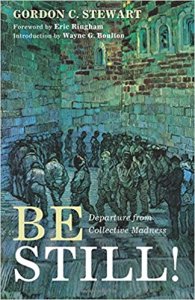
Be Still“BE STILL! To See More Clearly

This six-session program for churches invites you to re-examine the faith perspective (“lens”) through which you have come to “see” yourself and the world with brief selected readings from Be Still! Departure from Collective Madness.

“To see clearly, to see clearly, to see clearly–such is the great impulse and drive you meet on every page.” – Introduction to Be Still!  by Wayne. G. Boulton, Ph.D., former president of the Presbyterian School of Christian Education.

“Such essays are an eloquent rebuke to the prejudice that theological writing is abstraction from the concretions of life. I think of Stewart as an incarnational theologian like Bonhoeffer, who insisted that we pay attention to God’s presence in the concretions of our history.” – Donald Shriver, Ph.D., President Emeritus, Union Theological Seminary (NYC).

SIX One-1.5 hour SESSIONS using Be Still! Departure from Collective Madness

ONE—What is “public theology? Read and discuss the “Foreword” (ix-x), “Introduction” (xv-xviii), and Psalm 46.

TWO—The Author’s Lens. Read and discuss “The Preface (xi-xii), and the last paragraph of the “Acknowledgements” (xiv) about the Brothers of Opal Street.

THREE—Exceptionalism as Sin. Read and discuss “Only One Sin: Exceptionalism” (110-113) and “Memorial Day and the Soldier’s Helmet “ (10-12).

FOUR—Toward an Incarnational Theology. Read and discuss “Stillness at Blue Spring” (3-5) and “A Joyful Resting Place in Time” (5-7).

FIVE—No Gospel without the Blues. Read and discuss “The Forlorn Children of the Mayflower” (66-70) and “My Soul Waits in Silence” (98-100).

SIX—The Economy of God. Read “The Economy: Only One House” (114-115), “The World in an Oyster” (94-97), and “The Bristlecone Pines” (143-145).

ENDORSERS of Be Still! Departure from Collective Madness

Lucy A. Forster-Smith, Sedgwick Chaplain, Senior Minister in the Memorial Church, Harvard University:

”As a person who navigates the pleasures and perils of the twenty-first-century campus, having Be Still! at my fingertips will be like having a counselor, a guide, a very present help in these times. This volume touches the pulse of our times with the rare combination of unwavering candor and tender mercy.”

Walter Brueggemann, Columbia Theological Seminary:

”This wondrous collection of rich snippets would be of interest and value if only for the rich source material that Gordon Stewart quotes from, as it must be an inexhaustible memory and/or file. But the many words he quotes are no more than launching pads for Stewart’s expansive imagination and agile mind that take us, over and over, into fresh discernment, new territory, unanticipated demands, and open-ended opportunity. All of that adds up to grace, and Stewart is a daring witness to grace that occupies all of our territory.’’

Barrie Shepherd, author of Between Mirage and Miracle:

“Gordon Stewart has a way with words, a clean, clear, concise, and yet still creative way with words, a way that can set the reader almost simultaneously at the blood-stained center of the timely–the urgent issues of our day–and also at the deep heart of the timeless, those eternal questions that have forever challenged the human mind. Stewart looks at terror, Isis, and all their kin, from the perspective of Paul Tillich and, yes, John Lennon. He moves from Paris, Maine, by way of the town drunk, toward the City of God. This is strong medicine, to be taken in small, but serious doses. Wear a crash helmet!”

 Michael McNally, Professor of Religion, Carleton College; Author of Honoring Elders:

”Be Still! is needed at this American moment of collective madness even more than the moments that occasioned many of the essays originally airing on public radio and other venues. With a keen eye and a knack for telling the right story at the right time, Rev. Stewart speaks to the pressing issues in our politics, economy, and culture, and consistently, often poignantly, puts them in ethical and theological perspective that clarifies what too often mystifies. Great bedside reading for those of us who stay up at night concerned about where our world is heading!”

Frank M. Yamada, President, American Theological Society, former President, McCormick Theological Seminary:

”In Be Still! Stewart masterfully spins a counter-narrative to the collective madness that is gripping our world. Like the psalmist, Stewart prays thoughtfully through metaphors and religious tradition, meshing theologians with news headlines to lead the reader to a deeper, more sustained truth. Be Still! reads like part op-ed and part parable. In these troubling and anxious times, may we, who have ears to hear, listen!”

Joyce Sutphen, Minnesota Poet Laureate; Professor in English, Gustavus Adolphus College:

“Be Still!: Departure from Collective Madness, is exactly what its title proclaims: a departure from the frenzy and folly of our times. Each essay offers the reader an opportunity to breathe deep, to fall into the story or idea and consider what it means to be a citizen, a friend, a human being. The topics covered are both particular and universal (usually both at the same time), and the writing is wonderfully concise and open—much like poetry! This is a book you will want to open again and again; it’s what the world needs now, more than ever.”

ORDERING THE BOOK, INQUIRIES & SPEAKING ENGAGEMENTS

Be Still! Departure from Collective Madness is available from Amazon (paperback @$21 [shipping included w/Amazon Prime] or kindle @ $9.99), and from Wipf and Stock Publishers (paperback @$16.80 + shipping, or E-Book @$16.80). Churches and groups within 50 miles of Chaska, MN may order the book from the author @ a reduced rate.  A Study Guide is available at no cost.

Contact Gordon C. Stewart @ gordoncstewart@comast.net for speaking engagements, questions, or requests for more information.

Double Vision

Thomas and Peter are this writer’s favorite apostles. Thomas because he refused to believe unless he saw with his own eyes and confirmed “an idle tale” with his own hand; Peter because he was impetuous, quickly stepping onto the sea at Christ’s invitation only to plunge like a stone when his faith failed him.

It was through these two very different eyes — one of Thomas, the other of Peter — that we viewed Dennis Aubrey and PJ McKey’s Two Churches in the Cliffs on Via Lucis this morning.

The two churches on the cliffs appeared differently to these different eyes of faith.

3L1A5132

Apse, Église Notre-Dame-de-l’Assomption (Alpes-de-Haute-Provence) Photo by PJ McKey

The apse of Église Notre-Dame-de-l’Assomption with its narrow vertical window immediately elicited a Petrine sense of immediate belief. It held Peter’s eye for a long time.

Perhaps it was held by the yearning for the vertical, that which transcends the horizontal banality to which a mass culture has shrunk everything not of its own making. Perhaps it is the delight of hope from above that trembles the spine of the despairing. Or perhaps it’s the beauty of the apse’s proportionality, the genius of the central Christian symbol: the intersection of the horizontal by the more gracious vertical — the horror of human cruelty interrupted and transformed by the unexpected shaft of light and the still small Voice heard by Elijah in his cave.  Or all of the above and more.

But Thomas is never far beyond Peter. It is the Thomas in us that asks the hard questions, insists on separating fact from fiction, reality from illusion, good faith from what Sartre called bad faith. It is Thomas whose faith couldn’t make itself piggy-back on the shoulders of the other apostles’ story of having met the risen Christ. It was Thomas who insisted that he see for himself the evidence for “seeing” or believing in hope beyond the horror of the suffering, cruelty, and death his eyes had seen days before on the Hill of Skulls.

800px-Chapelle_Notre-Dame_de_Beauvoir

Chapelle Notre Dame de Beauvoir, Moustiers-Sainte-Marie (Alpes-de-Haute-Provence ) Photo by ICE-Marseille, courtesy of Wikipedia Commons


Which brings us to the second church on the cliff — the story of the stillborn in Via Lucis‘ post that awakens Thomas’ skepticism.

“Notre Dame de Beauvoir was known for its suscitations – stillborn children were carried up and baptised there, at which time they would immediately come to life and would be granted a place in heaven. This was a well-known phenomenon in the region and also known at two neighboring churches.”

While the thought of stillborn children immediately coming back to life appeals to Peter, it offends Thomas as an idle tale for the feeble of heart and mind. It’s either true or it’s not. And, if it’s true, what kind of cruel God would deny the same to the stillborn children and grieving parents who have not carried them up the steps to Notre Dame de Beauvoir for suscitations? Or is the tradition of Notre Dame de Beauvoir a sacred story of love and hope beyond what the empiricist eye of Thomas can see?

We have a left brain and a right brain, and sometimes it is true that never the twain shall meet. Likewise, faith has two eyes: Peter the believer, and Thomas the doubter — its own kind of double vision — looking out and up from one small brain.

  • Gordon C. Stewart, Chaska, MN, July 6, 2017.


Who’s taking the pictures? Who’s singing?

Re-blogging Dennis Aubrey’s photographic essay today (see previous post) took me back to the sermon Dennis inspired years ago with his experience in the basilica dedicated to Mary Magdalene in Vizelay, France.

At the end of a week in Chaska when my cup has been overflowing with reasons to touch again the power of the non-rational that is deeper than what goes on in my spinning head, we republish “The Stones Are Singing” in thanksgiving for Dennis’s and PJ McKee’s influence on me and Dom Angelico’s influence on them.

Gordon C. Stewart, Chaska, MN, June 11, 2017.

The Monk in the Morvan Forest (Dennis Aubrey)

We post Dennis Aubrey’s latest epistle for a number of reasons. Readers of Views from the Edge may recall that the Via Lucis photographic essay on the stones singing at Vizelay inspired a sermon on the stones singing. Here the monk who wrote the history of these Romanesque churches comes out from the shadows in a lovely tribute by Dennis, complete with pictures of PC and Dom Angelico Surchamp.

Dennis Aubrey's avatar

We are finally home again after two months photographing in France, Spain, and even a little bit of Italy. We drove 6,960 kilometers during that time at an arrive speed of 51 kilometers an hour, which translates to 4,344 miles and a dazzling 32 miles per hour. This demonstrates the narrowness of the country roads where we drive and the amount of time we spent in the Pyrénées and Alps. Until we hit the highway returning to Paris, the average speed was 48 kilometers per hour!

The trip ended in Vézelay at the Crispol hotel, which is almost like home to us. The Schori family is always so welcoming and the addition of the two children Max and Clémence makes it even brighter. It is always bittersweet leaving France. We love it there but we are always anxious to return home, this time to our new house amidst the Amish

View original post 521 more words

Memorial Day and the Soldier’s Helmet

“Memorial Day and the Soldier’s Helmet” is read aloud here from Be Still! Departure from Collective Madness (p. 10f.). This recording is not as professional as it will be this weekend when it airs on Minnesota Public Radio’s “All Things Considered.” This practice run starts out a little mushy! But it’s good enough that Day1.org posted it yesterday on their site.

Many thanks to Chuck Lieber for making it possible to turn “Be Still!” into a podcast.

  • Gordon C. Stewart, Chaska, MN, May 24, 2017.

Hammer-strokes against the darkness

We are living in what J. C. Blumhardt called “the wasted fields of mankind.” The fields of humankind are being laid waste in our time, as they were in his (1805 – 1880). What to do?

I’ve made phone calls. I’ve written. I’ve posted here and on FaceBook. I’ve written a book on collective madness. I’ve even tweeted! But none of it seems to have mattered much until I remembered the words of Johann Christoph Blumhardt, the German pastor who pioneered in the field of religion and mental illness at Bad Boll.

Our prayers are hammer-strokes against the princes of darkness; they must be oft repeated. Many years can pass by, even a number of generations die away, before a breakthrough occurs. However, not a single hit is wasted; and if they are continued, then even the most secure wall will fall. Then the glory of God will have a clear path upon which to stride forth with healing and blessing for the wasted fields of mankind.

Write. Write, Write. Make phone calls to congressional representatives, the White House, the princes who exercise public power and authority. Phone again if the voicemail box is full. Write again. But sustain all the activity with the hammer-strokes of prayer against the princes of darkness for the healing and blessing of the wasted fields of humankind. Live by the hope that not a single hit is wasted and that even the most secure wall will fall.

Thank you, Mom, for the faith to hammer on. RIP.

  • Gordon C. Stewart, Chaska, MN, Mother’s Day, May 14, 2017

The 101st Day – What to do?

Today, following the first 100 days of President Trump’s inauguration, we offer a non-partisan invitation to focus on a phrase from a familiar prayer:

deliver us from evil“and lead us not into temptation,

but deliver us from evil.” 

Most days we pray the prayer without much reflection. Like many other things we repeat by rote memory, we give little thought to temptation or the need to be delivered from evil. But today the phrase calls out for deeper self-examination and reflection about the world in which we live.

“This was the most divisive speech I’ve ever heard from a sitting American president,” said Republican former advisor to four presidents David Gergen in response to President Trump’s speech celebrating his first 100 days in office in Harrisburg, Pennsylvania.

“He treated [those who are disturbed about him or oppose him] basically as ‘I don’t care, I don’t give a damn what you think, because you’re frankly like the enemy,'” said Gergen. “I think it was a deeply disturbing speech.”

The Lord’s Prayer (aka “the Our Father” and “the Jesus Prayer”) will be prayed in churches throughout the world today.

“Thy will be done on Earth as it is in heaven…”

“Forgive us our sins (the acts and states of mind that separate/divide us from/ hurt others) as we forgive those who sin against us.” 

“Lead us not into temptation (or “the time of testing”/”time of trial”), but deliver us from evil.”

Amen. May it be so! Lord, save us, and the world You love, from our worst selves.

  • Gordon C. Stewart, Chaska, MN, April 30, 2017.


Jesus’s Last Wish

As Kay and I walked through the passion narrative in the Gospel according to John Friday night in the quiet of our living room, we paused a number of times to share questions or observations about what we were reading.

Few of the church’s traditional “seven last words” from the cross appear in John, the last written of the New Testament Four Gospels. Four of the “words” we expect to hear from having read Matthew, Mark, and Luke are missing in John:

  1. Father, forgive them, for they do not know what they do. (Luke 23:34)
  2. Truly, I say to you, today you will be with me in paradise. (Luke 23:43)
  3. My God, My God, why have you forsaken me? (Matthew 27:46 & Mark 15:34)
  4. Father, into Your hands I commit my spirit. (Luke 23:46)

The first three are altogether missing. A fourth “word” – the seventh of the traditional last words, becomes a third person description by the narrator, as it had been in Mark and Matthew: “. . .  he bowed his head and gave up his spirit.”

Brooklyn_Museum_-_What_Our_Lord_Saw_from_the_Cross_(Ce_que_voyait_Notre-Seigneur_sur_la_Croix)_-_James_Tissot

“What Jesus saw from the cross” – James Tissot

But while John’s Gospel offers less of what we have come to expect in light of the earlier Synoptic Gospels, it adds three words:

1.”I thirst,”

2.”It is finished,” and

3. this strikingly intimate conversation with his mother and an un-named “disciple whom he loved” within the hearing of “his mother’s sister, Mary the wife of Clopas (i.e. Jesus’s aunt), and Mary Magdalene:

“‘Woman, behold, your son!’ Then he said to the un-named disciple, ‘Behold, your mother!’ And from that hour the disciple took her to his own home.” (John. 19:27-28)

This startling exchange – this strangely intimate “last wish” normally reserved for the bedside of a dying patient – shifts the focus of John’s crucifixion narrative from the horror of Jesus’s torment to the primacy of the community: the familial bond between his mother and the beloved disciple which would survive him.

It is this beloved and loving community which carries forward the teaching and ministry of the Logos, the Word made flesh in him and in us, by the creative working of the Spirit of the Living God. “Woman, behold your son!” “Disciple, Behold your mother!”

The Good Friday conversation in our living room shifted from the anticipated tears of torment to the hope that rises whenever the invitation from the cross becomes reality, whenever we, in our time, become the beloved community of the un-named disciple: the transformed and transforming home for Mary and all her un-named children.

  • Gordon C. Stewart, Chaska, MN, April 18, 2017.