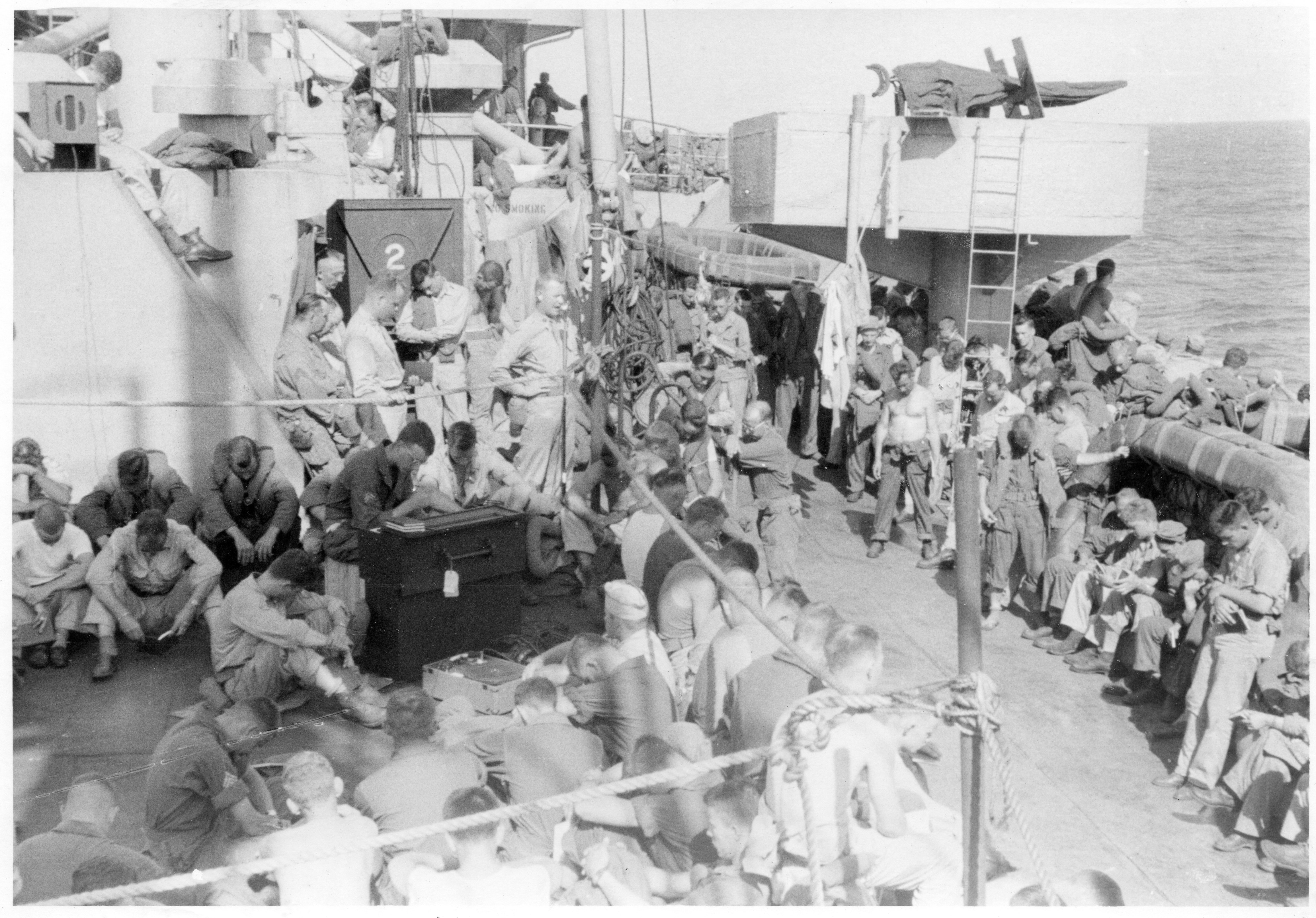
Every head was bowed

A reader of yesterday’s “On the Ship and on the Train” left a comment. The post featured this photograph of my father and his Army Air Force unit on board ship on the high seas on their way to Saipan in World War II.

My father, the Chaplain, on board ship to Saipan, WW!!.

My father, the Chaplain, on board ship to Saipan, WW!!.

Karin wrote:

“I clicked on the picture which made it large enough to fill my screen… I was amazed. Every man’s head was bowed. That brought a realization that they all knew what they were headed towards. Profound.”

My father was the Chaplain leading the prayer. Indeed, EVERY HEAD WAS BOWED.

Prayer came naturally to him. My brothers and I were blessed by his prayers every night at the dinner table. His head would bow. My mother’s head would bow. Our heads would bowed. There was a short, reverent silence – a time for centering, as we would call it today – followed by words. He addressed the Divine as “Thou”, not the familiar “you”. Antiquarian by contemporary standards, there was never any question that the “Thees” and “Thous” were not spoken to another one of us.

A remnant of his prayers – a sample of the kind of prayer by which he led the soldiers on the ship – was left in my possession in his old Bible.

God our Father, who hath commended thy love for us in that while we were yet sinners, Christ died for us: worthy was the Lamb that was slain to receive honor and glory and blessing.

Remembering once again him again whom we have pierced by our selfishness and folly, we acknowledge our sins and beseech thy forgiveness. We would learn of thee to forgive,  with thee to suffer, and in thee to overcome. Lord, in thy great mercy we ask that thou remember us now in thy kingdom – confirm our faith.

Forbid that we forget among our earthly comforts the mortal anguish our Lord Jesus endured for our salvation. As we behold him following the way of faith and duty even to the crown of thorns and the cross, grant us grace that we may learn the sterner lessons of life.

So endue us with power from on high that taking up our cross and following our Savior in his patience and humility we may enter in the fellowship of his sufferings and come at last to dwell with him in his eternal Kingdom.

I learned to pray at my father and mother’s table. Over time his theology changed in many ways, but his faith in Divine Goodness never waned.

In my last conversation with him before he died, I asked, “How are you doing with your faith?”

“Good,” he said with the heartiest smile his Parkinson’s would allow. He died two days later. His head was bowed.

The Reign of Christ

I’ve often wondered
why he included
me

in parables of goat
and sheep, of tare and
wheat

of a woman on a floor
to find her one
lost coin

of a manly crowd
with stones to throw at
“her”

of ramming rams and
bleating ewes and one
little lamb

of pride and loathing
of specks and logs in
eyes

of sight and light
of day and sleepless
nights

of father running to
greet his son from
empty sty

of water and wine
and miracles that healed
the sick and

called forth Lazarus
from the tomb, unwrapping
him and me

– GCS, Nov. 24, 2014 – early Monday morning the day following Christ the King (Reign of Christ) Sunday.

The Distant Murmurs of Prayer

“In our imaginations, we listen for the distant murmurs of prayer,” wrote Dennis Aubrey in his post “In Seclusio at Thines” posted on Via Lucis Photography.

Listening for the distant murmurs immediately brought to mind a hymn composed by Anne Quigley in 1992. The tune is LONGING. The textual refrain is:

“There is a longing in our hearts, O Lord, for you to reveal yourself to us. There is a longing in our hearts for love we only find in you, O God.”

It was the recollection of the text that drew me to LONGING. I searched YouTube for possible videos for this post but found that the lightness of the tune, like so much contemporary Christian music, left me longing for “the distant murmur of prayers” that echo down the ages in the Gregorian Chants once sung in the now empty or mostly empty monasteries and churches that inspired Dennis to conclude “In Seclusio in Thines”:

“[PJ and I] … hear the echoes of sandaled footsteps in lonely churches long deprived of their monastic communities. And in our imaginations, we listen for the distant murmurs of prayer.”

I long for gravitas awakened by the beauty of silence.

The President’s Speech

President Obama rang the bell last night in his speech on immigration. The President is a Constitutional lawyer. He is also a man of faith, a thoughtful Christian who interprets the Bible the way Abraham Lincoln did, and, like Lincoln before him, the President preached to a divided nation from the White House.

He used the bully pulpit to stop the bullying.

“Scripture tells us, we shall not oppress a stranger, for we know the heart of a stranger — we were strangers once, too. My fellow Americans, we are and always will be a nation of immigrants. We were strangers once, too.”

This morning Speaker of the House John Boehner, who for the past year-and-a-half has personally blocked a vote in the House on the bipartisan Senate immigration reform bill, filed a lawsuit, alleging the President has exceeded his authority. Mr. Boehner and others also threaten impeachment.

Very few of us understand the Constitutional separation of powers well enough to assess knowledgeably whether the President has or has not exceeded his executive authority, but given similar actions by every recent President, both Democrat and Republican, the Las Vegas odds-makers would surely lay heavy odds in favor of the Constitutional lawyer in the White House.

Catholic, Protestant, Jewish, Muslim and secular humanist leaders have led the fight for immigration reform for many years. They have commended the President’s actions and have renewed the call for Congress to pass bipartisan reform.

Because they’re not bomb-throwing religious extremists, there likely will be little media coverage of these religious leaders support for the President’s speech and actions. Like Mr. Obama, their faith, and the faith of the people and congregations they represent, are thoughtful and fairly quiet in demeanor. They don’t make headlines. But once in a while, one of gets to preach from the White House.

In the habit of some preachers who invite response from the pews following prayers or a sermon, “Let all the people say ‘Amen!’

Prayer

“She saw him standing in the parlor with his beautiful old head bowed down…praying looks just like grief. Like shame. Like regret.”
Lila, p. 95, Marilynne Robinson, 2014

Head bowed is the posture of humility, the position of a supplicant, petitioner, intercessor, or giver-of-thanks that looks to the eyes of the misinformed like grief or shame or regret. There is certainly all of that in those who pray, but it’s so much more, so much deeper, so much more reassuring.

We are often our own worst enemies. Every experience of the Beloved causes the head to bow and a tear to fall.

Weeping for Zion (Dennis Aubrey)

This post by Dennis Aubrey on Via Lucis Photography is splendid.

Dennis Aubrey's avatar

By the rivers of Babylon, there we sat down, yea, we wept, when we remembered Zion. Psalm 137:1 (King James Bible)

Aleksandr Solzhenitsyn was quoted as saying, “Over a half century ago, while I was still a child, I recall hearing a number of old people offer the following explanation for the great disasters that had befallen Russia: ‘Men have forgotten God; that’s why all this has happened.’ Since then I have spent well-nigh 50 years working on the history of our revolution; in the process I have read hundreds of books, collected hundreds of personal testimonies, and have already contributed eight volumes of my own toward the effort of clearing away the rubble left by that upheaval. But if I were asked today to formulate as concisely as possible the main cause of the ruinous revolution that swallowed up some 60 million of our people, I could not put…

View original post 765 more words

The Election: What Now? My Quandry

Rabbi Arthur Waskow of the Shalom Center granted permission to re-publish this morning’s reflection. It begins with a quote from Henry David Thoreau:

“Cast your whole vote,
Not a strip of paper merely.”

Dear friends,

During this week since the election, I have been living in a quandary.

The root of my quandary is my affirmation of these spiritual truths as applied to “political” events:

  • Ecology, the fullest expression of our science, teaches that if any species exerts total control over any eco-system — tries to gobble up all the nourishment in sight — it destroys the eco-system – and itself.
  • Torah teaches that we must love our neighbors as ourselves, and that we must grant the earth its rhythmic rest — or suffer disastrous floods, famines, exile.
    Democracy is an experiment in increasing interhuman compassion, community, and cooperation.
  • Ecologic sanity is an experiment in increasing interspecies compassion, community, and cooperation.

It seems to me that our recent election, dominated by huge gobs of money in the service of generating even huger gobs of money, marginalized both democracy and eco-sanity.

Part of me wants to believe that politics is always a game of waves — –– that a wave of attacks on democracy today will bring a wave of creative affirmations of democracy tomorrow. That the defeat of pro-democracy candidates (even in states where pro-democratic referenda won big) was an accident of abysmally low voter turnout (the lowest percentage since 1942), and that the progressive movement will recover in 2016.

On the other hand, part of me believes that at this moment in US history the whole system is broken, because extreme inequality of wealth and the dominant power of global corporations has smashed all the organs intended to protect and advance democracy.

And this part of me believes that this brokenness is driving not only America but all our planet into an enormous crash – a dead end where we cannot wait for the next wave of the old system, but instead must give birth to something entirely new. Beyond the kinds of elections we have now, beyond the economic structure built on fossil fuels during the past 250 years.

Not backward into feudalism but forward into new forms of eco-democratic community.

From the first perspective, what needs to happens next is more grass-roots organizing of the well-worn style, combined with a much bolder, clearer progressive populist message. The People vs. Wall Street.

From the second perspective, the meaning of this last election was taught 165 years ago in the midst of a growing crisis over slavery: “Cast your whole vote, not a strip of paper merely, but your whole influence. A minority is powerless while it conforms to the majority; it is not even a minority then; but it is irresistible when it clogs by its whole weight.” – Henry David Thoreau, “On Civil Disobedience”.

Which answer to my quandary is “right”? To get beyond my quandary – OUR quandary! – let’s start from basics:

Both our spiritual/religious traditions and the findings of modern science teach that community, connection, cooperation – in that dangerous four-letter word, LOVE –- are required for human beings and our planet to be healthy and life-giving.

It’s true that Control — in Buber’s language, I-It as distinct from I-Thou — is a necessary part of life. But when Control becomes so overwhelming that community, compassion, are erased –- disaster follows.

Triumphalism, like the “triumphs” of Pharaoh in enslaving people and the very earth his country lived in, becomes self-destructive.

Mentioning Pharaoh reminds us of an historical as well as moral truth:When Control becomes overwhelming, it self-destructs and a new form of society is born.

  • When the ancient Egyptian and Babylonian Empires over-reached, shattering the societies of early Western Semitic tribes, the new social form we know as Torah was born.
  • When the Roman Empire over-reached, it shattered Biblical Judaism – so that Christianity and Rabbinic Judaism and (a little later) Islam were born.
  • Now the machinery of Modernity has over-reached, and all the classic social forms of the last millennia have been shattered. Something new needs to be born. Is being born.
    For Control and Power to limit themselves so as not to over-reach –- is elementary wisdom, even simple sanity.

But this election was a triumph for the practice of insisting on Total Triumph — Big Money, Big Corporations, choking Earth’s atmosphere, heating Earth’s oceans, depriving the poor, the young, the Black, the Brown of the right to vote while giving the rich millions of extra votes in the form of hundreds of millions of dollars spent on elections.

More important – this election was a defeat for defeatists. Defeat for those who refused to stand up against these policies of Top-Down Power. Defeat for a President and a Party that has practiced preemptive surrender to Big Money since it took office in 2009. Defeat for those “liberals” who whimpered about Obamacare instead of proclaiming its undeniable though limited success.

By their timidity they were thinking to appeal to “moderates” — but instead they convinced these moderates that even the timidly progressive President and Party must be a failure.

Many of these same defeatists will behave as if 2016 can be won by the same defeatism that lost in 2014. They will point to mechanics: more Republicans up for grabs in the Senate, a respected woman candidate for President who is a pro-Wall Street “moderate,” more turn-out in a Presidential year.

But even their best efforts will be given to lessen disaster. The basic structure – enormous inequality in wealth, free use of that wealth in politics, the purchase of the Supreme Court by anti-democratic forces — will remain the same, and because of their own defeatism they will remain defeated, prisoners within it.

Even if they “win” the 2016 election, their “winning” will really conceal a more basic defeat — as it did for Obama in 2012.

Yet — preventing the worst is still desirable. Resistance to the worst attacks on democracy could begin right now: Not waiting for the next election, or even the next Congress to convene in January. What would that take?

(This is the first half of an exploration of the quandaries we face from a spiritually rooted perspective on the last elections. The second half is available at our website at https://theshalomcenter.org/content/election-what-next-my-quandary, and will also be in your in-box in the next few days.)

———————————

Thank you Rabbi Arthur Waskow for connecting the dots of faith, politics, economics, and the sacredness of the Earth.

Click HERE for the Shalom Center website.

The Good Earworm

This head scratching verse from Steve Shoemaker arrived this morning in response to yesterday’s post about the song in my head:

thegoodearworm

thelord’smyshep-herdi’llnotwant
hema-akesmedowntolie
inpa-asturesgreenhele-e-dethme
thequi-i-etwatersby

“What’s an earworm?” I wrote back. He phoned a few minutes later. “Don’t you know what an earworm is? Nadja didn’t know either. Look it up in an Urban Dictionary. It’s a song that gets stuck in your head.” “I didn’t know you were so street-smart,” said I. We had a good laugh. I looked it up.

Earworm: “A song that sticks in your mind, and will not leave no matter how much you try. The best way to get rid of an earworm is to replace it with another. Be prepared to become a jukebox.” (from Urbandictionary.com)

The earworm Steve seems to be hearing is the Crimond musical setting for Psalm 23. Dipping into the jukebox, here’s another lovely setting for the psalm, the replacement ear worm:


An Apple for Tim Cook

Apple CEO Tim Cook acted with courage yesterday. Click Tim Cook Speaks Up to read his October 30, 2014 letter in BloombergBusinessweek.

Every parent of a gay child, every gay person, every relative or friend should give an apple to the Apple teacher whose inspirations are Martin Luther King, Jr. and Robert Kennedy.

The Two Halves of Life

North Shore driftwood

North Shore driftwood


The first half is much bigger
than the second shorter half

green, naive, sprouting,
climbing, reaching, chasing

after stars we cannot yet see
but believe are there

in timeless skies that shine
and tease the imagination

of twinkling immortality that
halts when illness strikes

or death intrudes to put the
lights out in the sky

and remind us to look down
as well as up, at our mortality

this flesh and blood we are,
this dust and ash we cannot

shed no matter how we try
or imagine otherwise and

if we’re lucky or blessed,
we understand in the second

shorter wiser, browner, wilting
falling, losing, finding second

shorter half of life the calm
that comes in golden years.

– Gordon C. Stewart, Oct. 25, 2014