What is the “Militia” of the Second Amendment and how did “the right to bear arms” get there? Thom Hartmann summarizes a different account of what we now know as the Second Amendment. Please chime in after you’ve read through the piece.
“Woodbine Willie” is a strange name for an Anglican priest. The nickname was given to
G. A. Studdert Kennedy (1883 – 1929)
G. A. Studdert Kennedy (1883-1929) by the battered troops of the British forces to whom he ministered in World War I.
The name came from the “Woodbine” cigarettes he gave to the troops. Woodbine Willie grew up among the desperately poor. He had two great passions: the church and social reform. He never winced and, oh, how he was loved by what were then known as “the common people.” He was a fighter for social justice and human rights, but he also advocated civil conversation, what he called “a plane” upon which people of differing views and good conscience would come together to resolve a problem. Think about the current national debate in the wake of the tragedy at Newtown.
“There is, and there must be, a plane upon which we can think and reason together upon questions arising out of our wider human relations, social questions, that is, apart from and above party prejudice and sectional interest. If it is not so, and there is no such plane, and we can not think of these big questions outside the prejudices and passions that arise in party strife, then it is safe to assert that there will never be any solution of the problems whatsoever. The idea that politics in the true sense – that is, the art of managing our human relationships on a large scale – must remain a separate department of life, distinct from morals and religion, is ultimately irrational and absurd, and is an idea with which no responsible teacher ought to have anything to do. – Sermon, “The Church in Politics: a Defense”
Tomorrow night, Tuesday, Feb. 5, Shepherd of the Hill Presbyterian Church in Chaska will do its best to provide “a plane” for reasonable discussion of the epidemic of gun violence in America. 7:00 – 8:30 PM. Hope and pray that it be an evening where we step back to discuss “the big questions outside the prejudices and passions that arise in party strife.”
Thanks to the editor of The Chaska Herald for this piece on the series on “Gun Violence in America” that begin next, Tuesday, Feb. 5 at Shepherd of the Hill Church in Chaska.
First Tuesday Dialogues:examining critical public issues locally and globally* will host three Tuesday evenings of public discussion of the causes and remedies of gun violence in America. Each program will begin at 7:00 PM and end at 8:30 PM.
The series begins withCity of Chaska Chief of Police Scott Knight providing fact information and a law enforcement perspective. Chief Knight just returned from meetings in Washington, D.C. on the epidemic of gun violence in the wake of the tragedy at Newtown, CT.)
The series then turns to a face-to-face debate between proponents and opponents of increased gun control legislation, and concludes with a broader overview of the problem of violence, guns, self-protection, and law, led by a professor of ethics.
Tuesday, Feb. 5, 7:00 PM: Scott Knight, Chief of Police: “The Epidemic of Gun Violence in America”.
Tuesday, February 19, 7:00 PM: A respectful conversation between a proponent (Protect Minnesota) and opponent (NRA) of greater gun control.
Tuesday, March 5, 7:00 PM: A professor of ethics lead a discussion of the various Ethical Perspectives by which people of faith and good conscience approach the conundrum of violence, liberty, and the role of law in society.
* First Tuesday Dialogues is a community program of Shepherd of the Hill Presbyterian Church, ”a place for the mind and heart”, offered free of charge on behalf of the public good. All are welcome.
Walter Rauschenbusch (1861 – 1918), “father of the Social Gospel Movement”
“All human goodness is social goodness. Man is fundamentally gregarious and his morality consists in being a good member of his community.”
“The chief purpose of the Christian Church in the past has been the salvation of individuals. But the most pressing task of the present is not individualistic. Our business is to make over an antiquated and immoral economic system….”
The Rev. Walter Rauschenbusch had a profound impact on Christian theology and activism that led to the end of child labor and to legislation that protected worker rights in the early 20th Century. The man whose theology was shaped by his ministry with the poorest of the poor in the “Hell’s Kitchen” of New York City is the man from whose “Social Gospel” Glenn Beck now urges church members to flee for their lives.
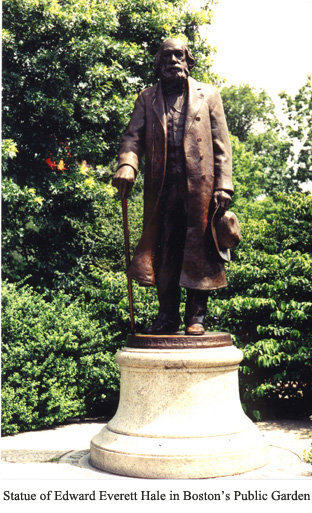
Edward Everett Hale was asked if he prayed for the Senators. He replied:
“No. I look at the Senators and pray for the country.”
The Reverend Mr. Edward Everett Hale (1822 – 1909) served as Chaplain to the U.S. Senate. He was appointed to the position because of his outstanding public ministry as Minister of South Congregational (Unitarian) Church in Boston. He proposed a public retirement pension system for both women and men long before there was Social Security.
First Church Boston’s website provides this account of his ministry.
Thanks to Caroll Bryant for capturing our attention with her blog’s publication of the witticisms famous historical figures.
It’s the eve of Martin King Day. This morning’s Star Tribune tells the story “Murderous ‘monster’ acquires an arsenal” in Carver County, Minnesota. Three cheers to you, Jim Olson, Carver County Sheriff. Thanks to the Star Tribune and other newspapers for keeping us informed.
The Oberender case exposes loopholes in national gun laws and Minnesota’s background checks. Here’s the link to the piece:
Today in worship we will look again at the call of Samuel and the call of Jesus’ first disciples who asked Jesus an odd question. “Where are you staying?” “Come and see,” he said. I wonder: Are there guns where Jesus lives?
Thanks to Robert Perschmann for bringing attention to this link, sent out as a New Year’s gift by The People’s World, the newspaper of the Communist Party USA.
Robert sent the link as a part of a comment on Views from the Edge’s post from “Every Valley” from Handel’s “Messiah”. I responded with the following reflection, slightly edited here.:
“Robert, the valleys and mountains, and the rough places a plain, or level place, are so clearly (biblical) metaphors for the coming of economic just. “He has put down the mighty from their thrones, and exalted those of low degree. He has filled the hungry with good things, and the rich he has sent empty away.” The hearer is transported into a vision and hope that can only be voiced and heard in poetry. It is the day of the lion and the lamb, the end of violence and sorrow, the end of the disparities of the sated and the sorrowful.
Josef Hromadka
“Josef Hromadka, Czech theologian and “father of Christian-Marxist Dialogue” during the Cold War, always said the church’s unfaithfulness to its calling was responsible for the atheism of communism. In Czarist Russia there were, on the one hand, the Czar and the Church, and, on the other, the peasants, the poor, the suffering who were oppressed by the throne and consigned to perpetual poverty by the church that taught them to be patient in their hope for another world. Hromadka called for the church to confess the sin of abandoning it charter and its hope. He saw in communism the re-awakening of the original grand hope for the coming of the Kingdom of God.
“Hromadka was a much-beloved professor of theology at Princeton Theological Seminary during the 30s and 40s. My father studied with him and remembered him fondly as a great teacher. When Hromadka left his secure teaching position in Princeton in 1947, many of his Western friends and colleagues were deeply disappointed and highly critical. They viewed him as naïve, a communist, or communist-sympathizer. Hromadka returned to create in Czechoslovakia and the wider Eastern bloc a dialogue that would contribute to the hope for a more humane and human society in both the church and the society..
“Thanks for the link. So interesting and rather mind-blowing that the newspaper of the Communist Party USA would choose Beethoven’s 9th as a New Year gift. I’ll listen with new ears.”
Princeton Theological Seminary Professor Charles West’s “Hromadka: Theologian of the Resurrection” offers an in-depth look at Hromadka’s life and witness as seen by a faculty colleague in the West. Here are some excerpts from the article:
Hromadka rejected both liberalism, with its shallow view (of the human crisis, and conservatism, with its allegiance to old structures which had lost their moral power. “We are living on the ruins of the old world, both morally and politically,” he concluded. “No one single element and norm of our civilization can possibly be taken for granted.”
With this faith which he continually translated into political judgments, Hromadka made the choice to return to Czechoslovakia in 1947, to accept the Communist coup d’etat in 1948, and to work as a Christian within the framework of a Marxist-dominated socialist society.
“I am in no sense a Communist,” he wrote, “but I take part in this revolution from the point of view of my Christian faith which sees the work of the forgiving grace of God in the midst of changes that are coming about.”
Thanks for coming by Views from the Edge. Leave a comment to promote discussion.





 Views from the Edge