
Idealism and Terror

When one thinks of idealism, Martin Luther King, Jr. or Gandhi comes to mind. Moral and spiritual giants who stand for ideals that make the world a better place. We think of Idealism as good in the face of evil, or of ideals lifting us up from the dirt of reality, purifying life from its toxins. Ah, but there lies the fatal flaw in idealism itself.

George Will’s Washington Post opinion piece “A Murderer’s Warped Idealism” looks afresh at idealism and evil, not just evil masquerading as idealism, but idealism as a source and form of evil itself.

Will’s commentary zooms in on Adolf Eichmann, executed at midnight 1961 for his role in the German State’s systematic extermination of 6,000,000 Jews. During the trial in Jerusalem Eichmann minimized his role in the Holocaust, presenting himself as a thoughtless functionary carrying out the orders of his superiors.

Referring to newly discovered writings by Eichmann which form the backbone of a new book by German philosopher Bettina Stangneth, Will writes:

Before he donned his miniaturizing mask in Jerusalem, Eichmann proclaimed that he did what he did in the service of idealism. This supposedly “thoughtless” man’s devotion to ideas was such that, Stangneth says, he “was still composing his last lines when they came to take him to the gallows.” (Bolding added by Views from the Edge)

Eichmann and Hitler were not without ideas or ideals. They were not thoughtless. Nor were they irrational, as those who believe that reason can sea us believe. They were idealists who sought to lift up a super race, burning away the world’s impurities as their deranged hearts conceived of them.

The late Dom Sebastian Moore, O.S.B. shone a different light on idealism and the remedy for human madness. He put it this way in The Crucified Jesus Is No Stranger:

“We have to think of a God closer to our evil than we ever dare to be. We have to think of [God] not as standing at the end of the we way take when we run away from our evil in the search for good, but as taking hold of us in our evil, at the sore point which the whole idealistic thrust of man is concerned to avoid.”

We are, says Moore, “conscious animals scared of our animality and seeking to ennoble ourselves.”

Eichmann, Himmler, and Hitler were idealists. Nationalist extremists are idealists. Racial and religious extremists are idealists. ISIL is idealist. American exceptionalism is idealist. Whether behind the banner of the State, or of religion, gender, ideology, scientism, or rationalism – idealistic terrorism lives to rid the world of evil as its adherents understand it, projecting evil as “the other” while fleeing “the sore point” that we conscious animals seek to avoid.

Only the God who meets us at the sore point of our shared animality can save us from fantasies. In his last book, Remembered Bliss ((Lapwing Publications: 2014), Dom Sebastian told the reader, “I’m ninety-six, and for most of my life I’ve been a monk. My life as a monk has been, for the most part, the search for God as real.” RIP.


Campaign Mind Control

Words are POWERFUL!  Timothy Egan’s “Deconstructing a Demagogue” in the NY Times reminds us of just how powerful they are:

Back in 1994, while plotting his takeover of the House, Gingrich circulated a memo on how to use words as a weapon. It was called “Language: A Key Mechanism of Control.” Republicans were advised to use certain words in describing opponents — sick, pathetic, lie, decay, failure, destroy. That was the year, of course, when Gingrich showed there was no floor to his descent into a dignity-free zone, equating Democratic Party values with the drowning of two young children by their mother, Susan Smith, in South Carolina.

Today, if you listen to the PAC ads flooding our television sets, you’ll hear the innuendoes and strategies  from the “Language: a Key Mechanism of Control” memo

And that’s just the beginning of the story of how language is used for social manipulation. Gingrich knew that language is “A Key Mechanism of Control.” Those who are well-schooled in theology and politics know that language is the primary mechanism of mind control: truth becomes falsehood and falsehood becomes truth; beauty becomes ugliness and ugliness becomes beauty; goodness becomes evil and evil becomes goodness, twisted by the language of innuendo and word association.

The cynicism that pervades the American electorate is due, in part, to this demagogic use of language. Words are precious things. Holy things. Sacred things. When they get twisted, they become vulgar and profane, one might even say ‘demonic’ in the sense in which Paul Tillich defined ‘demonic’: the twisting of the good. “The claim of something finite to infinity or to divine greatness is the characteristic of the demonic” (Paul Tillich, “Life and It’s Ambiguities,” Systematic Theology, Vol. 1, p. 102).

The campaign for control of the U.S. Senate and House of Representatives is in full swing. So is demagoguery and the Gingrich memo on mind control.

Words are sacred. Abuse of them plunges the speaker and the hearer into the darkness of the demonic twistings that led James Russell Lowell to write the hymn lyrics I sang as a child:

Once to every man and nation Comes the moment to decide, In the strife of truth with falsehood…. Though the cause of evil prosper, Yet t’is truth alone is strong; Though her portion be the scaffold, And upon the throne be wrong, Yet that scaffold sways the future, And, behind the dim unknown, Standeth God within the shadows, Keeping watch above His own.


– James Russell Lowell, 1945, “Once to Every Man and Nation”

I hope. I hope…and pray we’re as smart as Paul Tillich.

Forgiveness 360 – Moving On

Moving on is hard and joyful at the same time.

Fourteen (14) days to retirement. Joyful announcement yesterday introducing Dean Seal, the next pastor of Shepherd of the Hill in Chaska. Dean is Executive Director and Founder of Spirit in the House and Forgiveness 360. A stand-up comedian, actor, director, producer, and event organizer, Dean is an ordained Presbyterian minister who teaches religion as part-time adjunct faculty at Augsburg College in St. Paul, Minnesota. Wonderful choice. I’m moving on more easily knowing that Dean is coming to Shepherd of the Hill.

Glaring Omissions and “Something Else”

The Washington Post-ABC News Poll published September 9, 2014 is as interesting for what it ignores as for what it reveals.

Question #13 asks registered voters which of the following will be “the single most important issue in your vote for Congress” – the economy and jobs, international conflicts, health care, the way things are working in Washington, immigration or something else? Eleven percent said “Something Else”.

The omissions of climate change, wealth disparity, and Citizens United (campaign finance reform) are curious and glaring. The poll assumes what the public cares about. By ignoring these matters that reach beyond partisan divides the poll demonstrates one of two things, Either the Washington Post-ABC New Poll is out of touch with those who live on Main Street or their bread is buttered by the Wall Street and the one percent.

Polling and news institutions not only measure public opinion; they shape public discussion by the choices they make about which questions to ask.

The American public is often smarter than given credit for. But its intelligence and its opinions on public policy issues are informed and shaped by the information we receive from the “Fourth Estate” which – in theory, if not always in practice – is independent from the three government branches of the U.S. Constitution. The “free press” is the people’s watchdog, monitoring the actions and decisions of the three constitutional estates and their complex bureaucracies and institutions. We look to the free press to do for its readers what the individual cannot do: investigate the way things are – who’s making the deals and why, who’s stacking the deck, and who’s dealing from the bottom of the deck.

As the ownership of newspapers, radio stations and television cable and satellite dish companies has shrunk to the size of the one percent who live on Wall Street, the press, like the the three constitutional estates, is not so free. While Republicans and Democrats argue about whether climate change is real and while congress fails to act, it falls to the Fourth Estate to exercise whatever freedom it may still have to raise the flag of the single most important issue facing not only the planet itself. The same is true with the moral issue of the wealth disparity and the Supreme Court’s decision that turns the American electoral system over to the highest bidder

The detail of those who answered “Something Else” shows t 14 percent of “white non-evangelical protestants” in response to Question 13. Among this subset – the “traditional” protestant churches (Episcopalian, Presbyterian, United Methodist, Congregationalist United Church of Christ, Unitarian-Universalist) – much attention has been paid from pulpits and from church position statements to the alarming growth in wealth disparity and the environmental degradation that has led us to the brink of “climate departure” when there will be no way back.

Nothing on the list of “single most important” issues is as long-lasting as climate change. It is the darkening global cloud under which all other issues exist. Framing the public discussion as a choice between the economy and jobs, international conflicts, health care, the way things are working in Washington, or immigration continues the myopic gridlock that keeps our eyes too low to the ground. It makes little difference whether one proclaims or denies that the changes in weather patterns are evidence of global climate change that call for action now to reduce carbon and methane emissions. We all know that something is happening here on the North American continent and around the “pale blue dot” (Carl Sagan) that is changing the planet as we have known it.

Enter Vermont Senator Bernie Sanders (I) who answered “something else!” on “Meet the Press.” Congratulations to Meet the Press host Chuck Todd for widening the discussion.

Robin Williams and Us

Few people made so many laugh or cry as Robin Williams. Today we’re not laughing. We’re crying.

What Robin’s world inside his own skin was like no one else really knows. His sudden death strikes us with an equally sudden sadness. It punctures a hole in our perceptions, brings to a screeching halt the presumption of dailyness and the ordered worlds in which we wrap ourselves in a society whose madness Robin himself helped us to transcend.

We are not among the few who knew him intimately. As in the aftermath of Michael Jackson’s death, we are left to pause and pray for his family and closest friends and to consider again the greater tragedy of violent social order where reason and kindness are as alien as Mork was to this strange world.

The stories in the next days will feed public curiosity, appealing to the need for some cause on which to pin the tragedy, like pinning the tail on the donkey, some manageable explanation for why a man so funny and gifted would apparently take his own life. We will hear that it was clinical depression or bi-polar disorder or drugs or alcohol or some other diagnosis that explains his death.

But will they address the bigger human question to which Robin gave his life in comedy and in drama: why is the world so in love with death? Why is the world we have built for ourselves so cruel? Why does it take an alien named Mork with an innocent young woman named Mindy to deliver us from the love affair with a collective madness for which there seems to be no cure? And how do we, when we bump up against an inexplicable death like Robin’s, pause appropriately in his honor to give thanks for him in both his laughter and his tears?

Of Guide Dogs and Legislatures

Verse – The Blind Leading the Blind

To train a guide dog for the blind
it has been learned a puppy should
be taken from the mother on
the forty-ninth day exactly.

But in my State of Illinois,
there is a Law that says eight weeks,
not seven, is the earliest
a little pup can leave the dam.

The bonding to the new feeder
and comforter will not take place
so soon or easily, but this
was not known by the law-makers.

Or maybe some bad lobbyist
with deep pockets got to them first
“Eight…seven–no matter which!
Just let the blind fall in the ditch…”

– Steve Shoemaker, Urbana, IL, August 11, 2014

Sermon – Faith and Patriotism

Friendly fire and Fratricide

“There is the possibility that fratricide may have been involved,” said a U.S. military official yesterday of the five American soldiers’ deaths in southern Afghanistan, according to news reports like this one from NBC News. The sentence came over my car radio yesterday. I’ve been pondering it ever since.

Interesting choice of words: “fratricide”, the killing of a brother, meaning, in this case, one of our guys, not one of their guys.

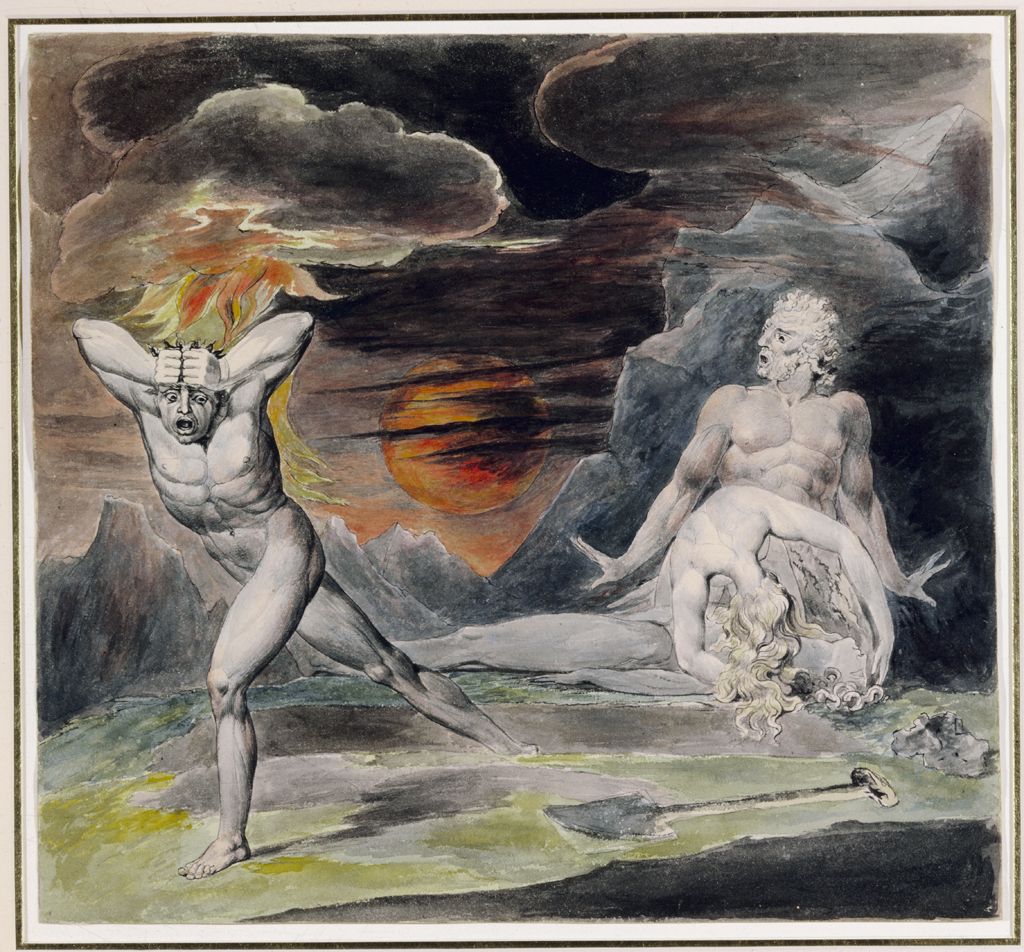
The Genesis story of Cain and Abel is the archetypal fratricide in Western culture. Cain turns to violence. Abel, his biological brother, is dead. When God asks Cain where his brother is, Cain retorts, “Am I my brother’s keeper?”

The answer is “Yes, Cain, you are.” Fratricide is out of order.

So is friendly fire. But what about killing the Taliban? Is that “unfriendly fire”? Is that not fratricide because the Taliban are not my brothers?

My ears are attuned to fratricide and to the use of language that brings theology and humaneness into stories like yesterday’s tragedy in Afghanistan and many wartime public relations press releases. The implication is clear. One of our guys may have killed one of his own guys.

In a subsequent statement, another military official said that, in the daylong fight preceding the apparent friendly fire airstrike, the joint U.S.-Afghan security forces operation had killed “lots of them” (i.e., Taliban, the enemy, the non-brothers). The case is being investigated.

Every death of a human being at the hands of another human being, on the ground or from the air, is an act of fratricide.

William Blake painting of "Cain fleeing from the wrath of God "as Adam and Eve look on in horror following the fratricide.

William Blake painting of “Cain fleeing from the wrath of God “as Adam and Eve look on in horror following the fratricide.


Do not forget! We ARE Nature – Nature Is Us

Text of sermon on sanity and madness visa a vis ourselves (homo sapiens) and the rest of nature preached at Shepherd of the Hill Presbyterian Church in Chaska, MN.

We need stories to keep us sane in a culture whose sanity is madness.

In Souls on Fire Elie Wiesel, the Nobel Peace Prize concentration camp survivor, tells the story of “prophetic madness” that challenges the collective madness of a people who ignore the coming calamity of impending crop failure. “Good people…What is at stake,” says the prophetic messenger, “is your life, your survival! The summons falls on deaf ears and the calamity of starvation is not averted.”

Wiesel concludes, “God loves madmen. They’re the only ones he allows near him.

Late in the year of 1964 a young geography student working toward his doctorate came upon a grove of Bristlecone Pines while doing research searching on Ice Age glaciers.

Wheeler Peak, on Nevada’s eastern border with Utah, reaches an altitude of 13,063 feet with a spectacular glacial cirque on its northeast side. Wheeler Peak cycles through five life zones, from the hot stony desert to alpine tundra, all within a five mile line. Along the edge of this cirque is the home of colossal bristlecone pines. Standing as they have for millennia, in their fields of stone, they overlook the desert far below.

When this student and his associate came upon the bristlecones at the timberline, they began to take core samples from several trees, discovering one to be over 4,000 years old! Needless to say they were excited, and at some point, their only coring tool broke. The end of the field season was nearing. They asked for, and were granted permission, by the U.S. Forest Service to cut the tree down.

They had just cut down one of the oldest living organism on the planet. An earlier group of researchers at Wheeler Peak and given names to the these ancient creatures whose lives reach back to the third century before Christ. They had named some of these trees. Ancient names like Socrates and Buddha. And then there was Prometheus, named after the god in Greek mythology who was punished for stealing fire from the gods and giving it to humankind. Zeus has Prometheus chained to a rock for an eternity of perpetual torment.

It was the tree named after Prometheus that the geology students had killed. They had cut down a tree that was 4,844 year old.

What happened that day on Wheeler Peak is now viewed as a kind of martyrdom by some of the Bristlecone Pine researchers – in inexplicable horror of Prometheus’ death served to save the other Bristlecone Pines from extinction at human hands. You might even say it is to the Bristlecone Pines what the cross of Jesus is to the human species, a death that brings life to the rest of us.

The death of a 4,844 year-old tree and the death of Christ are two sides of a single coin. The death of Prometheus at the tree line on Wheeler Peak is the death of nature at human hands. The death of Jesus on The Hill of Skulls is the death of humankind itself, and out of both deaths, by God’s grace alone, a new human awareness – a new humanity within nature – is awakened.

In the death of that old Bristlecone Pine the other researches came to a new appreciation of nature itself. Not only its magnificence. Not only our dependence upon nature. But our oneness with nature. Homo sapiens do not stand above nature; we stand within it. We are nature; nature is us.

Elie Wiesel reminds us that there are two kinds of madness. There is the societal madness that continues business as usual but is actually insane; the other is what he calls “prophetic” madness that challenges the madness which sees the Earth as a landfill or playground with no value in itself apart from its use to us. Prophetic madmen cry out, “Good people, do not forget! What is at stake is your life, your survival! Do not forget!”

As we remember that story out of which our faith awareness is born around the Lord’s Table, I close with another story from Elie Wiesel.

When the great Rabbi Israel Baal Shem-Tov saw misfortune threatening the Jews it was his custom to go into a certain part of the forest to meditate. There he would light a fire, say a special prayer, and the miracle would be accomplished and the misfortune averted.

Later, when his disciple, the celebrated Magid of Mezritch, had occasion, for the same reason, to intercede with heaven, he would go to the same place in the forest and say, “Master of the Universe, listen! I do not know how to light the fire, but I am still able to say the prayer.” And again the miracle would be accomplished.

Still later, Rabbi Moshe-Leib of Sasov, in order to save his people once more, would go into the forest and say, “I do not know how to light the fire, I do not know the prayer, but I know the place ad this must be sufficient.” It was sufficient and the miracle was accomplished.

Then it fell to Rabbi Israel of Rizhyn to overcome misfortune.

Sitting his his armchair, his head in his hands, he spoke to God: “I am unable to light the fire and I do not know the prayer; I cannot even find the place in the forest. All I can do is to tell the story, and this must be sufficient. And it was sufficient.

God made man because he loves stories.

Remember, Good people. Do not forget. God loves “prophetic madmen” who challenge the madness. Remember Prometheus. Remember the Hill of Skulls. Do not forget. We are not above nature. We are part of nature; nature is us. Thanks be to God.


The Bristlecone Pines