In Memoriam: the MSU Philosophy Student

“The life of the dead is placed in the memory of the living.” – Cicero

The philosophy student who shot himself in the library at Mankato State University yesterday could have been me many years ago. Or is it “could have been ‘I’”? I or me is a question of grammar without much consequence. Philosophy is a question of meaning. Grammarians don’t shoot themselves. Some philosophers do.

I know nothing about the 27-year-old philosophy major at MSU. I don’t need to know more for tears to fall while reading the Star Tribune news report over morning coffee.

A Minnesota State University Mankato student shot and killed himself Monday afternoon in the campus library.

Police were called about 4 p.m. to the library after receiving a report of a suicidal man. After searching Memorial Library, police found the 27-year-old man, a junior philosophy student, on the second floor. Police said he turned the gun on himself and shot.

Police said no one else was in any danger during the incident.

The library was open Monday evening but with access only to the lower level, first and third floors.

I feel sick. It’s sad enough when anyone takes his or her life. It’s sadder still, at least for me, to learn that he was studying philosophy and that he appears to have found a solitary place on the second floor, perhaps among the stacks in the philosophy section of the library, as I imagine it.

He was a junior, as I was when the course in contemporary philosophy plunged me into deep despair. Psychology majors might have called it depression because it looked like that on my face. But there’s a difference between depression and existential despair.

Jean-Paul Sartre’s Being and Nothingness, No Exit and The Flies, and Franz Kafka’s Metamorphosis and The Trial were like nothing I had ever read or heard. They blew my mind to smithereens, leaving me very much alone with the sense of nothingness.

By the time I hit the books in the library that junior year, I ate, drank, and slept philosophy. Of the 18 hours of courses I had decided to carry, only the philosophy course seemed important. Raised in a Christian home, I had always prayed, more or less, giving thanks and asking for blessings on those I loved and the less fortunate. But now prayer seemed a cruel hoax, “bad faith” as Jean-Paul Sartre put it. Why I would return from class and kneel down beside my bed not for “now I lay me down to sleep” but to tell God to go to hell is one of the great ironies, a question grammarians cannot answer.  Had I had a gun that afternoon, my roommate might have found me on the floor in Room 301 of Carnegie Hall.

I know nothing of the circumstances or state of mind of the 27-year-old MSU philosophy student. Perhaps no one will ever know for sure. It may be that his experience bears little or no resemblance to mine all those years ago. It’s not for me to know.

I don’t even know your name, but I sure do feel you! And I feel for those who mourn your loss. “That God does not exist, I cannot deny,” wrote Sartre, “That my whole being cries out for God, I cannot forget” – Jean-Paul Sartre.

Almighty God, Father of mercies and giver of comfort: deal graciously, we pray, with all who mourn; that, casting all their care on You, they may know the consolation of Your love. [The Book of Common Prayer]

Rest in Peace

– Rev. Gordon C. Stewart, Chaska, Minnesota (an hour from Mankato), Feb. 3, 2015.

Keystone XL Pipeline and Prairie Roots

The Keystone XL pipeline is more than a pipeline. It’s a rich man’s pipe dream that calls to mind an alternate view of reality itself: the psalmist’s tree with deep roots planted by the rivers of waters. Poets speak truth.

Blessed is the man
who walks not in the counsel of the wicked,
nor stands in the way of sinners,
nor sits in the seat of scoffers;
but his delight is in the law of the Lord,
and on his law he meditates day and night.
He is like ia tree
planted by streams of water
that yields its fruit in its season,
and its leaf does not wither.
In all that he does, he prospers.
The wicked are not so,
but are like chaff that the wind drives away.

– Psalm 1, ESV Bible

Say no to Keystone! Say it for the prairie. Say it for water. Say it for yourself. It’s good for big oil. Good for Congressional Representatives and Senators funded by big oil and and big money. Bad for the environment. Bad for national and global policy shift to renewable sources of energy. The Keystone XL lobby is, in the long run, like chaff which the wind drives away. Let the people say, “Amen!”


Tribute to Marcus Borg (1942 – 2015)

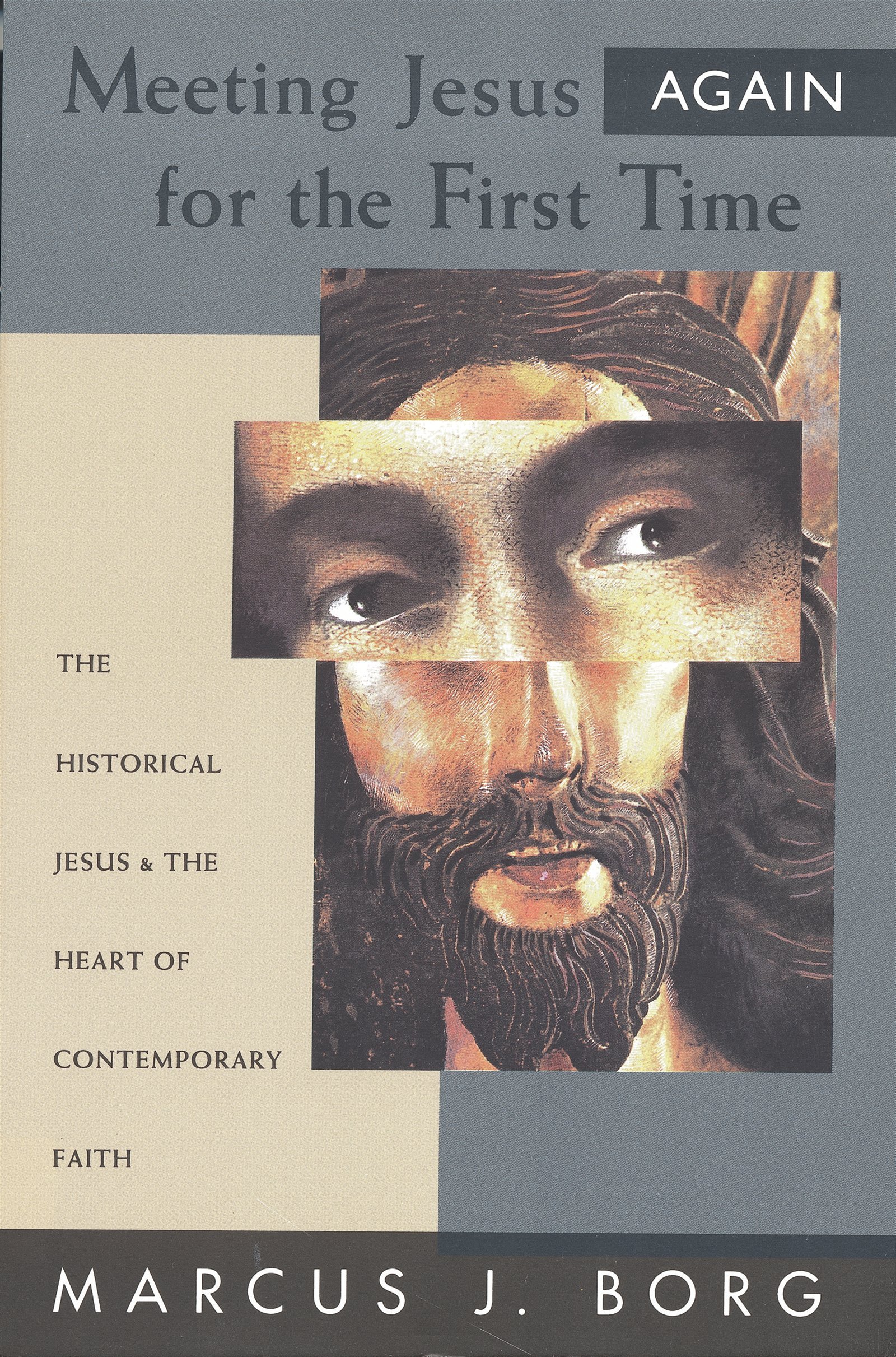
Cover of Marcus Borg book

Cover of Marcus Borg book

Marcus Borg’s writing and teaching affected millions.  Steve Shoemaker received an email of Marcus’s death yesterday from Barkley Thompson, who had quickly writtten the following tribute to Marcus on his blog “God in the Midst of the City“.

My friend, Marcus Borg
WEDNESDAY, JANUARY 21, 2015 / THE VERY REVEREND BARKLEY THOMPSON

Marcus Borg died this morning after a prolonged illness. I received a phone call this afternoon from a Cathedral parishioner and friend of Marcus, relaying the news to me.

I first became aware of Marcus Borg when I was a sophomore at Hendrix College. His landmark book, Jesus: A New Vision had just been released. It hit me at exactly the right time. I was a philosophy & religion major who knew God and increasingly knew about God, but I had little room or need for Jesus. Marcus’ book gave me an entirely new access point: to consider Jesus as Jesus had been historically, as a wisdom teacher, a healer, a social prophet, and more.

Marcus Borg

Marcus Borg

I first heard Marcus speak at Hendrix. He was the epitome of a college professor, right down to the cardigan sweater and pipe. He spoke calmly and with passion, and the first time I heard him in person was also the first time I understood how those tho things–calm and passion–could coincide.

I heard Marcus speak several other times over the years, but it was after I’d become a priest that I came to know him personally. When he was the annual Dodson Lecturer at St. John’s-Roanoke, he and I went to dinner. I was starstruck and wanted to quiz him about his research and his approach to Christianity. He’d have none of it. Marcus wanted only to talk about me, about St. John’s, about our ministry, and about my experience as a young priest in the Episcopal Church. He was solely interested in me, and I’ve never forgotten it.

Several shared meals and opportunities for fellowship later, my Christology has become higher and higher as the years have gone by. In ways I could not have done all those years ago in college, I now attest without hesitation that Jesus the Christ is God Incarnate, the hinge of history, the defeater of death, and the fulfillment in a single human life of God’s hopes for the whole world. And yet, my approach to Holy Scripture, my social convictions, and my love for the Episcopal Church mirror Marcus’ own perspectives quite closely. I once introduced Marcus to a church audience by saying, “I agree with roughly 75% of what Marcus will say to you this evening.” When he stepped into the pulpit, Marcus quipped, “I’m tempted to forego my notes and discuss with Barkley the other 25%!”

Unlike so many other writers in the field of religion (on both ends of the spectrum), Marcus was humble. Once one of my parishioners asked him during Q&A, “But how do you know that you’re right?” He paused, looked at her thoughtfully, and said, “I don’t know. I don’t know that I’m right.”

Very many people who had left the Christian faith have returned to it through Marcus’ evangelism (though he would grimace at my use of the word, I suspect). Marcus was a Christian, a follower of Jesus Christ in word and in deed. He understood Jesus (and especially the Resurrection) differently than I do. But the veracity of his faith was clear. And calm. And passionate.

Marcus and I last corresponded in late November. I’d asked how he was doing, and he responded, “I may have ten years left. Not sure I want more. There comes a time to let go. And I could, with gratitude, sooner than that. My life has been very blessed.”

Like Abraham, Marcus was blessed so that he could be a blessing. He blessed my life, and I am grateful.

NOTE: Since February 2013, Barkley serves as the eighth dean and twentieth rector of historic Christ Church Cathedral in Houston, Texas.  Click HERE for more information about the him.


Cuba: The Embargo Wall

“SOMETHING there is that doesn’t love a wall,

That sends the frozen-ground-swell under it,

And spills the upper boulders in the sun;

And makes gaps even two can pass abreast.”

Robert Frost, “Mending Wall”

Two human beings passed abreast through a wall yesterday: the invisible wall between the U.S. and Cuba.

The wall was built by human hands. It’s coming down by human hands. Like the Berlin Wall and “the Iron Curtain” that went up during the Cold War between the East and West.

Here in the States the story was that the wall and the curtain had gone up to keep people in. And that’s what I thought until the summer of 1966 while living “behind” the wall with the Schulz family in Bratislava as The Experiment in International Living’s Chicago Ambassador to Czechoslovakia.

A visitor from the West was immediately struck by the absence of bill boards. There were no advertisements like in Chicago. Bratislava struck me at first glance as a gray place, a dull place, a colorless place, a depressing place. But depression and beauty are in the eye of the beholder.

“The wall isn’t there to keep us in,” said my hosts at the third floor walk-up apartment at #7 Legionarska Street. “It’s there to keep you OUT.” Their story was altogether different. They were trying to keep Western materialism, Western greed and commercialism on the other side of the wall.

They built the wall, they said, to make possible the building of a new character: a more generous, less predatory, more social community beyond the old disparities of wealth and poverty.

“Today Robert Fronts-Diaz, who owns a Twin Cities translation and communications business, says the U.S. embargo was ‘an opportunity for Cuba to build character… Since I was a little kid, I wanted the Cuban embargo to be lifted,’ Fonts-Diaz said, his voice breaking with emotion. ‘I am very deeply touched that my request has been fulfilled,’” [“For state’s Cuban, change was a long time coming,” StarTribune, Dec. 18, 2014]

“SOMETHING there is that doesn’t love a wall….” In the end, over time, they all come down

[Eternity] “spills the upper boulders in the sun;

And makes gaps even two can pass abreast.”

Cuba – Finally a Breakthrough

Goliath’s bullying is almost over. After 53 years, by the good offices of Pope Francis and Canada, and  by order of U.S. President Barack Obama and Cuban President Raúl Castro, the U.S.A. and Cuba are taking steps to normalize relations. At long last, Cuba and we will be neighbors again.

FLASHBACK:

It’s later afternoon in 1979. A 37-year-old minister/college pastor from Wooster, Ohio is mixing with other guests from all over the world at a social hour on the veranda of the residence of the Rev. Dr. Jose Arce Martinez, Dean of the ecumenical Protestant seminary in Matanzas, Cuba.

Thirteen years earlier, the young minister, then a seminarian, had been sent by the City of Chicago Chapter of the Experiment in International Living to live for three months in Bratislava, Czechoslovakia. There he had participated in the Christian-Marxist Dialogue founded by Czech theologian and former Princeton Theological Seminary Professor of Theology Josef Hromadka. In Bratislava he had lived with the Schulz family.Mr. and Mrs. Schulz were employed by the Department of Economics and the Department of Justice. Pan (Mr.) Schulz, after welcoming him to their home with a shot of Slivovitz (plum brandy), had said with a a smile, “I’m a whole lot Marxist…but still a little bit Lutheran.”

The 75 international guests at the Matanzas seminary are Christian theologians, bishops, and pastors from Angola, Mozambique, Zimbabwe, South Africa, Argentina, Venezuela, Chile, Mexico, Uruguay, Peru, the U.S.S.R, East and West Germany, France, and the U.S.A. They’ve been convened at the invitation of the seminary with the consent of the government of Cuba following the Pope’s conference on human development at Puebla, Mexico.

Earlier that day the guests had stood on the lonely beach of Playa Girón, site of the Bay of Pigs invasion, where the air was still heavy from the deaths of the CIA-led invasion of Cuba that had failed. Being at Playa Playa Girón had been chilling. A Cuban Pentecostal minister who lost a leg in the battle at Playa Girón explained the scene of the American invasion to his North America visitor.

That afternoon, they return to the seminary for the social hour where they are joined by a small number of members of the Cuba government. The young minister engages in a conversation with someone named Raúl who asks him what it means to him to be a Christian. He answers that to be a Christian is to be a disciple of Jesus, and that to be a disciple of Jesus means to give oneself to the Kingdom of God. He tells Raul that Marx’s classless society is borrowed from Jesus’s teaching and that he shares that vision.

Raúl smiles and says that they will have to see whether it is of God or of Man that it comes. Only time will tell. They shake hands as brothers in a common cause to end human misery and agree that only time will tell.

Today Raúl Castro and Barack Obama agreed to pursue normal relations between little David and the giant Goliath.

Thanks you, Barack. Thank you, Raúl. Thank you, Canada. Thank you, Pope Francis. Thank you, God!


The Lonely Blogger and Steve Martin

It’s been lonely. Traffic is down on Views from the Edge. I ask myself why. But I suspect I know the answer. I’ve broken blogging rule #1. Blogs are mostly about entertainment, not serious stuff . People go to blogs to get away from serious stuff. Not that this one is all that serious, but it’s hardly a rendition of Steve Martin’s happy feet.

Then two comments arrive. The first is from Gary who shares the experience of being influenced early on by Ernest Becker’s seminal work, The Denial of Death.  The second comes from Jim, a former classmate. Both Gary and Jim went on to become teachers.

Gary wrote:

The book title Amusing Ourselves To Death by educator Neil Postman comes to mind. Postman believes we have reduced most values to equate with entertainment. Education he says has to be entertaining. We demand constant amusement through sports, films, travel etc. There is a constant search for entertaining experiences to make us feel alive. It is as though our existence is so fraught with escaping death that the only antidote to dying is amusement. Just as everyone uses humor to take the edge off of awkward social encounters, humor has become the background context of existence. Humor is used as a cover for what human nature really is about and that is “Real Politic” or the feeling that what needs to be done is whatever is practical to survive.

Two other books by Peter Gay and Karl Marx come to mind: Gay’s The Enlightenment: The New Paganism and Marx’s The Communist Manifesto. Gay suggests the Enlightenment led to a loss of traditional religious metaphors to live by, resulting in new forms of paganism arising to supplant the old worldviews. These include everything from “consumerism” to “new age” religions like Scientology. Karl Marx says in his “Manifesto” that “capitalism will destroy all that is permanent”. I think we can say Groucho Marxism seems to be the preferred way to analyze our culture’s ills. Everything has to be couched in humor or it is considered boring. At best we can say humor functions as the sigh of the oppressed as we try to take the edge off of everyday existence that seems to be all about a belief in human society as a survival of the fittest existence. We all want something better but science has been hijacked by capitalism for its own need to constantly revolutionize production to keep novel products arriving to allow us to feel alive when we no longer can see loving people as the real antidote to a preoccupation with fending off death. That was Christ’s reason for sacrificing himself in the face of a pagan Roman Empire. We have come full circle. Hopefully the Coliseum isn’t next as we escalate the need to amuse ourselves to death.

Jim wrote:

Folks get twisted in knots over things which they have neither read nor understood. Back in the days of teaching I had students read a writer who argued that under pure capitalism if profits are to be maximised there are several alternatives: Raise prices; Lower Wages. Then you have a product your workers cannot afford to buy. Because there are more workers than capitalists they will soon suffer. They liked the argument until they learned its author was Lenin.

Thanks, Steve Martin. Thanks, Gary. Thanks, Jim. I feel better.

Four-letter Words

Two four letter words are clean as a whistle until placed side by side.

‘Karl’ could be just another guy, like George Karl, the NBA coach, Karl Malden…or maybe Karl Rove.

‘Marx’ could be Groucho, Harpo, Chico, or maybe Richard. Or it could be mistaken for the word ‘marks’ as in grades in school. Or for targets, as in ‘marksmanship’.

Each name by itself has four letters but is not yet a four-letter word. Either can be spoken out loud. But speak the two together, as in ‘Karl Marx’, and heads will turn, fingers will wag, charges will be brought, electronic ears will be listening.

It’s popular to be a Groucho, Harpo, Chico, or Richard. It’s not so safe if your name is Karl, unless your last name happens to be Rove.

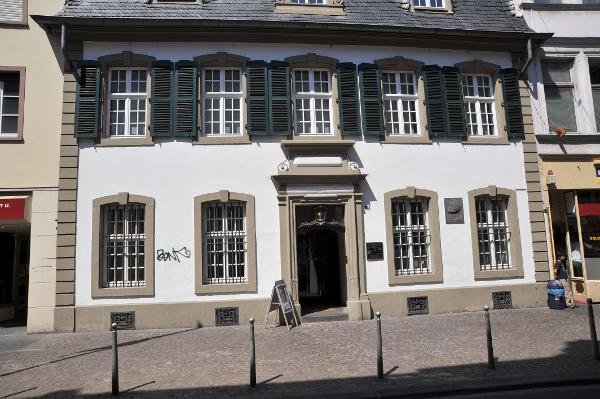
The older Karl grew up in a white house in Trier, Germany, but he never occupied the White House

Karl Marx Haus in Trier

Karl Marx Haus in Trier

The White House

The White House

Good News and Hard News – Nature and Capitalism

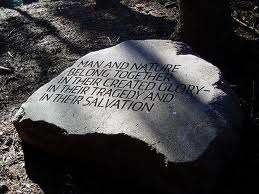
Paul Tillich quote in Tillich Park, New Harmony, IN: "Man and nature belong together in their created glory - in their tragedy and in their salvation."

Paul Tillich quote in Tillich Park, New Harmony, IN: “Man and nature belong together in their created glory – in their tragedy and in their salvation.”

A spiritual reflection for the Second Sunday of Advent, December 7, 2014.

The beginning of the GOOD news is HARD news, according to John the Baptist, calling people out into the wilderness. “We must change,” he said.  “Repent” by which the Judeo-Christian tradition means a 180 degree turn. “About face!” Only by turning will we be delivered from the consequences of the actions that have led us here.

For John the Baptist and the writer of the Gospel of Mark’s opening paragraph (Mark 1:1-8) the system at issue was Roman imperialism, an economic system centered in Rome, expanding out, and enforced by, military invasions, subjugation, religious tolerance (so long as the religious practice did not interfere with Roman prerogatives) and occupation.

One could repeat the sentence in 2014 with little change: “the system at issue [is [American] imperialism, an economic system centered in [Washington] expanding out, and enforced by, military invasions, subjugation, religious tolerance (so long as the local religious practice [does] not interfere with [American] prerogatives) and occupation.”

It is our spiritual, moral, economic, cultural and political captivity to a global system that cannot satisfy our real needs or the world’s that produces a longing in our hearts, a readiness to make the lonely trip to the wilderness.

We’re a weary people in 2014. Wearied and still disheartened 11 years after the “Shock and Awe” that took down Saddam Hussein on the pretense that he had weapons of mass destruction (WMDs) that threatened us, the Administration’s manufactured association of Saddam Hussein as the cause of 9/11. We’re wearied of lies and misrepresentations. Weary from budget fights that barely reference 10 years of un-budgeted military expenses, the loss of thousands of American soldiers’ lives and as many as 100,000 Iraqi civilians, a military venture undertaken on the assumption that the Iraqi people would welcome our presence as the beginning of democracy and a “free market” economy that would lift them all up.

That belief in the goodness of American intentions hit the rocks as quickly as Saddam’s statue hit the pavement in Baghdad. All the while we were wearied by the earlier invasion of Afghanistan, whose original justification was a quick elimination Osama bin Ladin and Al-Qaida untempered by realistic knowledge of the long history of the military interventions that mired the invaders in quagmires such as the Soviet Union found itself before leaving in defeat. To the Afghans it didn’t matter whether the troops were Soviet or American. They were the same. They were the occupation forces of an imperial power destined to fail.

In the midst of the weariness about what was happening abroad, the financial system at home took the American economy to the brink of disaster in 2008. Occupy Wall Street rose to the top of the news cycles. Although the movement fizzled over time, as such movements inevitably do, it caught the attention of television viewers, internet surfers, and newspaper and magazine readers. Occupy Wall Street and the spot light it placed on “crony capitalism” became a hot topic around water coolers at work and the table in the coffee shops.

For the first time in recent memory, capitalism was no longer sacred, no longer off limits. Time’s front cover asked the question whether Capitalism was dead. But, as with Occupy, public attention is short-lived. Amnesia sets in when people are weary. How soon we forget…until some new John the Baptist issues the cry for a 180 degree turn for the sake of something better.

Maybe Naomi Klein is edition of John the Baptist. This Changes Everything: Capitalism vs. the Climate, reviewed by the New York Times – places the over-riding systemic issue squarely before the general public again. Senator Bernie Sanders, America’s only socialist Senator who names climate action as among his four top priorities, is gaining attention as a possible presidential candidate. Elizabeth Warren, the Senate’s bulldog on holding Wall Street accountable is creating a wave of populist momentum. Put them with Bill McKibbon and 350.org and you begin to hear the echo of John’s all to the hard truth that is the beginning of the good news.

The hard truth that precedes good news is the discovery of the myth that has coupled democracy with capitalism in the American psyche, while demonizing socialism as democracy’s opposite. Ideological blinders are to nations and peoples what blinders are to horses on a race track: they limit vision to the straight-ahead narrow limits of the track. Ideological blinders prevent the owners’ horses from thoughts of anything but the track on which they’ve been placed to race each other.

But when the climate is changing our track in ways that compel our attention, and when we ask how we will make it through the changes together, the bigger question of the economic system – the race track itself – comes into view by virtue of necessity. It calls us off the track into the wilderness of Nature.

The words ‘economy’ and ‘economics’ derive from the Greek words for ‘house’ and ‘the management of the household’.  Economics not about markets, free or otherwise, or about the technicians and pundits who monitor investments and predict quarterly outcomes. It is not an academic discipline, the exclusive province of experts on Wall Street or in university Economics departments who understand how the free market works.

Economics is a spiritual perspective like the one on Paul Tillich’s marker in Tillich Park in New Harmony, Indiana. “Man and nature,” he said, “belong together in their created glory – in their tragedy and in their salvation.” There is no humanity with nature; the human calling of our time is to reshape our lives for the wellbeing of the one house in which all life lives.

During this Advent season of longing expectation, John the Baptist with his axe aimed at the root of the tree reminds us that economics is the spiritual issue of the first order. The good news is what the Hebrew Bible calls “the Day of the Lord” and John the Baptist and Jesus of Nazareth called “The Kingdom [i.e. Society] of God”. The hard news is we’ve been running on the wrong track, or, you might say, barking up the wrong tree.

The planet – this home we call “nature”, without which no person, society or form of life exists – is an economy that requires different management. The economy for which our hearts long is the one house imagined by the psalmist and announced by John in the wilderness beyond the Pax Romana: the good news awaiting our longing hearts to embrace it, a planetary home where “righteousness and peace will kiss each other” (Psalm 85:10) and wars will be no more.

The beginning of the GOOD news is HARD news. “Repent, for the kingdom of heaven is at hand.”

– Gordon C. Stewart, Chaska, MN, December 7, 2014

Capitalism, Socialism, and the Earth

The online Oxford Dictionary defines democracy as “a system of government by the whole population or all the eligible members of a state, typically through elected representatives….”

But it immediately biases the discussion with the following sentence to illustrate the word democracy: “capitalism and democracy are ascendant in the third world.” That is, capitalism and democracy go together. Wherever capitalism goes, democracy goes. The ascend together as was imagined to be the case in the Arab Spring.

To the contrary, the online Oxford Dictionary defines capitalism as “an economic and political system in which a country’s trade and industry are controlled by private owners for profit, rather than by the state.”

The Oxford Dictionary identifies what we are coming to realize in America. We do not live in a democracy. We live under “the economic and political system in which a country’s trade and industry are controlled by private owners for profit rather than by the state.” Neither are they controlled by the people of the state, the body politic.

The presumed ideological kinship between capitalism and democracy has existed in America culture as long as most of us can remember. It wasn’t always so in the 1920s and ‘30s, but, as we are beginning to understand again by virtue of circumstance, democracy does not depend upon a capitalist economy. In fact, democracy and capitalism are contradictions in terms. They are philosophically incompatible.

The more natural kin of democracy is socialism, as defined by the online Oxford Dictionary: “A political and economic theory of social organization that advocates that the means of production, distribution, and exchange should be owned or regulated by the community as a whole.”

Democracy is the rule of the people, “a system of government by the whole population….” or, “the community as a whole.”

Finally in America an intelligent discussion is afoot about democratic rule and economics. Naomi Klein’s This Changes Everything: Capitalism vs. the Climate takes the discussion to a new level that views global capitalism as “the most profound threat humanity has ever faced: the war our economic model is waging against life on earth.”

You might not believe this

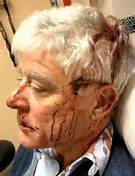
Mark Andrew after shopping at the Mall of America

Mark Andrew after shopping at the Mall of America

A year ago Mark Andrew was beaten within an inch of his life. We commented on the assault at the Mall of America at the time and are moved to comment now on the unusual sentence handed down yesterday in the case of his primary assailant.

Click “Young woman who beat Mark Andrews receives no jail time – at his request” – for the story aired yesterday by All Things Considered on Minnesota Public Radio.

Mark Andrew, man of compassionate wisdom

Mark Andrew, man of compassionate wisdom

There is judgment and there is mercy. Mark Andrew is a man of faith. He was taught and he believes that God’s judgment is always a function of God’s love, and, as Cornel West puts it, that “justice is what love looks like in public.”