After Boston: Above and Beyond

"Above and Beyond" - National Veterans Art  Museum, Chciago

“Above and Beyond” – National Veterans Art Museum, Chciago


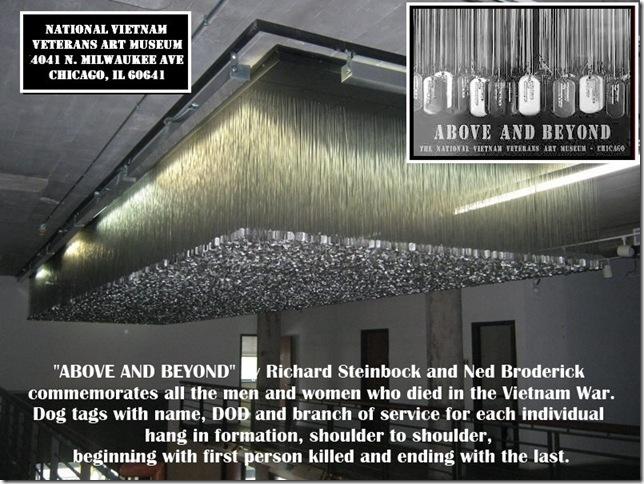
The National Veterans Art Museum in Chicago has an unusual work of art.

When visitors first enter the museum, they hear a sound like wind chimes coming from above them. Their attention is drawn upward 24 feet to the ceiling of the two-story high atrium.

The metal dog tags of the more than 58,000 service men and women who died in the Vietnam War move and chime with shifting air currents. The 10-by-40-foot sculpture, entitled “Above and Beyond” was designed by Ned Broderick and Richard Steinbock.

Family and friends locate the exact dog tag of a loved one as a museum employee uses a laser to point to the tag with the name imprinted on the dog tag, now part of a chorus of wind chimes.

After the horror and tragedy in Boston, our heads have been down. This work of art serves as a reminder to look up to hear the sound of the spirit of goodness, compassion, and creativity that can turn tragedy and death into wind chimes played in silence by the air.

The word for “Spirit” in Hebrew Scripture is “ruach” (“wind”). “When God began to create the heavens and the earth – the earth being unformed and void, with darkness over the surface of the deep and a wind from God sweeping over the water – God said, ‘Let there be light’; and there was light” (Genesis 1 – 3, translation from the Hebrew by Rabbi W. Gunther Plaut in The Torah: a Modern Commentary (Union of American Hebrew Congregations, New York, 1981).

Click HERE for a YouTube video of an interview with a National Veterans Art Museum volunteer Joe Fornelli.

Is there no cure for these?

Gordon C. Stewart April 11, 201

Today the Senate begins a floor debate on gun control that brings to mind an earlier “floor debate” several months ago in Chaska, Minnesota.

Ever since the community Dialogue on “Gun Violence in America,” I’ve searched for answers to what happened.

A crowd of 138 people came out on Tuesday night to chime in following the tragedy at Sandy Hook in Newtown, Connecticut.

As the night wore on, it became clear that there would be no real dialogue, no moderated discussion. No give-and-take. A series of monologues, without interruption and with a time limit, was the best we could expect.

Fear, anger, hostility and suspicion were in the room. The room was hot.

The months following have been a personal search for understanding of what happened that night, and how we in America move forward together on such a divisive issue.
———————————-
Imagine two people going into separate audiologist booths for hearing exams.

John grew up in rural America. Betty grew up in the city.

In their hearing booths Betty and John repeat the word they hear.

“Say the word ‘gun’, says the audiologist.

“Gun.”

Their hearing is good. They say the same word.

—————————–

After the hearing test, John and Mary are taken to different rooms for interviews. A social psychologist wants to know what emotions and thoughts are triggered when they hear the word ‘gun’.

“I’m going to give you a word. After you repeat the word, I want you to give me the other words that come to mind. It’s called “word association”. Don’t think about it. Just say whatever comes to mind.

“Gun”:

    John:

“Safety, protection, coyotes, wolves, cows, cattle, sheet, careful, responsibility, civil right.”

    Betty:

“Run, violence, threat, death, war, robber, gangs, school massacres, NRA, Sandy Hook.”

NRA:

    John:

“Second Amendment, right to bear arms, protector of civil liberties, defender of the Constitution.”

    Betty:

“Right-Wing, powerful, myopic, out-of-touch, vigilantes, white supremacist, radical, dangerous.”

Gun control:

    John:

“Government, anti-democratic, anti-Constitutional, intrusion, loss of freedom, fear, police state, socialism.”

    Betty:

“Safety, safe home, necessity, protection, peace, hope, end of fear.

Kingdom of God:

    John:

“Hmmm… Soul, salvation, heaven?”

    Betty:

“Hmmm… Safe streets, the common good, love?”

————————

Both are church members. They are practicing Christians. Betty and John pray the Lord’s Prayer. “Thy (Your) Kingdom come; Thy (Your) will be done on Earth as it is in heaven.”

Could the common bond of Jesus’ prayer bring the two into the same room in a shared search for understanding and action? Or are the formative cultural experiences so determinative that faith and religion are what Marx said they were – blinders that prevent them from seeing anything but what we’ve already chosen to see?

Perhaps some singing might help – a hymn or two – and reflection on the lyrics, like those of Fred Pratt Green (1969):

O Christ, the healer, we have come
To pray for health, to plead for friends.
How can we fail to be restored,
When reached by love that never ends?

From every ailment flesh endures
Our bodies clamor to be freed;
Yet in our hearts we would confess
That wholeness is our deepest need.

How strong, O Lord, are our desires,
How weak our knowledge of ourselves!
Release in us those healing truths
Unconscious pride resists or shelves.

In conflicts that destroy our health
We recognize the world’s disease;
Our common life declares our ills:
Is there no cure, O Christ, for these
?

Little Boys with Toys

(Previously published commentary on North Korean leader with more attractive title) 🙂

Rudolph Otto’s idea of the mysterium tremendum et fascinans, the source of holy dread and attraction that sends shudders down the human spine, rises to the fore as North Korea’s young leader Kim Jong Un plays with the possibility of nuclear holocaust.

It’s one thing to play with toys. It’s something else when the toys are nuclear bombs and missiles.

In The Idea of the Holy: An Inquiry into the Non-rational Factor in the Idea of the Divine and its Relation to the Rational, Rudolph Otto examines what he called the “numen,” the non-rational mystery that evokes feelings at once terrifying and sublime regarding our human condition.

“Otto on the Numinous” provides a concise introduction by an unidentified City University of New York English professor.

In The Idea of the Holy: An Inquiry into the Non-rational Factor in the Idea of the Divine and its Relation to the Rational, Rudolph Otto identifies and explores the non-rational mystery behind religion and the religious experience (“non-rational” should not be confused with “irrational”); he called this mystery, which is the basic element in all religions, the numinous. He uses the related word “numen” to refer to deity or God.

Forced, necessarily, to use familiar words, like “dread” and “majesty,” Otto insists that he is using them in a special sense; to emphasize this fact, he sometimes uses Latin or Greek words for key concepts. This fact is crucial to understanding Otto. Our feeling of the numinous and responses to the numinous are not ordinary ones intensified; they are unique (I use this word in its original meaning of “one of a kind, the only one”) or sui generis (meaning “in a class by itself”). For example, fear does not become dread in response to the numinous; rather, we cease to feel ordinary fear and move into an entirely different feeling, a dread that is aroused by intimations of the numinous or the actual experience of the numinous.

The word “absolute” is used in its metaphysical sense of “existing without relation to any other being; self-existent; self-sufficing” (OED); its adjectival form, “absolutely,” is used with the same meaning.”

The fact that North Korea’s young leader Kim Jong Un is threatening the world with nuclear holocaust does what World War I did to many theologians who had presumed that history is on a course of inevitable progress.

It is not.

The power of death is enticing, a sin to which Robert Oppenheimer, the father of the bomb, later confessed. The human will to power becomes evil when real soldiers, real nuclear bombs, and real missiles, and real threats of destruction are mistaken for childhood toys or computer games where human folly can be erased by hitting a delete button.

We are all children inside, for both good and ill.

Looking at the young North Korean leader, psychiatrists might see an Oedipus complex, the son outdoing the father at the game of nuclear threat, the boy who played with matches and determined that if his father was afraid to light the fuse, he would step out from his father’s shadow onto the stage of world power in a way the world would never forget.

But deeper and more encompassing than any Freudian analysis is Rudolph Otto’s mysterium tremendum et fascinans.

The philosophical-theological debates about Modernism and Post-Modernism are interesting. They deserve our attention. But neither Modernism’s rationalism nor Post-Modernism’s deconstructionism is equipped to address the most basic reality which encompassing the human condition: the mysterium tremendum et fascinans and the horror of its daemonic distortion in the shrinking of it by the human will to power.

Whenever we take the ultimate trembling and fascination of the self into our own hands, the world is put at risk. In the world of the ancients and the pre-historical world of our evolutionary ancestors the consequences were limited to a neighbor’s skull broken with a club. In the advanced species that has progressed from those primitive origins, we have fallen in love with our own toys of destruction, the technical achievements and manufactured mysteries that are deadly surrogates for the mysterium tremendum et fascinans that sends shudders down the spine in terror and in joy before what is Real.

Our time is perilously close to mass suicide. Unless and until we get it straight that I/we are not the Center of the universe, the likes of Kim Jong Un – and his mirror opposites but like-minded opponents on this side of the Pacific – will hold us hostage to the evil that lurks in human goodness.

Progress isn’t all it’s cracked up to be. The ancient shudder of the creature – the human cry for help in the face of chaos and the heart’s leap toward what is greater than the self or our social constructs – unmasks every illusion of grandeur in a world increasingly put at risk by little boys with toys.

P.S. Just as this piece was in final editing, Dennis Aubrey published “Mysterium Tremendum” on Via Lucis Photography.

Kim Jong Un and the Numinous

Rudolph Otto’s idea of the mysterium tremendum et fascinans, the source of holy dread and attraction that sends shudders down the human spine, rises to the fore as North Korea’s young leader Kim Jong Un plays with the possibility of nuclear holocaust.

It’s one thing to play with toys. It’s something else when the toys are nuclear bombs and missiles.

In The Idea of the Holy: An Inquiry into the Non-rational Factor in the Idea of the Divine and its Relation to the Rational, Rudolph Otto examines what he called the “numen,” the non-rational mystery that evokes feelings at once terrifying and sublime regarding our human condition.

“Otto on the Numinous” provides a concise introduction by an unidentified City University of New York English professor.

In The Idea of the Holy: An Inquiry into the Non-rational Factor in the Idea of the Divine and its Relation to the Rational, Rudolph Otto identifies and explores the non-rational mystery behind religion and the religious experience (“non-rational” should not be confused with “irrational”); he called this mystery, which is the basic element in all religions, the numinous. He uses the related word “numen” to refer to deity or God.

Forced, necessarily, to use familiar words, like “dread” and “majesty,” Otto insists that he is using them in a special sense; to emphasize this fact, he sometimes uses Latin or Greek words for key concepts. This fact is crucial to understanding Otto. Our feeling of the numinous and responses to the numinous are not ordinary ones intensified; they are unique (I use this word in its original meaning of “one of a kind, the only one”) or sui generis (meaning “in a class by itself”). For example, fear does not become dread in response to the numinous; rather, we cease to feel ordinary fear and move into an entirely different feeling, a dread that is aroused by intimations of the numinous or the actual experience of the numinous.

The word “absolute” is used in its metaphysical sense of “existing without relation to any other being; self-existent; self-sufficing” (OED); its adjectival form, “absolutely,” is used with the same meaning.”

The fact that North Korea’s young leader Kim Jong Un is threatening the world with nuclear holocaust does what World War I did to many theologians who had presumed that history is on a course of inevitable progress.

It is not.

The power of death is enticing, a sin to which Robert Oppenheimer, the father of the bomb, later confessed. The human will to power becomes evil when real soldiers, real nuclear bombs, and real missiles, and real threats of destruction are mistaken for childhood toys or computer games where human folly can be erased by hitting a delete button.

We are all children inside, for both good and ill.

Looking at the young North Korean leader, psychiatrists might see an Oedipus complex, the son outdoing the father at the game of nuclear threat, the boy who played with matches and determined that if his father was afraid to light the fuse, he would step out from his father’s shadow onto the stage of world power in a way the world would never forget.

But deeper and more encompassing than any Freudian analysis is Rudolph Otto’s mysterium tremendum et fascinans.

The philosophical-theological debates about Modernism and Post-Modernism are interesting. They deserve our attention. But neither Modernism’s rationalism nor Post-Modernism’s deconstructionism is equipped to address the most basic reality which encompassing the human condition: the mysterium tremendum et fascinans and the horror of its daemonic distortion in the shrinking of it by the human will to power.

Whenever we take the ultimate trembling and fascination of the self into our own hands, the world is put at risk. In the world of the ancients and the pre-historical world of our evolutionary ancestors the consequences were limited to a neighbor’s skull broken with a club. In the advanced species that has progressed from those primitive origins, we have fallen in love with our own toys of destruction, the technical achievements and manufactured mysteries that are deadly surrogates for the mysterium tremendum et fascinans that sends shudders down the spine in terror and in joy before what is Real.

Our time is perilously close to mass suicide. Unless and until we get it straight that I/we are not the Center of the universe, the likes of Kim Jong Un – and his mirror opposite but like-minded opponents on this side of the Pacific – will hold us hostage to the evil that lurks in human goodness.

Progress isn’t all it’s cracked up to be. The ancient shudder of the creature – the human cry for help in the face of chaos and the heart’s leap toward what is greater than the self or our social constructs – unmasks every illusion of grandeur in a world increasingly put at risk by little boys with toys.

P.S. Just as this piece was in final editing, Dennis Aubrey published “Mysterium Tremendum” on Via Lucis Photography.

Just leave me alone!

JESUS CHRIST!
(An Acrostic Conversation
for Holy Week, 2013 A.D.)

Just leave me alone!
Enough already!
Stay out of my life!
Useless you! I have
Success on my own!

Come unto me all you
Heavy burdened.
Receive my peace.
I give you life,
Salvation…
Then love one another.

– Steve Shoemaker, Urbana, IL, March 26, 2013

FURTHER REFLECTION (gcs)

In the tradition of Nietzsche’s parable of The Mad Man who enters the public square at midnight to cry out “God is dead! God is dead! And we have killed him, you and I,” Willem Zuurdeeg (author of An Analytical Philosophy of Religion, and Man Before Chaos: Philosophy Is Born in a Cry), declared that

Christ has been crucified by an Order which refused to be disturbed by him (Dostoevsky’s legend of the Grand Inquisitor). Christ historically was killed by the justifying Order of the Law. We establish similar Orders!

Zuurdeeg was part of the compassionate underground in The Netherlands that provided refuge for Jews fleeing the horrors of the Order of the German Third Reich. He spent his life in search for an answer to the question of how such a proud and sophisticated culture could become the perpetrator of unthinkable evil. During his years in the United States, he saw once more a social, economic, political, religious Order (Western Democracy and Capitalism) that muzzles the shameless crying out for what we so desperately need (Freud).”Contrasted to modern man (sic) who cannot cry, primitive man (sic) was not ashamed to cry, and his culture provided him with living, vital forms of crying out.”

We are offered a significant choice, namely between two ways of being human. The difference between logical necessities or physical necessities and vital necessities is made clear in that in the latter we have the possibility of refusing ‘to turn away from a disaster’ – we can in fact choose a lesser way of being human over a fuller way. What is at stake in the necessity of cry is one’s own humanity, the meaning of one’s own existence, and to turn away from crying is to turn away from decision and responsibility. This is to deny the very possibility of becoming genuinely human.

Man Before Chaos , published after Zuurdeeg’s untimely death at the age of 57, ends with the unedited notes from the sermon he preached to his students and faculty colleagues in the McGaw Chapel of McCormick Theological Seminary. Here is the conclusion of his sermon.

God is dead (II). This is now turned around. In principle the man gods, of the Primitive Order, the Law, of the Founding Fathers, o9f Democracy, of Reason, of Being (Necessary Being, Being-Itself), of a moral World Order – these are the gods who are dead. They are “idols in the sense that they exist only because we believe in them. They are dead, in principle, in hope, though the present reality is different…. And the God who is alive is Jesus Christ.

Elephants, palm trees…and us

Adult elephant mentor

Adult elephant mentor

This “comment” on Steve Shoemaker’s poem “What did you ask in school today?” deserves a posting of its own.

“Gordon, thanks for this from Steve S. This reminds me of a few things I’ve thought about lately. The images evoked when a parent says the above is that it is an example of how we nurture the young by helping them understand how to connect to their world in deeper ways than by just asking “what did you learn today”.

“The large Palm tree that stands wilted in front of the TreeHouse youth shelter on the highway 41 curve here in Chaska is a reminder that when we attend to our youth with the ideas in this poem we have a “live tree” vs. a dead tree”. In like manner when no attention is given to the affective behaviors the poem describes we have a “wilted” group of young people. The TreeHouse facility leaves the tree in place all winter after the Fall freeze to help our community remember it takes a village to raise our children. They will plant a live Palm again this Spring to help us see the results of their endeavors over the long winter to bring back to health the youth in their program.

The other thought that I was reminded of by Steve’s poem is about a National Geographic documentary last week that described the rebellion of young Elephants worldwide. Yes, strange as that sounds Elephants are killing trainers, strangers et al in epidemic numbers. Why? The program went in depth to explain that because we have destroyed so much Elephant habitat, and in the process we have also destroyed the adult males by culling the herds to ostensibly prevent the destruction of crops. The result is there are no older males to raise the young males resulting in the lack of control of violent behaviors among the young males. When young males are placed in herds with older males the murderous behaviors disappear as the seniors exert that influence. We’ve known for a long time how smart Elephants are but this goes way beyond that. There can be no doubt our children are at least as sensitive to our attention.”

NOTE: Gary Severson is a historian, researcher, and writer who recently completed his teaching career at Kennedy High School in Bloomington, Minnesota. Gary lives here in Chaska where he attends Shepherd of the Hill Presbyterian Church and leads an adult course on our common indigenous spirituality. Those who have the privilege of knowing Gary enjoy the repeated pleasure of this kind of thoughtful reflection – Gary’s own views from the edge.

What did you learn in school today?

Video

Pete Seeger and song-writer Tom Paxton get the last word on this Friday.

Stand and Fight?

“Views from the Edge” exists to promote public discussion of critical public issues. It’s not often that we post something from the NRA, but this one needs to be read by everyone who cares about the future of the United States of America. The “Stand and Fight” campaign announced in this piece is a call to arms. It assumes impending chaos. Readers of Views from the Edge rarely hear it from the horse’s mouth.

I invite readers to listen very carefully to what is said and what is not said – what is written between or below the lines – and the tone of how it’s said.
If you haven’t already read today’s earlier post – “The Common Ground Beneath the Gun Debate” – you might want to swing by it before or after you read this column by Wayne LaPierre, Executive Vice President of the National Rifle Association (NRA).

Click “Stand and Fight” to read how the NRA sees responsible life in our times.

Then post on “Views from the Edge” what you think you saw and heard. Thanks for coming by.

The Common Ground beneath the Gun Debate

Gordon C. Stewart, February 22, 2013 – Copyright.

“Ninety-nine percent of reality is perception.” Analytical philosopher Willem Zuurdeeg argued that perception itself is the expression of something far deeper, far more powerful.

Zuurdeeg, author of An Analytical Philosophy of Religion and Man Before Chaos: Philosophy Is Born in a Cry, spent his life listening to human speech, listening more deeply for what lay under the surface of the language.

Homo loquens (“man-who-speaks”) is homo convictus (“man-who-is-convicted/convinced”), the creature who establishes finite existence in time by powerful, unshakeable ‘convictors’ that anchor us against the chaos.

What we often describe as irrational speech, is, in fact, “convictional language”, the hidden power of which can only be understood by a kind of “situational analysis, i.e., the life “situation” (historical-convictional context) of the one who is speaking. Our varying perceptions are determined by the less conscious hidden convictions of implicit needs and unquestioned cultural traditions.

What is missing in the national debate is public expression of the non-rational perceptions of the word ‘gun’ and the unspoken convictions that shape our different perceptions.
We not only hear the word ‘gun’ differently. We hear different things differently.

Until we come together to discuss what we hear when we hear the word – our non-rational (not un-rational, as in opposed to reason, but non-rational, as in beneath the presumptions of reason) convictional worlds, the gun debate will be a shouting match that finds no common ground.

A simple exercise of word association demonstrates the difference.

Say the word ‘gun’ and listen for what it evokes in the hearer. In the ears of one, the word ‘gun’ means ‘safety’ and ‘protection’. In the ears of others, it means ‘without protection’ or ‘threat’.

But if we listen carefully to the apparently opposite responses, we discover a common ground they share: the threat of insecurity. The threat of chaos.

Whenever we hear a scream, something powerful is under assault. Chaos threatens. We cry out against the chaos. We cry out against death and extinction.

In Man Before Chaos, Zuurdeeg claims that, from its very beginning, western culture has been bound up with a powerful dread of chaos. Even Plato’s philosophy, argues Zuurdeeg, is born of a cry.

“Socrates has died. He himself does not fit very well into Athens’ political life. He is naked and defenseless and is not ashamed of it. He has the courage to cry against chaos and for Being and Goodness. All this has been smothered by the comfortable, although often quarrelsome, classical and medieval philosophy and theology. Who can live by a cry? Who can stand to hear such disturbing noise? Clear and calm reasoning under the guidance of venerable old philosophical schools (or just as respectable church fathers) enables us to live, make church and civilization possible. Who can endure permanently Plato’s uncertain, unsafe balance on the b rink of the abyss of chaos? By what does a man live? By a cry? Claims? The careful and broad elaboration of philosophy? All of them?” (Man Before Chaos, pp 43-44)

In the current debate about guns, the life situations, cultural traditions, and life experiences of the hearers are “worlds” apart. Perhaps…perhaps…if we could find the space to listen more deeply to our different cries in the face of chaos, we would find the common ground of homo convictus and move to something deeper than the shouting.

Tribute to Miriam Makeba

Video

Like Nelson Mandella, like Desmond Tut, like Martin Luther King, Jr., like Sojourner Truth…there is only one Miriam Makeba.

“Mama Africa” won a Grammy Award for “the Click song” (a Xhosa wedding song), so unique to western ears, that made her famous in the United States. But in South Africa she was more than a performer. She was a Civil Rights activist, a national hero, who paid a high price in the movement to end Apartheid and bring majority rule to her South African homeland. Her passport was cancelled. Her music was banned from being played or bought in South Africa. She was in exile for 30 years. There is nothing more dangerous than a human voice, and the South African regime knew it. Like Pete Seeger, whose “God’s Countin’ on Me” was posted here yesterday, Miriam was a voice of hope in the struggle for racial justice all over the world. She died at the age of 76 while performing in Italy on November 10, 2008.

Thank you, Miriam Makeba. “Well done, good and faithful servant.” Rest in Peace.