Public discussions of gun violence in America

Thanks to the editor of The Chaska Herald for this piece on the series on “Gun Violence in America” that begin next, Tuesday, Feb. 5 at Shepherd of the Hill Church in Chaska.

Click “Public discussions of gun violence begin” to read the article.

Protect Minnesota has agreed to be part of the Feb. 19 program.

Gun Violence in America

gun violence in AmericaFirst Tuesday Dialogues: examining critical public issues locally and globally* will host three Tuesday evenings of public discussion of the causes and remedies of gun violence in America. Each program will begin at 7:00 PM and end at 8:30 PM.

The series begins with City of Chaska Chief of Police Scott Knight  providing fact information and a law enforcement perspective. Chief Knight just returned from meetings in Washington, D.C. on the epidemic of gun violence  in the wake of the tragedy at Newtown, CT.)

The series then turns to a face-to-face debate between proponents and opponents of increased gun control legislation, and concludes with a broader overview of the problem of violence, guns, self-protection, and law, led by a professor of ethics.

Tuesday, Feb. 5, 7:00 PM: Scott Knight, Chief of Police: “The Epidemic of Gun Violence in America”.

Tuesday, February 19, 7:00 PM: A respectful conversation between a proponent (Protect Minnesota) and opponent (NRA) of greater gun control.

Tuesday, March 5, 7:00 PM:  A professor of ethics lead a discussion of the various Ethical Perspectives by which people of faith and good conscience approach the conundrum of violence, liberty, and the role of law in society.

* First Tuesday Dialogues is a community program of Shepherd of the Hill Presbyterian Church, ”a place for the mind and heart”, offered free of charge on behalf of the public good.  All are welcome.

Is gun control pro-life?

An interesting debate on gun control is developing among Roman Catholics that might be called “How shall Christians be pro-life?”

Click “Catholics raise issue of guns amid calls to end abortion” (New York Times), and leave your comment on “Views from the Edge” to promote discussion.

Out of the mouth of Walter Rauschenbusch

Walter Rauschenbusch, "father of the Social Gospel"

Walter Rauschenbusch (1861 – 1918), “father of the Social Gospel Movement”

“All human goodness is social goodness. Man is fundamentally gregarious and his morality consists in being a good member of his community.”

“The chief purpose of the Christian Church in the past has been the salvation of individuals. But the most pressing task of the present is not individualistic. Our business is to make over an antiquated and immoral economic system….”

The Rev. Walter Rauschenbusch had a profound impact on Christian theology and activism that led to the end of child labor and to legislation that protected worker rights in the early 20th Century. The man whose theology was shaped by his ministry with the poorest of the poor in the “Hell’s Kitchen” of New York City is the man from whose “Social Gospel” Glenn Beck now urges church members to flee for their lives.

Out of the Mouths of… #1

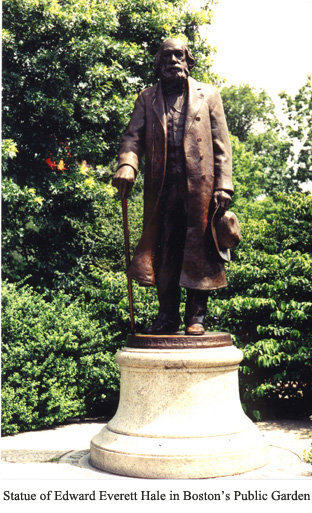
Edward Everett HaleEdward Everett Hale was asked if he prayed for the Senators. He replied:

“No. I look at the Senators and pray for the country.”

The Reverend Mr. Edward Everett Hale (1822 – 1909) served as  Chaplain to the U.S. Senate. He was appointed to the position because of his outstanding public ministry as Minister of South Congregational (Unitarian) Church in Boston. He proposed a public retirement pension system for both women and men long before there was Social Security.

First Church Boston’s website provides this account of his  ministry.

Thanks to Caroll Bryant for capturing our attention with her blog’s publication of the witticisms famous historical figures.

The Path Walker and the Road Builder

It’s 5th period in the Advanced Placement Art Class at the high school of an up-scale Minnesota suburb.

The African visitor who grew up walking the paths in Chad has been invited by the art teacher and the staff person whose job is to generate multicultural and cross-cultural consciousness. Koffi is standing in front of the Advanced Placement Art Class. The high-tech classroom with wi-fi displays the visiting artist’s Flicker portfolio on the large screen, reducing his art, it seems to me, to just one or two more commodities for sale, quickly deleted by the pressing of a key on the keypad. This is the world of the road builders…on the way to some advanced place.

The pitch-black, slender, physically fit path-walking landscape artist from Africa speaks in his third language to the privileged, mostly white, mostly single-language college-bound American students in the Advanced Placement Art Class of the road-builder society.

The road builders, says Wendell Berry (“The Native Hill”, The Art if the Common-Place), are the descendants of the placeless people who cut the forests, leveled the trees, and bulldozed their way to their ideas of what the world should be. They are the ancestors of Europeans who fled their familiar places to escape them. To build something better. Something freer perhaps, less restricted not only by law and custom but, more fundamentally, by the limits of creaturely life: time and space. They landed on the soil of the path walkers, the indigenous people whose foot paths wound their way harmlessly following the contours of the hills, rivers, streams and valleys. The artist from Chad, who represents the spirituality of the harmless foot paths and natural contours our road builder ancestors have disdained is standing before the Western Advanced Placement Art  Class.

“The road builders…were placeless people. That is why they ‘knew but little’. Having left Europe far behind” says Berry, “they had not yet in any meaningful sense arrived in America, not yet having devoted themselves to any part of it in a way that would produce the intricate knowledge of it necessary to live in it without destroying it. Because they belonged to no place, it was almost inevitable that they should behave violently toward the places they came to. We still have not, in any meaningful way, arrived in America. And in spite of our great reservoir of facts and methods, in comparison to the deep earthly wisdom of established peoples we still know but little.”

The Advanced Placement students watch the paintings flash across the screen in the school the road builders have built, but they show little interest or curiosity. They ask no questions of the flesh and blood African path walker whose paintings are of the natural habitat and his sisters and brothers, the elephants, lions, tigers, zebras, and giraffes,  who are disappearing because of poachers who profit from the ivory tusks of the elephants and the rhinos.

“I’m surprised and more than a little disappointed,” I say to Koffi after that class.

“Many Americans think we’re stupid. We’re from Africa. They think Africans are uncivilized,” he replies in the least preferred of the three languages he speaks fluently.

Who and what is more civil and civilized, I wonder. Many of us know that something has been lost. Something is dreadfully wrong. The students in the class and their generation are likely “greener” than my generation. But they also have drunk the poison of a linear view of history as advancement and progress. They are advancing…a step above the rest…in the Advanced Placement Class on their way to the prestigious universities that will induct them into the road builders society.

I am increasingly drawn to the simple insight of the Genesis writer who calls the prototypes of humanity “Earthlings” (the literal English rendering of the original Hebrew text) meant to delight within the limits of time and space. We are of the earth, dust to dust, ashes to ashes creatures who live in one time and one place at one time, not in every place all the time, and not all the time forever nowhere.

…..

I am on vacation…in a pool…in the Florida sun… where I dreamed of being five days ago in the Advanced Placement Art class back in  frigid Minnesota. The place is Orlando, the quintessential city of the road builders. The time is 10:00 a.m. EST. The date is January 16, 2013.

I am thinking about the path man and the students back in Minnesota when it suddenly dawns on me that even here…on vacation with no obligations, no goals to meet, no deadlines, nothing to do… I am acting like a road builder.

I alone…in the pool…doing my prescribed water exercises for my back and neck. “Lift left leg. Extend both arms. Pull arms to side as left leg goes down and right leg lifts. Keep abdomen tight. Keep neck and upper back muscles relaxed.”

Doing these exercises does not require movement from one side of the pool to the other. But I am making a highway in the water, always moving forward, advancing to the other side. ”One, two, three steps…nine, ten, eleven.” Turn. Repeat trip to other side. Repeat until the counting of strokes reaches 100. And I ask why.

I get out of the pool, dry off, and have trouble just being here…alone…in the Florida sun…by a pool surrounded by palm trees and tropical birds. I turn on the MacBook Air and, as I do, I realize that I have no good reason to turn on the MacBook Air other than to be somewhere else than where I really AM… right now, in this place…I’ve entered the world of the Flicker screen. My spirit never settles anywhere except during my afternoon nap with my two furry friends back home when the warmth of their bodies calms my spirit into a kind of joyful resting place. My dogs are not here. They’re at home in Minnesota wondering where the not-so-furry member of the pack is.

I turn of off the MacBook Air and reach over for the hard copy of The Art of the Common-Place, a book meant precisely for a reflective moment like this.

“Novalis, the German romantic poet and philosopher, once remarked that all proper philosophizing is driven instinctively by the longing to be at home in the world, by the desire to bring to peace the restlessness that pervades much of human life,” writes Norman Wirzba in the Introduction to the book

“Our failure – as evidenced in flights to virtual worlds and the growing reliance on ‘life enhancing’ drugs, antidepressants, antacids, and stress management techniques – suggest a pervasive unwillingness or inability to make this world a home, to find in our places and communities, our bodies and our work, a joyful resting place.”

A tiny lizard that has lost its tail scampers up to the arm of the lounge chair next to mine. I stay still. We look at each other…the lizard looks into the eyes of the road builder whose ancestors paved over his natural habitat; the road builder stares into the eyes of the lizard.

The lizard senses the threat…his chest and throat blow up like an orange balloon to camouflage itself into safety, then sucks the balloon back in just as quickly as the road builder moves. The lizard runs scampers back into the green foliage planted poolside by the resort’s developers, the “superior” species, the road builders of Western culture who were not content with the more humble paths that followed the natural contours and limits of time and place here in Orlando.

Here in the Florida sun by the pool it is as though a tiny ancestor of the serpent in the Garden story of Genesis 3 has returned with an altogether different question. If in the Genesis myth the serpent seduces the Earthlings into believing that they will be “like God,” the lizard now returns to the despoiled garden to ask the suddenly alert but still- advancing, far from home, restless, pool road-building vacationer in the lizard’s home:

“Do you still really think you’re God?”

A Joyful Resting Place in Time

I am on vacation…in a pool…in the Florida sun… where I wished to be several days ago back in frigid Minnesota.  I am here…but…not quite here. I am moving forward to something even in the water…not standing still in this pool. I am doing my prescribed water exercises. “Lift left knee. Extend arms. Pull arms to side as left knee goes down and right leg lifts. Keep abdomen tight. Keep neck and upper back muscles relaxed. Repeat.”

I’m doing the exercises, but even in this pool, I think I have to be moving forward, advancing to the other side. One, two, three steps. Eleven. Turn, repeat to other side. Count steps to give sense of progress.

Even in the Florida sun in this quiet pool with no distractions, I seem to feel I must accomplish something. Be on my way to something. If I’m in the middle of the pool, I’m working to get to the other side. When I reach the far side, I turn and start pulling for the opposite side. Until the counting of strokes reaches 100.  Then I change the exercise routine…and repeat…one, two, three, four, five, eleven, reach goal, turn, repeat until I count 100 strokes.

I get out of the pool, dry off, take my place in the lounge chair. I’m having trouble just being here…alone…in the Florida sun…by a pool surrounded by palm trees and tropical birds. I turn on the MacBook Air and, as I do, I recall that I am refusing to be here…where I really AM…right now. My spirit is placeless.

A tiny lizard perches on the arm of the lounge chair next to mine. I look at it; it stares at me. The lizard throat blows up like an orange balloon bigger than its head. I move. The lizard scampers away. This is the place where the lizard lives. I do not. I am human, able to be everywhere at any time, but homeless, scurrying like the lizard for a resting place.

I put down my passenger ticket to everywhere and nowhere…the MacBook Air… and reach over for the hard copy of The Art of the Common-Place: the Agrarian Essays of Wendell Berry I’ve brought for a quiet moment like this…a time to think….a time to dig deeper to get some perspective on life and the world. I open to the Introduction.

“Novalis, the German romantic poet and philosopher, once remarked that all proper philosophizing is driven instinctively by the longing to be at home in the world, by the desire to bring to peace the restlessness that pervades much of human life,” writes Norman Wirzba.

“Our failure – as evidenced in flights to virtual worlds and the growing reliance on ‘life enhancing’ drugs, antidepressants, antacids, and stress management techniques – suggests a pervasive unwillingness or inability to make this world a home, to find in our places and communities, our bodies and our work, a joyful resting place.”

The closest I get to that resting place is my daily afternoon nap back in Minnesota. I am not alone in the nap. Maggie and Sebastian join me in the siesta. Maggie cuddles up close to my head; Sebastian rests against my thigh, reminding their cerebral, restless friend, though without intention, that I really am in one place…at home…in the same time and space with them. If I am distracted when the time comes for the daily nap, Sebastian comes to get me and herds me up upstairs. “Come on, Dad, it’s nap time.” He and Maggie are attuned to time and place, the angle of the sun, the rhythms of day and night and our location in space while Dad is racing around the world and the universe on his MacBook Air looking for a resting place when the resting place is right upstairs in Chaska, Minnesota.

We humans think we are superior to the lizard who scampers down from the lounge chair, a superior species to the West Highland White Terrier and the Shitzu-Bichon Frise, yet we are less at home within the limits of creation itself…the limits of time and place…here in the Garden…where we are restless until we are timeless and spaceless…erasing all limits on the MacBook Air or the iPad…until we become…like God.

Discontent with embodied existence and valuing little, we scurry away, not seeing, not touching, not hearing, not feeling anything much but one, two, three, four…eleven on our way to nowhere in particular where perhaps the MacBook Air will take us vicariously to a joyful resting place…outside the Garden of time-bound lizards and dogs and human beings…a delusional placeless place beyond dust to dust, ashes to ashes… and we miss the whole experience…on the way to some place which is no place.

I want to learn to be in one place at one time. I want to live less anxiously. More present, one might say, to embodied life in this one spot where I really am…this one place… and find within it a joyful resting place.

The guns in my own back yard

It’s the eve of Martin King Day. This morning’s Star Tribune tells the story “Murderous ‘monster’ acquires an arsenal” in Carver County, Minnesota. Three cheers to you, Jim Olson, Carver County Sheriff. Thanks to the Star Tribune and other newspapers for keeping us informed.

The Oberender case exposes loopholes in national gun laws and Minnesota’s background checks. Here’s the link to the piece:

http://www.startribune.com/local/west/187610601.html

Today in worship we will look again at the call of Samuel and the call of Jesus’ first disciples who asked Jesus an odd question. “Where are you staying?”  “Come and see,” he said. I wonder: Are there guns where Jesus lives?

“The People’s Gas Company” SEQUEL

“Adult Night Terrors”

They called it an efficiency

apartment with  just one room, one

short trundle bed/couch (so fun

for us, still newlyweds, could be

enjoyed, but rather awkwardly.)

My young wife held me by the wrist,

the torn sheet in my hands. I’d dreamed

I’d fought the foreman, kicked and screamed:

his torture made me use my fist–

a warrior from a pacifist!

– Steve Shoemaker, Urbana, IL, January 8, 2013

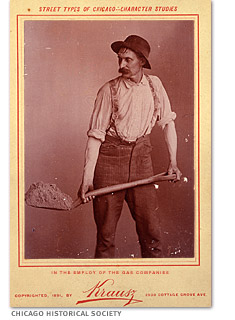
The People’s Gas Company, Chicago: Leaking Pipes Division

Chicago gas company

A memoir by Steve Shoemaker:

We had four tools:  a mattock (pick)

a shovel, spade, an air hammer

hosed to a trailing compressor.


The nasty foreman used orange paint

to spray a shape just like a grave

on the busy downtown street.


We broke through asphalt, concrete,

then threw the chunks and clods above

our heads as we dug out the hole.


The leaking gas pipe was below,

(ominously about six feet).

Our tee shirts sweat in summer heat.


The hated foreman never came

down in the hole because he knew

someone would drop a heavy tool…


After mechanics fixed the leak,

we filled the empty grave.  Quite near

there always was a bar for beer.

The foreman would stay in his truck.

– Steve Shoemaker, Urbana, IL, January 8, 2013