
Washington’s Provocation of North Korea

Washington’s Playbook to Provoke North Korea came to our attention this morning in a comment on yesterday’s Views from the Edge post “Little Boys with Toys” from a highly respected historian.

Sometimes the COMMENTS move in directions that deserve wider attention. This is one of those times. Below are 1) the comment, 2) Views from the Edge’s reply, and 3) an invitation to weigh in on the discussion.

1) The COMMENT:

As much as I agree with thoughts just posted about Kim Jong Un I think they need to be tempered by an understanding of the origin of North Korea’s behavior. Imagine a country 1/2 the size of Minnesota, N. Korea, with its 30 million people. Could Mn. feed 30 mill. people in its northern half where ag land is limited by forests and rock as N. Korea has to try and do? Not likely.

Then we have to consider the fact that in 1945 Henry Cabot Lodge was the US diplomat that unilaterally made the 38th parallel the border for the US interest in decapitating the nation of Korea to prevent it from going communist. How would we feel if an outside force turned the US into 2 countries to weaken us a nation.

At the time N. Korea has just seen the US drop 2 atomic bombs a few hundred miles away on Japan. The US then proceeds to bomb every building in N. Korea during the Korean War. Literally the US made the decision to bomb N. Korea back into the stone age. Again this done to a country that is geographically half the size of Minnesota. Why do we wonder about the behavior of the leaders of a country that has been treated this way by us. Me thinks Washington “doth protest too loudly”.

If we as a nation were willing to do what we did to N. Korea 67 yrs. ago why would we think the present US bellicose attitude is anything more than propaganda to perpetuate the neutralization of N. Korea as a force that might interfere with our interest to dominate Southeast Asia.

An understanding of geo-strategic theory we inherited from the British after WW II is instructive in understanding the hidden history of N. Korea. It is necessary to read Halford MacKinder, the 1890s British father of geo- strategic theory, to understand the Pentagon’s morally bankrupt approach to N. Korea.

2) The REPLY

I couldn’t agree more with the geo-political analysis of the sordid history that has isolated this small nation. As the old saying goes, “Just because you’re paranoid doesn’t mean there’s nobody out to get you.” They have many reasons to hate the U.S. A nation half the size of Minnesota with 30M people devastated by the Korean “Conflict” has ever reason to fear the most powerful nation on the face of the Earth. We (the U.S.A.) have not honored the terms of the treaties with N. Korea. They have no reason to trust.

The historian’s eye brings all of this front and center, and serves to remind us that we in the U.S. are constantly conditioned by propaganda and misinformation campaigns from the highest sources.

Even so, I can’t help but see the same father-son relationship in N. Korea that we saw in George Herbert Walker Bush and his son George W. who sought to finish (and outdo!) his father’s “manly” work. In both cases a sense of the numinous is shrunk to the size of the father and the nation that once worshiped him. Or…so I think 🙂

3) YOUR thoughts on the matter?
Little Boys with Toys

(Previously published commentary on North Korean leader with more attractive title) 🙂

Rudolph Otto’s idea of the mysterium tremendum et fascinans, the source of holy dread and attraction that sends shudders down the human spine, rises to the fore as North Korea’s young leader Kim Jong Un plays with the possibility of nuclear holocaust.

It’s one thing to play with toys. It’s something else when the toys are nuclear bombs and missiles.

In The Idea of the Holy: An Inquiry into the Non-rational Factor in the Idea of the Divine and its Relation to the Rational, Rudolph Otto examines what he called the “numen,” the non-rational mystery that evokes feelings at once terrifying and sublime regarding our human condition.

“Otto on the Numinous” provides a concise introduction by an unidentified City University of New York English professor.

In The Idea of the Holy: An Inquiry into the Non-rational Factor in the Idea of the Divine and its Relation to the Rational, Rudolph Otto identifies and explores the non-rational mystery behind religion and the religious experience (“non-rational” should not be confused with “irrational”); he called this mystery, which is the basic element in all religions, the numinous. He uses the related word “numen” to refer to deity or God.

Forced, necessarily, to use familiar words, like “dread” and “majesty,” Otto insists that he is using them in a special sense; to emphasize this fact, he sometimes uses Latin or Greek words for key concepts. This fact is crucial to understanding Otto. Our feeling of the numinous and responses to the numinous are not ordinary ones intensified; they are unique (I use this word in its original meaning of “one of a kind, the only one”) or sui generis (meaning “in a class by itself”). For example, fear does not become dread in response to the numinous; rather, we cease to feel ordinary fear and move into an entirely different feeling, a dread that is aroused by intimations of the numinous or the actual experience of the numinous.

The word “absolute” is used in its metaphysical sense of “existing without relation to any other being; self-existent; self-sufficing” (OED); its adjectival form, “absolutely,” is used with the same meaning.”

The fact that North Korea’s young leader Kim Jong Un is threatening the world with nuclear holocaust does what World War I did to many theologians who had presumed that history is on a course of inevitable progress.

It is not.

The power of death is enticing, a sin to which Robert Oppenheimer, the father of the bomb, later confessed. The human will to power becomes evil when real soldiers, real nuclear bombs, and real missiles, and real threats of destruction are mistaken for childhood toys or computer games where human folly can be erased by hitting a delete button.

We are all children inside, for both good and ill.

Looking at the young North Korean leader, psychiatrists might see an Oedipus complex, the son outdoing the father at the game of nuclear threat, the boy who played with matches and determined that if his father was afraid to light the fuse, he would step out from his father’s shadow onto the stage of world power in a way the world would never forget.

But deeper and more encompassing than any Freudian analysis is Rudolph Otto’s mysterium tremendum et fascinans.

The philosophical-theological debates about Modernism and Post-Modernism are interesting. They deserve our attention. But neither Modernism’s rationalism nor Post-Modernism’s deconstructionism is equipped to address the most basic reality which encompassing the human condition: the mysterium tremendum et fascinans and the horror of its daemonic distortion in the shrinking of it by the human will to power.

Whenever we take the ultimate trembling and fascination of the self into our own hands, the world is put at risk. In the world of the ancients and the pre-historical world of our evolutionary ancestors the consequences were limited to a neighbor’s skull broken with a club. In the advanced species that has progressed from those primitive origins, we have fallen in love with our own toys of destruction, the technical achievements and manufactured mysteries that are deadly surrogates for the mysterium tremendum et fascinans that sends shudders down the spine in terror and in joy before what is Real.

Our time is perilously close to mass suicide. Unless and until we get it straight that I/we are not the Center of the universe, the likes of Kim Jong Un – and his mirror opposites but like-minded opponents on this side of the Pacific – will hold us hostage to the evil that lurks in human goodness.

Progress isn’t all it’s cracked up to be. The ancient shudder of the creature – the human cry for help in the face of chaos and the heart’s leap toward what is greater than the self or our social constructs – unmasks every illusion of grandeur in a world increasingly put at risk by little boys with toys.

P.S. Just as this piece was in final editing, Dennis Aubrey published “Mysterium Tremendum” on Via Lucis Photography.

Kim Jong Un and the Numinous

Rudolph Otto’s idea of the mysterium tremendum et fascinans, the source of holy dread and attraction that sends shudders down the human spine, rises to the fore as North Korea’s young leader Kim Jong Un plays with the possibility of nuclear holocaust.

It’s one thing to play with toys. It’s something else when the toys are nuclear bombs and missiles.

In The Idea of the Holy: An Inquiry into the Non-rational Factor in the Idea of the Divine and its Relation to the Rational, Rudolph Otto examines what he called the “numen,” the non-rational mystery that evokes feelings at once terrifying and sublime regarding our human condition.

“Otto on the Numinous” provides a concise introduction by an unidentified City University of New York English professor.

In The Idea of the Holy: An Inquiry into the Non-rational Factor in the Idea of the Divine and its Relation to the Rational, Rudolph Otto identifies and explores the non-rational mystery behind religion and the religious experience (“non-rational” should not be confused with “irrational”); he called this mystery, which is the basic element in all religions, the numinous. He uses the related word “numen” to refer to deity or God.

Forced, necessarily, to use familiar words, like “dread” and “majesty,” Otto insists that he is using them in a special sense; to emphasize this fact, he sometimes uses Latin or Greek words for key concepts. This fact is crucial to understanding Otto. Our feeling of the numinous and responses to the numinous are not ordinary ones intensified; they are unique (I use this word in its original meaning of “one of a kind, the only one”) or sui generis (meaning “in a class by itself”). For example, fear does not become dread in response to the numinous; rather, we cease to feel ordinary fear and move into an entirely different feeling, a dread that is aroused by intimations of the numinous or the actual experience of the numinous.

The word “absolute” is used in its metaphysical sense of “existing without relation to any other being; self-existent; self-sufficing” (OED); its adjectival form, “absolutely,” is used with the same meaning.”

The fact that North Korea’s young leader Kim Jong Un is threatening the world with nuclear holocaust does what World War I did to many theologians who had presumed that history is on a course of inevitable progress.

It is not.

The power of death is enticing, a sin to which Robert Oppenheimer, the father of the bomb, later confessed. The human will to power becomes evil when real soldiers, real nuclear bombs, and real missiles, and real threats of destruction are mistaken for childhood toys or computer games where human folly can be erased by hitting a delete button.

We are all children inside, for both good and ill.

Looking at the young North Korean leader, psychiatrists might see an Oedipus complex, the son outdoing the father at the game of nuclear threat, the boy who played with matches and determined that if his father was afraid to light the fuse, he would step out from his father’s shadow onto the stage of world power in a way the world would never forget.

But deeper and more encompassing than any Freudian analysis is Rudolph Otto’s mysterium tremendum et fascinans.

The philosophical-theological debates about Modernism and Post-Modernism are interesting. They deserve our attention. But neither Modernism’s rationalism nor Post-Modernism’s deconstructionism is equipped to address the most basic reality which encompassing the human condition: the mysterium tremendum et fascinans and the horror of its daemonic distortion in the shrinking of it by the human will to power.

Whenever we take the ultimate trembling and fascination of the self into our own hands, the world is put at risk. In the world of the ancients and the pre-historical world of our evolutionary ancestors the consequences were limited to a neighbor’s skull broken with a club. In the advanced species that has progressed from those primitive origins, we have fallen in love with our own toys of destruction, the technical achievements and manufactured mysteries that are deadly surrogates for the mysterium tremendum et fascinans that sends shudders down the spine in terror and in joy before what is Real.

Our time is perilously close to mass suicide. Unless and until we get it straight that I/we are not the Center of the universe, the likes of Kim Jong Un – and his mirror opposite but like-minded opponents on this side of the Pacific – will hold us hostage to the evil that lurks in human goodness.

Progress isn’t all it’s cracked up to be. The ancient shudder of the creature – the human cry for help in the face of chaos and the heart’s leap toward what is greater than the self or our social constructs – unmasks every illusion of grandeur in a world increasingly put at risk by little boys with toys.

P.S. Just as this piece was in final editing, Dennis Aubrey published “Mysterium Tremendum” on Via Lucis Photography.

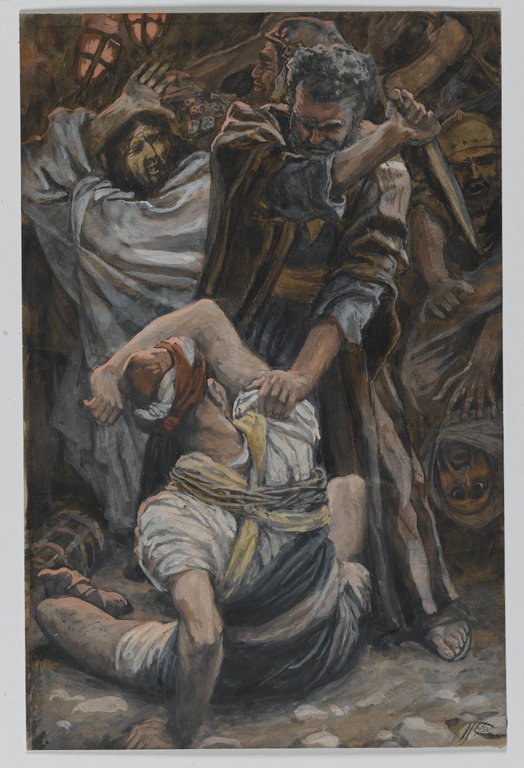
If only he’d had a gun!

Peter cuts off the ear of Malchus - James Tissot

Peter cuts off the ear of Malchus – James Tissot

Jesus of Nazareth (ca. 30 CE): “Those who take up the sword will die by the sword.” (Matthew 26:52b)

American City Council (2013 CE): Mandatory Gun Ownership Law Passes in Georgia Town

Gun-buying after Newtown massacre (2013): : Customers pack Connecticut gun stores after deal on laws

George Carlin (ca. 2000 CE): “I’m not concerned about all hell breaking loose, but that a PART of hell will break loose… it’ll be much harder to detect.”

Sojourners publishes Pleasantville Sermon

Yesterday Sojourners’ blog God’s Politics: a blog with Jim Wallis and friends published “The Garden Outside Pleasantville.” Thanks to Jim Wallis and the Sojourners staff for republishing.

Click HERE for the piece on Sojourners.

Good Friday 2013

Today is Good Friday.

Two pieces enriched the silence today. The first arrived early this morning.

Testimony

In Mark, the earliest account, the name
is given of the man who from the crowd
was forced to lift and carry the crude wood
cross that some carpenter had made the same
day. Simon of Cyrene is named, and then
the names of his two sons–as if they were
still living and could testify that their
father was one of the witnesses when
Jesus was crucified. Women were named
who saw the body buried in the grave,
and later returned to the empty cave
and found the heavy round stone had been rolled
away. Joseph of Arimathea
had given his own family tomb away.

But you are skeptical and full of doubt
that Christ is risen–you should check it out.
See that his followers who ran away
now risk their own lives when they sing and pray.
His students now have students. Many saw
him after death. They live and testify.
His movement grows, and some react with awe
and pass the story on, still testify…

– Steve Shoemaker, Urbana, IL, Good Friday, 2013

The second arrived this afternoon.

Click HERE to read Dr. Matthew Boulton’s Good Friday reflection in the Indianapolis Star. Matthew carries on the story as President of Christian Theological Seminary in Indianapolis, Indiana. Matt is the son of Wayne, my seminary roommate and best friend since 1964. “They live and testify. His movement grows, and some react with awe and pass the story on, still testify…”

Sojourners publishes “Just Leave Me Alone”

This afternoon Sojourners published “Just Leave Me Alone” as a Lenten Reflection. Jim Wallis, founder and CEO of Sojourners, is one of the nation’s outstanding social justice theologians and best-selling author.

Click Just Leave Me Alone to read the piece on Sojourners and leave a comment there.

Just leave me alone!

JESUS CHRIST!
(An Acrostic Conversation
for Holy Week, 2013 A.D.)

Just leave me alone!
Enough already!
Stay out of my life!
Useless you! I have
Success on my own!

Come unto me all you
Heavy burdened.
Receive my peace.
I give you life,
Salvation…
Then love one another.

– Steve Shoemaker, Urbana, IL, March 26, 2013

FURTHER REFLECTION (gcs)

In the tradition of Nietzsche’s parable of The Mad Man who enters the public square at midnight to cry out “God is dead! God is dead! And we have killed him, you and I,” Willem Zuurdeeg (author of An Analytical Philosophy of Religion, and Man Before Chaos: Philosophy Is Born in a Cry), declared that

Christ has been crucified by an Order which refused to be disturbed by him (Dostoevsky’s legend of the Grand Inquisitor). Christ historically was killed by the justifying Order of the Law. We establish similar Orders!

Zuurdeeg was part of the compassionate underground in The Netherlands that provided refuge for Jews fleeing the horrors of the Order of the German Third Reich. He spent his life in search for an answer to the question of how such a proud and sophisticated culture could become the perpetrator of unthinkable evil. During his years in the United States, he saw once more a social, economic, political, religious Order (Western Democracy and Capitalism) that muzzles the shameless crying out for what we so desperately need (Freud).”Contrasted to modern man (sic) who cannot cry, primitive man (sic) was not ashamed to cry, and his culture provided him with living, vital forms of crying out.”

We are offered a significant choice, namely between two ways of being human. The difference between logical necessities or physical necessities and vital necessities is made clear in that in the latter we have the possibility of refusing ‘to turn away from a disaster’ – we can in fact choose a lesser way of being human over a fuller way. What is at stake in the necessity of cry is one’s own humanity, the meaning of one’s own existence, and to turn away from crying is to turn away from decision and responsibility. This is to deny the very possibility of becoming genuinely human.

Man Before Chaos , published after Zuurdeeg’s untimely death at the age of 57, ends with the unedited notes from the sermon he preached to his students and faculty colleagues in the McGaw Chapel of McCormick Theological Seminary. Here is the conclusion of his sermon.

God is dead (II). This is now turned around. In principle the man gods, of the Primitive Order, the Law, of the Founding Fathers, o9f Democracy, of Reason, of Being (Necessary Being, Being-Itself), of a moral World Order – these are the gods who are dead. They are “idols in the sense that they exist only because we believe in them. They are dead, in principle, in hope, though the present reality is different…. And the God who is alive is Jesus Christ.

Beyonce on the floor of Congress

Video

Congressional leaders are singing off key, inviting a national food fight. They want us to believe they’re soul-singers. But the sound is wooden. No heart. No soul. Instead we hear only of sequestration, protestation, damnation, remonstration, and gyration, but no gestation, no universal gun registration. Only sequestration.

Bring in Beyoncé! “Swing low, sweet chariot, coming fo’ to carry me home. I looked over Jordan and what did I see? A band of angels comin’ after me, comin’ fo’ to carry me home.”

If you agree that Congress is acting like the prisoners before Beyoncé came to their rescue, send this link to your Congressional Representatives. Tell ’em Paul Robeson, Johnny Cash, Etta James, and Beyoncé told you to. 🙂

Sequestration Silver Lining

Budget Control Act

Budget Control Act

Only a deadlocked Congress could produce this unintentional miracle.

The military-defense budget has been a sacred cow. Proponents of Department of Defense budget cuts were tarred and feathered as weak on national security.

Perhaps only ‘Sequestration” – this unthinkable package of defense and entitlement program cuts that neither major party thought tolerable – could make it happen. I can hear the applause from the angels and from President Dwight David Eisenhower, whose last words from the Oval Office warned that the rise of the Military-Industrial-Complex was the greatest threat to democracy, even while they weep over the indiscriminate human impacts of Sequestration.

Somewhere over the rainbow….bluebirds…instead of drones…fly. Could it also be that sometimes God really does act in strange and mysterious ways…?