From Students, teachers should receive…

From students, teachers should receive

much money:  for the smart believe

they learned so much–and from the dull

because they raised unholy Hell.

(after Isocrates, 5th C., BCE)

– a Chreia
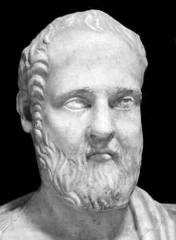
Isocrates, Greek teacher and rhetorician

A chreia in classical Greek culture was a brief, useful (“χρεία” means useful) anecdote attributed by the author to a particular character. In this case it was in honor of Isocrates, an honored rhetorician.The chreiai are remembered primarily for their role in classical Greek education, a system known as paideia in which wisdom was the goal. Children were introduced to simple chreiai almost as soon as they could read. These chreiai served as the means of character formation and the increase of wisdom for living in a civil society.

Later in their education, as they prepared to practice rhetoric (the art of discourse, both written and spoken), these chreiai served as the basis for formal eight paragraph essays in which the student elaborated on the subject of a chreia. The student would praise, paraphrase, explain, contrast, compare, provide an example, make a judgment, and, in conclusion, exhort the reader.

Thanks to my fellow student Steve for sending “after Isocrates.” In honor of my teachers – Gordon Kidder, Mrs. Martino, Mr. Thompson, Ms. Manlove, Harold Miller, Helen Semar, Esther Swenson, Ted Campbell, Lew Briner, Tom Parker, Krister Stendahl, my father and mother –  I’m going to write an eight paragraph essay on this chreia.

Winds

Winds can destroy a tower:

Steve with a kite on the IL prairie

the trees can break–no power…

but winds can lift a kite!

A hurricane is awesome:

with floods and death quite

gruesome…

but the wind can lift a kite!

Tornadoes rage in summer:

what was a house–now lumber…

but the wind can lift a kite!

A delta or a fighter,

a diamond or a stunter…

Yes, the wind can lift a kite!

A small child can hold the line,

a man’s kite can cheer his wife…

yes, a kite can lift a life…

– Steve Shoemaker, Urbana, IL June 19, 2012

The Death of Sidney Mahkuk

November 10, 2005

I stood there on the spot where she was found a few hours before.

An 11 year old girl dumped from a car onto the sidewalk…next a funeral home.

There were tokens of love and remembrance – a teddy bear, a Snickers bar, some fresh flowers, a poem, evidence that fear and intimidation could not stop the love of those who dared to reclaim that piece of land.

Sidney Mahkuk did not die of an overdose. She was overdosed. She was murdered. I wondered how it could happen. I wondered, as Sidney’s older sister would ask later at an impromptu memorial service on that same spot,

“Was she lonely?  Was she scared?  Did she know we cared?  Did she know we loved her?”

I never met Sidney. But I felt very close standing alone hours after her death on the spot where someone(s) had dump her body to send a message perhaps to someone else that you’ll end up here – at the funeral home – if you mess with us.

Then it dawned on me why this felt strangely familiar. This violence was not unusual.  It was ghastly, but it was not unusual.  Ask the prisoners who died at Abu Graib. Ask the parents of the Sidneys in Baghdad and Felujiah and Kabul. Ask the mothers and fathers of the young Americans who have lost their lives for what they were told was the noble cause of disarming Saddam’s weapons of mass destruction and promoting freedom – American mothers and fathers, Iraqi mothers and fathers whose teddy bears and Snicker bars and poems are ignored…because nobody dares to stand there and say that violence and intimidation are not acceptable.

Sidney’s death is unique. Sidney was unique. One of a kind – a Menominee and Potawatome. Sidney was a stranger on her on own native soil. She was American Indian, one of America’s First People, as the Canadians say. But as a stranger on her own soil she is like many of us who, weeping and bewildered, seek to find our way in this strange and foreign land we call America.

The tears falling on the sidewalk beside the funeral home – and only the falling tears – can wash the blues away and lead again joy.

Sometimes I feel all blue

sad  sorry  blue

all down in minor key

a rhapsody in blue.

Sometimes

when blue begins to play

its melody in me, sometimes

the minor turns to major key –

Blue bursts into purple and,

leaping into joy,

a burst of sun-burst yellow

splashes  the blues away

And I feel all clean

all wet  all whole  up

like a purple-yellow rhapsody,

an Ode to Purple-Yellow Joy.

NOTE: I was Executive Director of the Legal Rights Center when I wrote this piece. The tears still flow. Like too many other cases in Minneapolis’s poorer neighborhoods, Sydney’s case is still “open”.

– Gordon C. Stewart

The Water Line

The Water Line.

Strictly Alone

Bald, straight, strict

Balls of fire

Slips by the house

Flips on the TV

(the horses are running ) and

Flips it back off when

The horses have run

…….

His horse having lost

Without a word he slips out

The way he slipped in

Balls of fire

Bald, straight, strict

Uncle Harold…

Strictly alone.

– Gordon C. Stewart, June 6, 2012, Chaska, MIN

The Man at the Bar

“Damn” is not his last name,”

Said Herb

To the man on the stool

With the beer at the bar.

….

“What?” said the man with the beer

To Herb,

Drinking his vodka and milk

On the stool at the bar.

….

I said, “God damn!”

Said the man with the beer.

…..

“And I said ‘Damn is not His last name!’”

Cried Herb with his vodka and milk.

…..

“Pow!” came the fist

From the man with the beer.

…..

“What’d you do that for?”

Asked Herb from the floor

To the man with the beer

On the stool at the bar.

– Gordon C. Stewart, June 6, 2012, Chaska, MN

To turn away from beauty

    “Requiem” by Eliza Gilkeyson,

arranged for choir

by Craig Hella Johnson,

sung by The Chorale in Vienna


She had come to the church to worship God,

to hear a touring choir sing classics  with

some spirituals–she thought the choir was good.


The young liturgical dancer was lithe,

quite serious as she embodied grief

and bafflement at death from tsunami,

earthquake, and flood.


The choir prayed for relief,

for understanding from Mother Mary.


The worshiper, offended by the dance,

looked at the floor, her eyes narrow and hard,

her jaw was clenched, her lips were white and thin.


In choir and congregation there were tears

in sympathy with grieving mother, child…


To turn away from beauty is a sin.

– Steve Shoemaker, on tour, Vienna, Austria, June 12, 2012
 

Nature

The tick that carries spotted fever

malaria that mosquitos pass

on to mere kids, and then the cancer

that twists, subverts, deforms normal cells–

who can ever say this world is good?

The mind that in an empty room hears

loud voices saying run, hurt, be bad

not good, rape, kill, then die yourself.  Fears

are all around.  There is no hope left.

We can be as deformed as our world.

Can someone befriend us when bereft?

Join us with our demons in the cold?

Maybe not help us to understand

evil all around, but hold our hand?

– Steve Shoemaker, Urbana, IL, June 7, 2012

Waist

A narrow female waist and wider hip

is found to be attractive by the male

across all cultural boundaries.  To slip

a hand around a waist will never fail

to thrill a guy past puberty.  The waist

Need not be small:  the ratio is what counts

according to the anthropologist

as a sign of fertility.  An ounce

of thought, however, makes one think (if this

is what is going on in a male brain)

that pregnancy is not high on his list

of preferred outcomes…  It may be a strain

on his imagination to perceive

what happens to that waist if she conceive.

– Steve Shoemaker, Urbana, IL. Steve’s Sunday evening program “Keepin’ the Faith” can be heard anytime @ www.will.illinois.edu/keepinthefaith, including archive programs, “two of  which,” says Steve, “feature Gordon C. Stewart, my ‘publisher’.”

Pentecost Jazz

Whenever I hear Dave Brubeck, I think of Pentecost. Here’s a video of Brubeck and Al Jarreau that came to mind after reading my friend Steve’s poem (below) on Pentecost and jazz as the music of the Spirit.

PENTECOST (acrostic)

In Memory of Charles Reynolds*

(TO BE READ ALOUD )

Perhaps a jazz improvisation says

Exactly what is thinkable about

New life, fresh breath…the Holy Spirit.  Has

There ever been a music without doubt

Except jazz?  Faith, improvisation cause

Circles of sound to rise and fly throughout

Our cosmos.  Tongues of flame are seen on heads

Singing or playing solos.  Then without

Time passing–a new language:  Jesus!  Jazz!

*Charles Reynolds was Organist at the McKinley Church at the University of Illinois where Steve was the Senior Minister.

– Steve Shoemaker, Urbana, IL. Steve’s Sunday evening program “Keepin’ the Faith” can be heard anytime @ www.will.illinois.edu/keepinthefaith, including archive programs, “two of  which,” says Steve, “feature Gordon C. Stewart,my ‘publisher'”.