Verse – 50th Anniversary Memory

She brought her long brown hair
home in her hand.

From twenty-five to forty
it had grown
till she could tuck it under
her fine, round,
full bottom as she sat.
When she would stand
in front of me, my fingers
found her hair
and stroked and petted. Now
it all was gone…

The pixy cut was cute–
it would compare
to Michelle Williams now,
or Audrey Hepburn then–
the stylist was a friend
of ours, but so
was Bill, the County Sheriff.
I called, he sent
a deputy with handcuffs
to get Sue
at the downtown salon,
make her repent
of her barbaric crime
against true beauty.

I had no doubt it was
my civic duty…

– Steve Shoemaker, Urbana, IL, Jan. 16, 2015.

Steve and Nadja were married August 21, 1965.

Nadja Shoemaker

Nadja Shoemaker

The House Next Door on the Freedom Trail

We knew nothing about St.Augustine when we rented the house at 96 South Street for the month of January. It turns out that the house next door played an important part in the Civil Rights Movement. 94 South Street is on “The Freedom Trail” tour in St. Augustine in Lincolnville, the district settled by freed slaves in 1866.

94 South Street, St. Augustine, FL

94 South Street, St. Augustine, FL

Newly arrived, we notice that a group  gathers each day outside the house. Our second evening I walk by the house at dusk and greet the gray-bearded man sitting in a chair. He rises with his cane.

“Good evening.”
“Good evening,” he responds.
“You live here?” I ask.
“No, my friend does.”
“My name’s Gordon,” I say, extending my hand.
“Mr. _____” [I cant’ hear what he says]. “So tell me about this house. It’s an historic house, right?”
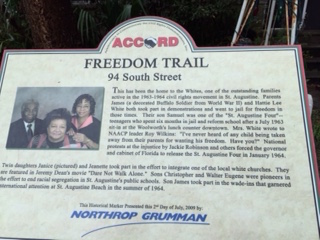
Freedom trail plaque“Read the sign,” he says, limping to the plaque next to the sidewalk. “Read it.”

I read it out loud.

Home of the White Family – Lincolnville

This has been the home to the Whites, one of the outstanding families active in the 1963-1964 civil rights movement in St. Augustine.  Parents James (a decorated Buffalo Soldier from World War II) and Hattie Lee White both took part in demonstrations and went to jail for freedom in those times.  Their son Samuel was one of the “St. Augustine Four”–teenagers who spent six months in jail and reform school after a July 1963 sit-in at the Woolworth’s lunch counter downtown.  Mrs. White wrote to NAACP leader Roy Wilkins, “I’ve never heard of any child being taken away from their parents for wanting his freedom.  Have you?”  National protests at the injustice by Jackie Robinson and others forced the governor and cabinet of Florida to release the St. Augustine Four in January 1964.

Twin daughters Janice and Jeanette took part in the effort to integrate one of the local white churches.  They are featured in Jeremy Dean’s movie “Dare Not Walk Alone.”

Sons Christopher and Walter Eugene were pioneers in the effort to end racial segregation in St. Augustine’s public schools.  Son James took part in the wade-ins that garnered international attention at St. Augustine Beach in the summer of 1964.

This marker is erected by ACCORD to honor all of the members of the family for their efforts to make St. Augustine, America, and the world a better place.

Christopher still lives in the house.

So here we are vacationing next to history. Look for more posts from conversations with Christopher and the people at St. Paul A.M.E. Church after the “Hands Up” workshop this Saturday.

– Gordon C. Stewart, Thursday, January 15, 2015


Martin Luther King Day in St. Augustine

The car dealer here in St. Augustine will be open on Martin Luther King Day. No holiday for its workers.

I learn this while waiting for my car to be serviced. I read the local paper, The St. Augustine Record, Wednesday, January 14, 2015. Tucked away page A6 under “News and Notes” is a small headline:

“Commemorative Breakfast Planned”

Commemorative of what? Martin Luther King, Jr., Monday, January 19 at First Coastal Technical College.

I put down the paper and walk through the show room to look at the new models. A white sales manager sees me get into one of the cars and points angrily to a 20-something African-American salesman to get with the program. The young man greets me through the passenger window. I tell him I’m just killing time during a routine oil change and that I’m from Minnesota. We exchange pleasantries.

I get a cup of coffee and go out to look at the used cars – it’s my thing, checking out used cars – and run into the young salesman again. I ask whether Martin Luther King Day is a big deal here in St. Augustine. He smiles. I tell him I’ve just read the newspaper and the small announcement. “Is the dealership closed for Martin Luther King Day?” I ask. “No, Sir. We’re open,” he says. “I’ll be working.”

“Do you know about The St. Augustine Four?” I ask. He doesn’t. I tell him we’re staying next door to the home of James and Hattie White whose 14 year-old son Samuel was sent to reform school in 1963 for sitting in at the Woolworth’s lunch counter, and that the case of the four teenagers was responsible for Dr. King and Jackie Robinson joining the cause in St. Augustine.

Before I leave the dealership, he finds me in the waiting area. “I asked the boss,” he says. “He said I can have the day off if I want it.”

I tell him there’s a “Hands Up!” workshop Saturday morning at the St. Paul African Methodist Episcopal Church (A.M.E.) where MLK and Jackie Robinson joined the local the Civil Rights Movement in St. Augustine. It’s just around the corner from where we’re staying in Lincolnville. “Come if you can!” “Thanks,” he says, “Maybe I’ll see you there.”


New Legislators, Selma and MLK

Verse – Advice to New Legislators

Support each capital IDEA
(notice the capital letters)
made in the State Capital
(but not always in the CapitOl building)
which will gain financial capital
(if it garners enough political capital)
by making good use of social capital
(without wasting natural capital)
and be sure to capitalize on it.

-Steve Shoemaker, Urbana, IL, Jan. 14, 2015

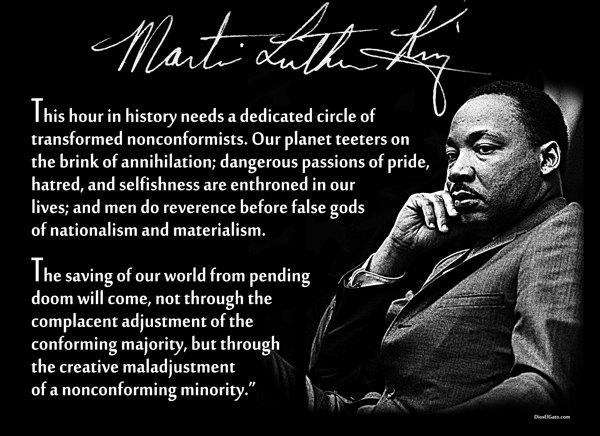
This hour of history - The Rev. Dr. Martin Luther King, Jr.

This hour of history – The Rev. Dr. Martin Luther King, Jr.

The Rev. Dr. Martin Luther King, Jr., whose life America celebrates this weekend, had a different IDEA. His was of a world “in which men no longer take necessities from the masses to give luxuries to the classes.

A mutual friend who marched with Dr. King from Selma to Montgomery and had just seen “Selma” sent the line, reminding us of “the lessons that are severe, easily forgotten amidst the King mythology, but as relevant today as they were when he first voiced them.

God wounded in Paris

Today’s news from Paris is chilling. Still reeling from the Charlie Hebdo attack, hostages are taken in a Kosher (Jewish) market in Paris. Fear of extremist Islamic terrorism spreads across France.

During a gathering of twelve of us at The Reformed Roundtable in Indianapolis two days ago, South African anti-Apartheid leader  the Rev. Dr. Allan Boesak quoted none other than John Calvin, according to whom whenever a human being wounds another, God is wounded.

The killers and hostage-takers in Paris claim the name of Allah. Their abuse of the name is an affront to faithful Muslims who reject violence and terror as much as adherents of Judaism, Christianity, Hinduism, and Buddhism. Religion itself, whatever its form and doctrine, is to be measured by its compassion.

Events in Paris remind me of Dr. Boesak’s statement and the Very Rev. James A. Whyte‘s sermon at the January 9, 1989 memorial service after Pan Am flight 103 carrying 259 passengers exploded over Lockerbie December 22, 1988. Eleven more were killed on the ground in the small town of Lockerbie.  The Church of Scotland reluctantly called it’s Moderator, James Whyte, out of mourning his wife’s death for his to preach at the memorial service for the victims of the terror at Lockerbie.

In that sermon he proposed a vexing answer to the vexing question: Where was God when the plane went down? “God,” he said, “was on the plane.” 

“Justice, yes; retaliation no,” he declared. “For if we move in the way of retaliation we move right outside of the fellowship of Christ’s suffering, outside of the Divine consolation. There is nothing that way but bitterness and the destruction of our own humanity.”

Four hundred years after Calvin’s statement and decades before James Whyte’s sermon at Lockerbie, Dietrich Bonhoeffer wrote the following from his prison cell before he was hanged by the Nazi’s whose “God” was without compassion. Bonhoeffer wrote as a disciple of Jesus, the Crucified, but his picture of God as suffering and the call to stand with God in God’s suffering int he world of human cruelty represents the compassionate faith shared by compassionate people of every stripe.

Christians range themselves with God in his suffering; that is what distinguishes them…. As Jesus asked in Gethsemane, “Could ye not watch with me one hour?” That is the exact opposite of what the religious man expects from God. Man is challenged to participate in the sufferings of God at the hands of a godless world. He must therefore plunge himself into the life of a godless world, without attempting to gloss over its ungodliness with a veneer of religion or try to transfigure it. He must live a ‘worldly” life and so participate in the suffering of God. He may live a worldly life as one emancipated from all false religions and obligations. To be a Christian does not mean to be religious in a particular way, to cultivate some particular form of asceticism (as a sinner, a penitent or a saint), but to he a man. It is not some religious act which makes a Christian what he is, but participation in the suffering of God in the life of the world.  [Bolded type added]

Dietrich Bonhoeffer, Letters and Papers from Prison

Today God is wounded again…in Paris, and we participate in the suffering of God at the hands of a cruel world.

 

The Foster Child who successfully fostered

Unusual obituaries come along once in a while. Steve and I found this one endearing.

RANTOUL, IL –

Joan Copeland chose Christmas to give up the goods and embark on her next adventure.

Her daughters, their husbands, several grandchildren, and her lifelong friend, Barbara Markland, were all with her at Carle Foundation Hospital to offer love as she transitioned.

She was born on July 25, 1934, to Louis and Elsie Fetters Silagy. She had a multitude of siblings. Severe hardship forced the family to scatter to the winds when she was a young girl.

She successfully fostered with the Gordon and Dorothy Almy famiiy of Indianola during grade school and then with the John and Opal Bettag family of Danville for her high school years. She graduated from Danville High School in 1552.

She went on to marry Don Carrigan and Benny Copeland Jr., both of whom departed before her. She turned down several other proposals of marriage over the years.

Those forced to forge ahead without her are [her three daughters, two sons-in-law, eight grandchildren, and 14 great-grandchildren.]

Also left behind is Sophie, her feline companion of 17 years and another longtime friend, Hazel Demeris of Champaign.

– News Gazette Obituary, Sunday, Jan. 4, 2015.

NOTE:  Joan Copeland “chose Christmas to give up the goods….” We all give up the goods in the end.  The deceased’s family provides a picture of someone we’d like to have known. Laced with humor – “she had a multitude of siblings” – and respect, they paint her not as a poor foster child but as an actor who “successfully fostered” with the Almy and Bettag families. At the same time they pay tribute by including the first names of all six of the parents, biological and foster alike, and the names of her closest friends human and feline. They include husbands Dan and Bennie but leave chose not to humiliate the suitors of “the several other proposals.”

Verse for a bad day

cold rain

constant drizzle
just above freezing
gray day stay inside
drive with friends
cancelled
snow at least
would have been white

– Steve Shoemaker, Urbana, IL, Jan. 3, 2015 – published Jan. 4.

Steve Shoemaker in his favorite chair with Blazer, his collie by his side, his iPhone, book, and newspaper. Kite soaring outside the window

Steve Shoemaker in his favorite chair with Blazer, his collie by his side, his iPhone, book, and newspaper. Kite soaring outside the window


Picture of Steve in his favorite chair with book, iPhone, newspaper, collie Blazer, and blue kite taken this morning by Kay Stewart in the Shoemaker home in Urbana. Later we did have snow.


Verse – Words with Enemies

Words with Enemies

You smile, and I’ll smile
and all the while we’ll
talk behind each other’s back
(but just to those we know
will have OUR back).

Then you will use a word
with just that tone, a word
that tears the skin from my back
(flaying piece by piece
and leaving bloody flesh.)

The words that I will then say
in return will burn and scar
and pierce you front to back
(I know it should be peace I seek,
but I won’t turn the other cheek.)

– Steve Shoemaker, Urbana, IL, January 4, 2015


A Man and His Dog

Barclay and Gordon

Barclay and Gordon

Few bonds are as close as a man and his dog. I sorely miss Barclay, the soccer dog, who’s living with his “sister” Kristin while Kay and I are “somewhere else” for a long time.

Kristin reports he’s doing well, eating all his food, taking his medicine, and happily playing goalie with his ball.

I wonder if Robert Frost had a dog. After writing “Mending Wall,” – Something there is that doesn’t love a wall….”, he might have thought, “Something there is that loves…a dog.”


Limerick

Mops waiting for guests to use at the Shoemaker residence.

Mops waiting for guests to use at the Shoemaker residence.

INTRO TO LIMERICK: Driving to Steve and Nadja Shoemaker’s this morning, we texted Steve revising the estimated time of arrival. Steve responded with this limerick and photo from his iPhone:

We love to have guests who show up
When they told us that they would turn up.
But please don’t come early
Or we will be surly,
It’s then that we start to clean up!

– Steve Shoemaker, Urbana, IL, January 2, 2014.