Pledging Allegiance

Yesterday an email from MoveOn invited me to host a gathering as part of a national resistance movement to the soon-to-be U.S. Administration. I began to fill out the form, but something didn’t feel right. I’m not a good groupie, but it was more than that.

The article that appeared in my inbox this morning puts its finger on what feels right and what feels wrong with almost everything I seek to do with respect to the specter of losing most everything for which I’ve worked over a lifetime. Thanks to Michael, the psychologist we met last week on The Nation cruise, for sharing this thoughtful piece. In it’s light, I think I’ll fill out the form and plan a candlelight vigil in the town square. No yelling. No screaming. Just a pledge to, and prayers for, the future.

The sections in green were added to this reposting for those who wish to get to what we take away from the commentary.

I Pledge Allegiance to . . .

I pledge allegiance to . . . what?

The Electoral College, to no one’s serious surprise, voted Donald Trump in as the nation’s 45th president, and the pot of outrage in the American spectator democracy begins to boil.

No, no, no, no, no, no, no — no to all his right-wing and idiotic cabinet and Team Trump appointments, no to his conflicts of interest and serial tweets, no to his sexism, his reckless arrogance, his ego, his finger on the nuclear button.

The word of the day is resistance. For instance, Nancy Altman and Ira Lupu, writing at Huffington Post, point out that Trump, though legally the new American president, lacks political legitimacy, thanks to widespread voter suppression, his huge loss in the popular vote and the anachronistic absurdity of the Electoral College; and even more disturbingly, is a thin-skinned, dishonest, immature jerk, utterly lacking the moral authority a national leader must project. These are flaws that cannot be ignored.

“Other elected officials, the media, and the citizenry at large have no obligation to afford him the slightest political respect,” they write. “Rather, the next four years should be a time of resistance and outright obstructionism. Opponents of Trump should be at least as aggressive in challenging the political legitimacy and moral authority of his presidency as Republicans were in disrespecting President Obama, whose political legitimacy and moral authority were beyond reproach.”

Wow, I get it. Don’t let Trump get away with anything! Fight every alt-right and nutcase appointment he tries to make, every racist or reckless policy he tries to implement. Above all, don’t let him shift the paradigm of normal.

There’s only one problem here, and it’s the same problem the Hillary Clinton campaign faced and had no way to overcome. The “old normal” — the Washington consensus, the status quo — that Trump is so successful at selectively mocking, even as he remains utterly enmeshed in it, is a ravenous predator and looming disaster of global proportions.

I pledge allegiance to the United States of War? To the United States of Prisons? To the United States of Poverty and Infrastructure Decay and Contaminated Water?

Indeed, the concept of American exceptionalism ensconced in the old normal and thoughtlessly touted by the corporate media is Trumpesque in its narcissism. And its time is running out. The economy is breaking down for much of the working class and some of our deep, foundational flaws — the racism, the militarism, the environmental exploitation — are getting increasingly difficult to avoid noticing.

The challenge presented by Trump requires something more than resistance. I believe it requires reaching for, and pledging our allegiance to, a much larger, more compassionate and peace-oriented country than the one we have now. It requires pledging allegiance to the planet and the future.

But what does this look like?

Half a century ago, the emerging nation could be seen in the civil rights movement. Today, perhaps the best place to look is Standing Rock, where an old wound, you might say, is insisting on its right to heal.

“What can we learn from their struggle?” Audrea Lim asks in The Nation. “Bombarded for months with tear gas, sound cannons, rubber bullets and water hoses (often in freezing temperatures, no less), the camp at Standing Rock grew from around ten in April to thousands by fall. They transformed what might have otherwise been a remote, invisible, rural struggle into national headline news.”

The struggle, she notes, had blatantly racist origins: “Originally meant to traverse the Missouri River north of Bismarck, city residents complained that it would threaten their municipal water supply, and the pipeline was re-routed to nearer the Standing Rock reservation in September 2014.”

She adds: “It is significant that Bismarck is 92.4 percent white.”

This could have been just one more isolated wrong, but for some reason the national or perhaps global moment was ripe for it to be something else. The struggle for water rights, for the sanctity of the land, for a wounded people’s dignity, sent a tremor through the whole country. Something sacred — to use a risky, old-fashioned word — had been violated. And maybe we’re no longer simply Consumer America, using up our resources, destroying our rivers, clotting our veins, to consequences born only by the racially and culturally marginalized. We used to be, but this is changing.

“We live today at a moment of transition between worlds.”

So writes Charles Eisenstein in The More Beautiful World Our Hearts Know Is Possible. The world that’s giving way — and the story, or mythology, that sustains it — is the world of “survival of the fittest” and winner takes all, the world of domination and conquest, isolation from nature, a dismissal of life itself as less than sacred.

“Today,” writes Eisenstein, “it is increasingly obvious that this was a bubble world built atop massive human suffering and environmental degradation.”

It isn’t merely resistance that will replace the bubble world of exploitation, but a new and deeper consciousness of connection with all of life and a reawakening to what is sacred.

I pledge allegiance to the world that is coming into being.

This work is licensed under a Creative Commons Attribution-Share Alike 3.0 License.

Robert Koehler

Robert Koehler is an award-winning, Chicago-based journalist and nationally syndicated writer. His new book, Courage Grows Strong at the Wound is now available. Contact him at koehlercw@gmail.com or visit his website at commonwonders.com.

Old Friends on FaceBook

Ted Bonsall and I became lifelong friends back in Kindergarten in Broomall, Pennsylvania. We played ball in each other’s yards every day for years. I have pictures to prove it!

All these years later, FaceBook invited me to wish Ted (“Russell”) Happy Birthday!”

FaceBook wasn’t around way back in 1947 in Broomall. It didn’t know Ted then and doesn’t seem to know him now. Although Ted died of cancer several years ago, his Facebook page is still up. Like memory itself, his page can never be erased by time.

Miss you, good buddy!

  • Gordon C. Stewart, Chaska, Minnesota, December 22, 2016


My, O, My! How things (don’t) change

Returning from a week with thoughtful speakers from The Nation magazine, including Vegans Dennis and Elizabeth Kucinich, took this  guilty but yet-to-repent meat-eater back to a guest commentary that aired on Minnesota Public Radio inelizabeth_harper_kucinich 2010.

Back then, the Affordable Care Act had just become law. My, O, my, how things do change! And not always for the better, although Elizabeth still hopes it’s a matter of time before the world wakes up to the industrial agricultural devastation that contributes to climate departure. As for health care? Who knows?

Click Commentary: Processed foods making us sick to listen to MPR’s “All Things Considered” guest commentary of May 22, 2010 when we assumed believed passage of the Affordable Care Act had put the national health care issue behind us.

  • Gordon C. Stewart, Chaska, MN, Winter Solstice, December 21, 2016


The Gophers and the Groper

Until University of Minnesota President Eric Kaler shared with the university football players (“the Gophers”) the investigation report of alleged sexual assault that led to the suspension of 10 of their teammates, the team was ready to boycott the Holiday Bowl. The grizzly details — and lots of parent tweets urging them to protect their own futures — put the young Gophers between a rock and a hard place: stand with your 10 teammates and be tagged forever as condoning sexual assault, or reverse the decision to stand together — all for one and one for all — and admit that some things go far beyond “boys will be boys”.

Early yesterday morning, team spokesman Adam Wolitarsky announced the team’s decision to play in the Holiday Bowl.

Rumor has it that the Gophers immediately received a tweet from someone in New York:

“Win one for the Groper!”


Is Democracy Threatened?

After a brain stretching week with The Nation‘s Katrina Vanden Huevel, John Nichols, Laura Flanders, Sasha Abramsky, Dorian Warren, Peter Kornbluh, Dennis and Elizabeth Kucinich, my head is still spinning. Too much to write about.

We return to Views from the Edge with this thoughtful NYT Sunday Review op-ed that addresses what The Nation speakers, panels, and guests spent the week discussing.

Click HERE to read  “Is Donald Trump a Threat to Democracy?”

  • Gordon C. Stewart, Chaska, MN, Dec. 17, 2016

Pinocchio and Pinochle in America

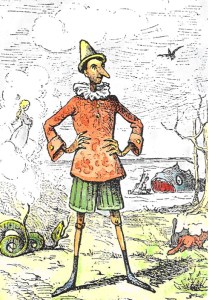
pinocchioWorking in his carpenter shop in Florence, Italy, Geppetto, the marionette-maker, could not have imagined that Pinocchio would become President of the United States of America. Neither could Carlo Collodi whose The Adventures of Pinocchio (1881) painted a more complex, less likable Pinocchio than the Walt Disney film version (1940) that popularized the story in America.

My generation grew up on Pinocchio. How could we not? He was eternally boyish. He was charming. When we told a fib to our parents, we empathized whenever poor little Pinocchio’s nose told on him. Pinocchio was a lovable liar in whom we saw our own flawed but lovable selves without the less attractive dimensions of Collodi’s original Pinocchio who, on the day he is born, cruelly snatches the wig from his marionette maker’s head. From his very first day, Pinocchio has a mind of his own far beyond and quite different from Geppetto’s imagination.

Neither Carloddi nor Geppetto could have imagined that on January 20, 2017 Pinocchio would raise his right hand to take the oath of office as President of the United States. If Geppetto were still able to pull the marionette’s strings, it would not happen. Geppetto would remember his stolen wig. And, if perchance, Geppetto were on the dais when the humanized Pinocchio raises his right hand, he might stretch out his own hand to check whether Pinocchio is wearing his wig.

Pinocchio has a way with words. He calls those who question his integrity ‘liars’ and ‘criminals’ He rallies people with his limited vocabulary. He gropes women and brags about it — it’s not every wooden marionette who gets to do what Geppetto would find deplorable. When he makes promises he cannot keep, his nose grows, but not everyone can see it. It grows slowly, inch-by-inch so that the original image blinds people to its peculiar length.

But there’s another dimension to Pinocchio’s personality that is largely unknown to the general public. He loves to play Pinochle, the game for four that is includes a trump suit, with his family. It’s harder to lie to three family members than it is on stage, and it may be that Pinochle may yet shrink the length of Pinocchio’s nose. Ivanka and Melania didn’t appear in Collldi’s The Adventures of Pinocchio or the Disney version of the story, but their parts in the ongoing story may save us yet.

Those who cringe at the thought of Pinocchio with his groping hands on a nuclear arsenal can always hope Pinocchio’s third wife and favorite daughter will transform the evening Pinochle game as a way to serve the people. In Pinochle the trump suit get spread among the players; no one can dominate. If we’re lucky, Ivanka and Melania will gentle the meanness Pinocchio exhibited when he snatched Geppetto’s wig the day he was ‘born’, keep his nose short, and do for Pinocchio’s what Eva Braun was never able to do: keep his right arm from rising to a salute.

Lazarus and “the rich man”

gustave_dore_lazarus_and_the_rich_man

Gustave Dore print of Lazarus and the rich man. (1890)

Jesus told a parable about a man with a name ‘Lazarus’ – a poor man – and a man who has no name – “a rich man”. The parable begins like this:

“There was a rich man who was dressed in purple and fine linen and who feasted sumptuously every day. And at his gate lay a poor man named Lazarus, covered with sores, who longed to satisfy his hunger with what fell from the rich man’s table; even the dogs would come and lick his sores.” [Luke 16:19-20 NRSV]

The scene then shifts from the difference between their earthly circumstances to the imagined differences between their circumstances in an afterlife. Lazarus is soothed in the bosom of Abraham. The rich man is in torment, pleading that if only he had known, he would have lived differently. He asks Abraham to send Lazarus to his five brothers to warn them. tell his living relatives. If he can come back to them from the dead, they will understand, change their ways, and avoid the coming judgment.

Abraham’s reply?

“‘They have Moses and the prophets; they should listen to them.’ [The rich man said, ‘No, father Abraham; but if someone goes to them from the dead, they will repent.’ [Abraham] said to him, ‘If they do not listen to Moses and the prophets, neither will they be convinced even if someone rises from the dead.’” [Lk. 16:29-31].

Jesus’ parable is not about the dead. It’s about the living. About how are to live together as neighbors. It’s about waking up to destitution and privilege and heeding the parable’s calling to a society beyond these extremes, a society known for its compassion.

Ask your friends to discuss the news in light of Moses’ response to the rich man. Ask your pastor, priest, or minister how she or he connects the dots with the news in 2016. Ask yourself the question as you listen to the morning and evening news. Ask yourself whether you’re getting the parable or whether the parable got you. Ask God for guidance, for mercy, for change, for transformation of a world of us and them. And give thanks for Jesus, Moses, and the prophets.

Goldman Sachs . . . again

Goldman Sachs former partner “Steven Mnuchin, a financier with deep roots on Wall Street and in Hollywood but no government experience, is expected to be named Donald J. Trump’s Treasury secretary . . . .”. – NYT, Nov. 30, 2016.

Here’s a memory jogger about Goldman Sachs from 2012.

“THE WALL STREET TATTLER” – Gordon C. Stewart — March 15, 2012
How could he do this? Is Greg Smith a tattler? Or, perhaps, Judas?

How could one of Wall Street’s own go to the New York Times (“Why I am leaving Goldman Sachs”) to publicly denounce the company’s culture? “He just took a howitzer and blew the entire firm away,” said Larry Doyle of Greenwich Investment Management.“ (“Wall Street Exec Quits with Public Broadside“).

According to the LA Times article, Goldman Sachs’ CEO Lloyd Blankfein suggests that Mr. Smith – Goldman’s executive director and head of the firm’s United States equity derivatives business in Europe, the Middle East and Africa.- is a “disgruntled employee.” William Cohan, author of Money and Power: How Goldman Sachs Came to Rule the World, says that “there are lots of disgruntled people who leave Wall Street, and they don’t do this” (i.e. open their mouths.) “What I’m hearing (on Wall Street),” said Cohan, “is sour grapes. You just pigged out at the trough for 12 years and you don’t have enough sense to keep your mouth shut.” (underlining mine)

Keeping one’s mouth shut is the name of the game on Wall Street.

Conscience may have its place so long as you keep it to yourself. You can have a conscience on Wall Street, just don’t exercise it. You’re part of an elite gang. Whether on the Street corners of impoverished neighborhoods like Watts in LA and Bedford-Styvesant in NYC, or in the center of crony capitalism that is Wall Street, gang members don’t rat on other gang members. If you don’t like it, swallow hard and keep your mouth shut.

Goldman’s rebuttal to Mr. Smith’s statement -“It makes me ill how callously people talk about ripping off their clients,” referring to their own clients as Muppets – hardly has the ring of strong denial. “We disagree with the views expressed, which we don’t think reflect the way we run our business.”

Hmmm. “…don’t think…”? Why not “don’t”?

It’s a rare thing for a spokesperson for a corporation with the best legal counsel in the world to say anything than a flat-out denial. “We don’t think” sets up the issue as a matter of perception, not fact. It’s Goldman’s perceptions of itself versus Mr. Smith’s disgruntled perception.

Mr. Smith’s refusal to live by the Wall Street gang code of conduct will lead to a barrage of attacks on his character calculated to divert the public’s attention from an institution that eats people’s investments and life savings to the Judas who is without integrity.

Goldman understands that for most of us the world is personal, not institutional. We don’t like tattlers and turn-coats, disgruntled employees who never learned the lesson of kindergarten that you never tattle on your friends. You don’t go running home to tell momma. Part of the code of the playground is not to tell.

What’s even more unusual in this case is that Greg Smith dealt in derivatives. Remember them? Derivatives – a complicated form of financial market gambling so convoluted that even the people who manage them can’t explain how they work – were at the center of the Wall Street meltdown in 2008. They were legal then. They are legal now. Goldman Sachs and the rest of the Wall Street gang of crony capitalism are still calling the shots with the highest paid Washington lobbyists money can buy.

Greg Smith is a Wall Street Judas who betrayed his gang not with a kiss but with a howitzer.

How could he do this? Why didn’t the guy who ate at the pig trough for 12 years just kiss and say good-bye? Why did he make his money and then break the code? Unless…unless…unlike so many of those who were taught not to tattle, Greg Smith couldn’t live with himself and decided not to run home to tell momma but to run to the New York Times. He’ll never again be allowed on the playground.

POSTSCRIPT, November 30, 2016: So much for the howitzer. Like Jimmy Stewart in “Mr. Smith Goes to Washington” in 1939, Greg Smith was a hero. Donald Trump is no Mr. Smith. So much for “draining the swamp.”

  • Gordon C. Stewart, Chaska, MN, November 30, 2016.


Falling

Fall is the season of falling. Falling leaves. Sap no longer running. Flowers fading. Red, yellow, purple dying into brown.

Each season reflects the movement of the soul, the eternal motion of the tides we sense within ourselves. Over a lifetime we move from the temporary wrinkles of birth to the etched wrinkles of aging. We love to look at babies. Old folks not so much.

More than a century ago Adalbert Stifter wrote of this in Der Nachsommer (English translation –The Indian Summer):

“Great beauty and youth capture our attention, excite a deep pleasure; however, why shouldn’t our souls gaze at a countenance over which the years have passed? Isn’t there a story there, one unknown, full of pain or beauty, which pours its reflection into the features, a story we can read with some compassion or at least get a slight hint of its meaning? The young point toward the future; the old tell of a past.”

Fall is a favorite season for many of us. At my age, I no longer wonder why.

The grass withers, the flower fades,
when the breath of the LORD blows upon it;
surely the people are grass.
The grass withers, the flower fades;
but the word of our God will stand forever. [Isaiah 40:7-8]

Be Still! Departing from Collective Madness

Writing Be Still! Departure from Collective Madness (scheduled for release by Wipf and Stock Publishers in January), I had a growing sense of its prescience. The subtitle “departure from collective  madness” is anchored in the works of Elie Wiesel and Old Testament scholar Walter Brueggemann, and the Gospel of Matthew’s story of the Wise Men (sic) who “departed” for their own country by another way.

As the date for final submission of the Be Still! manuscript drew near, I saw a madman running for the highest office of the land but underestimated the extent of the collective madness that would be drawn like iron to a magnet. The billionaire television personality who puts his name on everything his hands have touched, gave voice to people who have felt groped by the system.

Michael Moore, a champion of America’s forgotten working class, saw this coming. He was in touch with the many sources of anger that found a voice in Donald Trump, and he warned the Democratic Party to get in touch with it before it was too late.

Now it is history. I felt sick Wednesday morning. By yesterday evening, I was able to calm down. Today’s sense of nausea is worse than yesterday’s after reading “Meet Trump’s Cabinet-in-Waiting” – a cabinet which will put the country back into the hands Wall Street, big oil, climate change-deniers, and the likes of Chris Christie, Jeff Sessions (R-AL), Rudy Gulliani (Attorney General candidate), loose-talking groper Newt Gingrich (Secretary of State candidate), and CEOs.

President Obama and Secretary Clinton have called for the country to unite for an orderly transition. I believe in orderly transitions. I applaud them. A democratic republic depends upon such transitions. I support that. But I will not be united behind a madman or absorbed into a collective madness that bodes evil. I will not turn over cars. I will not stop traffic. I will not burn things. I will write. And write. And write knowing, as this election has reaffirmed, that words DO matter.

I will do my best to be still. I will follow the example the biblical Wise Men (sic) who “being warned of God in a dream that they should not return to Herod, . . . departed into their own country another way”[Matthew 2:12 KJV]. Herod was a strongman in whom there was no refuge. There was and is another way.

God is our refuge and strength,
a very present help in trouble.
Therefore we will not fear, though the earth should change,
though the mountains shake in the heart of the sea;
though its waters roar and foam,
though the mountains tremble with its tumult.

There is a river whose streams make glad the city of God,
the holy habitation of the Most High.
God is in the midst of the city; it shall not be moved;
God will help it when the morning dawns.

The nations are in an uproar, the kingdoms totter;
he utters his voice, the earth melts.

The Lord of hosts is with us;
the God of Jacob is our refuge.

Come, behold the works of the Lord;
see what desolations he has brought on the earth.
He makes wars cease to the end of the earth;
he breaks the bow, and shatters the spear;
he burns the shields with fire.

“Be still, and know that I am God!
I am exalted among the nations,
I am exalted in the earth.”

The Lord of hosts is with us;
the God of Jacob is our refuge.

[Psalm 46]

Amen. May it be so.

  • Gordon C. Stewart, Chaska, MN, November 10, 2016