Consolation following a loved one’s death comes hard sometimes. Wayne died of pancreatic cancer. But his greatest fear was that he would die the way his father did: living with Alzheimer’s, staring at his shoes. He still remembered how to tie his shoelaces. ~ Gordon, remembering Wayne G. Boulton (1941-2019).
Think about the work that goes into tying your shoelaces. It calls for physical exertion, dexterity, and cleverness, any child between the ages of six and nine years old knows it, early in life it is a serious matter, the bow the greatest mystery, the fingers, the hands, the laces, altogether an apparently unsolvable riddle. But once you have mastered it, you forget how complicated it is, the years pass until one day—having put your socks on—you look down at your feet, unsure of how to proceed.
1. PERSONAL CONTROL OVER THE ENVIRONMENT People can/should control nature, their own environment and destiny. The future is not left to fate. Result: An energetic, goal-oriented society.
2. CHANGE / MOBILITY Change is seen as positive and good. This means progress, improvement and growth. Result: An established transient society geographically, economically and socially.
3. TIME AND ITS IMPORTANCE Time is valuable - achievement of goals depends on the productive use of time. Result: An efficient and progressive society often at the expense of interpersonal relationships.
4. EQUALITY / EGALITARIANISM People have equal opportunities; people are important as individuals, for who they are, not from which family they come. Result: A society where little deference is shown or status is acknowledged.
5. INDIVIDUALISM, INDEPENDENCE AND PRIVACY People are seen as separate individuals (not group members) with individual needs. People need time to be alone and to be themselves. Result: Americans may be seen as self-centered and sometimes isolated and lonely.
6. SELF-HELP Americans take pride in their own accomplishments. Result: Americans give respect for self achievements not achievements based on rights of birth.
7. COMPETITION AND FREE ENTERPRISE Americans believe competition brings out the best in people and free enterprise leads to progress and produces success Result: Competition is emphasized over cooperation.
8. FUTURE ORIENTATION / OPTIMISM Americans believe that, regardless of past or present, the future will be better and happier. Result: Americans place less value on past events and constantly look ahead to tomorrow.
9. ACTION AND WORK ORIENTATION Americans believe that work is morally right; that it is immoral to waste time. Result: There is more emphasis on "doing" rather than "being". This is a no-nonsense attitude toward life.
10. INFORMALITY Americans believe that formality is "un-American" and a show of arrogance and superiority. Result: A casual, egalitarian attitude between people is more accepted.
11. DIRECTNESS / OPENNESS / HONESTY One can only trust people who "look you in the eye" and "tell it like it is". Truth is a function of reality not of circumstance. Result: People tend to tell the "truth" and not worry about saving the other person's "face" or "honor".
12. PRACTICALITY / EFFICIENCY Practicality is usually the most important consideration when decisions are to be made. Result: Americans place less emphasis on the subjective, aesthetic, emotional or consensual decisions.
13. MATERIALISM / ACQUISITIVENESS Material goods are seen as the just rewards of hard-work, the evidence of "God's favor." Result: Americans are seen as caring more for things than people or relationships.
Thoughtful people may quibble with Robert Kohl’s list. But few would erase the 11th value — honesty/trustworthiness –as bedrock to the American experiment in democracy.
The Magician’s Bargain
Looking each other in the eye and “telling it like it is” has been chipped away, replaced by the twists of tongue and cunning to get and hold power. In our time, truth has been reduced to a function of circumstance in the road to power. We live with the consequences of what C.S. Lewis called the magician’s bargain.
It is the magician’s bargain: give up our soul, get power in return. But once our souls, that is, ourselves, have been given up, the power thus conferred will not belong to us. We shall in fact be the slaves and puppets of that to which we have given our souls.
The surrender of soul in return for power is the seismic shift in the America of 2019. Honesty/openness/directness have never been a fact of our common life. The 11th traditional value is aspirational. There have been and always will be lies. But never in my lifetime has truth-telling been less valued than it is today in the highest places of government. To the chagrin and sadness of George Willand other principled traditional conservatives, it is the children of Jerry Falwell‘s Moral Majority who engage the moral magician’s bargain.
The Irony of the American Magician’s Bargain
Michael Cohen testified last week before the U.S. House Oversight and Reform Committee. The minority members of the Committee attacked the credibility of the convicted criminal who had served for 10 years as the president’s personal lawyer and “fixer” and chose to ignore the hard evidence the president’s “rat” had placed before them.
The only difference between Michael Cohen and those who refused to exercise their duty to uphold the Constitution was that Michael had confessed.
Do we feel the rumbling of the common ground beneath the partisan divide?
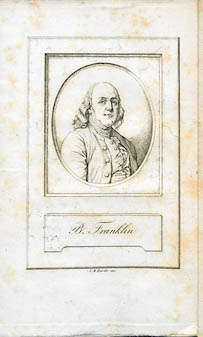
How deep is the loss! How much greater the challenge. Ben Franklin would have a cow!
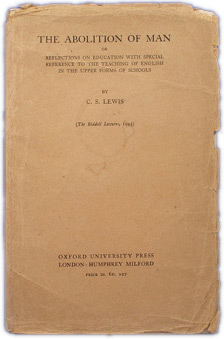
“We laugh at honor and are shocked to find traitors in our midst.” — C.S. Lewis, The Abolition of Man.
Elijah spoke yesterday. Elijah preached yesterday. Elijah spoke from the heart yesterday. Elijah was kind yesterday. Elijah warned us yesterday. Elijah spoke of destiny yesterday. Elijah challenged all of us yesterday:
“C’mon now! We’re better than this! We really are!
This morning Michael Cohen testifies publicly before the House Oversight Committee. He’s lied before. Will he lie again? Whether he does or doesn’t, how does one discern what’s true and what’s not?
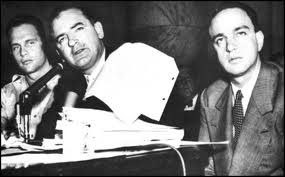
Michael Cohen walks in the long shadow of Roy Cohn (R in this photo), right-hand man and fixer for Sen, Joseph McCarthy (C in photo), and the lawyer, fixer, mentor for Donald Trump.
Roy Cohn continued to practice law and “fix” things until his fixing led to disbarment five weeks before he died. Like Roy, Michael Cohen will never practice law again. Unlike Roy Cohen, Michael Cohen may yet redeem himself from the darkness and unqualified public scorn.
Michael Cohen is going away for three years. But am I imagining that I see a different countenance since his sentence? That his face looks different — less troubled — and his walk lighter because he has little reason deny or twist the truth? Who’s to say?
Watching Michael on C-Span today, the Leonard Cohen’sThere Is a Crack in Everything. That’s How the Light Gets In will play in my head. Will Michael be a Roy or a Leonard? Will Michael “sing” or sing? Or are “singing” and singing the same thing when there’s a crack in everything?
When was the last time you had time to waste before boarding a flight? The uber drops you off at the curb in plenty of time. You check your bag. You pass through security. You have an hour or so to kill before the 11:10 boarding of your flight on Concourse C.
You haven’t had breakfast. You go to the food court, buy a coffee and a breakfast sandwich, and take a seat at a small table in the food court. You reach for your iPhone to check the time, read the texts and tweets, and read the e-edition of your favorite news source. But it’s missing! You rummage though your pockets or your purse. You’ve forgotten or, God forbid, lost your iPhone. You never do that. Never, never, never!
You scarf down the coffee and croissant sandwich and go across the hall for a newspaper. You buy a copy of today’s New York Times, return to the table in the food court, read the front page headlines, open to the sections of interest, and get absorbed in the latest news or this morning’s crossword puzzle or sudoku.
Suddenly, you realize you’ve lost track of time. You reach for your iPhone and remember. You look for a clock, but there are no clocks. You leave the food court in search of a clock. There are no clocks.
You race down the concourse toward your gate, looking for a clock to see whether you’re late for your flight. But there are no clocks. None. Anywhere. Not even on the flight arrival and departure boards. The flight boards display the schedule and whether your flight is on time, delayed, or cancelled, but they do not tell you what time it is now.
Arriving at the gate, there is no line for boarding. You breathe a sigh of relief when you learn you’re not too late. You sit down in the waiting area and sheepishly ask a stranger for the time. She checks her phone and gives you the time, while you explain that you’ve left home without your new iPhone6, or maybe you’d lost it, as though she cares.
On board the flight, you fasten your seat belt and break the rule of privacy. “Hi, my name’s Bob. Is this home, or do you live in Denver?” “Denver,” he says without looking up from his smartphone. You might as well have asked for his Social Security number. This flight will be a long exercise with silence, a chance for meditation, but you can’t do meditation without the meditation app on your iPhone.
After take-off, you take out the New York Times. It’s been awhile since you read a newspaper in print, and you’d missed out on an aisle seat where you could spread out. Your left arm is flush against the window. As you unfold the newspaper, you intrude again into the space of the guy from Denver in the middle seat. He looks up and shakes his head. You apologize for your rudeness and carefully fold the newspaper in half the way commuters do on trains on their way to work in the city. You settle down with the properly-folded newspaper. A headline leaps from the page:
Do Not Disturb: How I Ditched my Phone and Unbroke My Brain”(Kevin Roose, Feb. 23, NYT) comes to the rescue. It begins:
“My name is Kevin, and I have a phone problem. And if you’re anything like me — and the statistics suggest you probably are, at least where smartphones are concerned — you have one, too.”
I do! Yes! I do! you say to yourself. You wonder whether Kevin also has a clock problem. Whether he’ll lament our isolation in a world missing the one thing we all had in common before smartphones: public clocks on the tower of the old village square . . . and in airports!
On the way to baggage claim, the problem is bigger than the absence of a friendly clock. You’re in a strange city without information on where you’re supposed to go. The address of your hotel, how to get there, contacts, e-mail and text information, phone numbers, and the name of the restaurant where you’re to meet the headhunter for the job interview are carefully stored on your iPhone.
What to do? At baggage claim, a stranger takes pity on you. She lends you her smartphone. A family member answers your call, finds your phone, follows your instructions for unlocking your iPhone, and begins to give you the information you’ve asked for. But without a phone to take down the information, you’re still helpless!
“Hold on a minute,” you tell the family member back home, and return to the stranger. “I’m sorry to disturb you again, but do you have a pencil and a piece of paper?”
No, there isn’t. How would you know? You’re only 21.
You’re cruel, Bumpa! POTUS is kinder than you!
What’s gotten into your little head?
My head’s not little! My head’s bigger than 96 percent. Doctor said so! I’m in the top four percent!
I know. That’s good. But you shouldn’t get a big head about that! So, tell me, why do you think there’s a real national emergency?
POTUS declared it. I saw it on PBS!
On Sesame Street? Did Big Bird tell you?
No. It came on after Sesame Street. I saw it!
What did you see, Elijah?
MISSING children, Bumpa! Don’t you know? 1,475 kidnapped children, Bumpa! That’s a national emergency! We need to help rescue all those kidnapped children!
I hear you. We do. But the kidnappers didn’t come from south of the border. The kidnappers are not here illegally.
Bumpa, can I be president… or do I have to be a lawyer?
Yes, you can, and no, you don’t. Why would you ask that, Elijah?
‘Cause they’re the only people who count.
Oh, my, Elijah! You were born in a strange time!
Uh-uh! I was nine when I was born. Mom says it was past time. Mom was miserable before I got borned.
She was, Elijah. She sure was.
You’re miserable, Bumpa! Are you pregnant?
No, only young women get pregnant and miserable. Old men just get miserable and grumpy.
Yeah, we’re Minnesotans. When can we go ice fishing?
fish houses of ice fishermen in Minnesota
Grandpa doesn’t do ice fishing. Maybe Uncle Andrew will take you and Calvin together.
Does Uncle Andrew have a fish house?
No. You don’t have to have a fish house to go ice fishing.
But you have to have a big house if you want to be president or a lawyer, right?
Well, no. You don’t have to have a big house to be a lawyer. Some lawyers are street lawyers and public defenders. All lawyers take an oath to protect the constitution.
But some lawyers are bad, right? Like Michael Cohen and Rudy Giuliani. Grandma says they’re walkin on thin ice. It’s a national emergency!
Yes and no, Elijah. Mr. Cohen and Mr. Giuliani represented or represent the president. The president’s about to fall through the ice for making stuff up.
Yeah, the president’s a national emergency and his lawyers pretend he’s not!
Yes, that’s our opinion.
Right! I changed my mind. I don’t want to be president, Bumpa, and I’m glad I don’t have to be like Michael and Rudy.
Like I said, Elijah, you could be either president or a lawyer, but you don’t have to be. You can be anything you want.
OK! I wanna to be like Uncle Andrew! I can be a ice fisherman right here in Minnesota and grow up to be a grumpy old man. I wanna be like you, Bumpa.
— Grandpa (“Bumpa”) Stewart and Elijah (21 months old), Chaska, MN, February 17, 2019












 Views from the Edge