Progress and the Pit of Babel

Ever since Hegel , the view of inevitable progress has held sway in much of philosophy and in some schools of theology. In Christian theology, which is my faith context, fundamentalists project the ideal world backward in time to human origins in the Garden of Eden. For them, the Garden is not myth; it’s fact. “The Bible tells me so” and that’s that. Those who view the Genesis story as myth (not “untrue” but a literary genre expressing a timeless truth) tend to look at evolution as the unfolding of the Will of God toward what the Bible calls the Eschaton, the Great Last Thing, perceived as the achievement of the ideal or perfected state toward which the whole creation groans. The Ideal is not behind us but ahead of us as the conclusion of history.

Ever since my undergraduate philosophy professor, Esther Swenson, plunged me into existentialism – which was and still is a protest against all idealistic suppositions and conclusions about the world and humankind – I’ve been a skeptic of idealism. The projection of an Ideal or perfect world ignores, it seems to me, the fact that the end point of the planet itself is death, as it is for all of life. There is no permanence. There was no Garden of Eden in the past and there will not be one in the future. Projections or imaginations that place the Garden ahead of us are as flawed as the fundamentalist assumption that human history began with one.

Franz Kafka remains my favorite writer, in part because of his honesty and in part because of his economy of words. Dom Sebastian Moore, a rather eccentric Benedictine theologian, is linked with Kafka only in this one shared conclusion: the human project of an ideal human being or society is a flight from death into the arms of death itself.

Moore writes that the flight from death “is opting for an ultimate solitude.

“This choice can be made not only by the individual as the unconscious of his desperation, but also by the whole human race. It is being made by the whole human race, as between two poles, taking seriously only our self-awareness. Ignoring our being-part-of, that is the ecology of whose balance we are partly animals. The human race thinks it can go on with all its Narcissistic human normalities, of war, of politics, of religion, and that somehow the vast other side of the picture will look after itself. So in opting for ‘himself as conscious’, man is opting for an ultimate solitude.

“And ultimate solitude is death. It is to be cut off from the tree of life, and to whither.”
– Sebastian Moore, The Crucified Jesus Is No Stranger

Two parables of Kafka offer food for reflection. They are reverse images of the Genesis story of the Tower of Babel.

The Tower of Babel

If it had been possible to build the Tower of Babel without ascending it,
the work would have been permitted.

The Pit of Babel

What are you building? – I want to dig a subterranean passage.
Some progress must be made. My station up there is too high.
We are digging the pit of Babel.

On Monday mornings I meet for an hour with a group of wise octogenarians. When Kate had listened to the reading of Jeremiah – “my people have committed two evils: they have forsaken me, the fountain of living water, and dug out cisterns for themselves, cracked cisterns that can hold no water” (Jeremiah 2:13) – she had a far off look in her eyes. “What are you thinking, Kate? Where did you go?”

“Oh,” she said, “I went way off track. I couldn’t help but think of those leaking nuclear reactors in Japan.”

A penny for your thoughts.

Puppy salutes Martin Luther King’s Dream

Barclay and the memory of Martin Luther King, Jr.

Barclay and the memory of Martin Luther King, Jr.

Fourteen-week old Barclay was reading the morning paper where he read for the first time about the Rev. Dr. Martin Luther King, Jr. and his “I have a Dream speech” 50 years ago this Wednesday. “Woof!” said Barclay. Then his eyes became sad as he read the other stories in the paper and told his Dad to put on the Society for the Prevention of Cruelty to Animals (SPCA) shirt Barclay’s Mom found at a garage sale. The America Barclay wants is one that prevents cruelty to animals, including humans.

“Dad,” he said, “We have to go to Washington this Wednesday! We have to keep the dream alive.”

“We can’t go to Washington,” said Dad. “We’re not ready to go to Washington. Not until you learn to go potty outside. Maybe next year, when you’ve learned that going outside is your contribution to the prevention of cruelty to humans and the American way of life, we can go to Washington and visit Congress to train them too.”

Barclay looked at Dad and said Dad wasn’t worthy to wear that t-shirt. Dad goes inside all the time. “It’s prejudice, pure and simple and I won’t have any part in it! Dad hates dogs!”

“Sit,” said Dad.

“Just another form of cruelty and intimidation,” said Barclay. “Martin would never have treated me like that.”

“You don’t understand,” said Dad. “Martin was able to accomplish what he did in the Civil Rights Movement and the Peace Movement because he put himself under the strict discipline of non-violent resistance. Martin Luther King, Jr. understood discipline and self-discipline. I want you to learn the same thing. Every time you go in the house, it’s an act of violent resistance. It’s an act of terror. Do you understand? Sit!”

Barclay sat, knowing that the treat was in Dad’s hand. He took the treat, then squatted right in front of Dad, and said, “Maybe some day I’ll be self-disciplined like Dr. King. Right now I’m just a puppy in training. … So next year we can go Washington, D.C. and train everyone in Congress and the White House not to make a mess in their own houses?”

Glocks in the State Capitol Building

Glock owner at State Capitol hearing. Photo by David Joles, StarTribune.

Glock owner at State Capitol hearing. Photo by David Joles, StarTribune.

Not in my worst nightmares did I think I’d see the day.

This morning’s Star Tribune front page “Debate Triggers Show of Weapons” and the accompanying photographs are chilling. There are two photos. In one a young man with a loaded Glock strapped to his waist stands with arms folded, looking defiantly smug while he waits to testify about before a legislative committee in the Minnesota State Capitol. In the other two men sit at the hearing table with microphones. One reads from a manuscript; the other covers his face with his left hand as though he can’t believe they’re even discussing this.

I identify with the man with the hand covering his face. I don’t understand the man who brought the .40-caliber Glock to the hearing loaded with 15 rounds. Why would he do that?

“You have to be your own hero on your own white horse” is the way he explained it. He feels safer with his Glock.

Put next to that the statement of Pope Francis, as reported by Vatican Radio: “Faith and violence are incompatible.”

The Pope was preaching on the exact text often used by those who believe that violence and division are compatible with Christian faith. The text is Luke 12:51 in which Jesus asks, “Do you think that I have come to bring peace to the earth? No, I tell you, but rather division!” The division, as interpreted by the Pontiff, is between living for yourself or living in the light of God. Here are Francis’ words:

“The word of the Gospel does not authorize the use of force to spread the faith. It is just the opposite: the true strength of the Christian is the power of truth and love, which leads to the renunciation of all violence. Faith and violence are incompatible”.

The halls of a legislature are intended to be sacred spaces where differences are resolved for the sake of the greater good, where my self-interest and your self-interest, as they are perceived by elected representatives, are expressed and resolved peacefully without intimidation. The chambers of representative democracy are the last place where any legislator or innocent visitor to the State Capitol should face the explicit or implicit intimidation of someone with a Glock.

Faith and violence are incompatible… so are democracy and intimidation.

Sermon on Faith and Economics

Video

A Sermon at Shepherd of the Hill Presbyterian Church in Chaska, MN, August 11, 2013.

Dad was bad today

Barclay (Cavalier King Charles Spaniel) and bad Dad (homo sapiens)

Barclay (Cavalier King Charles Spaniel) and bad Dad (homo sapiens)

The new puppy (3 pounds 8 ounces) was leaping from my arms, flying to the sidewalk before I knew what was happening. It happened so quickly. Barclay was still excited from meeting the children around the corner; he was not his customary docile self.

The plunge from my arms was terrifying. The yelping was blood-curdling. I thought for sure he had hit his head or broken a leg or suffered some internal injury. He crawled forward under the Blue Spruce for protection, still crying loudly. I fetched him from under the tree, held him close, apologized profusely – “I’m so sorry, little guy. I’m so sorry” – and carried him into the house, still traumatized and whimpering. He settled down in my arms while I checked his body for signs of damage. Finding none, I put him down to see how he would walk. His walk was slow but straight. He spent the rest of the day more quietly but was fine as the day wore on, returning to his playful self during late afternoon play time.

Barclay greeted Kay’s return from work with a wagging tail and kisses to her face, as if to say, “Dad was bad today, but I forgave him. I’m glad you’re home!”

Bemused by Time

Gordon C. Stewart, August 8, 2013 copyright.

I have always been bemused by time . . . and place. I am on a train listening in the night to the eerie sound of the train whistle and the constant click-clacking of the wheels. Where were we? Where are we going – and why, just my mother and I?

We were between times and places. My father had shipped out for war in the South Pacific. Hewas somewhere on a ship and might not return. My mother and I were on our way from LA to Boston. Two different places: one hours behind, one many hours ahead. But for the time being, there was only the now of the train, the whistle, and the steady clickety-clack from the track carrying us from there to here to there, from then to now to then. Perplexity with time and place is my earliest memory.

We are all in transit. But from where to where and from when to when have become less and less my questions.

I do not share the popular view that time is an illusion or that the material world is the prison from which we will be released at death. Time and place are gifts of creaturely existence, boundaries within which we live our lives appreciatively or scornfully in the midst of the Eternal. To scorn them is to deprecate existence itself in the Promethean hope that we can steal fire from the gods to become what we are not: timeless and placeless.

Time and place are set within the larger Mystery that Rudolph Otto called the Mysterium tremendum et fascinans – the Mystery that makes us mortals tremble and fascinates us at the same time, the Mystery of the Eternal without which we are nothing that draws us to itself like iron to a magnet. Time and place – birth, finite life, death – exist within the Mystery of that which does not die: Eternity.

I am not amused by the denial of death that is so rampant in our culture. Surveys show that roughly 90% of Americans, regardless of religious affiliation, believe in life after death, by which they do not mean that life will go on without them, but that they themselves will never die.

I have come to believe that the denial of death and the fear of death lie close to the core of American culture at its worst. Ernest Becker’s The Denial of Death informs how I see the world and myself; Becker sits beside me as I turn to the Scriptures in the morning.

Psalm 90:1-5, paraphrased by Isaac Watts (1719) and sung as the hymn “O God, Our Help in Ages Past” is as much in my early memory bank as the train whistle on the ride to Boston. It has always represented a mature faith that takes seriously Otto’s Mysterium:

Before the hills in order stood,
Or earth received its frame,
From everlasting Thou art God,
To endless years the same.

A thousand ages in Thy sight
Are like an evening gone;
Short as the watch that ends the night
Before the rising sun.

Time, like an every rolling stream
Bears all its sons away;
They fly forgotten, as a dream
dies at the opening day.

O God, our help in ages past,
Our hope for years to come,
Be Thou our guard while life shall last
And our eternal home.

Standing at the gravesites over the years, I have prayed the same prayer so many times that it has become an essential part of me. I confess that I don’t know what it means exactly but it expresses the sentiment of good faith as I have come to understand it for myself.

O Lord, support us all the day long,
until the shadows lengthen,
and the evening comes,
and busy world is hushed,
and the fever of life is over,
and our work is done.
Then, in Your mercy,
grant us a safe lodging,
a holy rest,
and peace at the last.

The shadows have grown longer since the trip to Boston and the first time I sang the hymn. Evening is closer now. The sense of the Mysterium tremendum et fascinans is different but no less real now than it was on the train to Boston. The hush of the busy world will come soon enough. Between now and the day my work is done, I want to listen more attentively for the Hush in the midst of time, and give thanks that the Silence is not empty. It is full of Eternity. I am bemused by time.

Click O God, Our Help in Ages Past for a video that captures the spirit of the hymn and the prayer.

It’s a Puppy World

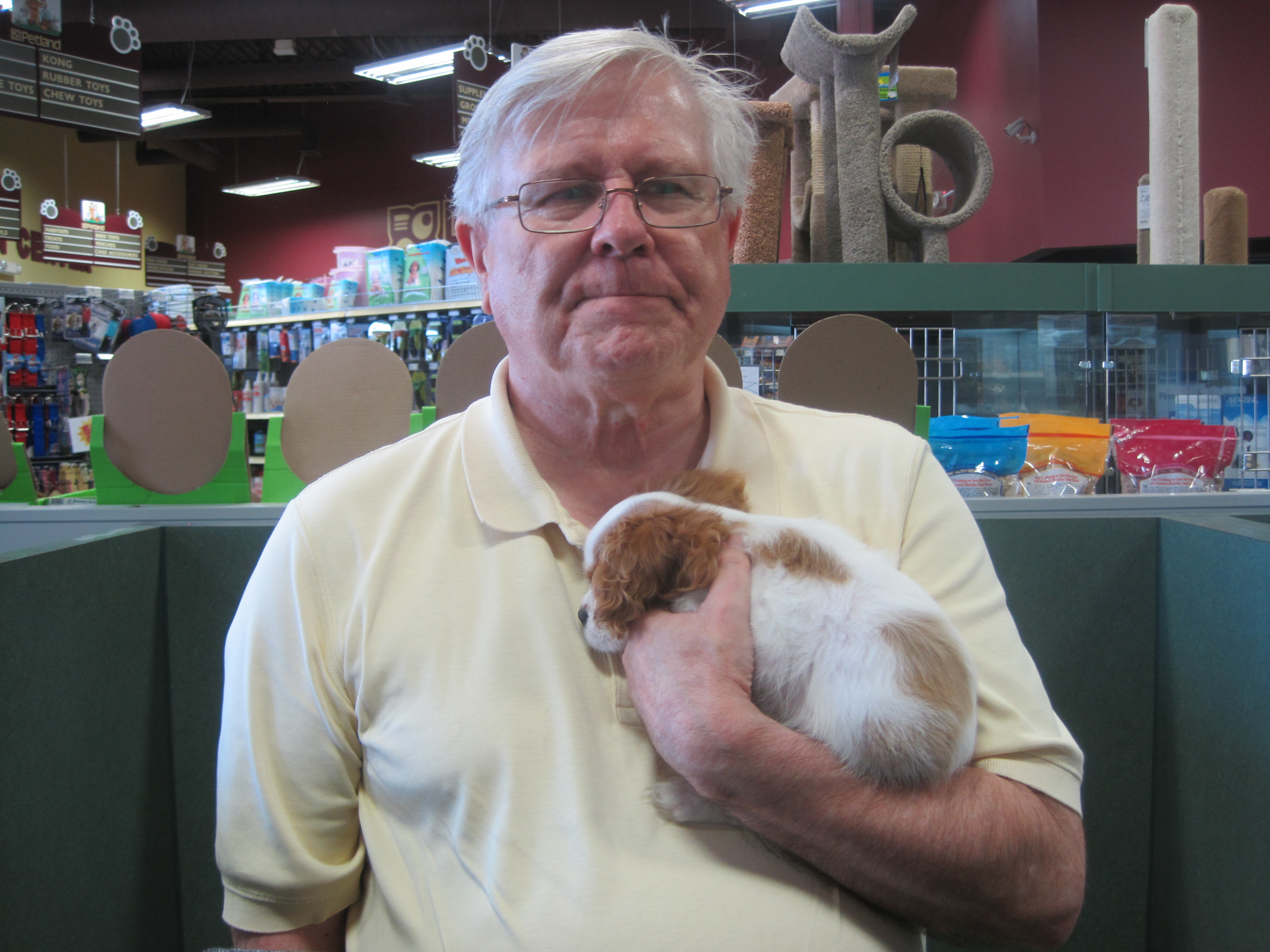
Barclay on chestAfter much careful (actually impulsive) thought, we decided to add to the household. Barclay arrived in this world May 21, 2013. We brought him home last Sunday evening.

Barclay is a Cavalier King Charles Spaniel, a breed known for extraordinary companionship, quietness, intelligence, beauty, and ease of training, all of which drew us to the breed. But when we saw this little guy, saw those big eyes and that excitedly wagging tail, picked him up (all 3 lbs.6 ounces of him), and experienced the quick licks to the face and gentle nibbles on the ear, we were putty in a 10 week-old puppy’s paw.

Life has changed for him and for us.

He has a home…..and our sleeping days are over. He’s very quiet. Doesn’t whine at all. As we learned Monday night, he’s too young to make it through the night without a potty time. Poor little guy was cold, wet, and shivering when Kay came down at 4:30 for her cup of coffee and quiet time. He recovered well throughout the day, and we adjusted our schedule to be better “parents” to the un-house-broken baby. He has had no other accidents…largely because I watch his every move every day. I’m the stay-at-home puppy dad who now required TWO naps a day, just like Barclay.

We feel very blessed to have lost our mind and ask your good wishes and prayers that the three of us survive puppyhood in “a good way,” as our American Indian friends say.

Verse – Suspicions

Is she? Is he? Are they?
Have they? Will they?

They look, they speak,
they touch, she smiles,
he stares, but do they…

He also stares at men–
Could he be…

She has a woman friend–
Might she be…

Bi? Poly? Omni?
Asexual? Surely not…

Celibate? Faithful?
Don’t make me laugh.

– Steve Shoemaker, Urbana, IL, August 7, 2013

An acrostic verse: Missa Solemnis

“Missa Solemnis”

LORD HAVE MERCY begins the Mass
Under the baton of Maestro
Dean Craig Jessop. The last word: PEACE.
Wisdom and beauty from solo
Instrument, the mass choir, voice
Go to the top of Cathedral.

Vast walls of sound show pain also,
Arising from those who are cruel.
Nothing human escapes alto,

Bass and tenor and soprano.
Even a skeptic like Ludvig
Enlisted to create music,
Tries to make out of the tragic:
Hope, faith, love, kindness, and courage.
Overwhelmed by suffering, he
Values still signs of human will.
Even though stone deaf, he can be
Nurturing peace and harmony.

– Steve Shoemaker, Urbana, IL August 7, 2013

EDITOR’S NOTE: Craig Jessop is Dean of the College of the Arts at Utah State University, and former Director of the Mormon Tabernacle Choir.

Solitude and Society