Echoing through time

Eleven years ago tomorrow – November 14, 2004 – the sounds of Windy Downwind’s flute and AIM founders Clyde Bellecourt, Dennis Banks, and Bill Means’s Honor Song convened the respectful celebration of the life of Doug Hall in the St. Felix School Gymnasium in Wabasha, MN.

I often think of Doug and his life-partner Marian, but it was yesterday’s re-descovery of “The Book of Doug”, a gift from the Hall family following the celebration of Doug’s life, that led to this post.

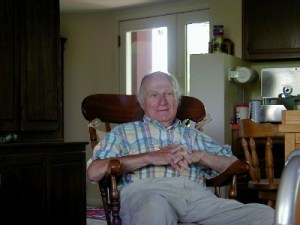
Doug Hall at home in Wabasha

Doug Hall at home in Wabasha

Verse – His Own True Self

He sits and smiles,
His dog Sparky
Resting against his leg,
His eyebrows hanging
Like willow branches.

The bell has tolled
For him, a tolling
Like a wind-song
From the North
Marking the end.

Stephanie Autumn and Clyde Bellecourt honoring Doug with Indian blanket

Stephanie Autumn and Clyde Bellecourt honoring Doug with Indian blanket

He sits and smiles,
Peaceful, thankful,
Accepting, connecting
With those he loves,
Caring for those he will leave

The earth, his home,
Calls him to itself,
Beyond eternal claims
Or expectations,
He sits at peace

Mortal flesh he knows
Cannot prolong itself,
Nor should it seek what it
Cannot attain
Beyond its measure.

No control of time
Which bears us all away,
No need now to storm
The barricades against
The end of time.

He sits and smiles
In gratitude and wonder
For sun and shadow,
For all creatures great and small,
For family love and friends.

For these he sits and smiles –
This self-disclaiming man
Who intended nothing
But his own true self
In whatever time was his.

[Gordon C. Stewart, 2004]

Windy’s flute and the Honor Song drumming echoed Doug’s spirit. Like Old Joe Hill, Doug’s voice still echoes down through the ages of time for all who seek justice, love mercy, and walk humbly on this Earth.

Minnesota Law and Politics named Doug Hall to Minnesota’s Legal Hall of Fame. Scroll down to #38 to read the Law and Politics’ tribute to him.

– Gordon C. Stewart, November 14, 2015


A Papal Education by Daniel A. Wagner – Project Syndicate

In September, the UN and Pope Francis both called on the international community to fight poverty and preserve the environment. At the center of these efforts will be education – particularly one goal on which the world is still falling short: literacy.

Source: A Papal Education by Daniel A. Wagner – Project Syndicate

Daniel (“Dan”) Wagner is UNESCO Chair in Learning and Literacy, Professor of Education, and Director of the International Literacy Institute at the University of Pennsylvania, and a long-time friend.

Thanks to Dan’s spouse, Mary Eno, a Ph.D. practicing psychologist in private practice and friend of Kay Stewart since junior high school, for bringing Dan’s article to our attention.

Do prairie grasses ever get depressed?


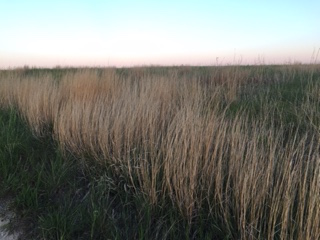
Prairie grassland, Photo by Kay Stewart

Prairie grassland, Photo by Kay Stewart

Each alone and
all together
planted on
the prairie plain
we go nowhere
in sleet and snow
wind and rain
scorching heat
and frigid cold
sun and drought
quarter moons
half moons
three-quarter moons
full moons
no moons
starless nights
and starlit nights
we stay and wait
for nothing in
particular knowing
who and where
we are — a prairie
grassland sown
for us to be our
own true selves
together and alone.

– Gordon C. Stewart, Hutton Niobrara Ranch Wildlife Sanctuary near Bassett, Nebraska, September 23, 2015.

Morning Fog and the Horizon

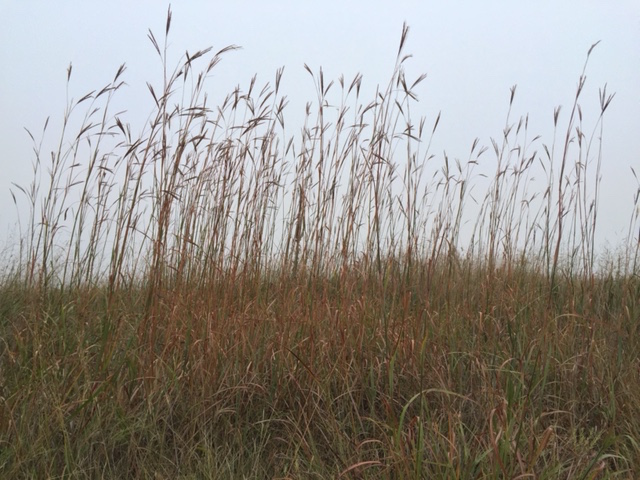
The horizon disappears behind the morning fog.Prairie grasses in fog

Tall grasses that yesterday colored the prairie as far as eye could see are still there. Only the nearest 100 feet of the rusty red, yellow, and brown prairie grasses now appears, the rest only imagined behind the gray mist curtain.

The Nebraska prairie and its earth-tone colors are native to Kay. They’ve been less appreciated by her husband, raised on the tree-covered hills and the bright ocean blues and greens, dotted occasionally with sumac red and willow yellow, of the Northeast Coast.

The Hutton Niobrara Ranch Wildlife Sanctuary, this 5,000 acre wildlife refuge of Audubon of Kansas, feels unspoiled by human hands, except for the indigenous people who long ago vanished with the buffalo along the Niobrara River.

By noon the fog is still here. So are the earthen colors. What’s changed is the Yankee’s fresh appreciation for the intrinsic beauty of the browns, yellows, and rusty reds he once viewed as the dull, faded colors of boredom and decay.

The Earth is a splendid place to live. Morning fog blew in years ago over Old Garden Beach in Rockport, Massachusetts leaving only the gray granite, red sumac and pink primrosed white picket fence visible to the eye. Then and now, there and here, life is wrapped in mist and wonder. The horizon disappears in morning fog.

  • Gordon C. Stewart, Hutton House, Hutton Niobrara Ranch Wildlife Sanctuary, somewhere near Bassett, Nebraska, September 22, 2015.

Planetary Economics

The beginning of the GOOD news is HARD news, according to John the Baptist calling people out into the wilderness of Nature (Gospel of Mark 1:1-8).

“We must change,” he cries. Only a 180 degree turn can deliver us from the consequences of the actions that have led us here. He sounds like Bill McKibbon.

For John the Baptist the system at issue was Roman imperialism, an economic-political system centered in Rome expanding out, enforced by military invasions, subjugation, occupation, buffered by generous religious tolerance so long as the religious practices did not interfere with Roman prerogatives.

One could repeat the sentence in 2015 with little change: “the system at issue is [American] imperialism, an economic system centered in [Washington] expanding out, enforced by military invasions, subjugation, occupation, and religious tolerance so long as the local religious practice does not interfere with [American] prerogatives.”

It is this spiritual, moral, economic, cultural and political captivity to a global system that cannot satisfy our real needs or the world’s that produces a longing in our hearts, a readiness to make the trip to the wilderness. We are being called to abandon the house built on the quicksands of greed, manifest destiny, national exceptionalism, and the illusion of unsustainable growth.

We’re a weary people in 2015. Wearied and still disheartened 14 years after “Shock and Awe” took down Saddam Hussein on the pretense that he had weapons of mass destruction (WMDs) that threatened us and the Bush Administration’s persistent mis-association of 9/11 with Saddam Hussein. We’re wearied of lies and 11 years of un-budgeted military expenses, the loss of thousands of American soldiers’ lives and as many as 100,000 Iraqi civilians, a military venture undertaken on the assumption that the Iraqi people would welcome our presence as the onset of a new representative democracy and “free market” economy.

That belief in the goodness of American intentions hit the rocks almost as quickly as Saddam’s statue hit the pavement in Baghdad. All the while we were wearied by the earlier invasion of Afghanistan, whose original justification was a quick elimination of Osama bin Ladin and Al-Qaida untempered by realistic knowledge of the long history of the military interventions that mired the invaders in quagmires such as the Soviet Union found itself before leaving in defeat. To the Afghans it didn’t matter whether the troops were Soviet or American. They were the same. They were the occupation forces of an imperial power destined to fail.

In the midst of the weariness about what was happening abroad, the financial system at home took the American economy to the brink of disaster in 2008. Occupy Wall Street rose to the top of the news cycles. Although the movement fizzled over time, as such movements inevitably do, it caught the attention of television viewers, internet surfers, and newspaper and magazine readers. Occupy Wall Street and the spot light it placed on “crony capitalism” became a hot topic around water coolers at work and the table in the coffee shops.

For the first time in recent memory, capitalism was no longer sacred, no longer off limits. Time’s front cover asked the question whether Capitalism was dead. But, as with Occupy, public attention is short-lived. Amnesia sets in when people are weary. How soon we forget…until some new John the Baptist issues the cry for a 180 degree turn for the sake of something better.

Maybe Naomi Klein is a new kind of John the Baptist. This Changes Everything: Capitalism vs. the Climate, reviewed here by the New York Times, places the over-riding systemic issue squarely before the general public again. Senator Bernie Sanders, America’s only socialist Senator who names climate action as among his four top priorities, is gaining attention as a presidential candidate. Elizabeth Warren, the Senate’s strongest voice on holding Wall Street accountable, is a bulldog who won’t let go. Put them with Bill McKibbon and 350.org and you begin to hear the echo of John’s recognition of the prophetic hard truth-telling that is the forerunner of good news.

The hard truth that precedes good news is the discovery of the myth that couples democracy with capitalism while viewing socialism as democracy’s opposite. Ideological myopia is to nations and cultures what horse blinders are to horses on a race track: they limit vision to the narrow path of the track they’re on. They prevent their adherents from seeing beyond the track.

When the climate is changing in ways that have begun to compel our attention, and when we ask how we will make it through the changes together, the bigger question of the economic system (the track itself) comes into view by virtue of necessity. It calls us off the track of species supremacy and “man over nature” into the wilderness of Nature itself.

The words ‘economy’ and ‘economics’ derive from the Greek words for ‘house’ and ‘the management of the household’. Their real subject is not about markets, free or otherwise. The issue is what and how the managers manage and why we let them. Economics is every citizen’s business because we all live together in the one house. No exceptions. Economics in the original sense is a spiritual-ethical perspective before it creates systems that support (or contradict) its premise of shared life and responsibility for the planet.

John the Baptist with his axe laid to the root of the tree, reminds us that economics is a spiritual matter of the first order. It is what the Hebrew Bible calls “the Day of the Lord” and John the Baptist and Jesus of Nazareth called “The Kingdom [i.e. Society] of God”. Economics is not an academic discipline, or the exclusive province of Wall Street traders who understand how the free market works. Genuine economics begins and ends with the philosophical commitment to the wellbeing of the entire household of Nature and its inhabitants.

The planet — this home within Nature without which no person, society or form of life exists — requires different management. The economy for which our hearts long is the one house imagined by the psalmist and announced by John in the wilderness beyond the track of the Pax Romana: the good news waiting for longing hearts to embrace it, an economy where “righteousness and peace will kiss each other” (Psalm 85:10) and wars will be no more.

The beginning of the GOOD news is HARD news. “Repent, for the kingdom of heaven is at hand.”

– Gordon C. Stewart, Chaska, MN, June 16, 2015

Our Common Home: Pope Francis and Bernie Sanders

Pope Francis’s Encyclical Laudato Si‘: On Care for Our Common Home has caught the world’s attention. (Scroll down for the Encyclical Letter’s opening paragraphs.)

In our view, Pope Francis and Bill McKibben of 350.org are prophetic figures, i.e., they seem to utter a Word not totally their own. So does Sen. Bernie Sanders (I, VT), who is, not by accident, Bill McKibben’s close friend from Vermont, and the ONLY candidate to place climate change action among the top priorites of his presidential campaign. He speaks boldly, and his message echoes the cry of Luudato Si‘ for action now for the sake of the planet. There is no obfuscation.

“The United States must lead the world in tackling climate change, if we are to make certain that this planet is habitable for our children and grandchildren. We must transform our energy system away from polluting fossil fuels, and towards energy efficiency and sustainability.” – Excerpt from Sen. Bernie Sanders’s campaign priority on Climate Change and the Environment.

Religion, science, and politics each deal with reality, superstition, and obfuscation. The Pope’s call for global action requires political legs to make it walk. Political engagement is not optional at this moment in the history of planetary development. In that regard, no other presidential candidate is so clear on climate change and sustainability as Bernie Sanders. No other candidate speaks with such passionate conviction or knowledge. Pope Francis is a man of God, a modern John the Baptizer appearing in the wilderness, following the lead of Bill McKibben, the scientific consensus, and The Pontifical Academy of Sciences’s research and counsel.

The Pope’s position on nature, born of a more ancient wisdom than the mechanistic “man over nature” view of postindustrial society, is thoroughly catholic, the0logically classical, and steeped in scientific research.  “Man over nature” and “history over nature” are figments of our imagination. Nature always wins. We ARE nature and nature is us.

1. “LAUDATO SI’, mi’ Signore” – “Praise be to you, my Lord”. In the words of this beautiful canticle, Saint Francis of Assisi reminds us that our common home is like a sister with whom we share our life and a beautiful mother who opens her arms to embrace us. “Praise be to you, my Lord, through our Sister, Mother Earth, who sustains and governs us, and who produces various fruit with coloured flowers and herbs”.[1]

2. This sister now cries out to us because of the harm we have inflicted on her by our irresponsible use and abuse of the goods with which God has endowed her. We have come to see ourselves as her lords and masters, entitled to plunder her at will. The violence present in our hearts, wounded by sin, is also reflected in the symptoms of sickness evident in the soil, in the water, in the air and in all forms of life. This is why the earth herself, burdened and laid waste, is among the most abandoned and maltreated of our poor; she “groans in travail” (Rom 8:22). We have forgotten that we ourselves are dust of the earth (cf. Gen 2:7); our very bodies are made up of her elements, we breathe her air and we receive life and refreshment from her waters.

[1] Canticle of the Creatures, in Francis of Assisi: Early Documents, vol. 1, New York-London-Manila, 1999, 113-114.

– Gordon C. Stewart, Chaska, MN. July 28, 2015

Verse – Flooded Former Bean Field

Champaign County, Illinois.
June 29, 2015, A.D.

Climate Change is still my tune,
Everyone will know it soon;
It’s rained just twice,
And that is nice:
Once all May, and once all June…

[“LIKE” if you wish water could
be shared with the West!

Flooded bean field - Champaign, IL

Flooded bean field – Champaign, IL

– Verse and photograph by Steve Shoemaker, Champaign County, IL, June 29, 2015


Texas Flood, Ted Cruz, and Zombie games

The other night a professional baseball game was played during a torrential downpour at Target Field in Minnesota. Meanwhile down in Texas, historic level floods were rising.

Senator Ted Cruz, the climate change denier who opposed the bill providing disaster relief to the Northeast following Hurricane Sandy in 2013, was shouting for urgent federal assistance above and beyond ordinary disaster relief.

Back in 2013 when the victims of Sandy were in New York and New Jersey, the Senator from Texas opposed the federal government “wasting” tax payers’ money.

“This bill,” he said, “is symptomatic of a larger problem in Washington—an addiction to spending money we do not have. The United States Senate should not be in the business of exploiting victims of natural disasters to fund pork projects that further expand our debt.”

Now that the scene of the disaster has shifted to Texas, he says, “At a time of tragedy, I think it’s wrong to try to politicize a natural disaster.”

“Amen” to that!

But, then again, according to The Daily Beast on May 28,

At the moment, Cruz is playing “Plants vs. Zombies,” a game where users collect sunlight points to feed plants who fight off waves of zombies; “Candy Crush,” the puzzle game where he claims he’s in the 217th level; and “The Creeps!,” a tower defense game.

One can almost hear the voice of Senator Cruz’s predecessor, Senator Lyndon B. Johnson (D), crying from the grave, wondering how the zombies took over his beloved Texas.

Senator, please join the rest of us in fighting for the plants against the zombie Climate Change denier obstructionists. What’s happened in New York and New Jersey, and what’s happening now in Minnesota, Texas and Oklahoma is not a video game. “Let’s play ball!”

– Gordon C. Stewart, Chaska, MN 55318

Good News! Goodbye fossil fuels

Video

Tesla Energy’s announcement of a global solar solution to carbon pollution is a potential game changer. Imagine the world where carbon pollution is nipped in the bud. Tesla Energy has agreed to share its technology in the interest of the planet itself. What a breath of fresh air.

Click Tesla’s Elon Musk just changed the world to hear the story.

– Gordon C. Stewart, Chaska, MN, May 3, 2015

Climate change or just weather?

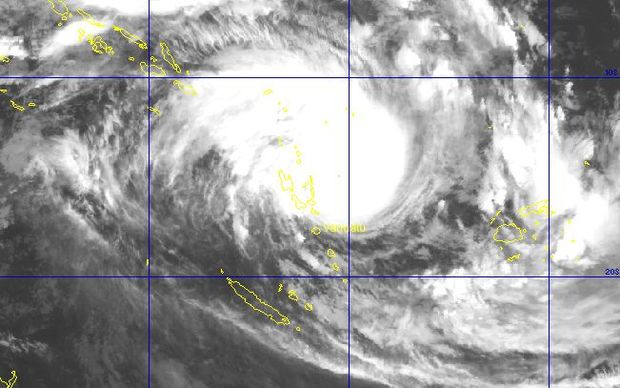
Cyclone PamReading  The Atlantic story – “A Cyclone that Destroyed a Nation” [March 15, 2015] – about the category 5 storm that has left most of Vanuatu’s population homeless, brought to mind our earlier post, Winston Churchill on Climate Departure.

New Zealand and Australia are coming to the rescue with massive aid. The question that hovers over every compassionate relieve and rescue attempt is how many rescues it will take before “we” – the human species – plan differently for habitable habitations that take climate change as inevitable.

“The era of procrastination, of half measures, of soothing and baffling expedients, of delays, is coming to its close. In its place we are now entering a period of consequences…. We cannot avoid this period, we are in it now…” – Winston Churchill

Click A Cyclone that Destroyed a Nation to read the story in The Atlantic. Then chime in on the topic of climate change, weather, and climate departure.

– Gordon C. Stewart, Chaska, MN, March 16, 2015