Our Common Home: Pope Francis and Bernie Sanders

Pope Francis’s Encyclical Laudato Si‘: On Care for Our Common Home has caught the world’s attention. (Scroll down for the Encyclical Letter’s opening paragraphs.)

In our view, Pope Francis and Bill McKibben of 350.org are prophetic figures, i.e., they seem to utter a Word not totally their own. So does Sen. Bernie Sanders (I, VT), who is, not by accident, Bill McKibben’s close friend from Vermont, and the ONLY candidate to place climate change action among the top priorites of his presidential campaign. He speaks boldly, and his message echoes the cry of Luudato Si‘ for action now for the sake of the planet. There is no obfuscation.

“The United States must lead the world in tackling climate change, if we are to make certain that this planet is habitable for our children and grandchildren. We must transform our energy system away from polluting fossil fuels, and towards energy efficiency and sustainability.” – Excerpt from Sen. Bernie Sanders’s campaign priority on Climate Change and the Environment.

Religion, science, and politics each deal with reality, superstition, and obfuscation. The Pope’s call for global action requires political legs to make it walk. Political engagement is not optional at this moment in the history of planetary development. In that regard, no other presidential candidate is so clear on climate change and sustainability as Bernie Sanders. No other candidate speaks with such passionate conviction or knowledge. Pope Francis is a man of God, a modern John the Baptizer appearing in the wilderness, following the lead of Bill McKibben, the scientific consensus, and The Pontifical Academy of Sciences’s research and counsel.

The Pope’s position on nature, born of a more ancient wisdom than the mechanistic “man over nature” view of postindustrial society, is thoroughly catholic, the0logically classical, and steeped in scientific research.  “Man over nature” and “history over nature” are figments of our imagination. Nature always wins. We ARE nature and nature is us.

1. “LAUDATO SI’, mi’ Signore” – “Praise be to you, my Lord”. In the words of this beautiful canticle, Saint Francis of Assisi reminds us that our common home is like a sister with whom we share our life and a beautiful mother who opens her arms to embrace us. “Praise be to you, my Lord, through our Sister, Mother Earth, who sustains and governs us, and who produces various fruit with coloured flowers and herbs”.[1]

2. This sister now cries out to us because of the harm we have inflicted on her by our irresponsible use and abuse of the goods with which God has endowed her. We have come to see ourselves as her lords and masters, entitled to plunder her at will. The violence present in our hearts, wounded by sin, is also reflected in the symptoms of sickness evident in the soil, in the water, in the air and in all forms of life. This is why the earth herself, burdened and laid waste, is among the most abandoned and maltreated of our poor; she “groans in travail” (Rom 8:22). We have forgotten that we ourselves are dust of the earth (cf. Gen 2:7); our very bodies are made up of her elements, we breathe her air and we receive life and refreshment from her waters.

[1] Canticle of the Creatures, in Francis of Assisi: Early Documents, vol. 1, New York-London-Manila, 1999, 113-114.

– Gordon C. Stewart, Chaska, MN. July 28, 2015

Verse – Flooded Former Bean Field

Champaign County, Illinois.
June 29, 2015, A.D.

Climate Change is still my tune,
Everyone will know it soon;
It’s rained just twice,
And that is nice:
Once all May, and once all June…

[“LIKE” if you wish water could
be shared with the West!

Flooded bean field - Champaign, IL

Flooded bean field – Champaign, IL

– Verse and photograph by Steve Shoemaker, Champaign County, IL, June 29, 2015


Texas Flood, Ted Cruz, and Zombie games

The other night a professional baseball game was played during a torrential downpour at Target Field in Minnesota. Meanwhile down in Texas, historic level floods were rising.

Senator Ted Cruz, the climate change denier who opposed the bill providing disaster relief to the Northeast following Hurricane Sandy in 2013, was shouting for urgent federal assistance above and beyond ordinary disaster relief.

Back in 2013 when the victims of Sandy were in New York and New Jersey, the Senator from Texas opposed the federal government “wasting” tax payers’ money.

“This bill,” he said, “is symptomatic of a larger problem in Washington—an addiction to spending money we do not have. The United States Senate should not be in the business of exploiting victims of natural disasters to fund pork projects that further expand our debt.”

Now that the scene of the disaster has shifted to Texas, he says, “At a time of tragedy, I think it’s wrong to try to politicize a natural disaster.”

“Amen” to that!

But, then again, according to The Daily Beast on May 28,

At the moment, Cruz is playing “Plants vs. Zombies,” a game where users collect sunlight points to feed plants who fight off waves of zombies; “Candy Crush,” the puzzle game where he claims he’s in the 217th level; and “The Creeps!,” a tower defense game.

One can almost hear the voice of Senator Cruz’s predecessor, Senator Lyndon B. Johnson (D), crying from the grave, wondering how the zombies took over his beloved Texas.

Senator, please join the rest of us in fighting for the plants against the zombie Climate Change denier obstructionists. What’s happened in New York and New Jersey, and what’s happening now in Minnesota, Texas and Oklahoma is not a video game. “Let’s play ball!”

– Gordon C. Stewart, Chaska, MN 55318

Good News! Goodbye fossil fuels

Video

Tesla Energy’s announcement of a global solar solution to carbon pollution is a potential game changer. Imagine the world where carbon pollution is nipped in the bud. Tesla Energy has agreed to share its technology in the interest of the planet itself. What a breath of fresh air.

Click Tesla’s Elon Musk just changed the world to hear the story.

– Gordon C. Stewart, Chaska, MN, May 3, 2015

Verse – Buzzkill

Buzzkill

Five in a line in our family
(all of them females, of course),
have the name Bee in the middle
(between their last and their first.)

Half of the bees in our country
died over winter last year.
One out of three of our foodstuffs
need bees or will disappear.

Einstein may not be who said it
(no one has proved it was he),
that we will die, yes, each family
within two years of the bee.

We need more prairies and fruit trees,
(that are not sprayed from above.)
Honey from new hives can happen:
we need to give bees our love.

[written in 9 minutes early this morning after hearing a PechaKucha 20-slides-each-20 seconds talk last night by Urbana, Illinois, beekeeper Maggie Wachter at a Sola Gratia Farm dinner.]

– Steve Shoemaker, Urbana, IL, April 12, 2015

Climate change or just weather?

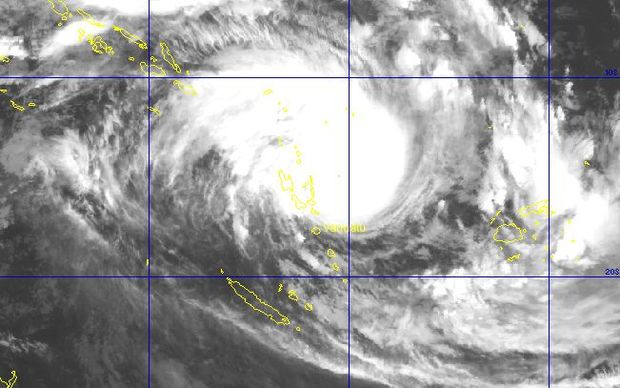
Cyclone PamReading  The Atlantic story – “A Cyclone that Destroyed a Nation” [March 15, 2015] – about the category 5 storm that has left most of Vanuatu’s population homeless, brought to mind our earlier post, Winston Churchill on Climate Departure.

New Zealand and Australia are coming to the rescue with massive aid. The question that hovers over every compassionate relieve and rescue attempt is how many rescues it will take before “we” – the human species – plan differently for habitable habitations that take climate change as inevitable.

“The era of procrastination, of half measures, of soothing and baffling expedients, of delays, is coming to its close. In its place we are now entering a period of consequences…. We cannot avoid this period, we are in it now…” – Winston Churchill

Click A Cyclone that Destroyed a Nation to read the story in The Atlantic. Then chime in on the topic of climate change, weather, and climate departure.

– Gordon C. Stewart, Chaska, MN, March 16, 2015

Shall the meek inherit the earth?

The meek shall inherit the earth, according to the fourth Beatitude of Jesus’ Sermon on the Mount: “Blessed are the meek; for they shall inherit the earth” [ Gospel of Matthew 5:5].

Will they?

And, if they will, what kind of earth will they inherit? Will it be worth inheriting?

Will there be….

As in the rest of Jesus’ teachings, the contrary value system of the powerful, the rapacious, and the vested interests is turned on its head. The prevailing fourth beatitude then and now is different, the beatitude that parades under the cover of freedom from government interference:

“Blessed are the indomitable, for they will have title to the planet.”

This morning’s story “Dayton, safety rules get blasted” [StarTribune, p. 1], is a local illustration of the two sets of beatitudes playing themselves out in American public life.

The Minnesota Legislature is muscling in on the power of state agencies in a broad effort to assume more influence on everything from from water quality to health and safety regulations.

A  coalition of Republicans and DFLers from the Iron Range and rural districts say regulators are socking businesses and cities with burdensome, expensive rules in order to keep Minnesota’s water clean of sulfates, phosphorus and other contaminants.

What will be left of the Earth by the indomitable may not be worth inheriting. The StarTribune article goes on to quote a South Saint Paul legislator at a recent hearing, which makes the connection between the need environmental protection and the need for campaign finance reform. “The pollution in the system is money.”

However that may be, one thing is clear. No one owns a planet.

Only the meek deserve the inheritance we’re now wasting — the Earth to which no one owns title.

– Gordon C. Stewart, Chaska, Minnesota, March 11, 2015


February in America

Our Subaru left Chicago
and used each wheel of 4-wheel drive
to navigate 2 feet of snow.

The ice we saw off Lake Shore Drive
got worse as we drove by Sox Park,
but after 97th Street

the Interstate was dry. We mark
the trip-o-meter: it is set
at zero–so is temperature.

We take I-57 south–
by Memphis the results are clear:
one degree warmer on the route

for every 13 miles we drive.
By Florida (smile!) it’s 75!

– Steve Shoemaker, Urbana, IL [written from Central and South America without cell phone access]

Good News and Hard News – Nature and Capitalism

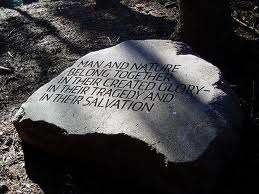
Paul Tillich quote in Tillich Park, New Harmony, IN: "Man and nature belong together in their created glory - in their tragedy and in their salvation."

Paul Tillich quote in Tillich Park, New Harmony, IN: “Man and nature belong together in their created glory – in their tragedy and in their salvation.”

A spiritual reflection for the Second Sunday of Advent, December 7, 2014.

The beginning of the GOOD news is HARD news, according to John the Baptist, calling people out into the wilderness. “We must change,” he said.  “Repent” by which the Judeo-Christian tradition means a 180 degree turn. “About face!” Only by turning will we be delivered from the consequences of the actions that have led us here.

For John the Baptist and the writer of the Gospel of Mark’s opening paragraph (Mark 1:1-8) the system at issue was Roman imperialism, an economic system centered in Rome, expanding out, and enforced by, military invasions, subjugation, religious tolerance (so long as the religious practice did not interfere with Roman prerogatives) and occupation.

One could repeat the sentence in 2014 with little change: “the system at issue [is [American] imperialism, an economic system centered in [Washington] expanding out, and enforced by, military invasions, subjugation, religious tolerance (so long as the local religious practice [does] not interfere with [American] prerogatives) and occupation.”

It is our spiritual, moral, economic, cultural and political captivity to a global system that cannot satisfy our real needs or the world’s that produces a longing in our hearts, a readiness to make the lonely trip to the wilderness.

We’re a weary people in 2014. Wearied and still disheartened 11 years after the “Shock and Awe” that took down Saddam Hussein on the pretense that he had weapons of mass destruction (WMDs) that threatened us, the Administration’s manufactured association of Saddam Hussein as the cause of 9/11. We’re wearied of lies and misrepresentations. Weary from budget fights that barely reference 10 years of un-budgeted military expenses, the loss of thousands of American soldiers’ lives and as many as 100,000 Iraqi civilians, a military venture undertaken on the assumption that the Iraqi people would welcome our presence as the beginning of democracy and a “free market” economy that would lift them all up.

That belief in the goodness of American intentions hit the rocks as quickly as Saddam’s statue hit the pavement in Baghdad. All the while we were wearied by the earlier invasion of Afghanistan, whose original justification was a quick elimination Osama bin Ladin and Al-Qaida untempered by realistic knowledge of the long history of the military interventions that mired the invaders in quagmires such as the Soviet Union found itself before leaving in defeat. To the Afghans it didn’t matter whether the troops were Soviet or American. They were the same. They were the occupation forces of an imperial power destined to fail.

In the midst of the weariness about what was happening abroad, the financial system at home took the American economy to the brink of disaster in 2008. Occupy Wall Street rose to the top of the news cycles. Although the movement fizzled over time, as such movements inevitably do, it caught the attention of television viewers, internet surfers, and newspaper and magazine readers. Occupy Wall Street and the spot light it placed on “crony capitalism” became a hot topic around water coolers at work and the table in the coffee shops.

For the first time in recent memory, capitalism was no longer sacred, no longer off limits. Time’s front cover asked the question whether Capitalism was dead. But, as with Occupy, public attention is short-lived. Amnesia sets in when people are weary. How soon we forget…until some new John the Baptist issues the cry for a 180 degree turn for the sake of something better.

Maybe Naomi Klein is edition of John the Baptist. This Changes Everything: Capitalism vs. the Climate, reviewed by the New York Times – places the over-riding systemic issue squarely before the general public again. Senator Bernie Sanders, America’s only socialist Senator who names climate action as among his four top priorities, is gaining attention as a possible presidential candidate. Elizabeth Warren, the Senate’s bulldog on holding Wall Street accountable is creating a wave of populist momentum. Put them with Bill McKibbon and 350.org and you begin to hear the echo of John’s all to the hard truth that is the beginning of the good news.

The hard truth that precedes good news is the discovery of the myth that has coupled democracy with capitalism in the American psyche, while demonizing socialism as democracy’s opposite. Ideological blinders are to nations and peoples what blinders are to horses on a race track: they limit vision to the straight-ahead narrow limits of the track. Ideological blinders prevent the owners’ horses from thoughts of anything but the track on which they’ve been placed to race each other.

But when the climate is changing our track in ways that compel our attention, and when we ask how we will make it through the changes together, the bigger question of the economic system – the race track itself – comes into view by virtue of necessity. It calls us off the track into the wilderness of Nature.

The words ‘economy’ and ‘economics’ derive from the Greek words for ‘house’ and ‘the management of the household’.  Economics not about markets, free or otherwise, or about the technicians and pundits who monitor investments and predict quarterly outcomes. It is not an academic discipline, the exclusive province of experts on Wall Street or in university Economics departments who understand how the free market works.

Economics is a spiritual perspective like the one on Paul Tillich’s marker in Tillich Park in New Harmony, Indiana. “Man and nature,” he said, “belong together in their created glory – in their tragedy and in their salvation.” There is no humanity with nature; the human calling of our time is to reshape our lives for the wellbeing of the one house in which all life lives.

During this Advent season of longing expectation, John the Baptist with his axe aimed at the root of the tree reminds us that economics is the spiritual issue of the first order. The good news is what the Hebrew Bible calls “the Day of the Lord” and John the Baptist and Jesus of Nazareth called “The Kingdom [i.e. Society] of God”. The hard news is we’ve been running on the wrong track, or, you might say, barking up the wrong tree.

The planet – this home we call “nature”, without which no person, society or form of life exists – is an economy that requires different management. The economy for which our hearts long is the one house imagined by the psalmist and announced by John in the wilderness beyond the Pax Romana: the good news awaiting our longing hearts to embrace it, a planetary home where “righteousness and peace will kiss each other” (Psalm 85:10) and wars will be no more.

The beginning of the GOOD news is HARD news. “Repent, for the kingdom of heaven is at hand.”

– Gordon C. Stewart, Chaska, MN, December 7, 2014

Capitalism, Socialism, and the Earth

The online Oxford Dictionary defines democracy as “a system of government by the whole population or all the eligible members of a state, typically through elected representatives….”

But it immediately biases the discussion with the following sentence to illustrate the word democracy: “capitalism and democracy are ascendant in the third world.” That is, capitalism and democracy go together. Wherever capitalism goes, democracy goes. The ascend together as was imagined to be the case in the Arab Spring.

To the contrary, the online Oxford Dictionary defines capitalism as “an economic and political system in which a country’s trade and industry are controlled by private owners for profit, rather than by the state.”

The Oxford Dictionary identifies what we are coming to realize in America. We do not live in a democracy. We live under “the economic and political system in which a country’s trade and industry are controlled by private owners for profit rather than by the state.” Neither are they controlled by the people of the state, the body politic.

The presumed ideological kinship between capitalism and democracy has existed in America culture as long as most of us can remember. It wasn’t always so in the 1920s and ‘30s, but, as we are beginning to understand again by virtue of circumstance, democracy does not depend upon a capitalist economy. In fact, democracy and capitalism are contradictions in terms. They are philosophically incompatible.

The more natural kin of democracy is socialism, as defined by the online Oxford Dictionary: “A political and economic theory of social organization that advocates that the means of production, distribution, and exchange should be owned or regulated by the community as a whole.”

Democracy is the rule of the people, “a system of government by the whole population….” or, “the community as a whole.”

Finally in America an intelligent discussion is afoot about democratic rule and economics. Naomi Klein’s This Changes Everything: Capitalism vs. the Climate takes the discussion to a new level that views global capitalism as “the most profound threat humanity has ever faced: the war our economic model is waging against life on earth.”