INTRODUCTION: Views from the Edge‘s earlier post from 40th ACCORD referred the KKK kidnapping of four civil rights activists in St. Augustine, FL. Yesterday Francis (“Tate”) Floyd said otherwise.
“No,” said Tate, who was visiting next door, “they weren’t kidnapped. They got caught at a KKK rally downtown and got their asses kicked.”
Below is more complete information posted by The St. Augustine Record on May 17 , 2014 by Matt Soerge. “Views from the Edge” has added the bolded print and photographs to the text.
Civil rights: 50 years later, the memory is still clear
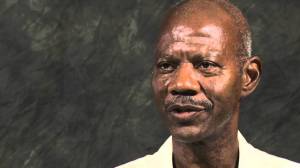
Purcell Maurice Conway
In 1964 St. Augustine, Purcell Conway, a black 15-year-old, held hands with a white nun during a civil-rights demonstration that drew the angry attention of a white mob from the Ancient City and beyond.
The mob surged forward. Conway was attacked, and so was the nun. They tore off her headdress. They dragged her to the ground by her hair. They kicked her.
Fifty years later, the memory is still clear: How can people be so cruel, so petty? he asks, How silly, he says, that there is so much hate over the color of one’s skin.
Conway traveled Wednesday to Tallahassee, where he reunited with other activists from what he calls the “teenage rebellion” — the civil rights demonstrations that rocked St. Augustine from 1963 until the summer of 1964, when the Civil Rights Act became law.
They went to the Capitol building to see Robert B. Hayling inducted into the Florida Civil Rights Hall of Fame. His portrait will go up there along with those of the other inductees, the late James Weldon Johnson and A. Philip Randolph, both of whom grew up in Jacksonville.
Hayling, 84, still sharp and witty, was a dentist who inspired and led the youthful demonstrators in St. Augustine.
Now in their late 60s and early 70s, most of them grew up together in the largely black neighborhoods of Lincolnville and West Augustine.
Asked to describe the St. Augustine of his youth, Shed Dawson, who was arrested nine times, gave a long pause before speaking.
“Scary. Very challenging. Dangerous. Sad.”

Dr. Robert B. Hayling and Mr. James Jackson
You had to be careful, said James Jackson, who was captured and beaten by the Ku Klux Klan.
“You didn’t want to go and get caught out alone at night, especially outside of your comfort zone, outside of Lincolnville.”
Jackson knew many of the Klansmen by sight. He’d see them going about their business during the day, on the streets downtown.
And as the Civil Rights Act moved through Congress, the Klan rallied, openly, on St. Augustine’s quaint downtown streets, in robes that exposed their faces for all to see.
Houses were firebombed. Grenades were thrown at juke joints. Shots were fired.
One white man, with a loaded shotgun on his lap, was shot and killed as the car he was in cruised through a black neighborhood one night. In his death convulsion, he fired shots of his own through the floor of the car.
Young blacks from St. Augustine picketed outside stores, sat at lunch counters where they could not be served. And they marched through the city’s streets, past churches that would not admit them.
One sign asked: “Are you proud of your 400 yrs history of slavery & segregation.”
Demonstrators were threatened and beaten. They were arrested and jailed for attempting to integrate the beaches, lunch counters, hotels.
Many of the black demonstrators were trained in nonviolent ways of protesting and pledged to never strike back.
Others made it clear that they were armed and would defend themselves, their families and their community if called to do so.
Conway says two things united the young black demonstrators: They were fed up with the status quo, where they were permanent second-class citizens. And they were inspired by the civil-rights struggles elsewhere.
Why not St. Augustine too?
“It gets to a point in your life that you’ve been stepped on, mistreated, seen your family members mistreated,” he said. “Forget about the fear — you will die to see this changed.”
‘A mean lady’
At 12, Conway had a white friend, a fellow paperboy, and when they each ordered milk shakes at the lunch counter at the McCrory’s store, he couldn’t understand why the woman there let his friend eat inside, but insisted he go outside.
His friend joined him on the sidewalk. “She’s a mean lady,” he said.
At 14, Conway was mowing the lawn of a white woman who offered him a sandwich and a drink. She left it for him on her garage floor, next to the dog’s bowl.
As a child, he’d been naive. But now his eyes were open — and he chafed as he saw how his parents had to call white people “Mister” or “Miss,” while they were simply called by their first names, George and Julia.
So he was ready, at 14, to join the Movement. That’s what he and his friends called it.
Conway recalled that black teenagers would go the swimming pool at Florida Memorial College, a black Baptist school that moved to Miami a few years later.
College students would tell the teenagers about the Movement. They’d talk about what was happening around the South, about why action was needed in St. Augustine.
By 1964, the Movement drew Martin Luther King Jr. and other prominent black leaders to the city.
It drew the support of many white college students from elsewhere, who were beaten and threatened alongside the young black demonstrators.
It drew the support of rabbis and priests and nuns and 72-year-old Mary Elizabeth Peabody, mother of the governor of Massachusetts, who was jailed after supporting the demonstrators.
And it drew national and international coverage to a tourist city preparing for its 400th anniversary.
Tourists stayed away. In 1965, a state legislative report on the unpleasantness in St. Augustine would note that the city lost $5 million in tourism, which meant the state lost taxes, too.
“Which means that all citizens of Florida indirectly paid for Martin Luther King’s visitation to America’s oldest city,” the report said, before fretting about the “devastating barrage of unfavorable publicity” from “purported” news accounts.
“Despite massive propaganda to the contrary,” the state report said, “Negroes and whites have lived together amicably in St. Augustine for centuries.”
‘I was afraid’
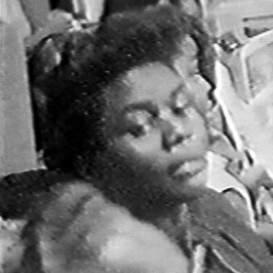
Maude Burrows Jackso
Maude Burroughs Jackson knew unfairness as she grew up in the small black community of Hill Top in Middleburg. Still, she was relatively sheltered, there in the country.
She came to St. Augustine in 1960 to go to Florida Memorial College. The city, she said, felt hostile. Discrimination was open.
“It seemed like a mean place,” she said. “Things have really changed over the years. But I was afraid many times.”
She got involved in the Movement after going to Hayling’s dental office with a toothache.
She went to wade-ins at segregated beaches, and between classes she sat at lunch counters or picketed. She was jailed three times.
One night, in Hayling’s office, she made dinner for King — steak and toast and salad. “He’d come in late that night, and with the situation being the way it was, you couldn’t just go outside and eat.”
‘All right, that’s enough’

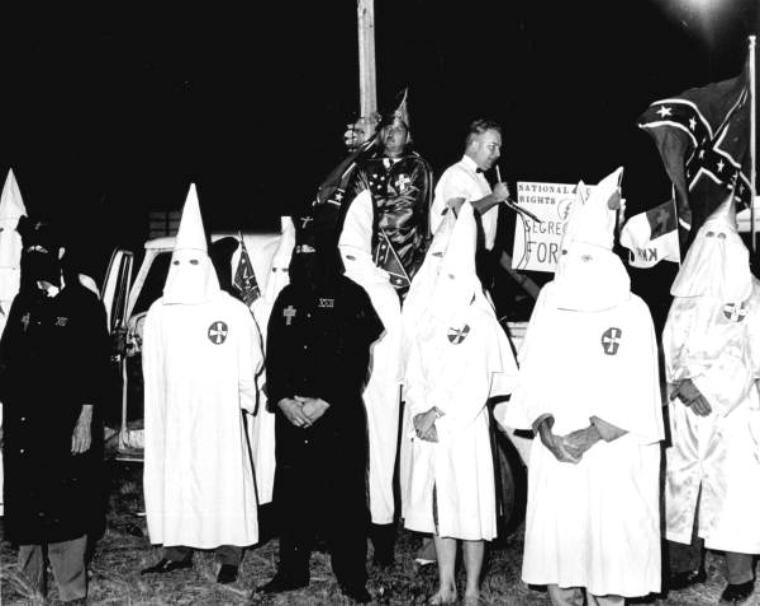
KKK rally, St. Augustine, FL
James Jackson said he tries to find the humor in every situation. So he laughs, still, about the night the Ku Klux Klan caught him, Hayling and two other black men, James Hauser and Clyde Jenkins.
He said he stayed calm through talk about getting killed, about getting set on fire. But when the Klan got to talking about castration? “I said, ‘I got to get out of here.’”
Jackson and his companions had gone to eavesdrop on a Klan rally that drew hundreds to St. Augustine, and figured they could spy safely from a back road. That was almost a fatal error. They were beaten, severely.
Jackson shows off a scar on his forehead, courtesy of a lug wrench. And the Klansmen paid particular attention, he said, to the hands of Hayling, a dentist: How could he practice his profession with broken hands?
“We were lucky as hell to get out of their with out lives,” Jackson said.
The story he heard later was that a preacher in the crowd sneaked away to alert police. Sometime later, an officer walked up to the rally. “He said, ‘All right, that’s enough,’” Jackson recounted.
He took them to the hospital, and then to the sheriff’s office. There, bloodied and bruised, they were charged with assault.
After the Civil Rights Act was signed, Jackson remembers coming out of a hardware store and running into Halstead “Hoss” Manucy, one of the prominent white segregationists in town. Manucy had hurled many insults at Jackson, but apparently didn’t recognize him when they bumped into each other.
“Now I’m not a tall man, but he was shorter than me, and he looked up at me and said, ‘Excuse me sir.’”
Jackson laughed. “Excuse me sir! The biggest smile came over my face.”
‘Shell shock’

Shed Dawson, St. Augustine Movement
Dawson graduated from R.J. Murray High School just a few weeks before the Civil Rights Act was passed. But he was already a civil-rights veteran; he was arrested nine times and spent at least 90 days in jail.
So within a day or two of the act’s passage, he and three other black teens went to a barbecue place on U.S. 1 to “test” the bill.
They squeezed their car into a tight space at the front door. As they approached the door, a group of 25 to 30 men and women came from behind the building, almost as if they were waiting for them.
They had bricks and beer bottles and baseball bats — “their own little personal weapons,” Dawson said.
The four friends split up and ran. Dawson made it to some nearby woods. “Because I was 18 and they were half-drunk, they couldn’t catch me.”
Frustrated, the mob returned to their truck. Perhaps 15 minutes later, Dawson came out of the woods and saw the truck approaching, with people crowded into the back of it — still looking for him.
He ran back in the woods, hiding there for more than two hours. Finally, he crept out and saw a highway patrol car parked in front of another restaurant. Now, he thought, he would be safe.
Dawson went into the restaurant, where the manager stopped him brusquely: “What do you want?”
Dawson’s shirt and tie were filthy, his best pants were muddy and his good shoes were caked with mud. He said he needed to talk to the trooper, who sat, just a few feet away, ignoring him.
“He’s eating lunch,” the manager said.
Dawson insisted. Eventually the trooper got up, locked Dawson in his car, and resumed his meal.
As he ate, a crowd of whites assembled around the car, rocking it back and forth, pounding on the windshield, calling Dawson names.
The trooper, frustrated, came out, started the engine, and got on the radio. “I found the n—– y’all are looking for,” he said.
At the station, they took Dawson’s mug shot, took his fingerprints, but eventually didn’t charge him. The trooper then took him to the headquarters of the Movement, where Dawson’s disappearance was big news.
“He (the trooper) was a hero,” Dawson said. “Everybody was cheering — yeah yeah yeah — and shaking his hands. He was soaking it up.”
King spoke that night at a church, and invited Dawson to sit with him at the pulpit. So he did, still in his filthy clothes.
Dawson ended up traveling the world as a civil servant for the Navy, working on aircraft carriers — a life that would have seemed impossible to him as a teenager. Before things changed, he might have been a cook or a yard man. If lucky, he could perhaps have been a brick mason or a plumber’s helper.
The struggle was worth it, he said, although when he returns to his hometown, the past sometimes feels far too close.
“I’ve been all around the world and I’m OK,” he said. “But when I got back to St. Augustine, to a restaurant, I feel fear, like flashbacks, like the soldiers had. Shell shock. I guess it will never go away.”
Views from the Edge Note: Click HERE for hour-long Library of Congress interview with Purcell Conway.





 Views from the Edge