Wall Street Man

Missing Something

Missing Something

Stone cold bronze age
Man sits stone cold still
In clothes no ape would wear
Living inside his business suit
Even when alone.

His faceless head retains
the slivered brain of stone-cold
Men who wage the wars
And capitalize on capital
And Capitols.

There is no logic, no capacity
For reason or self-assessment,
Where air blows through the
Empty space a left brain
Might fill.

What’s left is all right and
would still feel and leap
For joy or bow with sadness
Had it not been turned to
Bronze or gold.

His fingers touch left to
Right and right to left
In prayerful hope for the
Missing mind and face, and
Heart of flesh.

– Gordon C. Stewart, May 10, 2013, Chaska, MN

“I will give you a new heart and put a new spirit in you; I will remove from you your heart of stone and give you a heart of flesh.” – The promise for the bones in the Valley of the Bones (Ezekiel 36:26).

Pete Seeger and the HUAC

Pete Seeger is an American legend. But it wasn’t always so. Pete just turned 94.

Spadecaller posted the video on YouTube. He also wrote the following history behind “Where have all the flowers gone?”

On July 26, 1956, the House of Representatives voted 373 to 9 to cite Pete Seeger and seven others (including playwright Arthur Miller) for contempt, as they failed to cooperate with House Un-American Activities Committee (HUAC) in their attempts to investigate alleged subversives and communists. Pete Seeger testified before the HUAC in 1955.

In one of Pete’s darkest moments, when his personal freedom, his career, and his safety were in jeopardy, a flash of inspiration ignited this song. The song was stirred by a passage from Mikhail Sholokhov’s novel “And Quie Flows the Don”. Around the world the song traveled and in 1962 at a UNICEF concert in Germany, Marlene Dietrich, Academy Award-nominated German-born American actress, first performed the song in French, as “Qui peut dire ou vont les fleurs?” Shortly after she sang it in German. The song’s impact in Germany just after WWII was shattering. It’s universal message, “let there be peace in the world” did not get lost in its translation. To the contrary, the combination of the language, the setting, and the great lyrics has had a profound effect on people all around the world. May it have the same effect today and bring renewed awareness to all that hear it.

Click HERE for the transcript of Pete’s testimony before a sub-committee of the House Un-American Activities Committee.

Pete is an American patriot. He stands for the very best of the American character. He has never been intimidated by the likes of Senator Joseph McCarthy whose accusations turn people of courage into quivering jelly. He wrote and sang the songs that still stand up to the bullies who assassinate the character of others by means of innuendo and association. His joyful resilience exposes the demonic (the twisting of the good) character of public manipulation, mass hysteria, scapegoating, and the misplaced patriotism that marches to the drumbeats if war.

Happy birthday, good Sir! Your voice still echoes around the world.

If you want attention…

Maggie caring for her sick friend Doug

Maggie caring for her sick friend Doug

Sparky and Doug Hall, Wabasha, MN

Sparky and Doug Hall, Wabasha, MN

Ever since posting about the loss of Maggie and Sebastian we’ve been flooded with affectionate Facebook comments.

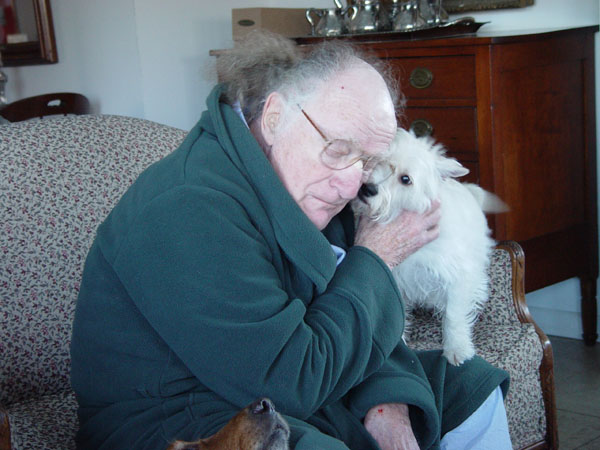
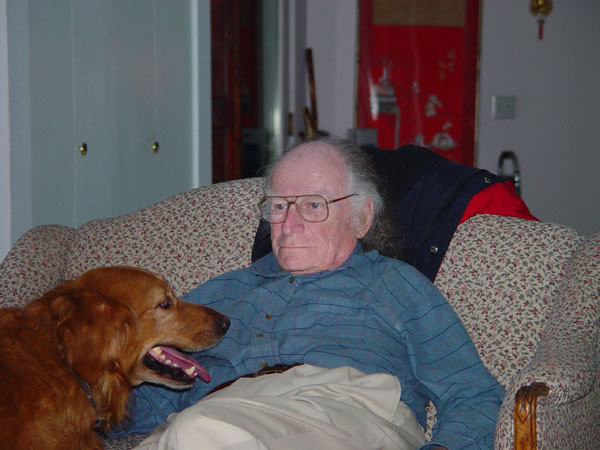
Dogs touch the deepest parts of us. These photos were taken in the home of Doug and Mary Hall in Wabasha, MN several years ago. Doug, a “street lawyer” (John Gresham) if ever there was one, founding Director of the Legal Rights Center, Inc. in Minneapolis, lawyer for American Indian Movement occupation of Wounded Knee, and restorative justice pioneer, was dying of cancer.

Doug and Mary’s dog Sparky, a lovely Labrador retriever, never left Doug’s side.

Click Nature Boy for Nat “King” Cole singing there was a boy who wandered far only to learn that “the greatest thing is to love and be loved in return.”

If you want attention…No…if you want to love and be loved in return, become a nature boy or girl. Get yourself a dog or two. You’ll be blessed by them. And, when they finally leave your side, your friends will sympathize.

After Boston: Above and Beyond

"Above and Beyond" - National Veterans Art  Museum, Chciago

“Above and Beyond” – National Veterans Art Museum, Chciago


The National Veterans Art Museum in Chicago has an unusual work of art.

When visitors first enter the museum, they hear a sound like wind chimes coming from above them. Their attention is drawn upward 24 feet to the ceiling of the two-story high atrium.

The metal dog tags of the more than 58,000 service men and women who died in the Vietnam War move and chime with shifting air currents. The 10-by-40-foot sculpture, entitled “Above and Beyond” was designed by Ned Broderick and Richard Steinbock.

Family and friends locate the exact dog tag of a loved one as a museum employee uses a laser to point to the tag with the name imprinted on the dog tag, now part of a chorus of wind chimes.

After the horror and tragedy in Boston, our heads have been down. This work of art serves as a reminder to look up to hear the sound of the spirit of goodness, compassion, and creativity that can turn tragedy and death into wind chimes played in silence by the air.

The word for “Spirit” in Hebrew Scripture is “ruach” (“wind”). “When God began to create the heavens and the earth – the earth being unformed and void, with darkness over the surface of the deep and a wind from God sweeping over the water – God said, ‘Let there be light’; and there was light” (Genesis 1 – 3, translation from the Hebrew by Rabbi W. Gunther Plaut in The Torah: a Modern Commentary (Union of American Hebrew Congregations, New York, 1981).

Click HERE for a YouTube video of an interview with a National Veterans Art Museum volunteer Joe Fornelli.

Space to Breathe and Grow

Verse – “Pruning”

Even under insulating cones,
roses in the Midwest winter die
back and turn brown from the tips of canes
almost to the ground. It’s time for my
pruning shears to clip away the dead
wood and give the living plant some air–
space to breathe and grow. The thorns are red,
black or brown, but still sharp so I wear
gloves of thick cowhide to carry all
cuttings to the backyard burn pile. Fire
turns them all to ashes which I pile
at the foot of every rose bush. There
fertilizer, water, and bonemeal
grow the blooms that make it all worthwhile.

– Steve Shoemaker, Urbana, IL, April 15, 2013

Toy Gun Manufacturers – Tom Paxton and Pete Seeger

Pete Seeger hosted the show. Tom Paxton sang the song he composed. That was way back in 1965.

Today….a cute three-year-old boy dressed in a cowboy hat, cowboy shirt, Sheriff’s badge, and cowboy boots, waves his toy pistol as he proudly marches past the tables and the three rifles of the video shooting-range at Heartbreakers pub on his way out the door into the world.

The toy gun manufacturers will deliver him into the hands of the real gun manufacturers; the toy gun will become a real one in the hand of the real man when his little mind expands.

Roger Ebert Acrostic

MOVIE LOVER
(Acrostic)

Responding quickly to a word

Or face, or plot or place… seeing

Gladly signs of wit, insight and

Even truth… in the dark writing

Relentlessly for all who read…

Ever hoping goodness will win

Before greed drags it down… helping

Everyone see beauty in one

Rosebud film frame… celebrating

The movies… overlooking none.

– Steve Shoemaker, Urbana, IL, April 3, 2013

NOTE: Film critic Roger Ebert and Steve Shoemaker were friends.. Steve is a great admirer. The Ebert Film Festival at the University of Illinois has long been one of the highlights of Steve’s year. He has often spoken of the magnificent way Roger continued to review the films and “chat” with Festival attendees by means of his computer after he could speak no longer with his resonant voice.

Kim Jong Un and the Numinous

Rudolph Otto’s idea of the mysterium tremendum et fascinans, the source of holy dread and attraction that sends shudders down the human spine, rises to the fore as North Korea’s young leader Kim Jong Un plays with the possibility of nuclear holocaust.

It’s one thing to play with toys. It’s something else when the toys are nuclear bombs and missiles.

In The Idea of the Holy: An Inquiry into the Non-rational Factor in the Idea of the Divine and its Relation to the Rational, Rudolph Otto examines what he called the “numen,” the non-rational mystery that evokes feelings at once terrifying and sublime regarding our human condition.

“Otto on the Numinous” provides a concise introduction by an unidentified City University of New York English professor.

In The Idea of the Holy: An Inquiry into the Non-rational Factor in the Idea of the Divine and its Relation to the Rational, Rudolph Otto identifies and explores the non-rational mystery behind religion and the religious experience (“non-rational” should not be confused with “irrational”); he called this mystery, which is the basic element in all religions, the numinous. He uses the related word “numen” to refer to deity or God.

Forced, necessarily, to use familiar words, like “dread” and “majesty,” Otto insists that he is using them in a special sense; to emphasize this fact, he sometimes uses Latin or Greek words for key concepts. This fact is crucial to understanding Otto. Our feeling of the numinous and responses to the numinous are not ordinary ones intensified; they are unique (I use this word in its original meaning of “one of a kind, the only one”) or sui generis (meaning “in a class by itself”). For example, fear does not become dread in response to the numinous; rather, we cease to feel ordinary fear and move into an entirely different feeling, a dread that is aroused by intimations of the numinous or the actual experience of the numinous.

The word “absolute” is used in its metaphysical sense of “existing without relation to any other being; self-existent; self-sufficing” (OED); its adjectival form, “absolutely,” is used with the same meaning.”

The fact that North Korea’s young leader Kim Jong Un is threatening the world with nuclear holocaust does what World War I did to many theologians who had presumed that history is on a course of inevitable progress.

It is not.

The power of death is enticing, a sin to which Robert Oppenheimer, the father of the bomb, later confessed. The human will to power becomes evil when real soldiers, real nuclear bombs, and real missiles, and real threats of destruction are mistaken for childhood toys or computer games where human folly can be erased by hitting a delete button.

We are all children inside, for both good and ill.

Looking at the young North Korean leader, psychiatrists might see an Oedipus complex, the son outdoing the father at the game of nuclear threat, the boy who played with matches and determined that if his father was afraid to light the fuse, he would step out from his father’s shadow onto the stage of world power in a way the world would never forget.

But deeper and more encompassing than any Freudian analysis is Rudolph Otto’s mysterium tremendum et fascinans.

The philosophical-theological debates about Modernism and Post-Modernism are interesting. They deserve our attention. But neither Modernism’s rationalism nor Post-Modernism’s deconstructionism is equipped to address the most basic reality which encompassing the human condition: the mysterium tremendum et fascinans and the horror of its daemonic distortion in the shrinking of it by the human will to power.

Whenever we take the ultimate trembling and fascination of the self into our own hands, the world is put at risk. In the world of the ancients and the pre-historical world of our evolutionary ancestors the consequences were limited to a neighbor’s skull broken with a club. In the advanced species that has progressed from those primitive origins, we have fallen in love with our own toys of destruction, the technical achievements and manufactured mysteries that are deadly surrogates for the mysterium tremendum et fascinans that sends shudders down the spine in terror and in joy before what is Real.

Our time is perilously close to mass suicide. Unless and until we get it straight that I/we are not the Center of the universe, the likes of Kim Jong Un – and his mirror opposite but like-minded opponents on this side of the Pacific – will hold us hostage to the evil that lurks in human goodness.

Progress isn’t all it’s cracked up to be. The ancient shudder of the creature – the human cry for help in the face of chaos and the heart’s leap toward what is greater than the self or our social constructs – unmasks every illusion of grandeur in a world increasingly put at risk by little boys with toys.

P.S. Just as this piece was in final editing, Dennis Aubrey published “Mysterium Tremendum” on Via Lucis Photography.

If only he’d had a gun!

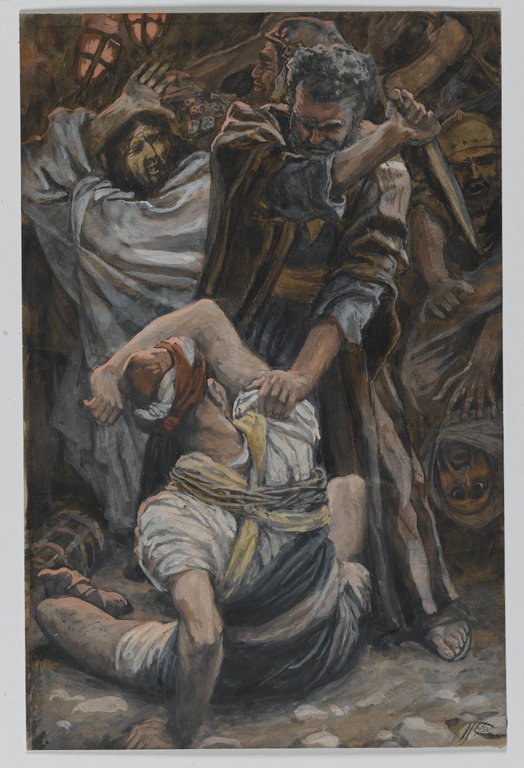
Peter cuts off the ear of Malchus - James Tissot

Peter cuts off the ear of Malchus – James Tissot

Jesus of Nazareth (ca. 30 CE): “Those who take up the sword will die by the sword.” (Matthew 26:52b)

American City Council (2013 CE): Mandatory Gun Ownership Law Passes in Georgia Town

Gun-buying after Newtown massacre (2013): : Customers pack Connecticut gun stores after deal on laws

George Carlin (ca. 2000 CE): “I’m not concerned about all hell breaking loose, but that a PART of hell will break loose… it’ll be much harder to detect.”

Easter Sermon: The garden outside Pleasantville

Easter Sermon preached yesterday at Shepherd of the Hill Presbyterian Church in Chaska, MN contrasting the illusion of Pleasantville, the ’50s black-and-white television gray utopia where nothing ever goes wrong (the Garden of Eden?), with the colorful encounter of Mary Magdalene with the Risen Christ in the garden outside the empty tomb.