Tesla Energy’s announcement of a global solar solution to carbon pollution is a potential game changer. Imagine the world where carbon pollution is nipped in the bud. Tesla Energy has agreed to share its technology in the interest of the planet itself. What a breath of fresh air.
How do you explain this? Watch and read Steve’s explanation.
Verse – We Serve & Protect
Sadly, some white policemen
serve themselves, their deepest fears,
on the streets American,
by protecting their ideas:
they think they hear their wives say,
I choose a black man today.
(Only this sort of a Freudian analysis, I think, can explain the extreme anger and violence.)
What we forget often hurts us. Sometimes remembering helps turn the tide.
Establishing a 0.03 percent Wall Street speculation fee, similar to what we had from 1914-1966, would dampen the dangerous level of speculation and gambling on Wall Street, encourage the financial sector to invest in the productive economy and reduce the deficit by more than $350 billion over 10 years.
Wealth for the Common Good, a movement of America’s wealthiest people with a conscience, is calling for the same:
Tax Wall Street Speculation
We, the undersigned investors, business owners and executives, call on the President and Congress to institute a modest federal tax on trades of stocks, futures, credit default swaps, and options. This modest levy would dampen speculation that threatens financial markets while also raising more than $150 billion annually in revenue for the US Treasury.
In the run up to the 2016 national elections, citizen support for re-establishing the speculation fee is one specific way to register voters’ desire for economic fairness and democracy.
The day after Earth Day the world is returning to business-as-usual. Which opens the door to a commentary on the nature of the human species within the order of nature, and the way religion supports or belittles the Earth.
Two days ago we posted about a curious and rather humorous dream of Jesus as a patient in the hospital (Jesus in the Hospital).
Some readers likely stopped reading when they saw the name Jesus. Others like or are neutral about or curious to read the story. Yet another group is distraught or confused by the thought of Jesus as a patient in the hospital; it might be okay for him to appear in the dream as the doctor, but the thought of Jesus as a patient seems over the top.
The picture of Jesus in a hospital bed is a day-after-Earth-Day issue, an every day question of how we see ourselves, the world, and Eternity.
A Jesus who was never sick a day in his life, a Jesus without bodily functions, pains, and hungers, a Jesus who didn’t feel the hammer slam his thumb at his carpenter’s bench, is a not one of us. That Jesus is a figment of imagination.
The theological tradition of the church has always insisted on the full humanity of Jesus. His humanity was only half the Chaledonian Formula (fully divine-fully man), but Jesus’ humanity is the starting point for any claim to the formula’s other half: the divinity of Christ. From roughly 70 C.E. until now fanciful representations of Jesus have diminished Jesus’ humanity. The historical Jesus is, in effect, obliterated by a dualism that views spirit and matter as mutually exclusive, as are immortality and morality, eternity and finitude. Jesus wears flesh and blood the way an actor playing a part assumes a costume to draw an audience into the play. In these versions of Christian faith, the bodily Jesus is a disguise for God, but not fully human as we are.
According to Hebrew Scripture the human species is of the earth. The human being is named “adam” (Hebrew for “earthling”). We are one with the dirt, the earth, nature. Likewise, our end is dust. “Dust to dust, ashes to ashes” we say at the end, as we do every Ash Wednesday to remind ourselves before the end.
Strangely, the dream I had the other night didn’t seem strange at the time. A friend who knows the Byron who appeared in the dream wrote that she laughed and laughed because “I could totally hear you and Byron having that conversation” about whether a member of the church staff had visited Jesus in the hospital and whether to announce his hospitalization from the pulpit and pray for Jesus in the morning prayers.
The day after Earth Day I still don’t know what prompted the dream. What I do know is that the dream wouldn’t have come without a deep sense of Jesus as flesh and blood, an “adam” like us. Only a deeper appreciation of our complete oneness with nature will open our eyes to the real Jesus, the real us, and the sacredness of creation. Matter is not evil; matter is sacred.
Jesus in the hospital is a game changer – a view of human frailty and mutual dependence in a world that too often confuses the goal of religion as the escape from mortality, the soul’s release from the prison of material existence. This dualism is notably errant and it is dangerous to the planet.
Earth is in the hospital. Will we work and pray for healing – a kind of planetary resurrection? Or will we go back to a deadly dualism – business-as-usual – the day after Earth Day?
Ted Cruz, Ron Paul, Marco Rubio, and Hillary Clinton are taking their places in the starting gates for the horse race to the White House in 2016. Smiles and frowns all around, emails asking “Are you IN?“with a request for money from the partisan Yea-Sayers and Nay-Sayers. But the fact is that every horse they ride – conservative and liberal – is owned by Wall Street.
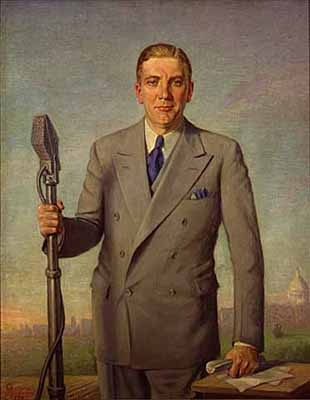
Painting of Governor Floyd B. Olson
I’m not “IN” until a candidate rides a different horse into the starting gate. Until someone acts and sounds like Floyd B. Olson.
Click What would Floyd B. do?to find a candidate who puts them all the declared candidates to shame.
Floyd B. Olson was neither a Democrat nor a Republican. He was the first third party candidate elected Governor of Minnesota as the candidate of the progressive Farmer-Labor Party. Years later the Farmer-Labor Party joined with the Democratic Party to form the Democratic Farm-Labor Party (DFL).
“I am not a liberal. I am what I want to be — a radical,” said Governor Olson to the 1934 Farmer-Labor party convention. A radical is not an ideologue. It’s a person who insists on going to the root of things. Olson was the nemesis of Wall Street, a champion of the people.
The Farmer-Labor party, a loose and, at times, tenuous coalition of farmers, workers, socialists, isolationists and progressives, coalesced around the idea that working together they would bring about a fairer distribution of income for themselves and increase social justice for the larger society. – Russell Fridley, Minnesota Law & Politics.
If and when someone like Floyd B. Olson rides a different horse into the starting gate for the 2016 White House horse race, I’ll be IN with both feet. Until then, I’m not IN.
“Where were you on April 9, 1956?” The answers are pouring in from the Class of 1960.
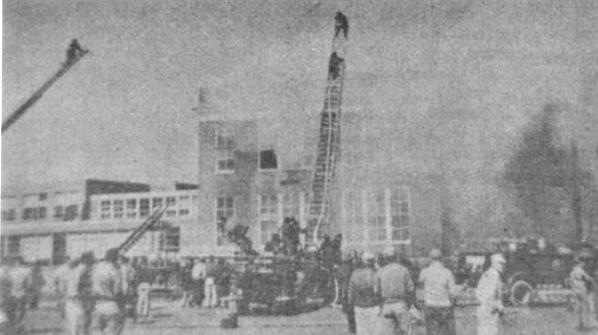
Marple-Newtown Junior High-Senior High School Fire, April 9, 1956
We were in the 8th grade of Marple-Newtown Junior-Senior High School. On that day we were eating lunch, getting ready for our next class when the fire alarm sounded. Must be a fire drill. We knew the drill. So did the teachers. The teachers led us outside, hand-in-hand in the continuous line processional we’d learned in those ridiculous fire drills. The school was going up in flames.
One of my classmates, Dave, remembers it this way:
The Boys’ Room was crowded with guys smoking cigarettes before class, the air was filled with a cloud of tobacco smoke and smells, so we didn’t have any indication that a fire was building below the first floor. Hearing the fire alarm, we stepped out into the hallway to see a trickle of smoke rising from each plank of the hardwood flooring. Seeing that smoke, we knew that the school and the students were facing a serious fire emergency. An orderly evacuation began and although it was a cold day, no one was permitted to go back to their homerooms for their coats.
To a chorus of cheers, we all stood outside shivering for what seemed to be a long time and watched the fire fully consume the building. To a chorus of boos, the fire trucks finally arrived and the volunteer firemen had trouble hooking up the hoses and getting water on the destructive blaze.
The school building was obviously a total loss and since I was cold, I decided to hitchhike home. It was about lunchtime, when I arrived home. My mother immediately descended on me, “…why are you home, are you playing hooky and where is your leather jacket?” “No,” I said. “It wasn’t my fault,” I blurted out, before feeling the back of her hand across my face. “Tell me the truth,” she demanded. I said,”the school burned down,” just before getting a fresh one on the other cheek.
One of the memories we share is the picture of Mr. Harvey, still inside the building, handing the typewriters out the upstairs window from his typing class to Seniors who were ascending and descending a firetruck ladder to save the typewriters until he had to come down himself to loud gasps and cheers.
Fred, remembers being “in typing class a year later using one of those ‘saved’ machines with melted keys.”
Ellie, who wasn’t in the building when the first started, adds something else:
I was approaching the school entrance after lunch at the pizza shop and was met by students rushing out to safety. Still remember that once we were all assembled by homerooms Mr. Rathey went tearfully from group to group checking whether we were all accounted for.
What a surreal day!
Mr. Rathey pointing
The miracle is that we all made it out safely. Before Mr. Rathey, shown here pointing to the school, could see his charges walk across the stage at graduation, he was diagnosed with cancer. The Class of 1960 presented him with a gold watch at his early retirement. Ellie reminded us today of Mr. Rathey’s tearful care on the day the school burned down and in the years that followed.
It’s not often we follow up of Steve’s poems. But today’s post (“Verse – Indiana”) on Indiana’s Religious Freedom Restoration Act (RFRA) merits further comment on Holy Saturday.
some so-called Christians change the
Golden Rule:
“Do unto others what hate did to you.”
Steve and I are both Presbyterian ministers. We’re Protestants. We’re not proud of it; it’s just who we are. At this point in his life, Steve restricts his social commentary to poems and verses.
Here are the earlier stanzas of of “Indiana” that succinctly set the Indiana religious Freedom Restoration Act in its ironic historical context:
To America came the Protestants.
In England they could not live
as they would.
They were despised by ruling residents
and fled to freely worship their own God.
Conservatives want to preserve the past,
forgetting which side they were on…
They now
discriminate against those who resist
and say, “To your beliefs we will not bow.”
Tomorrow Steve will celebrate Easter in Illinois. I will celebrate Easter in Minnesota. The symbol of the stone rolled away will be front and center. There can be no hate at the empty tomb. Governor Pence and legislators, pay close attention. “Father, forgive them, for they know not what they do.” It’s hard to believe they didn’t know what they were doing, but in the sense in which the prayer from the cross was uttered, they really didn’t know`1.
To America came the Protestants.
In England they could not live
as they would.
They were despised by ruling residents
and fled to freely worship their own God.
Conservatives want to preserve the past,
forgetting which side they were on…
They now
discriminate against those who resist
and say, “To your beliefs we will not bow.”
Instead of helping people to be free
to live and love as God made them to be,
some so-called Christians change the
Golden Rule:
“Do unto others what hate did to you.”
As a child, I wondered why they called Good Friday ‘good’. It wasn’t. It was awful.
At the annual Good Friday service my mother’s cheeks were wet. She’d hold her handkerchief in one hand and, without drawing attention to herself — Mom was shy and shunned attention — she would dab the tears, hoping no one would notice.
A soloist would sing:
Were you there when they crucified my Lord?
Were you there when the crucified my Lord? Oh……
Sometimes it causes me to tremble, tremble, tremble.
Were you there when they crucified my Lord?
Mom would dab her cheeks and eyes.
As I grew older I began to understand why they called the Friday of the crucifixion ‘good’. It wasn’t good because they nailed him to the tree, or because they took him down and laid him in a borrowed tomb. It was good because, in that deep darkness, tears fall in grief and in hopes of something else. Tears that recognize both the betrayal, denial, flight — our own and others’ – and the steadfast love, courage, and magnanimity of the man on the cross.
Both sides of the human condition are front and center on Good Friday. So is the sense of god-forsakenness – the wrenching cry from the cross, “Eloi, Eloi, lama sabachthani?” (“My God, my God, why have you forsaken me?”) — the gnawing feeling of senselessness, meaninglessness, and helplessness, hanging alone, tortured and mocked, over the abyss of nothingness.
Over the years, I’ve learned that a healthy sense of denial is sometimes a good thing. So is truth-telling. Good Friday brings me face-to-face with myself at my worst and my best. And at the heart of it all is a man with arms spread wide, looking out at us who still crucify him — ours is a Good Friday world — with eyes that reach my soul. “Father, forgive them, for they know not what they do. Into Your hands I commit my spirit.”
On Easter Mom would dab her eyes for joy because she’d brought her handkerchief with her from Good Friday.
As Sesame Street’s Kermit the Frog croaks that it’s not easy being green, today reminds me that it’s not easy being right, whatever “right” is.
The Presbyterian Church (USA) recently amended the Church’s constitutional definition of marriage as a commitment between two people. It was a good day for those of us who have discussed, debated, and advocated for full inclusion over the last 40 years.
It represents something akin to the civil rights movement – institutionalization of the same ethic that refused any longer to deny equal rights to African-Americans in the Civil Rights Act of 1964. It was the right thing to do.
But nothing ever happens in a vacuum. Collateral consequences accompany every controversial decision, and sometimes those collateral consequences place us in conflict between two highly prized commitments.
No sooner did the Presbyterian Church (USA)’s constitutional change make the news than the National Black Church Initiative (NBCI) announced its decision to break fellowship with the Presbyterian Church (USA). Click HERE for the story. The NBCI claim that the PC(USA) has abandoned or “manipulated” sacred text is not a new charge, but it’s a mistaken one. Said NBCI’s President, the Rev. Anthony Evans:
“No church has the right to change the Word of God. By voting to redefine marriage PCUSA automatically forfeits Christ’s saving grace. There is always redemption in the body of Christ through confession of faith and adhering to Holy Scripture.
“In this case, PCUSA deliberately voted to change the Word of God and the interpretation of holy marriage between one man and one woman. This is why we must break fellowship with them and urge the entire Christendom to do so as well.”
But the PC(USA) did not alter Scripture. It amended its understanding of the Word of God, as we did when we repented of the biblically acceptable practice of slavery. Scripture and tradition without the guidance of the Holy Spirit are not the sine qua non of the Christian faith. It was and is through the guidance of the Spirit of the Living God that we are called to read the Bible through the eyes of Christ, the eyes of love and human dignity, to bring the church and society into a greater light.
It seems, as best I can tell, that there are two grounds on which opposition to the PC(USA)’s full embrace of GLBT members is based. One is psychological (fear). Whenever fear appears, we are called to be compassionate. To understand and walk in the fearful one’s shoes. The second ground is intellectual, as in arguing against biblical interpretation. To argue that one’s biblical literalism is the only faithful reading of the Bible is intellectually dishonest. It’s buried in denial, but it no less intellectually dishonest if it were spoken from unfettered consciousness.
Life is messy. Theology, ethics, and morality are messy. Every decision is contextual, and in that complex set of competing claims and valued, we stand responsible for our decisions of interpretation, faith, and action.
The “breaking of fellowship” by the National Black Church Initiative and its 36,000 African American congregations cuts to the bone of a church for whom racial justice and reconciliation has long been a mandate of the gospel of Jesus. Racism is America’s great sin. Its forms are personal and institutional.
The PC(USA) Confession of 1967 declared the ending of discrimination as of first important to the church’s mission of reconciliation, a confession of faith we now apply to discrimination against the GLBT community. Section 4 on Reconciliation in Society, begins as follows:
In each time and place there are particular problems and crises through which God calls the church to act. The church, guided by the Spirit, humbled by its own complicity and instructed by all attainable knowledge, seeks to discern the will of God and learn how to obey in these concrete situations. The following are particularly urgent at the present time.
a. God has created the peoples of the earth to be one universal family. In his reconciling love he overcomes the barriers between brothers and breaks down every form of discrimination based on racial or ethnic difference, real or imaginary. The church is called to bring all men to receive and uphold one another as persons in all relationships of life: in employment, housing, education, leisure, marriage, family, church, and the exercise of political rights. Therefore the church labors for the abolition of all racial discrimination and ministers to those injured by it. Congregations, individuals, or groups of Christians who exclude, dominate, or patronize their fellowmen, however subtly, resist the Spirit of God and bring contempt on the faith which they profess.
It was in that same spirit of God’s reconciling love in Jesus Christ that the Presbyterian Church (USA) slowly moved over the last 40 years to the position of full inclusion of GLBT members, culminating in the marriage amendment.
It’s not easy being green. It’s not easy being right, whatever right means, especially when one right creates another wrong, or is perceived as sin.
This Wednesday of Holy Week, we once again move with Jesus toward the cross. Green, black, white, yellow, red, and brown, straight and gay; the certain and the confused. Sin is everywhere, even in our best intentions, and often it hides in the corners of our own claims of righteousness. Only a vast love and mercy can overcome the gulfs of estrangement that divide us. Some sins are plain to us, some escape us, some we cannot face. Even our best intentions…. Johan Hermann’s text “Ah Holy Jesus, How Hast Thou Offended” (1630) set to music by Johann Cruger’s “Herzliebster Jesu” (1640) is a heartfelt prayer for the whole Church and for the world itself as we move through confession on Maundy Thursday and Good Friday toward Easter this Holy Week.


 Views from the Edge