The Honesty Factor

What helps explain the unexpected rise of Donald Trump and Bernie Sanders in the polls?

E. J. Dionne’s Washington Post piece “Don’t look now, but Sanders is Rising” contains a clue to the difference between public perception of Trump and Sanders, on the one hand, and most other candidates for President, on the other.

It’s pretty simple, as it was when the people of Minnesota shocked the world (and themselves!) by electing Jesse Ventura, the former professional boa scarf wearing wrestler and straight-talking, no holds barred, Minneapolis radio talk show host, as Governor.

E. J. Dionne cites a poll by WMUR-TV in New Hampshire trying to get a handle on the primary race between Sanders and Hillary Clinton. Of all the questions, the one that stood out from the standard questions about one’s position as liberal, moderate, or conservative was this simple question: “Who is least honest?”

Thirty-one (31) percent answered Hillary Clinton. Only three (3) percent picked Bernie Sanders. To put it positively, 97 percent trusted Bernie as the straighter shooter.

Watching the Republican Presidential Candidates Debate last night, something similar was on display. I scratched my head wondering how it happens that Donald Trump was the highest rated candidate in the polls that led to the top 10 Republican candidates. When asked whether he would support the eventual party nominee, Trump said he would not make that pledge. He was booed by many in the audience. But I suspect the audience and those watching on their televisions and iPads would rate him as low on the “least honest” factor last night as the New Hampshire Democrats answered for Bernie.

Jesse Ventura was elected by Independents, Democrats, and Republicans who were disgusted by the less than honest answers of the two experienced politicians on the stage of the debates. Jesse did full Nelsons, pinning the more experienced “less honest” (i.e., more skilled at obfuscation) Skip Humphrey and Norm Coleman to the mat.

E.J. Dionne ends his column with this observation:

“As for alienation from the system, Trump and Sanders do speak to a disaffection that roils most of the world’s democracies. But their way of doing so is so radically different – Sanders resolutely pragmatic, Trump all about feelings, affect and showmanship – that they cannot easily be subsumed as part of the same phenomenon. Sanders’ candidacy will leave policy markers and arguments about the future. Trump’s legacy will be almost entirely about himself, which is probably fine with him.”

I would add that the American electorate understands feelings and affect, and that, in an entertainment culture, we have come to expect to be entertained. In the Donald and in Bernie we see and hear two men who stand against the odds, and the one thing (perhaps the only thing) that links them in the hearts of those who watch and listen is that they are “the least dishonest”.

But honesty and showmanship alone do not a good governor or president make. We need to bring our minds as well as our hearts to ringside.

On Hiroshima Day 2015 – Like a Child Piling Blocks

Like a child piling blocks
Your words construct new dreams,
Towering poet.

Gentle and strong, as trees
Bend gracefully in wind,
You stand – and I bow.

One of the great pleasures in life has been the unexpected friendship with Japanese theologian Kosuke Koyama.

Ko, as his friends called him with great affection, and his wife Lois, a native Minnesotan, came to Minneapolis following retirement from a distinguished teaching position at Union Theological Seminary in the City of New York. I knew him only by reputation: John D. Rockefeller, Jr. Professor of World Christianity Emeritus; cutting edge Asian liberation theologian and leader in Thailand, Singapore, New Zealand, and the United States; author of Water Buffalo Theology, No Handle on the Cross, Three Mile an Hour God, Mt. Fuji and Mt. Sinai, among others; pioneer in Buddhist-Christian intersection and inter-religious dialogue; spell-binding keynote speaker at the Fifth Assembly of the World Council of Churches in Nairobi, Kenya.

The friendship that developed, if friendship can be defined to include mentors and those they mentor, great minds and ordinary ones, people of stature and those who look up to them, the wise and the less wise, was particularly impactful because my father had been an Army Air Force Chaplain in the South Pacific in World War II.

During the March, 1945 firebombing of Tokyo, the planes came from my father’s air base. Though my father rarely spoke about the war, there was a certain sullenness that would come over him whenever I would ask him for stories. Now, after my father’s passing, I was learning from Ko what the war had meant to the 15 year-old Japanese boy being baptized in Tokyo while the bombs dropped all around his church.

The pastor who baptized him instructed him. “Kosuke, you are a disciple of Jesus Christ. You must love your neighbors…even the Americans.”

For the rest of his life Ko pursued the daunting question of what neighbor love means. Who is the enemy? Who is the neighbor? Are they one and the same? Late in his life, before he and Lois moved from Minneapolis to live with their son in Massachusetts, he had come to the conclusion that there is only one sin: exceptionalism. At first it struck me as strange. Can one really reduce the meaning and scope of sin to exceptionalism? What is exceptionalism, and why is it sinful?

At the time of our discussion, the phrase “American exceptionalism” – the claim that the United States is exceptional among the nations – was making the news. It was this view that led to the invasions and wars in Afghanistan and Iraq – the unexamined belief that the Afghanis and the Iraqis would welcome us with open arms as liberators – that captured in a phrase the previously largely unspoken popular conviction that America is exceptional.

In this American belligerence Ko heard the latest form of an old claim that had brought such devastation on his people and the people of the world. The voices from the White House, the State Department, and the Department of Defense, though they spoke English, sounded all too familiar, impervious to criticism and restraint on the nation’s military and economic adventures.

Nine years ago today, on Hiroshima Day, 2006 he spoke to a small crowd at the Peace Garden in Minneapolis at the exact hour the bomb incinerated Hiroshima. His voice rang with a quiet authority that only comes from the depths of experience. Here’s an excerpt from that speech:

“During the war (1941-45) the Japanese people were bombarded by the official propaganda that Japan is the divine nation, for the emperor is divine. The word ‘Divine’ was profusely used.This was Japanese wartime ‘dishonest religion’, or shall we call it ‘mendacious theology’? This ‘god-talk’ presented an immature god who spoke only Japanese and was undereducated about other cultures and international relations. Trusting in this parochial god, Japan destroyed itself. “

“Then,he said to make his point to his American listeners, “dear friends, do not trust a god who speaks only English, and has no understanding of Arabic or islamic culture and history. If you follow such a small town god you may be infected with the poison of exceptionalism: ‘I am ok. You are not ok.’ For the last 5,000 years the self-righteous passion of ‘I am ok. You are not ok’ has perpetuated war and destruction. War ’has never been and it will never be’ able to solve international conflicts, says Pope John Paul II.”

Two paragraphs later, Koyama spoke in terms that speak to the policy of drones and other advanced military technology:

“In spite of the remarkable advances humanity has made in science/technological [sic], our moral and spiritual growth has been stunted. Humankind seems addicted to destruction even with nuclear weapons and biological weapons. Today there are 639 million small arms actively present in the world (National Catholic Reporter, June 30, 2006).Fear propaganda always kills Hope. Violence is called sacrifice. Children killed in war are cruelly called a part of the ‘collateral damage’.”

Today, Hiroshima Day, 2015 I wish I could break bread with Ko and my father to discuss the meaning of it all, and share with Dad the haiku poems published in The New York Times following Ko’s death, written in his honor by his colleague at Union, Peggy Shriver, testaments to hope in belligerent times:

Smiling East-West spirit,
You move with sun and Son,
Shining Peace on us.

+++++

Like a child piling blocks
Your words construct new dreams,
Towering poet.

+++++

Gentle and strong, as trees
Bend gracefully in wind,
You stand – and I bow.

  • Gordon C. Stewart, Chaska, MN, August 6, 2015

Kosuke Koyama – Hiroshima Day

INTRODUCTION: Today is the 60th anniversary of the bombing of Hiroshima. It seems fitting for Views from the Edge to publish an address Japanese theologian and social critic Kosuke Koyama delivered at the Peace Garden in Minneapolis, MN at the very hour “Little Boy” turned Hiroshima into an inferno.  Dr. Koyama spoke these words on August 6, 2006 at the hour the bomb dropped on Hiroshima

Hiroshima Day Speech at the Peace Garden, Minneapolis – August 6, 2006. Kosuke (“Ko”) Koyama was living in downtown Minneapolis at the time.

It is hardly possible to imagine that in an atomic era,
war could be used as an instrument of justice (Pope John XXIII)

Dear Friends,

Sixty-one years ago, at 8:15 in the morning of August 6, 1945, the Japanese city of Hiroshima was annihilated by a nuclear bomb. The bomb, nicknamed “Little Boy” exploded 570 meters above the ground creating a fireball 100 meters in diameter with a temperature at its center of 300.000 degrees Celsius. Instantly the city became a land of death and destruction. 140.000 people perished. Three days later, on August 9th, the city of Nagasaki suffered the same fate. 80.000 perished. The Japanese authority told us that this extremely powerful bomb was the atomic bomb and advised people to wear white shirts and carry ointment. When the war ended 66 major cities of Japan were desolate wildernesses through fire-bombing. During the night of March 10, 1945, five months before Hiroshima, 325 B29s burned 16 square miles of Tokyo killing 100.000 people. I narrowly survived that holocaust.

As we pause to remember Hiroshima day this morning we are deeply disturbed and concerned about the destruction going on in the Near East today. Any bombing is a demonstration of human depravity. It breeds nothing but despair and hatred. Above all, it kills innocent children! Injuring and killing children is an “absolute” evil. Bombing is an indefensible act of terrorism. It must be totally outlawed and abolished if humankind is to remain human. I am not afraid of God. God will never drop nuclear bombs upon the inhabited cities. I am afraid of humans, for they have actually done it and may do it again! Religious speeches about hell do not frighten me. Hell cannot be worse than what I saw and went through the night of March 10, 1945 in Tokyo. I do not think God can make a worse hell than the one made at the order of American Air Force General Curtis E. LeMay. (1906-1990).

What is it in the thinking of people that allows for the kind of violence and terror that we have created through the use of our modern weapons? Sadly we have to admit that too often violence is encouraged by fanatic religious language. Nothing can be more ignorant and violent than religious motivated fanaticism. “God is on our side!” To release the horrors of war in the name of God is the worst of heresies. War is “the failure of all true humanism.” “It [war] is always a defeat for humanity,” says Pope John Paul II. The sages of Asia, Buddha and Confucius, taught that “god-talk” makes humans irresponsible. People, they said, are responsible for what they do. “You make a mess. You clean it up” they say. This is an honest message. “You made a hideous mess in the Rape of Nanjing in 1937. You are responsible. You clean it up!” There is no conflict between this Asian message and the message of the religions of Abraham: Judaism, Christianity and Islam. Honest confrontation may activate “an enormous capacity for goodness and generosity” hidden in human spirits (The New York Times, July 31, 2006, from the Tikkun Advertisement, “STOP THE SLAUGHTER IN LEBANON, ISRAEL AND THE OCCUPIED TERRITORIES!) As I reflect the litany of atrocities that has taken place during my life time I am led to say that it is honest human talk, not dishonest religious talk, that will give 21st century humanity the wisdom and courage to live by hope.

James Baldwin says: “It is a terrible, an inexorable, law that one cannot deny the humanity of another without diminishing one’s own; in the face of one’s victim, one sees oneself.” This is an honest observation not unlike Newton’s law of motion that to every action there is an equal reaction. We cannot demonize others without demonizing ourselves. We cannot bomb others without bombing ourselves. We cannot kill other children without killing our own children. “All who take the sword will perish by the sword,” says Jesus. This is honest human talk. To think that one can deny the humanity of another without diminishing one’s own is pornographic. To suggest that by taking the sword we can prosper by the sword is deceitful. The children in Hiroshima or in Baghdad are as precious as the children in San Francisco. Any religion, any political power, or any ideology that despises this universal preciousness of the lives of children and all human beings must be publicly condemned for the sake of the sanity of human spirit.

During the war (1941-45) the Japanese people were bombarded by the official propaganda that Japan is the divine nation for the emperor is divine. The word “divine” was profusely used. This was Japanese war-time “dishonest religion,” or shall we call it “mendacious theology.” This “god-talk” presented an immature god who spoke only Japanese and was undereducated about other cultures and international relations. Trusting in this parochial god Japan destroyed itself. Then, dear friends, do not trust a god who speaks only English, and has no understanding of Arabic or Islamic culture and history. If you follow such a small town god you may be infected with the poison of exceptionalism: “I am ok. You are not ok.” For the last 5.000 years the self-righteous passion of “I am ok. You are not ok” has perpetuated war and destruction. War “has never been and it will never be” able to solve international conflicts, says Pope John Paul II.

Today eight nations (the United States, Great Britain, Russia, China, France, India, Pakistan and Israel) are in possession of nuclear arsenals. The bomb confers the power that I may characterize as “absolute.” Something that is “absolute” should not be trusted to unreliable human hands. The sanity of being human is to recognize human limitation. The idea of unlimitedness is demonic. Indefensible Weapons (Robert J. Lifton / Richard Falk) are “glorified” for their ability to pose an ultimate threat to an enemy. Albert Einstein saw that “war cannot be humanized. It must be abolished.” That is not an utopian dream. Let me quote from the recent New York Times Tikkun Advertisement: “The paranoid and allegedly ‘realistic’ version of global politics asserts that we live in a world in which our safety can only be achieved through domination, or others will seek to dominate us first. Of course, when we act on this assumption, it becomes self-fulfilling.” Martin Luther King Jr. said that “if we want to survive upon the earth, for our own self-interest, we better learn to love our enemies.”

In spite of the remarkable advances humanity has made in science/technological, our moral and spiritual growth has been stunted. Humankind seems addicted to destruction even with the nuclear arsenal and biological weapons. Today there are 639 million small arms actively present in the world (National Catholic Reporter, June 30, 2006). Fear propaganda always kills Hope. Violence is called sacrifice. Children killed in war are cruelly called a part of the “collateral damage.”

Remember that fireball! It is a human copy of the great fireball called the Sun. Humanity is now in possession of the unimaginable possibility of cosmic super-violence. We, the species called human on the third planet of the solar system, are now capable to obliterate all living beings upon the earth. When Hiroshima/ Nagasaki was nuclear bombed, symbolically the whole world was bombed. Every bomb used against others is ultimately a bomb exploded upon ourselves. How dedicated we are to destroy ourselves! Since Hiroshima, war is no longer about this nation against that nation. It is we, all of humanity, who are against our own good.

We must hold on to the vision of the “enormous capacity for good and generosity” of the billions of people upon the earth! At this moment it is fitting for the world to remember the gift the American people made to Japanese people in 1945 which was enshrined in the Article Nine of the Post War Constitution of Japan:

Aspiring sincerely to an international peace based on justice and order, the Japanese people forever renounce war as a sovereign right of the nation and the threat or use of force as means of settling international disputes.
In order to accomplish the aim of the preceding paragraph, land, sea, and air forces, as well as other war potential, will never be maintained. The right of belligerency of the state will not be recognized.

Our Common Home: Pope Francis and Bernie Sanders

Pope Francis’s Encyclical Laudato Si‘: On Care for Our Common Home has caught the world’s attention. (Scroll down for the Encyclical Letter’s opening paragraphs.)

In our view, Pope Francis and Bill McKibben of 350.org are prophetic figures, i.e., they seem to utter a Word not totally their own. So does Sen. Bernie Sanders (I, VT), who is, not by accident, Bill McKibben’s close friend from Vermont, and the ONLY candidate to place climate change action among the top priorites of his presidential campaign. He speaks boldly, and his message echoes the cry of Luudato Si‘ for action now for the sake of the planet. There is no obfuscation.

“The United States must lead the world in tackling climate change, if we are to make certain that this planet is habitable for our children and grandchildren. We must transform our energy system away from polluting fossil fuels, and towards energy efficiency and sustainability.” – Excerpt from Sen. Bernie Sanders’s campaign priority on Climate Change and the Environment.

Religion, science, and politics each deal with reality, superstition, and obfuscation. The Pope’s call for global action requires political legs to make it walk. Political engagement is not optional at this moment in the history of planetary development. In that regard, no other presidential candidate is so clear on climate change and sustainability as Bernie Sanders. No other candidate speaks with such passionate conviction or knowledge. Pope Francis is a man of God, a modern John the Baptizer appearing in the wilderness, following the lead of Bill McKibben, the scientific consensus, and The Pontifical Academy of Sciences’s research and counsel.

The Pope’s position on nature, born of a more ancient wisdom than the mechanistic “man over nature” view of postindustrial society, is thoroughly catholic, the0logically classical, and steeped in scientific research.  “Man over nature” and “history over nature” are figments of our imagination. Nature always wins. We ARE nature and nature is us.

1. “LAUDATO SI’, mi’ Signore” – “Praise be to you, my Lord”. In the words of this beautiful canticle, Saint Francis of Assisi reminds us that our common home is like a sister with whom we share our life and a beautiful mother who opens her arms to embrace us. “Praise be to you, my Lord, through our Sister, Mother Earth, who sustains and governs us, and who produces various fruit with coloured flowers and herbs”.[1]

2. This sister now cries out to us because of the harm we have inflicted on her by our irresponsible use and abuse of the goods with which God has endowed her. We have come to see ourselves as her lords and masters, entitled to plunder her at will. The violence present in our hearts, wounded by sin, is also reflected in the symptoms of sickness evident in the soil, in the water, in the air and in all forms of life. This is why the earth herself, burdened and laid waste, is among the most abandoned and maltreated of our poor; she “groans in travail” (Rom 8:22). We have forgotten that we ourselves are dust of the earth (cf. Gen 2:7); our very bodies are made up of her elements, we breathe her air and we receive life and refreshment from her waters.

[1] Canticle of the Creatures, in Francis of Assisi: Early Documents, vol. 1, New York-London-Manila, 1999, 113-114.

– Gordon C. Stewart, Chaska, MN. July 28, 2015

Ego Trips

Image

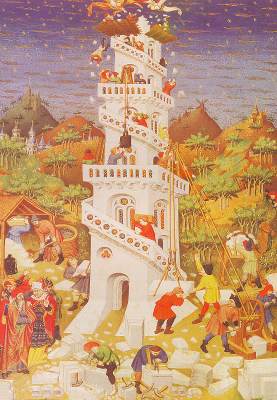
“Come, let us build ourselves a city and a tower with its top in the heavens, and let us make a name for ourselves…” [Genesis 11: 4]. No further comment needed.

Building of the Tower of Babel - Master of the Duke of Bedford

Building of the Tower of Babel – Master of the Duke of Bedford

International Trump Tower and Hotel, Chicago, IL

International Trump Tower and Hotel, Chicago, IL

Verse – I’m Still a Presbyterian

I have made a new “Friend” on my FaceBook:
It is Francis, the Pope–you can look;
But he never will “Comment”,
Or will “Like” what I present,
He just Pronounces and quotes the Good Book.

– Steve Shoemaker, Urbana, IL, July 14, 2015

WalMart Chicken Wing

Un-plucked Walmart chicken wing

Un-plucked Walmart chicken wing

There’s nothing quite so special as a WalMart (un)plucked roasted Chicken wing! Mmmm.  Good!

“So what were you doing @WalMart?” you might ask.

We don’t shop at WalMart. But when a neighbor gives you a bunch of unused gift cards with $20 on them…and you want plants for the front entrance…you have an excuse to shop at the place we love to hate. The plants were plucked; the chicken was NOT! If you like to pluck your own chicken, WalMart’s the place to shop.

– Gordon C. Stewart, Chaska, MN, July 14, 2015.


Not your typical ho-hum Bible!

A Sermon preached July 12, 2015 at St. Timothy’s Memorial Chapel, Southern Cross, MT.

Reading the Bible is not easy. Sometimes the very mention of reading the Bible causes eyes to glaze over and yawns to break out, like the time Howard, a poor soul suffering from early dementia, but still driving to church, leaving dents and scratches on the other cars in the church parking lot without ever noticing he hit them, interrupted a sermonic pregnant pause with a loud “Ho-hum!” True story!

But the Bible is far from a Ho-Hum book.  The Bible’s staunchest defenders are often its worst enemies because they read it so poorly that potential thoughtful readers looking for something more interesting than painting by numbers are turned away before they give it a try.

The story of Jesus walking in the water is a story like that. The story has many layers discovered by mining the text for the rich metals that lie just below the surface with clues in the words and the Hebrew Bible material out of which the story is carefully crafted. Often, like Marcus Daly, you find something far richer than you’d imagine.

The last thee weeks here at St. Timothy’s we’ve read passages from the Gospel of Mark, the earliest of the four Gospels of the New Testament. Each of these biblical texts from Mark’s Gospel is like that. They all have hidden, and not so hidden, references to the economic-political-cultural-religious context of the life of the historical Jesus and the struggles of the early church. The hints of a clash between the Kingdom of God and the claims of the Roman Empire, the Kingdom of Caesar, are there for trained eyes to see. They glimmer like nuggets of gold in a panhandler’s stream; once you see them, you want more of what’s there. These are not just any old rocks, any old stories, these are powerful stories filled with both conflict and comfort, despair and hope, doubt and faith.

We see the clues in the previous weeks’ texts in words and phrases that triggered the deeper recognition of value and meaning beneath the surface understood by the New Testament’s original readers. Before moving to today’s Gospel reading, take a look at the no “ho-hum” allusions to the collision between the Kingdom of God and the Kingdom of Caesar in the twin stories of the Stilling of the Storm and the healing of the demon-possessed man who lived among the tombs, the Gerasene Demoniac.

The casual reader of Mark 4 and 5 will not see the deeper meanings of the stories. They will not know, without help of biblical research and scholarship, that the Stilling of the Storm and the Gerasene Demoniac stories are told during the time when the Roman 10th Legion, (“the 10th Fretensis”) occupied the streets and alleys of Jerusalem at the end of the Jewish-Roman War in 70 A.D. They will not know what the earliest readers knew: that the occupation forces –  10th Fretensis – wore two insignia on their helmets, shields, and the bricks of their barracks.

One insignium was a ship. The other was a wild boar. The occupants of Jerusalem and Palestine were under the heel of the Roman Legion – the legion that sailed the seas and acted as ferociously as a wild boar. The people for whom the first Gospel was written are living under Roman occupation, totally defeated. They had hoped for and expected the coming of the Kingdom of God. Instead they got the Roman Legion. The whole community is living, you might say, among the tombs, possessed by the Legion. “What is your name?” asks Jesus of the man who lives among the tombs. “My name is Legion (a LATIN world in a Greek text, a clue to the heart of the story), “for we are many.” Jesus calls the demons of the Legion to leave the man; the demons cease to occupy him; they go into the swine/boars (an anti-Semitic symbol without parallel), and rush headlong toward the sea where they plunge into the sea, all 2,000 pigs, the exact size of a Roman Legion’s battalion.

Mark has taken the old Exodus story and done with it what the Hebrew Bible and Rabbi Jesus had done so often. He has resurrected the original story of the Exodus where the Hebrew slaves in Pharaoh’s Kingdom safely pass through the sea, as if on dry land, and Pharaoh’s armies (the Roman Legion) drown in the sea.

Which brings us to this morning’s reading of the endangered disciples alone in the boat on the sea, and Jesus coming to them walking on the sea.

As biblical scholar J.J. Von Allman notes, along with others, that the sea in biblical cosmogony is not what it is to us. The sea is a place “thought to harbor the enemies of God, and the impression is received that in speaking of it one is assured on each occasion that God is the stronger; it is so dangerous with its tempests…and with its monsters…that it is important to state, with expressions of thankfulness, that God is its Master: He is its creator.”

Thus, at the end of the Stilling of the Storm, the disciples ask of Jesus, “Who can this be that wind and waves obey him?”

Just so, again in today’s reading, there is a tempest on the sea, the haunt of demons from which the nations come. But this is not just any sea. It has a name. This is the Sea of Galilee, as the indigenous population called it. But in the time the story was written, the Sea of Galilee had been renamed with a Roman Imperial name. So the text says that it all took place on the Sea of Galilee – parenthesis, “the Sea of Tiberias.”

So, is this just another Ho-Hum sermon that leaves dents in the cars of the parking lot, or does it have something to do with our lives in 2015?

Were it not for a preacher’s vanity, I’d leave it to you and Howard to decide. But things as they are, it seems to me the deeper significance is everywhere to be found, and you don’t need to be Marcus Daly to recognize the treasure.

Whatever waves your personal world is making, God is the redeemer yet. Whatever storms batter your little boat, God is the Master still. However lonely, sad, or forsaken you may feel or be in the wake of some great tragedy, there is yet One who comes to you walking on the sea of terrorism, the sea of drones, the haunt of demons, the enemies of God. However much we live in the kingdoms of domination and violence, the community and peace of Christ are with us. And, as the disciples of Jesus, imperiled on the sea, we look to Jesus to show us the way.

Is your boat on the Sea of Galilee or on the Sea of Tiberias? Are you rowing on the Seas of Domination or are you pulling on the oars toward the Kingdom of God

Let us pray.

O, God of sea and wind and wave, who stills the stormed-tossed sea and treads upon the waters of the demonic powers of national divisions and imperial aspirations, grant us the  courage and peace of Your Spirit to live as disciples of Your Son Jesus Christ, our Way, our deepest Truth, our Life. Amen.

– Gordon C. Stewart, Southern Cross, MT, July 12, 2015

Daily Riches: Pimping Religion, Confronting Empire – Part I (Dan Clendenin)

Bill Britton's avatarRicher By Far

“Amos wrote 2,800 years ago, but his prophecy reads like today’s newspaper. He lived under king Jeroboam [whose] kingdom was characterized by territorial expansion, aggressive militarism, and unprecedented economic prosperity. Times were good. Or so people thought. The people of the day interpreted their good fortune as God’s favor. Amos says that the people were intensely and sincerely religious. But theirs was a privatized religion of personal benefit. They ignored the poor, the widow, the alien, and the orphan. …Making things worse, Israel’s religious leaders sanctioned the political and economic status quo. They pimped their religion for Jeroboam’s empire. Enter Amos. Amos preached from the pessimistic and unpatriotic fringe. He was blue collar … neither a prophet nor even the son of a prophet in the professional sense of the term. Amos was a shepherd, a farmer, and a tender of fig trees. He was a small town boy who…

View original post 314 more words

Verse – Wasp Leg

WASP LEG
(How to remember
the 7 Deadly Sins)

Wrath is unrighteous indignation
Avarice is wanting more than enough
Sloth kept me from doing what I should
Pride has I in the middle
Lust will do it no matter what
Envy hates that you have more than I do
Gluttony is as American as apple pie

– Steve Shoemaker, Urbana, IL, July 13, 2015