I've always liked quiet. And, like most people, I've experienced the world's madness. "Be Still! Departure from Collective Madness" (Wipf and Stock Publishers, Jan. 2017) distills 47 years of experiencing stillness and madness as a campus minister and Presbyterian pastor (IL, WI, NY, OH, and MN), poverty criminal law firm executive director, and social commentator. Our cat Lady Barclay reminds me to calm down and be much more still than I would be without her.
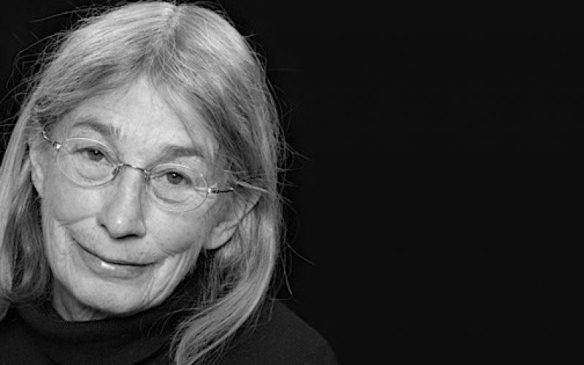
David Kanigan’s tribute to Mary Oliver arrived this morning while waiting for word of the end of a best friend’s life that will die too soon from pancreatic cancer. His family and friends are paying close attention, kneeling down in the grass for a holy rest and peace at the last.
Who made the world?
Who made the swan, and the black bear?
Who made the grasshopper?
This grasshopper, I mean-
the one who has flung herself out of the grass,
the one who is eating sugar out of my hand,
who is moving her jaws back and forth instead of up and down-
who is gazing around with her enormous and complicated eyes.
Now she lifts her pale forearms and thoroughly washes her face.
Now she snaps her wings open, and floats away.
I don’t know exactly what a prayer is.
I do know how to pay attention, how to fall down
into the grass, how to kneel down in the grass,
how to be idle and blessed, how to stroll through the fields,
which is what I have been doing all day.
Tell me, what else should I have done?
Doesn’t everything die at last, and too soon? Tell…
I go to Sake Sushi‘s Happy Hour and strike up a conversation with a stranger. We look to be the same age. Turns out it’s his birthday. “Well, happy birthday!” I say. “How old?”
“A lot older than you,” he says. “I don’t think so,” I reply and ask “How old?” “Seventy-two,” he says. “Gotcha by four years,” say I. “I thought you were maybe 65,” he says. I love this guy! So began last night’s friendly conversation that took us outside our respective comfort zones.
We live in bubbles that burst even while celebrating a birthday — separate bubbles that collide when CNN is served with drinks on the big TV screen in front of the sushi bar.
“Fake news,” he says. “Just a pack o’ lies.” I have a feeling this isn’t going to go well. “So where do get your news?” “I don’t pay much attention to politics,” he says. “As long as the economy is good. That’s all I care about. Business is booming. I’ve made a lot of money the last two years.”
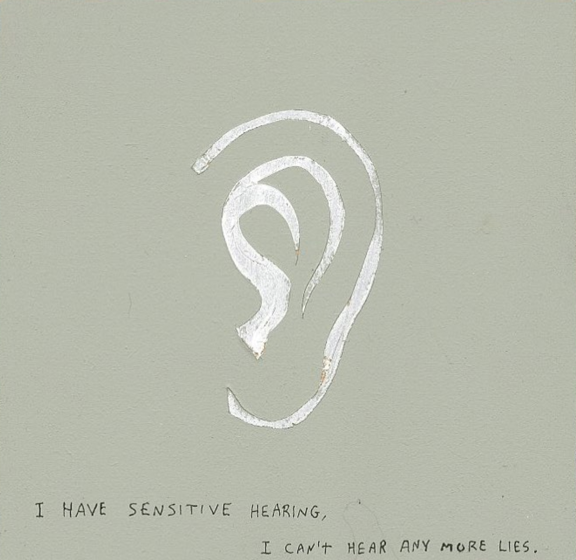
What little news he gets is from a different bubble from the one I live in. “We’re in big trouble,” I say. “What you’re calling an economy is not an economy; economics is not measured by the stock market. There is only one economy — the planet and everything in it — and it’s not doing well. It’s only a matter of time.”
“Where do you get your news?” he asks. I answer that I get it from as many sources as I can. “Ever watch FOX News?” “Every once in a while. As little as possible,” I say, and now we’re both out of our bubbles that make us both “Bubble Boys”. The conversation turns to the occupant of the Oval Office he credits with the booming economy. “He’s going down,” I say. He laughs. ‘No way,” he says, and changes the subject to Barack Obama as a failed president. “He almost destroyed the military,” he says. “Obama made us weaker. Trump inherited a mess. He’s turned it around. America’s strong again.” He’s ex-military, a former Marine once stationed for eight year in Okinawa.
General Jim Mattis
I call his attention to the number of Generals who have left the Trump Administration. He knows nothing about that. I mention General Mattis. “Mad Dog? Great General! The best!” he says. “What about him?” I ask whether he’s read Secretary of Defense Mattis’ letter of resignation. He hasn’t. He has no knowledge of Mattis’ disagreement with the president’s policies. I urge him to read it. He says he will.
The wait person brings a large paper sack with a take-out order of his favorite Japanese dish. “It’s not on the menu,” he says. “Just ask for ‘Dynamite’. I guarantee you’re gonna love it!” “So it’s the ‘Dynamite Roll’?” I ask. “No, it’s different. You have to ask for it.” “So, if I ask for ‘Dynamite’, will they know what I’m talking about?” “The American girl won’t. Ask one of the Japanese guys. They’ll know. Get some and take it home. I guarantee you’re gonna love it!”
The mere thought of Dynamite puts us in the same bubble. We’re Bubble Boys in one bubble: the global economy of shared taste buds. As he rises to leave for home, I thank him for his Dynamite recommendation and the conversation, shake his hand, and wish him a Dynamite 72nd Birthday.
Next time I wander over to the bar at Sake Sushi, I’ll ask for Dynamite . . . and two Martinis.
— Gordon C. Stewart, Chaska, MN, February 1, 2019.
“I can soon begin to tell the time by how the light is slanting off our walls at sunrise and when the darkness falls — and I suppose back to a more essential human life.“
~ Pico Iyer, The Urgency of Slowing Down. An Interview with Krista Tippett (Onbeing, November, 2018), quoted by Live & Learn.
Living within nature’s rhythms comes less naturally to us than it did for our ancestors. I say, “Let there be light,” flip a switch, and there is light. “The light was called ‘day’ and the darkness called ‘night’.” Not anymore. The darkness is as light to us. But not to dogs!
Barclay, the canine companion who joins me for my daily afternoon nap, is what they call a shadow chaser. He lives by the movements of the sun, the hourly changes of light and shadow. Barclay aims to please. He’s very respectful of the napper. He lies very still . . . until it’s time . . . and he moves from the foot of the bed up to the pillow and licks my face to say “it’s time!”
The angle of the light from the bedroom window is his alarm clock. He knows the exact moment of the shift in the light’s angle that says it’s time to get up and head quickly to master suite bathroom where the light will be like the aurora borealis. Time to rise and shine. Time for me to open and shut the shower door. Over an over, to make the light move around the floor and walls so he can jump at it, pounce on it, eat it, or catch it with a paw. It’s playtime! Until the angle of the light shining through the small hexagonal window changes and the stream of light disappears until tomorrow about 3:10 PM . . . unless the clouds hide keep the light away, and it’s time to stay quiet at the foot of the bed for another day.
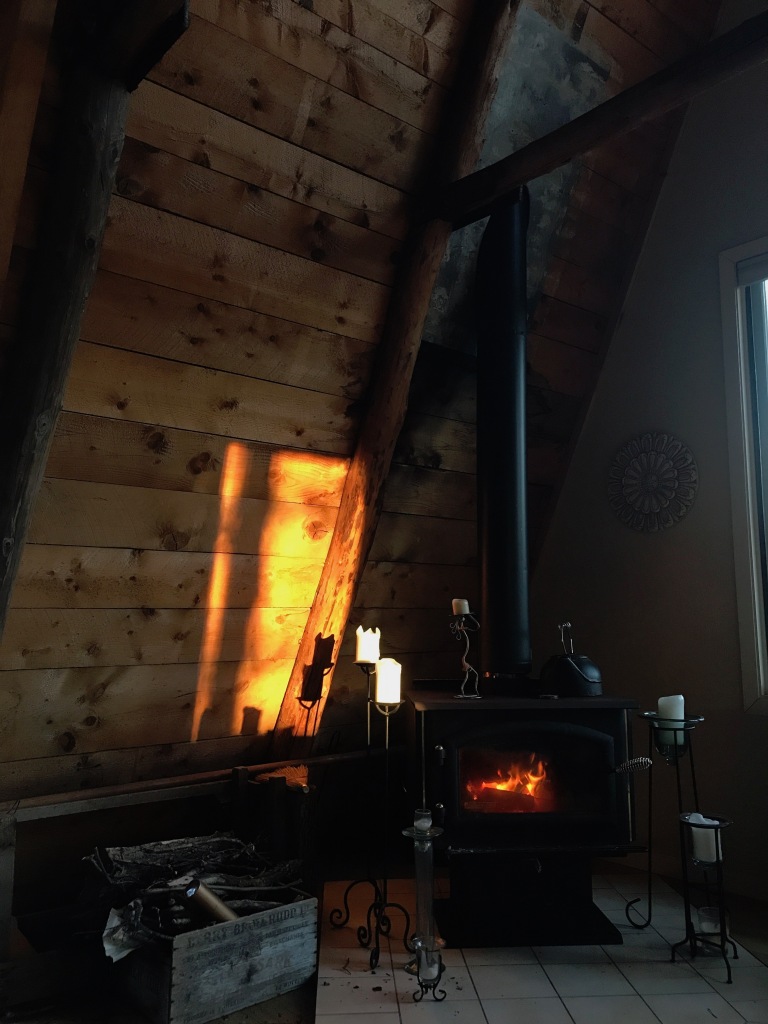
The closest I get to nature’s rhythms here in Chaska is the end of nap time. At the cabin by the wetland, it’s altogether different. The light streams in everywhere, always from a different angle, luscious golden sunlight dancing on the rough-cut pine walls, or the blue light of the full moon that streams through once a month. And all without flipping a switch.
And God said, “Let there be light”; and there was light. And God saw that the light was good; and God separated the light from the darkness. God called the light Day, and the darkness God called Night. And there was evening and there was morning, one day. (Gen. 1:3-5)
— Gordon C. Stewart, Chaska, Minnesota, January 31, 2019.
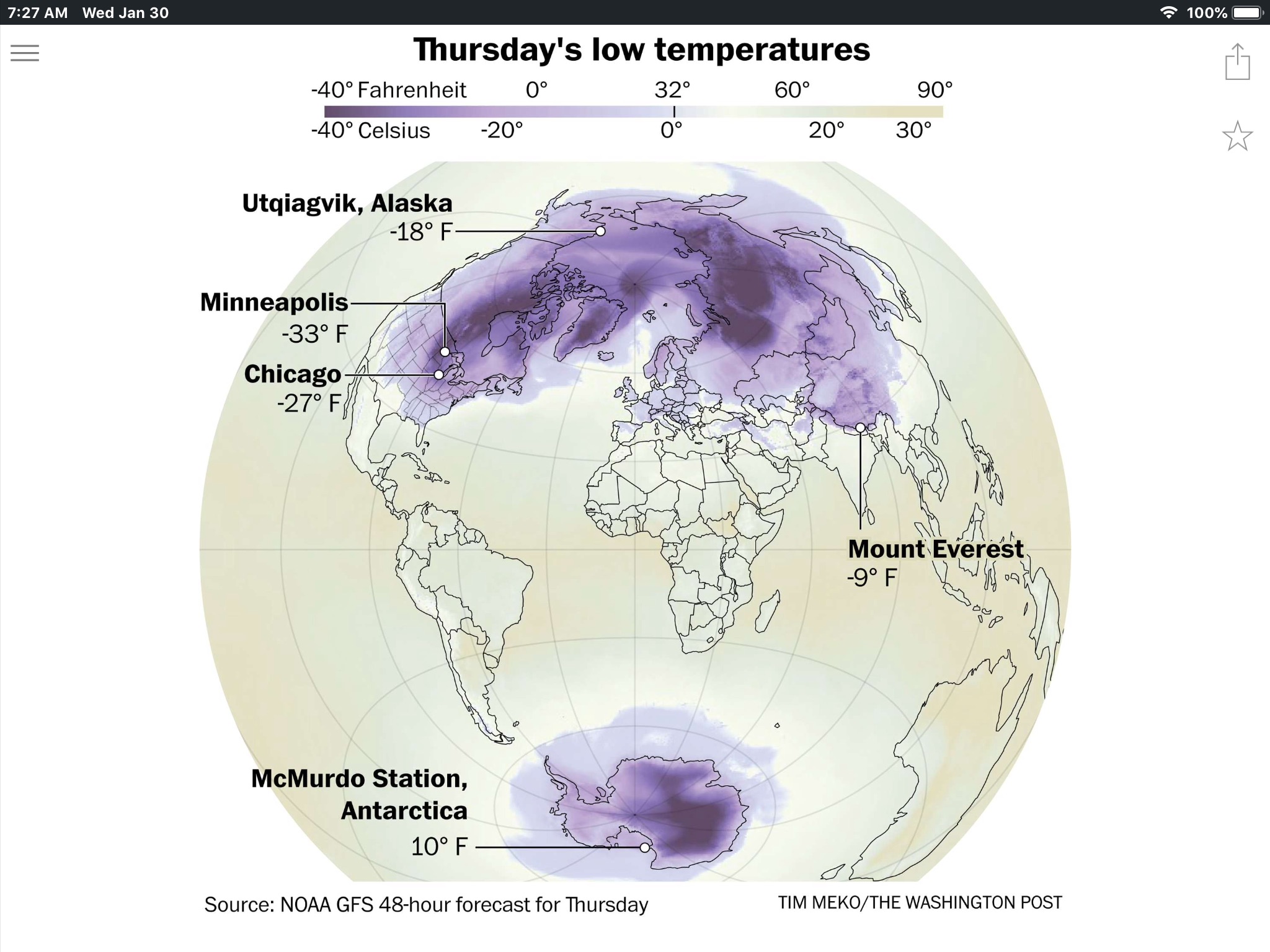
The following conversation took place this morning with Barclay, the five year old Cavalier King Charles Spaniel, in a warm living room in Chaska, Minnesota where it’s -33 degrees F outside.
temperature map, Jan. 30, 2019.
I’m not going!
You have to!
Why?
‘Cause you’re a dog.
But it’s 26 degrees BELOW ZERO out there! It’s only 10 above in Antarctica!
I know. We’ll make it quick. I promise.
Oh, sure! What you mean, “We’ll make it quick?”
We’ll go out and go real fast.
Easy for you to say. You have a big coat and boots!
But you’re a dog. You have a coat.
You’re makin’ stuff up. You’re prejudiced!
I’m not prejudiced!
Are too!
Am not!
Prove it!
There’s no way to prove I’m not.
Uh-huh! You go outside and I’ll go inside!
You can’t go inside and I can’t go outside.
Why?
‘Cause dogs go outside and humans go inside. I’d get arrested for indecent exposure.
See. I told you! You’re prejudiced. I’m not going out there!
Barclay, I’m sorry. There’s no alternative.
Uh-huh!!!! It’s warm in the basement.
But the basement’s part of the house. You’re a dog. You know the rule. You can’t go in the house!
I’m not going out there! You have paper towels. Take me to the basement! It’s warm down there.
How about I put on your winter coat and your booties?
Barclay in his winter coat..
Okay! Deal!!!You put on my winter coat and booties . . . then we go in the basement!
Gordon C. Stewart, Chaska, Minnesota, January 30, 2019.
We’re in a real pickle this morning, Elijah. I don’t know how we’re ever going to get out it!
dill pickle
I like pickles! Pickles are good. You’re getting senile, Bumpa. You can’t get in a pickle!
No, no, we’re not inside a pickle. It’s is an idiom.
You said a bad word, Bumpa! I’m telling Mom! Mom says we’re not supposed to use that word.
I didn’t say idiot, Elijah. I said idiom. It’s a figure of speech, like “It’s raining cats and dogs.”
It’s raining cats and dogs? You must be senile, Bumpa. I’m little, but I’ve never seen it rain cats and dogs, and I know we can’t fit inside a pickle! You’re freaking me out!
I like pickles, too. Well, most kinds of pickles. Especially sweet pickles, like bread-and-butter pickles. I also like Jewish deli pickles. But this morning’s pickle is a real pickle that makes me sick.
Yeah, I hate that. I was sick last week. I hate throwing up.
Some pickles are sweet. Some pickles are sour. It’s the sour ones that sour my stomach.
So, are we in a sweet pickle or a sour pickle? Are we in a little pickle or a big pickle?
A BIG pickle, and it’s really sour.
You should only eat bread and butter pickles, Bumpa, and stop watching Rachel and Ari. Turn off the television and have a bread-and-butter pickle. Pickle is GOOD!
TURN UP THE SOUND and listen carefully as Elijah with his pickle tells his mother “Pickle is good!”
19 month old Elijah, notice the pickle in left hand, tells his Mom, “Pickle is good!”
— Bumpa Gordon, Chaska, Minnesota, January 29, 2019.
I’d forgotten the moment during the children’s sermon until David’s mother Jan refreshed the memory of everyone around the dinner table the night before David’s ordination. “Do you remember the time David asked you why Jesus had to go to hell?'” David is forty now. He was five or six when he asked the question on the chancel steps.
Who knows what goes on in a child’s mind? Who expects a Presbyterian church to become a comedy theater? When I turned to look back a my colleague for help, Jack smiled, shrugged, and said, “Your sermon!”
Jack was working toward his PhD. in semiitic langauges at Hebrew Union College at the time. Why Jesus had to go to hell wasn’t question of a Jewish education! Knox Church wasn’t big on hell either. The idea of Jesus in hell was strange enough, but David’s question was why Jesus had to go to hell.
David was a pure soul. A concrete thinker like others his age. He was also thoughtful. Curious. Questioning. Listening carefully to the words we adults spoke, like the Apostles’ Creed: “He was crucified, dead, and buried. He descended into hell.”
“Why did Jesus have to go to hell?”
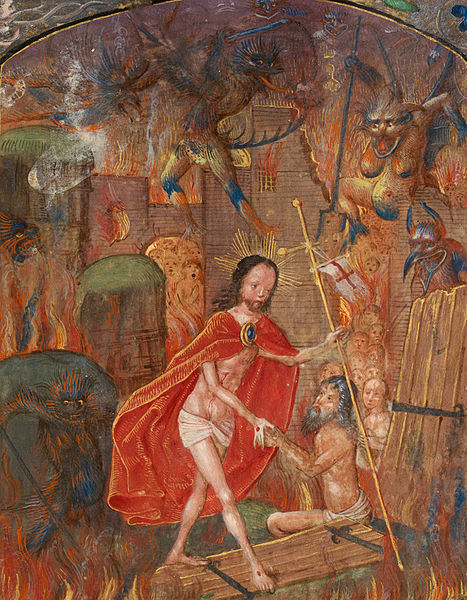
The Eastern Orthodox tradition of the Christian faith celebrates “the Harrowing of Hell” — the descent of the crucified Jesus to open the gates of hell. The Harrowing of Hell expresses symbolically that no one is so far from God that they cannot be reached; there is more mercy in God than there is sin in us.
This preserved parchment scroll from the sixteenth century depicts Christ having “gone to hell,” taking the hand of Adam, a symbol of the unyielding persistence and sovereignty of reconciling Love.
The Harrowing of Hell — Christ leads Adam out of Hell (1503-4)
David’s ordination took place on the same chancel where he had stumped the pastor. Now it’s his turn to field the questions. I’m retired!
— Gordon C. Stewart, Chaska, MN, January 27, 2019.
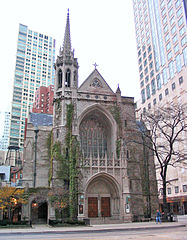
John Buchanan provides in Hold to the Good what he did from the pulpit of Fourth Presbyterian Church in Chicago, and as publisher of The Christian Century: timely reflection on current events in light of biblical texts. His latest post, The Children, shines the light of an often ignored part of the Christmas story — Herod’s Slaughter of the Innocents — on the royal palace’s current cruelty toward children on America’s southern border.
Christmas is over but a singular Biblical incident is haunting me this year. The Christian story, from the beginning, is set in the context of political power, insecurity and cruelty. “In the time of King Herod” is the way Matthew begins. The Magi, mysterious seers from the east- modern Iran, Iraq and Saudi Arabia, following a star that announced the birth of a new king, stop at the royal palace in Jerusalem, the locus of imperial political power. They assume, reasonably, that if a new king has been born it must be in the palace of the current king, Herod. The story recounts how Herod, obviously distressed and frightened by what the Magi said, learns from his own experts that Hebrew scripture predicts “From Bethlehem shall come a ruler who is to shepherd my people, Israel.” When Herod later discovers that the Magi have deceived him, not returning with the…
There are for most of us those rare moments that give definition to one’s life. Such singular moments cast a wider light on all the other moments on calendars and clocks.
These are moments of the heart that touch us deeply — like Sunday’s return to Cincinnati to preach the sermon for the ordination of David Annett who was a boy when I served as his pastor at Knox Church 25 years ago, and the Monday and Tuesday times with my best friend Wayne as he nears the end of life in Indianapolis. Jean-Paul Sartre’s words from Nausea were never far away:
“One is still what one is going to cease to be, and already what one is going to become. One lives one’s death, one dies one’s life.”
The friendship with Wayne began at McCormick Theological Seminary in Chicago where the housing director had assigned us to room together in Room 311 of Alumni Hall. No friendship has been longer or deeper since that day in 1964. We have lived our deaths together over the years, and now one of us is in hospice care dying his life. The visits last Monday and Tuesday were what they have always been: moments described by the old hymn “Blest be the ties that bind Our hearts in Christian love.”
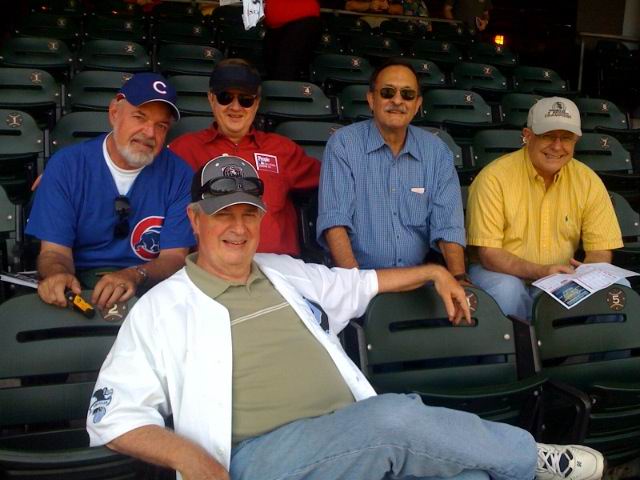
Front row: Don. Back row: Harry, Wayne, Bob, and Gordon at Wrigley Field
Sometimes a singular moment of time reveals one’s continuing character. I cannot yet find the moment that would open the window into who Wayne is or what our friendship has meant over the years since we met in Room 311. Memory will open it when the time is right, as it did when David invited me to preach his ordination sermon.
Our life stories rise out of the meeting points when our separate journeys converge as a dramatic moment that feels like fiction. As I spiraled back to the 11 years with David here at Knox, a singular moment in time seemed to put a frame around who you have ceased to be but still are, David, and who you will become after we have prayed over you with the laying on of hands.
The day I’m remembering happened years ago. You were eight years-old the day I’m remembering. Your grandmother was dying, You asked me to take you to see you grandmother one last time. We drove to Mercy Hospital and talked about what it’s like to visit a hospital, what he was likely to see in preparation for David’s visit with his Grandma.
At the hospital, David punched the elevator button for Grandma’s floor. When the doors opened, we exited the elevator, and walked side=by-side down the long hall toward her room. As I recall, I had to slow you down! You marched down that hall like a soldier, brave and true, a soldier of love for you grandma. You went directly to your grandmother’s hospital bed and stood there, refusing to submit our culture’s denial of death. You didn’t run. You put your hand on her arm and stayed awhile in the silence. And, when you’d taken in the sober reality of it, you spoke the words you had come to say, “I love you, Grandma.” We offered a brief prayer by her bedside and walked back down the hall in the kind of silence that comes over you when you’ve said good-bye to a loved one.
I was so proud of you that day! That moment will stay etched in my memory so long as my memory lasts. I feel that same pride now as you become the pastor who takes a walk down the hall with the other Davids of this world — the children here at Knox and at Cranston Memorial, and their parents; and the Syrian, Yemeni, and Guatemalan children and parents who have been left to fend for themselves. That brave, compassionate walk down the hall that is behind you is the ministry before you. As your train makes the curve around the bend to ordained Minister of Word and Sacrament, the connections slowly emerge, and the way you’ve come is the way ahead. Long before today, David, you were already what you would become.
Excerpt from Ordination sermon, Knox Church, Cincinnati, OH 1/13/19
The Monday following David’s ordination, I drove two hours to Indianapolis, knowing it likely would be the last time with Wayne. But funny things happen on a walk down the hall to the room that soon will be empty. To my surprise, the one dying his life was more cheerful than the one who expects to continue living his death. Sometimes, the one who’s dying becomes the pastor to the boy.
— Gordon C. Stewart, Chaska, MN, January 20, 2019.
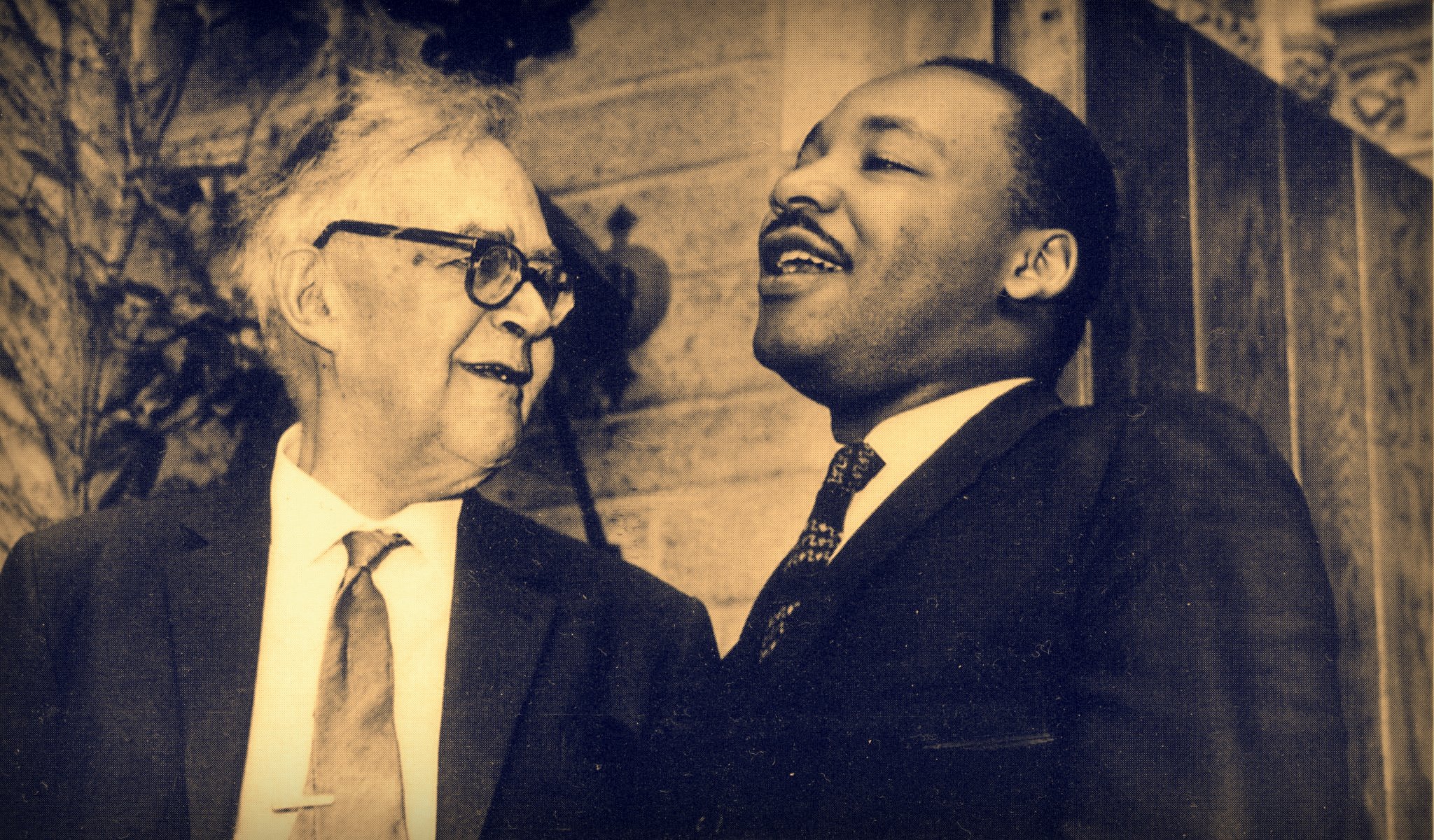
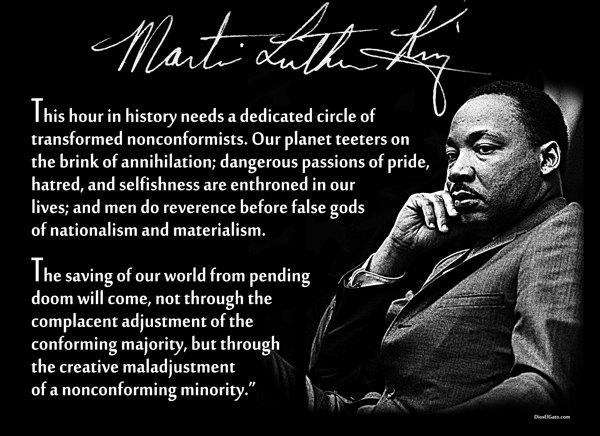
This year’s Martin Luther King, Jr. commemoration comes in the fifth week of the American federal government partial shut-down over a wall. In the name of the Beloved Community — the just and peaceable society — Dr. King and Dr. Barth had things to say about building walls.
Karl Barth and Martin Luther King, Jr. are formative influences on my life. I hadn’t realized until this morning how fully their theology and ethic were in the warp and woof of last Sunday’s sermon at Knox Church in Cincinnati. With apologies to these two great figures, we post an excerpt from a sermon of one of the many lesser lights who live in their long shadows.
Something there is in the Beloved that doesn’t love a wall. Something there is in Jesus that tears down the walls between neighbors and turns enemies into friends, brick by brick, stone by stone — between the Judeans and the Samaritans, and between the male apostles and the Canaanite woman; between the “righteous” who choose purity over compassion and the “good” Samaritan who binds up the wounds of the one in the ditch; between the publicly scorned blind beggar and the charitable nickel-and-dimers who passed by on their way to secure homes and lavish parties; the crowds on the street and the sinful Zacchaeus in the sycamore fig tree; between the Beloved Son and the hosts of sinners who flocked to him for acceptance, forgiveness, healing, hope, and compassion.
For Jesus, love was not a private thing. Love must be made public. As Cornel West puts it, “Justice is love made public.”








 John Buchanan provides in Hold to the Good what he did from the pulpit of
 Views from the Edge