Unknown's avatar

About Gordon C. Stewart

I've always liked quiet. And, like most people, I've experienced the world's madness. "Be Still! Departure from Collective Madness" (Wipf and Stock Publishers, Jan. 2017) distills 47 years of experiencing stillness and madness as a campus minister and Presbyterian pastor (IL, WI, NY, OH, and MN), poverty criminal law firm executive director, and social commentator. Our cat Lady Barclay reminds me to calm down and be much more still than I would be without her.

America as Babylon

THE BACK STORY: Introduction to Martin Gonzalez Sostre

It was during our weekly Wednesday evening program with prisoners in Dannemora, NY  that I first learned about the case of Martin Gonzalez Sostre, held in solitary confinement in resistance to dehumanizing prison practices, and joined the campaign for his release.

A year later at the Gunnison Memorial Chapel of St. Lawrence University I delivered a sermon inspired by a fresh reading of the Book of Revelation and what I had learned about Martin. The sermon – “Worship and Resistance: the Exercise of Freedom” – was  published by The Christian Century in March, 1974.

The first half of the “Worship and Resistance: The Exercise of Freedom” introduces the hearer/ reader to Martin Sostre’s resistance as a political prisoner incarcerated in solitary confinement at Clinton Correctional Facility in Dannemora, NY, known as “New York’s Siberia” or, as the inmates refer to it, “the Hell Hole of the New York Prison system”.

THE CONTINUING STORY: resistance as worship

Excerpts from “Worship and Resistance: The Exercise of Freedom:

“Incarcerated on the Aegean Island of Patmos, a penal settlement of the Roman Empire in the first century A.D., was a political prisoner named John. He wrote a political-religious manifesto declaring open resistance to the Roman Empire. The Revelation to John – the Apocalypse, the last book of the Bible – is the earliest extant Christian tract deliberately and openly directed against the pretensions of the world’s greatest power. In the Revelation to John, resistance to Roman power and authority is so inextricably bound together with worship of God that they constitute two sides of the same coin. Worship and resistance are the twin sides of faith’s freedom to celebrate God’s gift of life. The unity of resistance and worship is expressed with notable clarity in the passage where the fall of mighty Babylon occasions a celebration in heaven. The destruction of Babylon is joined to the salvation of the world itself and is the sign of God’s power and righteous rule over the nations. Only those who profit by Babylon’s wealth, power and injustice have reason to mourn her fall, while those who have ‘come out of her’ – who have disentangled themselves from her oppression, corruption and imperial claims – have cause to worship God and sing joyful hymns of praise.”

….

“Babylon is the state or nation in its presumption to be God. Babylon is any state, nation, or constellation of principalities and powers, which attempts to rule as final judge of persons and nations. Babylon is any such power – in any time or place – which makes its people subjects, calling them into idolatry of the nations, and any state or nation that persecutes its prophets of righteousness, peace and justice while rewarding the aggressive supporters and the silent ones who acquiesce. America is Babylon.”

….

“Envision once more a visit to Clinton Correctional Facility. Remember the disorienting sensation of having left everything familiar on the other side of the wall, the feeling of walking out of a real world into a nightmare, the shock induced by the size of the walls and the presence of the guards – strange and terrifying.

“But the closer one gets to the prison reality, the more one comes to realize that it is not so strange, that it is simply a more exaggerated and visible form of our own everyday reality in the face of death. Here on the outside, the walls are not visible, but they are much higher. Out here the guards do not stand poised with machine guns, but they are real and far more powerful – the guards our own fears provide.”
….
“Then I heard another voice from heaven saying, ‘Come out of her, my people, lest you take part in her sins…’” (Rev. 18:4 RSV).

THE FRONT STORY: 2017

I see more clearly now what I took into the pulpit at St. Lawrence in 1974, magnified a thousand times over in the name of a false patriotism that turns love of country into worship of America. “We’re going to make America great again!”

In the Book of Revelation Babylon is the mythic city that dehumanizes its people, the “bad” city (to use a favorite word of our current president) which people of faith and conscience are called to resist. Worship requires it. Without resistance, worship is dead. So is the U.S. Constitution and a democratic republic.

  • Gordon C. Stewart, Chaska, MN, April 1, 2017

By the Rivers of Babylon (Dennis Aubrey)

Dennis Aubrey of Via Lucis became a friend after we found each other’s work through the web. As he has many times before, Dennis has spoken for me.

Dennis Aubrey's avatar

By the rivers of Babylon, there we sat down
Yea, we wept, when we remembered Zion.
We hanged our harps upon the willows in the midst thereof.
For there they that carried us away captive required of us a song;
And they that wasted us required of us mirth, saying, Sing us one of the songs of Zion.
How shall we sing the Lord’s song in a strange land?

Psalm 137:1-4 (King James Version)

When I lived in Los Angeles from 1972 to 2000, the city was filled with men and women who lived and died on the streets. It seemed an inevitable part of urban life, where displaced humanity would collect in the hidden corners of our cities. Facilities for the mentally ill had closed, prices for homes had accelerated and more people lost their ability to own or even rent. I knew what was happening in the rust…

View original post 761 more words

Truth and Lies

This brief video addresses questions that continue to stump me. Will we ever get it back? Whatever one’s view of Barack Obama, one cannot refute the flagrant juxtapositions between the values the current Republican Party professes and the real life disdain for those same values.

President Barack Obama to Republican supporters of Donald Trump.

It’s time to stop the White House’s frontal assault on the equality among the three branches of federal government defined under the U.S. Constitution. Time for us, the American people, to tell those in Congress to do what Congress is supposed to do. Contempt of Congress is partisan. It is contempt for the institution itself, and for the Constitution that establishes and protects the American experiment under the rule of law. It’s time for boldness.

Anyone who witnessed Attorney General Barr’s testimony before the Senate Judiciary Committee saw and heard the AG’s disdain for truth-telling. He lied. The next day he refused to appear before the House Committee. This is not time for patience. It’s time for Congress to act swiftly and boldly with arrests for contempt of Congress.

  • Gordon C. Stewart, Chaska, MN, May 3, 2019.

Tell me what you know

“I notice that as soon as writers broach this question, they
begin to quote. I hate quotations. Tell me what you know.”
— Ralph Waldo Emerson, Journals

If we don’t say what we know, what happens next will be on us. We can’t let that happen.

The question to which Ralph Waldo Emerson referred in his journal was different from the one we broach now, but — with apologies for the quotation he would have hated — his challenge to us would be the same: Tell me what you know. If we don’t speak what we know, the shredding of the U.S. Constitution’s system if checks-and-balances among three equal branches of government will be on us.

Emerson was referring to immortality. He knew what many others did not. No one really knows about immortality. Not first-hand. His advice can be understood differently by reading the last sentence aloud, stessing different words— tell me what you know, or tell me what you know — but no matter where you put the emphasis, Emerson’s point seems to have been the same. Don’t speculate. Speak of what you know from your own experience..

What you see with your eyes, hear with your ears, smell with you nose can be delusional, but seeing, hearing, and smelling are the ways mere mortals know whatever we know, or think we know.

What my EYES know

Whenever Donald Trump comes into view — I see a peacock. A peacock’s feathers are stunning. They’re beautiful. And they know it. They strut. A peacock commands everyone’s attention. You can’t help but look. Such confidence! Look at all those eyes!

But, as I Iearned years ago visiting wealthy parishioners whose peacocks had free reign on the grounds of their estate, you keep your distance from a peacock. If you get too close, they make a ruckus. They shriek to put you on notice. Come closer and you will pay the price. Peacocks are mean.

Donald Trump speaking at CPAC 2011 in Washington, D.C. photo by Gage Skidmore from Peoria, AZ.

Watching the current American president feels like that. I see facial expressions when he tells an audience what he knows they want to hear instead of what he knows. He’s lying. Even his secure base knows it. I see the 2020 rallies, the crowds cheering for a peacock strutting around, fanning his feathers.

What my EARS know

You don’t need to have stood in the Rose Garden to know when a peacock is feeling cocky. Or threatened. You know from the sound. Bring a friendly television camera crew to show off his feathers by fanning his tail, and give him a microphone with free range and the peacock is in his glory. Camera crews permitted on his property have taken orher photos of the peacock strutting across the lawn with one of his harem, knowing the cameras already are rolling to show other TV-watching peacocks what he has that they don’t — except in their dreams — a hen with feathers like that! The peahen is all show. She never makes a squack. She only speaks out to shine the light on school bullies, guys like Daryl at my elementary school and like whoever bullied her peacock before he learned to preen and parade his way to the world’s biggest playground.

The peacock hardly ever tells the truth. Everyone knows he lies all the time. He may know it; he may not. It’s hard to tell. He speaks convincingly as one who knows, and knows more than all the other peacocks and members of the camera crews. He never quotes anyone, routinely referring to himself in the third person, as though someone else is speaking about him. What we hear is very strange. Ornotholigists provide a more objective description of the peacock’s behavior.

The peacock’s behavior is a common cause for fear. They are known to be aggressive, fiercely territorial birds…. The peacock’s low intelligence has caused wild peacocks in urban areas to attack dark-colored luxury cars: the birds see their reflections, interpret it as a second bird and attack. Peacocks have also been seen chasing people to take their food. At the same time, when a peacock is angry they have a tendency to spread themselves out – and seeing a bird your size or larger fan out, with feathers that could be misconstrued as eyes, is more than enough to cause a child to develop a long-standing phobia.

–Blake Flournoy, “Reasons to Fear Peacocks,” Sciencing, 2018.

I hear loud shrieks as the peacock chases the camera crews off the property. But the shrieks are not loud enough to drown out the sound of paper shredders shredding the papers the camera crews have come to see.

What my NOSE knows

I have a long-standing fear of fire. I remember watching the flames and smelling the smoke from the four alarm fire I watched through my bedroom window. My father, a volunteer fireman, had left home that night to put out the fire. I was afraid he wouldn’t come back.

I’m no longer five years old, but my nose knows the smell and knows that where there’s smoke, there’s fire. I smell smoke coming from the White House. I smell the Constitution burning, and see a peacock running loose, attacking his own reflection on the presidential limousine.

Leave YOUR COMMENT to widen the conversation. Tell me what you know.

–Gordon C. Stewart, Chaska, MN, April 26, 2019.

Donald Trump Photo Attribution: Donald Trump speaking at CPAC 201; photo by Greg Skidmore.

Elijah asks Grandpa about lying

Bumpa, put your hearings in. I got a question. It’s serious.

Okay. Just a minute. Now, what’s your question, Elijah?

We’re not supposed to lie, right?

Right. We should always tell the truth. We don’t want be liars.

Why? Everybody’s doing it?

No they’re not, Who’s everybody?

The mean guys!

What mean guys?

The Publicans!

You mean Republicans?

Yea, them. The Publicans.

Where’d you get that, Elijah?

I saw it on Rachel!. We couldn’t watch Simple Songs at daycare!

What did you see?

The Publicans putting little Mexican children in prison. I saw it on TV.

Okay, I see. Anything else?

Yes. Marissa says we don ‘t have to worry about dictators. We shouldn’t have to worry about dictators. Right, Bumpa? What’s a dictator?

Ah, I see. Dictators do whatever they want. They lie and cheat and get away with murder. Their countries don’t have constitutions to check their power. Understand?

We live in America, right?

Well, yes. We live in North America, like Canada, but yes, our country is called The United States of America. Does that make sense?

Bumpa, I’m only 23!

No, you’re not 23. You’re almost two. You’re 23 months, not years. You have 16 more years before you can vote.

That’s not fair! One last question before you clean your hearing aids, and don’t make it complicated.

Okay, shoot. Try me.

You said we don’t have a dictator. Do we really have a constitution?

Preamble of the United States of America

— Gordon (Bumpa) and Elijah, Chaska, MN, April 27, 2019.

The Miracle of Reconciliation– Two Memories of Good Friday

MY M0THER AND THE THREE MARYS

I remember my mother’s tears on this day, Good Friday, and wondering why she was so sad. Jesus had been crucified a long, long time ago. It wasn’t happening now. But, to Mom, it was. Like the three Mary’s at the foot of the cross, Mom was weeping in her pew. I remember the white handkerchief dabbing the corners of her eyes.

I was five or six years old the first time I saw Mom at the foot of the cross with the three Marys. The Marys were all gone. Only Mom and her white handkerchief continued the vigil, and it happened every year on Good Friday. It was in junior high school that I began to get under the tears and weep them for myself. I “got” the cruelty of it.

The pounding of nails into wrists and feet. The soldiers laughing at him while they gambled for his clothes. If they were gambling for his clothes, was Jesus naked in front of the whole world? Was the crown of thorns the only thing he wore? Were the thorns cutting into his head? “I thirst.” They give him vinegar on the end of stick! He looks down at John. “Behold your mother; woman, behold your son.” Take my mother home! Mary doesn’t go home. She stays by him until the end. She winces at the nightmare she cannot end: “Eloi, Eloi, lama sabstachtani?” (My God, my God, why have You abandoned me?), watches as a soldier puts a hole in his side; weeps inconsolably when it is finished, and they take him away.

How could Mom not cry hearing that? How could anyone not reach for a handkerchief?

“GOD WAS IN CHRIST, RECONCILING THE WORLD TO HIMSELF”

Years later, Ken and Ilse Beaufoy and I observed Good Friday in the pews of Shepherd of the Hill Presbyterian Church. Aside from one or two others who dropped by for a short time each year, we were alone in the church. Beginning at noon, at half hour intervals, we read aloud a portion of the Passion narratives, paused in silence, listened to the corresponding musical movement from Rutter’s Requiem, spoke a brief prayer, and sat in the stillness until the next half hour.

The Good Fridays with Ken (and Ilse, before she died) were unique. An American Presbyterian minister with a married couple, Ken, a former Biitish soldier, and Ilse, a former member of the Luftwaffe. Ken and Ilse met at a dance sponsored by the Allied occupation that followed the end of WW II.

Ilse was one of two women soldiers awarded the Iron Cross for standing her post during the Allied bombing of Hamburg.

Despite objections and death threats from family members, Ken and Ilse committed themselves to the bonds of marriage. What else but the reconciling love of God could bridge the gulf of former enemy combatants? Five decades later, Ilse died moments after hearing the words of permission that would only have meaning to a decorated war hero who had stayed at her anti-aircraft post atop the Hamburg bunker to protect the civilians below. “You no longer need to stand your post. You no longer need to fight. It’s time to go home. Go in peace.” From that day on, there were just the two of us staying by the cross from noon to 3:00 on Good Friday.

Rutter’s “Pie Jesu” did not explain the crucifixion or the peace it brought Ken and Ilse Beaufoy. It didn’t need to. Some things cannot be explained. They can only be lived…with thanksgiving for abounding grace while dabbing the corner of your eyes with a handkerchief.

— Gordon C. Stewart by the wilderness, Minnesota, Good Friday, April 19, 2019

The Trumpeter Swans and I

At daybreak, far from the ranting and raving that hurt my ears, I’m alone with The Book of Common Prayer. I’ve come here for silence, interrupted only by the calls of the loons and the pair of trumpeter swans that return every spring.

For generations the swans’ inner compasses have brought them back to this unspoiled place to hatch their young before flying south again for winter. The swans and I are a lot alike; we both come back when the ice is almost gone.

My Rocking Chair

I settle into the hickory Amish rocker Jacob Miller crafted to fit my slim dimensions 40 years ago back in Millersburg, Ohio. Though its measurements are the same, It feels narrower. But we’re still made for each other. The rocker is where I rock awhile, like Jacob on his front porch after a hard day’s work, until he had to light the kerosine lamps inside.

I reach to the lamp table next to the rocker for The Book of Common Prayer that belonged to Sue Kahn until the day she gave it to me. Sue had relocated to Cincinnati to be nearer her daughter after macular degeneration had left her functional sightless. A lifelong Episcopalian who savored the language of The Book of Common Prayer, she joined her her daughter for worship with the Presbyterians. She asked one day whether I had a copy of the Book of Common Prayer. A week later, Sue stayed after worship. “I want you to have this,” she said, placing it in my hands. “I know you’ll treasure it as much as I.”

I open to the appointed Psalm for this Wednesday of Holy Week, Psalm 55.

Hear my prayer, O God;
do not hide yourself from my petition.

It’s the day before release of the redacted report of Special Counsel Robert Mueller III, a report that may answer my prayer for full disclosure of the truth I suspect has been hidden.

Listen to me and answer me;
I have no peace because of my cares.

The arrogance — “listen to me; answer me!” — disturbs me. Prayer is not an exercise in telling God what to do! The psalmist is arrogant and it’s selfish, more than a little Narcissistic, like the man in the Oval Office who might push the button on the red phone after typing the letters into th unsecured iPhone he uses to tweet.

But I have come to the wilderness because I have no peace watching Ari and Rachel and waiting for the nightmare to end.

I am shaken by the noise of the enemy;
and by the pressure of the wicked…

I don’t like talk of ‘enemies’; it puts me off. “Love your ememies and do good to them who persecute you.” Framing one’s opponents as ‘wicked’ is the less develped morality that has not yet recognized the inertwining of good and evil. But the psalms express the vicseral feelings of the heart unfiltered by the cerebral cortex. Like the psalmist, I am shaken to the core by the noise of an enemy; the pressure of the wicked. The noise hurts me ears.

For they have cast an evil spirit upon me,
and are set against me in fury.

l do not stand on solid ground. The cloud of evil and wickedness I routinely ascribe to ‘them’ hangs over me. I cannot claim to be righteous, right, or good as opposed to the unrighteous, wrong, and evil. I live under an ‘evil spell’ – the fall from essential goodness that comes with the presumption of the knowledge of good and evil — the knowledge that belongs to God alone. There is no escape from the pressure and the fury.

My heart quakes within me,
and the terrors of death have fallen upon me.
Fear and trembling have come over me,
and horror overwhelms me.

I quake as a fish caught in a net. I thrash and tremble in darkness at noon as at midnight. The snare of terrors encompasses me.

And I said “Oh, that I had wings like a dove!
I would fly away and be at rest.
I would flee to a far off place
and make my lodging in the wilderness.”

The crackling from the fire and the trumpet calls of the trumpeter swans across the wetland break the silence of daybreak. In this far off place, I am at rest. II make my lodging in the wilderness beyond the snare and blare of right and wrong, good and evil.

— Gordon C. Stewart by the thawing weland, April 18, 2019

Cracked heads in need of mending

“…Heaven have mercy on us all – Presbyterians and Pagans alike – for we are all somehow dreadfully cracked about the head, and sadly need mending.” — Herman Melville, Moby Dick.

Watching BBC/Netflix series The Fall — all three seasons in one huge gulp — led me to recall Arthur Miller’s play by the same title, the Genesis story, and the works of Herman Melville, William Golding … or even John Calvin. The brief appearance mid-way through the series of a 20£ bill with a note scrawled across it in red ink — He who does not love abides in death — and its unanticipated re-appearance in the series’ final scene seemed to this Presbyterian preacher like the subtext from which Allan Cubitt create The Fall.

Great literature likeMoby Dick, and insightful sermons, films and television series are sometimes rooted in, and explicate, a text, a line, an aphorism. Allan Cubitt’s choice of the series’ title calls to mind Arthur Miller’s The Fall and the Hebraic biblical story of humankind’s attempt to master paradise by the raid on what belongs to the Creator alone — the knowledge of good and evil (Genesis 3:1-8) — that quickly results in fratricide between humankind’s first children.

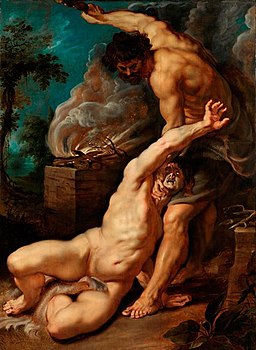
Cain murders his brother Abel. Abel is blown away. Only Cain remains. But the echo of Abel’s horror remains to spoil the good earth: “Listen; your brother’s blood is crying out to me from the ground!” (Genesis 4:10). Allan Cubbit’s title points to the Genesis story. Likewise, his work, The Pool of Bethesda, is taken from Christian scripture.

Film critic reviews like Sophie Gilbert’s “Netflix’s ‘The Fall’ Comes to a Maddening End in its Third Season” (Nov. 5, 2016) in The Atlantic — express disappointment that The Fall “forgot” to answer “the questions [The Fall] raises about misogyny, madness, and obsession.” They see the bill as a glimpse into the deranged mind of Paul Spector, the serial killer, but nothing more.

The final scene of the final episode of the series begs for more. Stella, the detective who has cracked the case, has returned to solitude in her bloodless London flat. She pours herself a glass of red wine and reads again the red ink message: ”He who does not love abides in death,” the verbatim biblical quotation carefully plucked from the New Testament epistle that focuses on love as life itself, and lovelessness as death (I John 3:14). The note’s reappearance is more than a reminder of the bloody horror Stella seems to have escaped, or a return to the vexing inner workings of Paul Spector’s lethal psyche. It serves a larger purpose: to expose the series’ subtext, throwing a light backward on the inexplicable darkness and obsession with death and raising the question of Stella’s own loveless psyche and future, leaving the viewers to ponder for ourselves the complexities of love and life, lovelessness and death.

Works of art do not give answers. Neither does Cubitt’s The Fall. They do not explain reality; they describe it — the mystifying entanglement of lovelessness and love, of evil and goodness, the inexplainable complexity of all the sisters and brothers of Cain. Cubitt’s own reflection on the BBC calls attention to another scene midway through the series in which the serial killer’s Intensive Care nurse, Sheridan, tells him she will pray for him. “My idea is that the line ‘I will pray for you’ is provocative,” said the author. “Surely he is beyond redemption? It seems Sheridan [Spector’s ICU nurse] doesn’t think so. Has anyone ever prayed for Spector before?”

This and other scenes are, by design, “subtle and nuanced and ambiguous, open to all kinds of interpretations, replete with possibilities.”

“…and Heaven have mercy on us all – Presbyterians and Pagans alike – for we are all somehow dreadfully cracked about the head, and sadly need mending.”
― Herman Melville, Moby Dick.

— Gordon C. Stewart, a Presbyterian cracked head, Chaska, MN, April 15, 2019.

Who is loyal to America?

Nationalism is an infantile disease. It is the measles of mankind.

Albert Einstein to George Sylvester Viereck, 1921.

There is a world of difference between nationalism and patriotism. Patriots love their country. Nationalists idolize it.

WHO IS DISLOYAL IN AMERICA?

Who are the really disloyal? Those who inflame racial hatreds, who sow religious and class dissensions. Those who subvert the Constitution by violating the freedom of the ballot box. Those who make a mockery of majority rule by the use of the filibuster. Those who impair democracy by denying equal educational facilities. Those who frustrate justice by lynch law or by making a farce of jury trials. Those who deny freedom of speech and of the press and of assembly. Those who demand special favors against the interest of the commonwealth. Those who regard public office merely as a source of private gain. This who would exalt the military over the civil. Those who for selfish and private purposes stir up national antagonisms and expose the world to the ruin of war.

–Henry Steele Commager, Who Is Disloyal to America? HARPER, 1947

THE ART OF PROPAGANDA

Propaganda must always address itself to the broad masses of the people. (…) All propaganda must be presented in a popular form and must fix its intellectual level so as not to be above the heads of the least intellectual of those to whom it is directed. (…) The art of propaganda consists precisely in being able to awaken the imagination of the public through an appeal to their feelings, in finding the appropriate psychological form that will arrest the attention and appeal to the hearts of the national masses. The broad masses of the people are not made up of diplomats or professors of public jurisprudence nor simply of persons who are able to form reasoned judgment in given cases, but a vacillating crowd of human children who are constantly wavering between one idea and another. (…) The great majority of a nation is so feminine in its character and outlook that its thought and conduct are ruled by sentiment rather than by sober reasoning. This sentiment, however, is not complex, but simple and consistent. It is not highly differentiated, but has only the negative and positive notions of love and hatred, right and wrong, truth and falsehood.

Propaganda must not investigate the truth objectively and, in so far as it is favourable to the other side, present it according to the theoretical rules of justice; yet it must present only that aspect of the truth which is favourable to its own side. (…) The receptive powers of the masses are very restricted, and their understanding is feeble. On the other hand, they quickly forget. Such being the case, all effective propaganda must be confined to a few bare essentials and those must be expressed as far as possible in stereotyped formulas. These slogans should be persistently repeated until the very last individual has come to grasp the idea that has been put forward. (…) Every change that is made in the subject of a propagandist message must always emphasize the same conclusion. The leading slogan must of course be illustrated in many ways and from several angles, but in the end one must always return to the assertion of the same formula.

— Adolf hitler, Mein Kampf, chapter vi

Respectfully submitted for consideration in 2019,

Gordon C. Stewart

Germany in 1933 and the U.S.A. in 2019 — Then and Now

THEN

In this short video Karl Barth addresses the question of how the German people were led to sacrifice a democratic constitutional republic for the dream of Adolf Hitler.

Karl Barth, theologian, professor, author, founder of the Confessing Church which refused to participate in the surrender of faith to the ideology of the Third Reich, and author of The Declaration of Barmen.

NOW: VIOLATION OF THE OATH OF OFFICE

What we see in the U.S.A. in 2019 is chilling. During his visit to the U.S.–Mexican border the American President violated his oath of office “… to the best of my Ability, to serve, protect, and defend the Constitution of the United States of America.” (Article II, Section One, Clause 8, U.S. Constitution). If, during his recent visit to Calexico, the President advised U.S. Border Patrol officers to pay no attention to judges, as reported by CNN and Jake Tapper, the President committed an impeachable offense. He not only did not serve and protect the Constitution. He openly defied it. He put himself above the law.

EYE DISEASE and THE LORDLESS POWERS

It takes what Barth called “eye disease” not to see the systematic erosion of the rule of law by what Barth called “political absolutisms and lordless [i.e. unaccountable] powers” built around a charismatic madman’s dream. The parallels between then and now smack us in the face every day: requiring from cabinet members a sworn loyalty oath and breach of silence agreement; telling the U.S. border patrol to ignore the law and the courts and do what he says; ignoring the law and court orders upholding the legal and human rights of asylum-seekers; separating migrant children and their parents; declaring that his knowledge of world affairs superior to career State Department, Department of Defense, military, and intelligence professionals; ignoring wise advice and counsel; ridiculing past presidents as inferior to himself; assaulting freedom of the press guaranteed by the First Amendment; encouraging violence by refusing to criticize white supremacy, white nationalism, and white hate groups; replacing legitimate patriotism — love of one’s country — with national idolatry; putting personal and family wealth, power, and fame ahead of the checks and balances of the U.S. Constitution.

SEEING THROUGH OBFUSCATION AND DELAY

Wednesday’s (April 10) news further to the sense of a kind of coup d’état — the bloodless undermining of the rule of law in this constitutional republic by those sworn to uphold it. Attorney General William Barr’s refusal to answer questions posed by a Congressional committee re: his decisions about redaction and release of the Mueller Report, and Treasury Secretary Munchen’s deferral to the Department of Justice re: the Congressional demand from the IRS for the past six years of President Trump’s tax returns led me back to Barth.

FAITH AND ETHICS: UNMASKING THE LORDLESS POWERS

“We do not know what we are doing when we pray ‘Thy Kingdom come,’ namely that, negatively at least, we are asking for the gracious unmasking, overcoming, and ultimate abolition of these absolutisms that rule us per neras [i.e. by wrong].” – Karl Barth, The Christian Life, p. 219.

— Gordon C. Stewart, Chaska, MN, April 12, 2019