I've always liked quiet. And, like most people, I've experienced the world's madness. "Be Still! Departure from Collective Madness" (Wipf and Stock Publishers, Jan. 2017) distills 47 years of experiencing stillness and madness as a campus minister and Presbyterian pastor (IL, WI, NY, OH, and MN), poverty criminal law firm executive director, and social commentator. Our cat Lady Barclay reminds me to calm down and be much more still than I would be without her.
“The silent colossal National Lie that is the support and confederate of all the tyrannies and shams and inequalities and unfairnesses that afflict the peoples—that is the one to throw bricks and sermons at.” — Samuel Clemmons (Mark Twain).
The National Lie of white supremacy may lie silent for a time, but it doesn’t die easily. It was the unspoken lie behind the invasion and slaughter of people it called ‘savages’ to justify stealing America’s indigenous peoples’ continent and herding them onto federal reservation. The conquerers were white. The indigenous peoples were ‘red’. The invaders spoke English. Those they conquered did not. The same colossal National Lie rationalized the invasion of “the dark continent” to capture men, women, and children as slave labor to work the plantation owners’ cotton fields. The faces of the Lie wore white hoods, lit crosses on lawns, and hanged their former slaves from the lynching trees. And on and on it goes. It lives on in 2020, no longer silent, branding brown, Spanish-speaking migrants fleeing for safety “invaders” who must be stopped.
It’s a long way from El Paso TX to Dayton OH — a 22-hour drive through Oklahoma, Missouri, Illinois, and Indiana. It took less than 13 hours for El Paso and Dayton to become twin cities suffering together “all the tyrannies and shams and inequalities and unfairnesses that inflict the people” while the lie of White Nationalism carries on.
“A lie can travel halfway around the world while the truth is putting on its shoes.” — Mark Twain.
How we look at the world is a matter of personal experiences and how we integrate them. Each new experience confirms or changes how we see and what we see. Reading exchanges about Baltimore took me back to a shattering of perception at the end of a summer internship as a street outreach worker with Corinthian Avenue Chapel in North Philadelphia. The acknowledgements of Be Still! Departure from Collective Madness take the reader back to “the Brothers of Opal Street”:
Last, but by no means least, is a group of men who would be shocked to find themselves mentioned anywhere but in a courtroom. “The Brothers of Opal Street,” as they called themselves — eight black homeless former inmates of Eastern State Penitentiary in North Philadelphia — had a farewell conversation in late August 1962, with me, a naive nineteen year-old street outreach worker. As we sat on the stoop of a boarded up tenement on Opal Street, they said good-bye with a startling instruction not to return to the ghetto. “Go back to ‘your people’ and change things there. Only when things change there will there be hope for the people here.”
What they called “my people” lived in the white western suburbs of Philadelphia. I have come to believe that last day on Opal Street was its own kind of ordination. This book is in memory of them.
Opal Street was one-block long with no traffic. The far end of the street was boarded in the same way the street’s tenements were. At the far end was the yellow chalk outline of a body. Half way between the entrance to Opal Street and the police chalk mark sat the men on wood orange crates, passing the bottle or the jug to numb themselves against the world that had no regard for their dignity or the stories that had brought them there.
“‘Go back to your people and change things there” sent me home and off to college asking existential questions about who ‘my people’ were and what the relationship was between the manicured lawns, rash-free streets, and country clubs of the Mainline western suburbs and the “rat and rodent infested mess” I had left behind in North Philadelphia.
Some moments last a lifetime. Some experiences forever change what we see as much as how we see. It’s hard to see Opal Street over drinks at the 19th hole.
Views from the Edge is pleased to share this recording of Max Picard’s The World of Silence read aloud by David Juda of Voetica Poetry Spoken.
Here’s a taste of Picard:
The silence of God is different from the silence of men. It is not opposed to the word: word and silence are one in God. Just as language constitutes the nature of man, so silence is the nature of God; but in that nature every- thing is clear, everything is word and silence at the same time.
Excerpt from Silence and Faith of Max Picard, read by David Juda on Voetica Poetry Spoken
Why does the psalmist speak of ‘gods’ — “before the gods I will sing Your praise” (Ps.138:1) –as though there is more than the One the psalmist proclaims? Why does the First Commandment of the Ten Commandments say, “You shall have no other gods before Me”?
These ‘gods’ are real. They do not exist only in our imagination. They make their appeals to our human need and aspirations in the midst of time. Like the First Commandment, Psalm 138 recognizes the ‘gods as contenders with the One God of heaven and earth. It goes to the heart of the human longing for closer-at-hand gods, the imposters of God that charm us with their melodies and promises.
...before the gods I will sing Your praise.” (Ps. 138:1 NIV)
We live among the ‘gods’. We see them with our own eyes. We hear them with our own ears.
Children held in squalid ‘detention’ camps in the name of national security. Parents whose children have been kidnapped and lost in the name of national security. The multitudes walking on blistered feet in hopes of crossing the Rio Grande to safety. The asylum-seekers fleeing cruel regimes. They are all living under the siege of the ‘gods’, resistance to which is commanded the First Commandment.
I will sing Your praise before the gods. I will not sing in silence. I will not praise You in hiding. I will publicly defy the ‘gods’ that solicit my praise and obedience. I will place my hope and trust where it belongs. Before the gods that divide and terrorize I will sing Your praise.
I will sing Your praise before the gods of national security that kidnap babies, separate families, and stereotype those seeking safety as criminals, drug runners, rapists and terrorists.
I will sing Your praise before the gods and not be silent when my president deceives the public, announcing that asylum-seekers may now apply for asylum in Guatemala, one of the nations from which the poor flee for safety because of human rights violations, whose military we train and whose arms we supply.
I will sing Your praise before the gods of homophily that erase the American aspiration of e pluribus from e pluribus unum, leaving the unum of whiteness.
I will sing Your praise before the gods of my country’s original sins: stealing the continent from its indigenous peoples’, and stealing African men, women, and children to become slaves.
I will sing Your praise before the gods under which the constitutional checks and balances that protect a democratic republic from totalitarian rule are eroded.
I will sing Your praise before the gods of fossil fuel profiteers and a government that denies climate change, removes restraints protecting clean air and water, and scorns international cooperation necessary for responsible action in the face of climate change.
I will sing Your praise before the gods of greed that amass wealth, consolidate power, and skirt Congress to proved arms to Saudi Arabia in spite of an American journalist’s dismemberment and supplying arms for continuance of a proxy war in Yemen.
I will sing Your praise before the gods of racist nationalism that excite the masses — Mein Kampf, the speeches of Hitler, and strategies for the seizure of power — now echoing from the Oval Office and campaign rallies.
I will sing Your praise before the gods that divert attention from atrocities at the Southern border with tweets describing the congressional district represented by the Chair of the House of Representatives’ Committee on Oversight and Government Reform as a “disgusting rat and rodent infested mess” immediately following the Rep. Elijah Cummings‘ pointed criticism of inhumane conditions for which the Trump Administration is responsible.
I will praise You, LORD, with all my heart;
      before the gods I will sing Your praise. (Ps/ 138:1 NIV)
 For though the Lord is high, he regards the lowly,
      but the haughty he knows from afar. (Ps. 138:6 NRSV)
Before the gods: Jesus of Nazareth
One of them . . . tested [Jesus] with this question: “Teacher, which is the greatest commandment in the Law?” Jesus replied: “‘Love the Lord your God with all your heart and with all your soul and with all your mind.’ This is the first and greatest commandment. And the second is like it: ‘Love your neighbor as yourself.’ All the Law and the Prophets hang on these two commandments.” (Matthew 22:35-40 NIV)
Before these ‘gods’ — and so many more — I will sing Your praise.
So help me God, in the name of Jesus, Gordon C. Stewart, Chaska, MN, July 28, 2019
Special Counsel Robert Mueller’s appearance before Congress brings a sliver of hope that truth will prevail. Living in a surreal era where absurdity is the rule rather than the exception led me back to words from an earlier time and another country, the description offered by French novelist and absurdist philosopher Albert Camus (1913-1960).
Never before has the individual stood so alone before the lie-making machine. We used to wonder where war lived, what it was that made it so vile. And now we realize that we know where it lives, that is inside ourselves.
Albert Camus, Notebooks
If you see a turtle on top of a fencepost, you can be sure it didn’t get there by itself.
This remembrance of Dennis Aubrey, written by Dennis’s brother for Via Lucis, touches the heart and soul, and the expansive brilliance known by those whose lives have been deepened and enriched by him. There is opportunity to comment or leave your condolences for PJ and members of PJ and Dennis’s family.
It is with infinite sadness that I must tell you that Dennis passed away suddenly last Friday. I write this on behalf of his wife and partner, PJ.
With his passing, Dennis leaves a gaping abyss in our lives. He was a man larger than life, zestful in his embrace of all that life offered. Readers of this blog enjoyed the excellence of PJ and Dennis’s photographic art, and the enlightening and entertaining musings that accompanied those featured photographs.
The power of Dennis’s writing derived from his encyclopedic brain: he brought his vastly read knowledge to every subject he wrote about, whether history, or philosophy, religion or geometry, music or poetry. Via Lucis isn’t simply a photography blog. It isn’t simply an art and architecture blog. It is a brief—and intriguing—glimpse into the mind of one of the artists who brings these Romanesque churches to life through photograph and word.
“I’m having a hard time ...”
 he said with a scowl
 coming through the line
 to shake the hand
 of the preacher who had
 preached his first sermon
 at the church judged
 to be the leading voice in
 the civil rights and peace
 movements in the city.

 “I’m having a hard time
 not hitting you,” he said,
 holding back his right arm
 with his left hand as the
 new 26 year-old anti-war
 pastor reached to shake
 his hand.

 “Pools of Blood” had packed
 a punch with the chair of the
 City Human Rights Commission.
GCS, July 20, 2019
Written in response to today’s Weekend Writing Promptchallenge to write a poem or prose on the word “judge” with exactly 95 words.
It’s almost always wise to take a deep breath. Step back as though you’re looking in from the outside, rather ‘objectively’ you might say, in order to see more clearly what’s happening.
“Why don’t you just leave/ go back where you came from?” has a certain logic and a history. Click HERE for the entire Wikipedia article on propaganda.
Ergo decedo (traitorous critic fallacy)
Ergo decedo, Latin for “therefore leave” or “then go off”, a truncation of argumentum ergo decedo, and colloquially denominated the traitorous critic fallacy,[1] denotes responding to the criticism of a critic by implying that the critic is motivated by undisclosed favorability or affiliation to an out-group, rather than responding to the criticism itself. The fallacy implicitly alleges that the critic does not appreciate the values and customs of the criticized group or is traitorous, and thus suggests that the critic should avoid the question or topic entirely, typically by leaving the criticized group.[2]
Argumentum ergo decedo is generally categorized as a species of informal fallacy and more specifically as a species of the subclass of ad hominem informal fallacies.
In politics
Argumentum ergo decedo is directly related to the tu quoque fallacy when responding to political criticism. As whataboutism is used against external criticism, is used against internal criticism.
Examples
Critic: “I think we need to work on improving Nauru‘s taxation system. The current system suffers from multiple issues that have been resolved in other places such as Tuvalu and the Marshall Islands.
Respondent: Well, if you don’t like it, why don’t you just leave and go somewhere you think is better?”
Critic: “Our office’s atmosphere is unsuitable for starting constructive conversations about reforms for the future of the company. A number of improvements are needed.
Respondent: “Well, if you don’t like the corporate system, then why are you here? You should just leave!”
A Personal Reflection
A Personal Reflection
Last night’s campaign rally in North Carolina sent chills up my spine. “Send her back! Send her back!” has a history. It paints criticism of the nation’s policies and behavior as unpatriotic. But patriotism (love on one’s country) is not nationalism. Patriotism is love of country. Nationalism makes the nation god.
We’ve heard these words before. I heard them used during the reign of terror fired up by Sen. Joseph McCarthy. II heard them in response to Ruby Bridges in Little Rock. I heard them from George Wallace and sheriffs, Selma, and Chicago. I heard them again when criticizing our policy in Vietnam War. Back then it was “America: Love it or leave it!” Now, as then, the cry to go home is not a criticism; it’s ergo deceto –a bullying response to criticism. Constitutional democratic republics assume a baseline of respect between and among people who disagree. No scapegoating. No name calling. No dismissal of each other as enemies, and a full, thoughtful discussion of policy and criticism. Wherever criticism is met with the traitorous critic fallacy, constitutional democratic republics are put to the brink of fascism.
Flash back: March 9, 1954: Dissent and Loyalty
We must not confuse dissent with disloyalty. . . . (McCarthy’s actions) “have caused alarm and dismay amongst our allies abroad and given considerable comfort to our enemies. And whose fault is that? Not really his. He didn’t create this situation of fear; he merely exploited it — and rather successfully. Cassius was right. ‘The fault, dear Brutus, is not in our stars, but in ourselves.’ Good night and good luck.
Edward R. Murrow, March 9, 1954, CBS; Commentary credited with stopping McCarthyism.
Publicity photo portrait of Groucho Marx, host of You Bet Your Life
“Humanitarianism is the expression of stupidity and cowardice.”
“Do not compare yourself to others. If you do so, you are insulting yourself.”
“The victor will never be asked if he told the truth. ”
“The only preventative measure one can take is to live irregularly.”
“I use emotion for the many and reserve reason for the few.”
“______________ will start winning again, winning like never before.
“The receptivity of the masses is very limited, their intelligence is small, but their power of forgetting is enormous. In consequence of these facts, all effective propaganda must be limited to a very few points and must harp on these in slogans until the last member of the public understands what you want him to understand by your slogan.”
“. . . People can be made to see paradise as hell, and also the other way round, to consider the most wretched sort of life as paradise.”
“I know that fewer people are won over by the written word than by the spoken word and that every great movement on this earth owes its growth to great speakers and not to great writers.”
“It is the press, above all, which wages a positively fanatical and slanderous struggle, tearing down everything which can be regarded as a support of national independence, cultural elevation, and the economic independence of the nation.”
“We will build new roads, and highways, and bridges, and airports, and tunnels, and railways all across our wonderful nation.”
“We share one heart, one home, and one glorious destiny.”
“The highest form of vanity is love of fame.”
Don’t be shy! Who said what?
Thought for the day.
“Those who cannot remember the past are condemned to repeat it.”– George Santayana, The Life of Reason.
Tell me what ya know. I’m still little. I just learned my ABC’s. I’ll take history when I’m three! Send Granmpa your answers. quick. . . before he takes his nap!
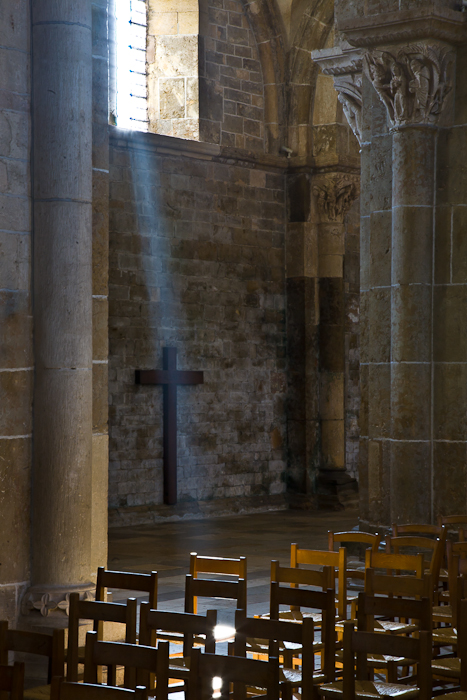
Light through a window of the Basilica of the Madeline in Vézelay, France – Photo by Dennis Aubrey
Reason only partially explains why and how some people become friends.
“Reason, you’ll always be half blind,” said Mechtild of Magdeburg, the 13th century German mystic beguine, author of The Flowing Light of Divinity.
Friendship
There are reasons that partially explain why and how Dennis Aubrey and I became friends. Cyberspace is how we met. I can’t recall which of us started the conversation. I do know that finding Via Lucis: Photography of Religious Architecture was like a window opening a dark room to light and air. Why one of us reached out to comment on the other’s site had its reasons. Each of us was wading in the same waters, asking the same questions. Dennis did it by means of professional photography and commentaries on Romanesque and Gothic churches in France and Germany. I did it through commentaries on faith and public life.
Wading in the same waters differently led us to each other. Although I have always loved beautiful architecture, I knew little about Romanesque and could not have cared less about the Medieval period when the Romanesque cathedrals, basilicas, and churches were built. These structures were the waters in which Dennis sought and found light. The ancient texts of Hebrew and Christian scripture were the waters in which I did the same. Discovering each other wading in the same waters differently led to an eight year friendship in person at Dennis and PJ’s new home in Ohio, by internet comments on each other’s work, and the kind of phone calls peculiar to close friends.
Last Saturday I called Dennis to discuss his latest posted on Via Lucis. There was no answer. Perhaps I’d called too early. Perhaps he and PJ were in France. Perhaps they had driven to the Amish farm stand where the Amish adolescent sold them organic vegetables or had gone to the Amish auction. Or maybe Dennis had silences his cell phone. I left a voicemail. An hour later at 9:43 A.M. the return call came from Dennis’s cell phone number. But the voice was not Dennis’s, it was PJ’s. “I can’t believe you called,” she said. “Dennis died last night.” Our worlds suddenly became smaller.
As the hart panteth after the water brooks, so panteth my soul after Thee, O God. My soul thirsteth for God, for the living God: when shall I come and appear before God? [Psalm 42:1-2 KJV]
Panting after the water brooks
Faith takes many forms. Which forms, if any, are grounded in reality is a lifelong quest for some of us. A cynic may dismiss all forms of faith as ungrounded — floating in the clouds of human imagination and illusion. Yet there remain those murmurings from within or the majesty one sees outside the self in nature or great works of art. Dennis and PJ posted an an announcement and invitation to a new exhibit July 29 bearing the artists’ witness to imagination: “This exhibition is not about the iconographic programs of medieval historiated capitals, but rather an appreciation of the human imagination that created these sculptures.”
The search for authentic faith — trust in something greater than the self and all that we can see, feel, taste, smell, or touch — is not a straight line. It spirals between opposites. We disbelieve and believe. We believe and disbelieve. We fall and we get back up. We gasp for air and we gasp in awe. We turn our backs on the past and embrace it again as though we’d never met it.
When shall I come before Thee?
St. Augustine wrote that our hearts are restless until they find their rest in Thee. Like faith itself, what the Hebrew psalmist called the soul’s ‘panting’’ and Augustine called ‘restlessness’, takes many forms. Sometimes, as in the parable of the lost son, it takes us far away from the water brooks; sometimes it goes numb; sometimes it draws us closer to the water brooks. But even there by the side of the water brooks, like Narcissus, we refuse to drink.
Dennis was on a lifelong search for what the psalmist likened to a deer thirsty for water — longing for union with the Ineffable that was shrouded in mystery but given to his eyes in a shaft of light reflecting on a stone wall at dusk, or on one of the capitals the craftsmen of a by-gone time invited his imagination and research. He shared in photography and commentary moments where his panting desire for God was quenched by the stones themselves: the song of Mary Magdeline echoing from the stones of the Basilique Sainte Madeleine in Vézelay, and the sounds of uncluttered simplicity and beauty of Gregorian chant that calls us to remember who and Whose we are.
His last words on Via Lucis were posted in reply to his latest and most personal post. “Judy, thank you so much. It is the ineffable sensation of that spirituality that drives both PJ and me when we photograph.”
Deep calleth unto deep at the sound of Thy waterspouts.
Dennis was joyful. He was attuned to the calling of the Deep. He was reverent before the abyss, the yawning hole in existence itself, the nights haunted by the 3:00 o’clock in the morning questions that beg for answers. He shared those times of wrestling with PJ and with Rudy, the cat on his lap in whom he took such delight, and, sometimes, with readers of Via Lucis. I could only say “Yes! Yes! Yes!” Opening one of his posts on Via Lucis was like meeting the twin brother I didn’t know I had. No matter how deep into the Deep his blog posts would go, there was always the echo of the Divine calling to him from the depths.
My soul is cast down within me.
Dennis had an eye for beauty and the camera and words to reflect what he saw when he took the shot. It was a rare gift. The antidote to sleepless nights was a day with PJ in a Romanesque Basilica like the one at Vezelay, waiting for the precise moment when the light and shadows would be just right. The beauty was already there in the stone walls and buttresses, the choirs, chancels, the side chapels built to the glory of God by artisans whose names were forever lost to future generations. I think Dennis saw himself as one of them, creating works of art that drew attention not to himself but to his subject.
Only wonder comprehends anything
Looking back after he has left us, it occurs to me that Dennis’s faith was of the Eastern (Byzantine) tradition of Christianity much more than of the Western (Roman) tradition in which he was raised. Dennis could well have spoken the words of Gregory of Nyssa.
“Concepts create idols; only wonder comprehends anything. People kill one another over idols. Wonder makes us fall to our knees.”
He was horrified by what had been done in the name of Christ: the Crusades that swept through the world like a wild fire, destroying towns and villages, and disobedient monastic sites because their concepts were not right.
The kind of thing that sunshine is
Concepts are ‘cataphatic’; wonder is ‘apophatic’. Cataphatic religion is logical — it lives in the head. Apophatic spirituality is awake to what cannot be reduced to a concept. Dennis’s artistic spirit was apophatic — awake to the beauty all around him and cringing at human cruelty produced by the idols in our heads.
Just as many questions might be started for debate among people sitting up at night as to the kind of thing that sunshine is, and then the simple appearing of it in all its beauty would render any verbal description superfluous, so every calculation that tries to arrive conjecturally at the future state will be reduced to nothingness by the object of our hopes, when it comes upon us.
Gregory of Nyssa (c.335-c.395 CE)
Dennis’s writing respected the ineffability of sunshine with words that helped us see the beauty his apophatic eyes had seen.
“I shall yet praise him”
The poetry of Psalm 42 was akin to the poetic imagination by which the Hebrew prophet Isaiah described his experience in the temple:
In the year that king Uzziah died I saw also the Lord sitting upon a throne, high and lifted up, and his train filled the temple. Above it stood the seraphim: each one had six wings; with twain he covered his face, and with twain he covered his feet, and with twain he did fly. And one cried unto another, and said, Holy, holy, holy, is the Lord of hosts: the whole earth is full of his glory. And the posts of the door moved at the voice of him that cried, and the house was filled with smoke.
Isaiah 6:1-4 (KJV)
In the 20th and 21st centuries Isaiah’s temple was a Romanesque church Dennis and PJ experienced in ways best expressed in poetic prose and photograph. Their art brought to life our sense of the seraphim soaring above the throne of the Holy One. Those gasping for air found ourselves gasping with awe at what the eye of this gentle soul had seen. Sometimes the Ineffable takes our breath away and drops us to our knees in an empty church where the sun still shines its light on the stones, the stones cry out, and the Magdeleine still sings.










 Views from the Edge