Unknown's avatar

About Gordon C. Stewart

I've always liked quiet. And, like most people, I've experienced the world's madness. "Be Still! Departure from Collective Madness" (Wipf and Stock Publishers, Jan. 2017) distills 47 years of experiencing stillness and madness as a campus minister and Presbyterian pastor (IL, WI, NY, OH, and MN), poverty criminal law firm executive director, and social commentator. Our cat Lady Barclay reminds me to calm down and be much more still than I would be without her.

Capitalism, Socialism, and the Earth

The online Oxford Dictionary defines democracy as “a system of government by the whole population or all the eligible members of a state, typically through elected representatives….”

But it immediately biases the discussion with the following sentence to illustrate the word democracy: “capitalism and democracy are ascendant in the third world.” That is, capitalism and democracy go together. Wherever capitalism goes, democracy goes. The ascend together as was imagined to be the case in the Arab Spring.

To the contrary, the online Oxford Dictionary defines capitalism as “an economic and political system in which a country’s trade and industry are controlled by private owners for profit, rather than by the state.”

The Oxford Dictionary identifies what we are coming to realize in America. We do not live in a democracy. We live under “the economic and political system in which a country’s trade and industry are controlled by private owners for profit rather than by the state.” Neither are they controlled by the people of the state, the body politic.

The presumed ideological kinship between capitalism and democracy has existed in America culture as long as most of us can remember. It wasn’t always so in the 1920s and ‘30s, but, as we are beginning to understand again by virtue of circumstance, democracy does not depend upon a capitalist economy. In fact, democracy and capitalism are contradictions in terms. They are philosophically incompatible.

The more natural kin of democracy is socialism, as defined by the online Oxford Dictionary: “A political and economic theory of social organization that advocates that the means of production, distribution, and exchange should be owned or regulated by the community as a whole.”

Democracy is the rule of the people, “a system of government by the whole population….” or, “the community as a whole.”

Finally in America an intelligent discussion is afoot about democratic rule and economics. Naomi Klein’s This Changes Everything: Capitalism vs. the Climate takes the discussion to a new level that views global capitalism as “the most profound threat humanity has ever faced: the war our economic model is waging against life on earth.”

Voices

NOTE: This e-mail was shared among friends from my wife Kay’s high school days. When asked how best to introduce her, Kathy replied, “just another person seeking to understand how to respond.”

“It’s so hard to make sense sometimes of all the voices, the messages, that break into a usual day.

“Downtown, I heard the sound of a ragtag bunch of demonstrators on the next block, chanting in one voice, ‘Hands up, don’t shoot’, in solidarity with protesters all around the country. I saw an armored police vehicle, moving quietly, on the next block, seemingly trying to get ahead of where the protesters would be coming next. There was no sound at all coming from the twelve or fifteen police who were mounted around the outside of the vehicle, like so many tin soldiers, with protective gear and plexiglas shields. If they were speaking, it wasn’t for us to hear. On the next block, at least two dozen police on bicycles were making their way up a crowded sidewalk; probably more in total than the group of protesters.

“Somewhat shaken, and wondering, as I often do, whether I belong out there with the marchers, and where is my place in the confusing discussion. What does my own voice need to say? I made my way back home. After all, there was no place to leave my car in our crowded downtown if I wanted to join the marchers. I was not “dressed” for a protest. I said to myself, “a walk in the park is what I need, even though it is getting dark. It’s not raining, and it’s mild and not windy”.

“As I walked up the slope around the corner from our house, I heard chanting again, this time happy voices. I couldn’t quite make out the words at first, but soon I realized it was three girls singing “Come on down to our holiday sale, our holiday sale, our holiday sale”. Of course, that group was much easier for me to join, and there were most certainly no police in sight. The girls had hot cocoa, gingerbread cookies, and origami birds for sale. Conversation was easy. One girl told me she was raising money for ‘cancer’, the next for the ‘pet shelter,’ and the last for ‘homeless’.

“I had to offer a prayer of gratitude for everyone who is working to make this longing world a more just and welcome place.”

Kathy Elliott
Portland, Oregon
December 7, 2014

Verse – Limerick: We Racists

We racists know we can’t treat laws like a joke,
We’d all go to jail if WE kill all those folk
That we hate and we fear,
But we secretly cheer
That if I’m a COP I can beat, shoot, or choke.

– Steve Shoemaker, Urbana, IL, December 8, 2014

He had his own means of communication

My cousin Dennis sent this following the post about his older brother Alan who was paralyzed with Cerebral Palsy. See the earlier two posts on Views from the Edge for background information.

“For all the limitations Alan suffered, he was so loved by all of us and in his own way could express his love with ‘ah’s and laughter and joy that came through his facial expressions, vocal inflections and expressive eyes. He had his own means of communication which Gwen and I grew to understand. He could express all the human emotions. Alan could speak in his own special way. He called our Dad ‘fata’.

“I learned so much about life and what real love is from growing up with him. We never felt him a burden in any way. We all helped feed him, bathe him and change his diapers.  It was a family project that we all did willingly.

“When he was put in an institution we missed his laughter and grieved for him deeply as a family. I don’t think any member of my family was loved and admired more than Alan.

“My father, mother and sister would be so proud of this blog.  Their hearts would soar knowing Alan is part of the real world again and a living example of God’s love for us all.  Alan did not live in vain.  He was a courageous person who had to battle through his palsy to be just another human being like you and me.

“No father cared more for a son than my  Dad.  He was entirely devoted to him.  And Alan looked up to him with adoration in his eyes.  Alan could utter several words much like a one year old. He used his throat and lips to utter a very gutteral sound that few could understand but the immediate family.  His ‘ah’s were his method of communicating his emotions and it varied depending on the circumstance.  He understood everything you said to him and he would respond in his own way to let you know that he understood what you were saying.  His eyes and facial expressions spoke a thousand words.”

Joy and Gratitude – my cousin Alan

Over lunch today my 89 year-old friend asked what had drawn my attention to my paralyzed first cousin Alan who never spoke a word due to Cerebral Palsy (see Views from the Edge’s  post “Father and Son – Bob and Alan”).

Alan was completely helpless. His body was rigid. He had no control over his bodily functions or anything else. He was utterly dependent on his family. He could not feed himself. He couldn’t speak. Even so, his eyes communicated joy.

The joy of kinship and love came from inside himself in spite of all.  I want the joy and gratitude that emanated from Alan’s eyes and smile whenever we came into each other’s presence. Control is a debilitating disability – an isolating illusion – among the “abled”.

The Streets of Ferguson, Cleveland, NYC, Minneapolis

A 19 year-old African American walks into the Legal Rights Center (LRC). He insists on seeing the Executive Director.

He’s a large man, his speech is fast, his eyes are angry. He pulls up his shirt to show the swastika he alleges the police carved on his back while he lay on the street in North Minneapolis.

There are witnesses. Three women and a man who saw it happen  during another man’s arrest. “Raymond”, we’ll call him, was objecting to the arrest when two officers took him down to the pavement, face down, while one of the officers used his key to etch the Swastika into his flesh. He was not arrested.

Police abuse of power, racial profiling, the use of unreasonable force, shootings, and prosecutors and grand juries looking the other way always have been the way it is in America.  What’s new is the public outcry, the jarring of consciousness and conscience among those who do not live in places like North Minneapolis, Ferguson, or one of the poorer African-American neighborhoods in Cleveland or New York City.

After several years of the LRC Executive Director referring complainants to the Minneapolis Police Civilian Review Board without satisfaction of remedy, I proposed something out of the ordinary. We went directly to the commanding officer of the 4th Precinct of the Minneapolis Police Department.

The Commander’s attention seemed to wander as I introduced myself and Raymond until Raymond pulled up his shirt. The Commander asked if Raymond got the number of the squad car or remembered the badges of the officers. He didn’t. The Commander then, to my great surprise, named a number of officers, asking if Raymond recognized any of the names. Those officers were well-known for terrorizing the North Minneapolis African-American community.

“This is way beyond Internal Investigation,” he said. “You need to take this to the F.B.I.”

Raymond didn’t trust the F.B.I. any more than he trusted the Minneapolis Police Department. He decided to let it go.

Lots of people like Raymond have decided over the years to let it go. Until Michael Brown was shot and killed in Ferguson and a grand jury decided not to indict him. Until 12-year old Tamir Rice was killed by a police officer in Cleveland. Until Eric Garner died of a police officer’s choke hold saying, “I can’t breath!” The inferno of anger boiling over across the streets of America is new only in the breadth of consciousness and conscience.

It will take time. It will take a change of heart and mind. But, mostly, it will NOT change until America gets it straight that for most African-Americans being black is also an issue of class. Class is about power and powerlessness. Only when what we call “the middle class” understands that its interests lie with African-Americans in Ferguson, Cleveland, NYC, and Minneapolis will thing change in America.

Attorney General Eric Holder just released a Department of Justice Investigation report. Click HERE for the story.

It’s all about the economics: up or down. There really is no middle. “Hands up!” “I can’t breath!”

The Dancing Dog Eatery and Juicery

An Acrostic Tribute

The vegetarians love it!
How do omnivores love it too,
Even though all is vegan food?

Delicious, each bite of the pies!
Animal friends happy outside!
Nice, the waiters are always nice!
Chips and fish, the menu says,
Inside is plant-based tasty food,
Never cooked from any other!
Good! And never had a mother!

Delicious, I use the word twice!
Orange, apple, grape, amazing juice!
Good wine and beer, let’s give a cheer!

– Steve Shoemaker, Urbana, IL, Dec. 4, 2014. The Dancing Dog is in Urbana, IL. Here’s a link to the restaurant.

The Dancing Dog Eatery and Juicery

The Dancing Dog Eatery and Juicery

Father and Son – Bob and Alan

Bob Smith and his first-born child, my cousin Alan, never had what you and I would call a normal conversation. But I suspect they “talked”more deeply in their own father-son ways.

Alan’s tongue and body were held captive from birth by Cerebral Palsy. He never spoke a word that I could understand.

Each morning Alan’s mother, my Aunt Gertrude, and his father, my Uncle Bob, lifted Alan from his bed, cared for his morning needs with tender respectfulness, carried him downstairs to the kitchen for breakfast. Sitting on his father’s lap, the spoon and fork came to his mouth from the hand of his father. Uncle Bob would then carry Alan to the parlor, the back room on the first floor of the house on Porter Street, where Alan would lie until lunch. Uncle Bob came home from the Oxford County Court House for lunch every day  to be with Alan, Gertrude, and Alan’s young brother and sister, my cousins Dennis and Gwen. He would go to the den, lug Alan to the kitchen, feed him lunch…. Repeat, repeat, repeat at dinner. Carry Alan upstairs, prepare him for bed, and, as I imagine it, say a prayer that Alan could hear and understand but could not speak. He did that for 14 years.

My time with Uncle Bob and Alan dates back to my earliest years. Every summer I stayed at my uncle and aunt’s house for a week while the rest of my family stayed with my grandparents. My relationship with my cousin Dennis, only six months older than I, was special enough to separate me out for special time at the house on Porter Street.

Looking back on it now awakens me to the sense of heaviness that came over me watching Alan, seeing the joy in his eyes and the contorted smile that broke out on his face, and listening to the moans of greeting and sheer delight that came from his palsied vocal chords whenever he and I would see each other after the long year’s absences between my family’s vacations.

There was a bond deeper than words. The bond of eyes and smiles. The bond of kinship and shared joy, as well as sorrow. I always wondered what was going on in Alan’s head. Aunt Gertrude, an elementary school teacher, claimed he was very intelligent, but there was no way to measure it. Had he been born 40 years later Alan might have been a Stephen Hawking “talking” by other means, but he wasn’t. He was born in 1939. And if there was a silent bond of awkwardly expressed love between two cousins whose visits were annual, how much deeper and familiar was that bond between the father and his son?

I’ve often wondered what it was like being Alan. I’ve scolded myself in times of self-pity, and sought the deep courage and joy that emanated from Alan.

I’ve also marveled at Uncle Bob, a wrrior in the trenches, fighting despair over Alan’s plight, what might have been and would never be for him, rising to the daily-ness of it all, some days resenting it, some days wishing he could take his family of vacations like other families, some days finding comfort and courage playing a great sacred music piece on the organ of First Congregational Church of South Paris where he served as Organist and Choir Master for 40 years. Perhaps the familiar hymn tune “Serenity” set to John Greenleaf Whittier’s poem “Immortal Love, Forever Full”, encouraging the love he bore for his speechless son:

Im-mort-al Love, for-ev-er full,
For-ev-er flow-ing free,
For-ev-er shared, for-ev-er whole,
A nev-er ebb-ing sea!

The heal-ing of [Christ’s] seamless dress
Is by our beds in pain;
We touch Him in life’s throng and press,
And we are whole a-gain.

At the end of really good days when joy was high with thanksgiving for the father-son bond with Alan, I imagine him walking down Main Street to the darkened church, taking his seat on the organ bench with the lights out except for the organ light, his feet pumping the pedals, his fingers flying over the keyboards and reaching for the stops to play the Widor Toccata he played every Easter, a lush oasis “in life’s throng and press.”

The Politics of Vision

Voter turnout in the November election was the lowest since 1942. Many folks have given up on the political establishment. The know that Citizens United baptized the privilege and power of the billionaire class.

Very few candidates stood up against the pejorative, demagogic ad campaigns that painted progressive candidates with a red brush. Most campaign ads focused on what the candidate opposed. Very few put forward what they stood for, as well as against.

But what if…. What if a candidate answered the question “What do you stand for?” very clearly? Something like this:

YES to raising the minimum wage.

YES to a massive jobs program rebuilding our crumbling infrastructure.

YES to transforming our energy system away from fossil fuels.

YES to pay equity for women workers. YES to overturning Citizens United.

NO to cuts in Social Security.

NO to cuts in Medicaid.

NO to converting Medicare into a voucher program.

NO to new trade legislation that sends our jobs overseas and hammers our middle-class workers.

NO to cuts to nutrition programs, education, or environmental protection.”

Someone did say this. Senator Bernie Sanders, (I), Vermont. How does America’s only socialist Senator from the small state of Vermont manage to get elected? How does it happen that conservative Vermont farmers and small business owners support him?

His “Yes” means “YES” and his “No” means “NO”. He is honest. He has a message. He doesn’t fudge the way Mitch McConnell’s Democratic opponent did in Kentucky when she re-made herself to sound tougher than Sen. McConnell on immigration enforcement.

Clarity of message is everything. So is honesty. Boldness. “Where there is no vision the people perish” [Proverbs 29:18]. Where there is (a good) vision, the people follow and thrive.

Traditional American values were not up for debate in 2014. Disgust was the issue. Anger was the issue. Distrust was the issue. Cynicism took over. Between now and 2016 we can expect more of the same. But there is also a national debate brewing about the vision.

“Write the vision and make it plain, so he may run who reads it.” [Habakkuk 2:2]

Thanks you, Bernie Sanders, for writing yours so clearly. I look forward to hearing others’ plain Yeses and No’s, such that might inspire us to run to the polls next time.

← Back

Thank you for your response. ✨


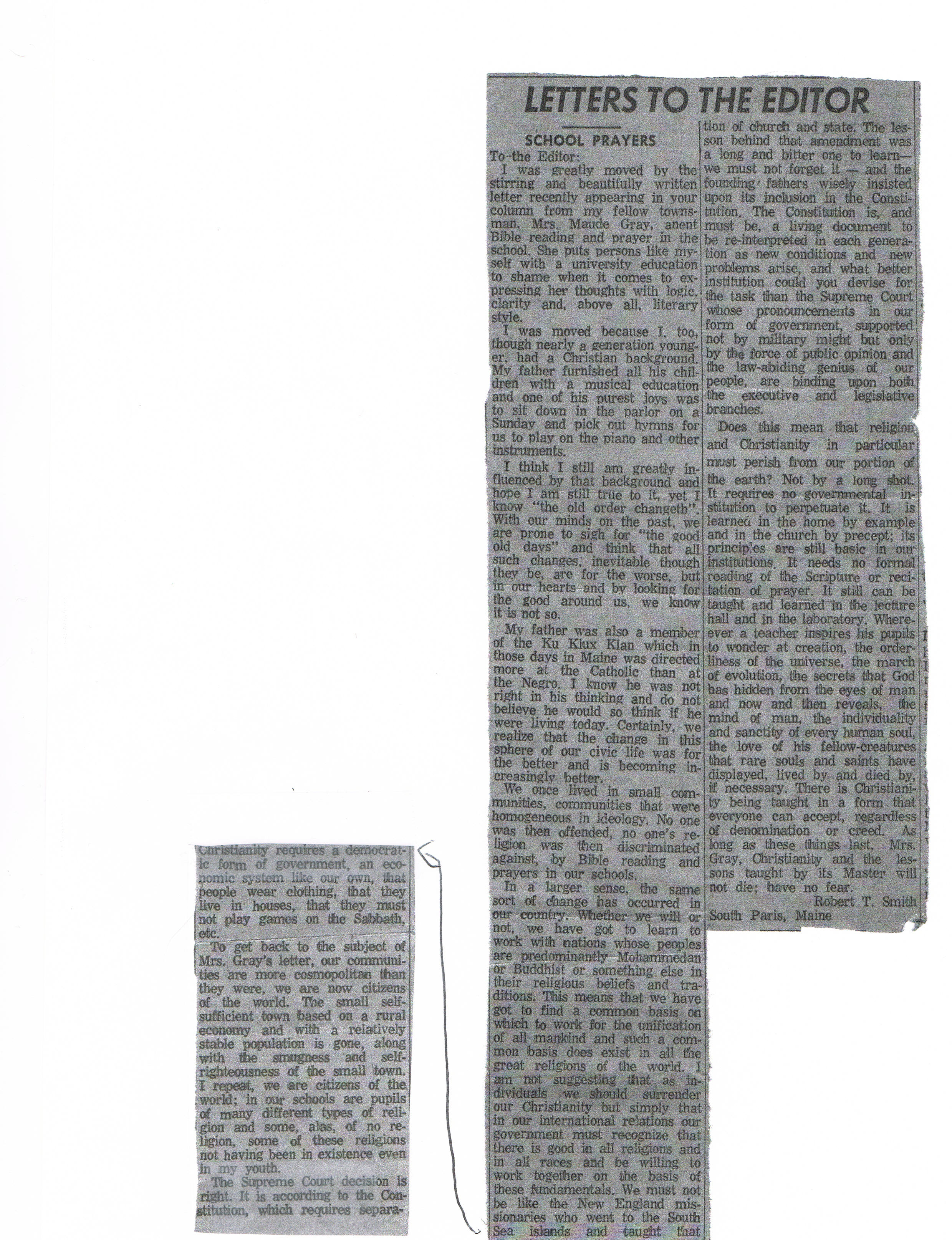
Prayer in Public Schools – Letter to the Editor

Uncle Bob's letter to the Editor - 1963

Uncle Bob’s Letter to the Editor – 1963

Does this look old? It is. Typed on a manual typewriter in 1963. Some things are worth their weight in gold. This Letter to the Editor is one of them.

Robert Smith, my Uncle Bob, sent this Letter to the Editor of the local paper in South Paris in Oxford County, the poorest county in the State of Maine.  A native of Kennebunk, Maine, he was a relative of John Smith of the legendary tale of Pocahontas, who  married my mother’s sister, Gertrude, after graduating first in his class at Harvard Law. He opened a law office in South Paris, met the love of his life and courageously raise a family: my first cousins Alan (who never spoke a word because of Cerebral Palsy), Dennis, and Gwen.

He became the District Attorney and then the Probate Judge in Oxford County. A Republican of the Nelson Rockefeller brand, he wrote his Letter to the Editor after the U.S. Supeme Court ruled that prayer in the public schools was unconstitutional. To the chagrin of many of his neighbors, he supported the Supreme Court decision.

His daughter, my cousin, Gwen, sent this to me. with a note:

“I am amazed at how ‘global’ his thinking was, especially when you think of South Paris! I couldn’t wait to get out as I saw it as being so insulated from the real world…knew there was something better out there. Dad would be drummed out of the Republican party he so strongly supported with this thinking, but all politicians could take a lesson in civility from this!”

Bob Smith died of a cerebral hemorrhage leading a congregational meeting of the First Congregational Church of South Paris where he was the President of the Congregation, Choir Master and Organist. He died the way he lived – with the courage of his convictions and a faith in Divine providence that does not depend upon or favor the tyranny of the majority.