It’s sexist, demeaning, though hard to explain
That a positive adjective can be a pain:
The papers we scan
Don’t say Jane’s handsome man,
It’s always Joe Blow and his lovely wife, Jane.
– Steve Shoemaker, Urbana, IL, April 16, 2015


It’s sexist, demeaning, though hard to explain
That a positive adjective can be a pain:
The papers we scan
Don’t say Jane’s handsome man,
It’s always Joe Blow and his lovely wife, Jane.
– Steve Shoemaker, Urbana, IL, April 16, 2015
On Snoring
I wake and my lips are all chapped,
My sinuses completely stopped.
Breath through my nose is what’s missing.
My biggest regret: no kissing.
– Steve Shoemaker, Urbana, IL, April 15, 2015
What I believe
and state firmly
does not matter
nearly as much
as my actions
in revealing my
character.
Who I am
can be seen:
much more clearly
by observers
than learned by
hearers or readers
of my words,
so carefully chosen.
– Steve Shoemaker, Urbana, IL, April 12, 2015
Buzzkill
Five in a line in our family
(all of them females, of course),
have the name Bee in the middle
(between their last and their first.)
Half of the bees in our country
died over winter last year.
One out of three of our foodstuffs
need bees or will disappear.
Einstein may not be who said it
(no one has proved it was he),
that we will die, yes, each family
within two years of the bee.
We need more prairies and fruit trees,
(that are not sprayed from above.)
Honey from new hives can happen:
we need to give bees our love.
[written in 9 minutes early this morning after hearing a PechaKucha 20-slides-each-20 seconds talk last night by Urbana, Illinois, beekeeper Maggie Wachter at a Sola Gratia Farm dinner.]
– Steve Shoemaker, Urbana, IL, April 12, 2015
Minnesotans are known for Minnesota Nice, a phrase that describes Minnesota’s Scandinavian culture of civility. Sometimes Minnesota Mean lies just below the surface. Other times civility and gentleness pervade a person’s character. John Skogmo was Minnesota Nice at its best. There was no meanness in him.
Minnesotans also don’t like fanfare. That Minneapolis is called “the little apple” refers not only to the city’s size compared to “the Big Apple” but also to Minnesotan’s disdain for big splashes, big stages, and floodlights. ‘Ego’ and ‘Minnesotan’ belong together in the Thesaurus as antonyms.
Working back stage behind-the-scenes is what Minnesotans are about at their best. John Skogmo’s obituary, laced with subtle humor, is a great tribute. John was a man without guile; his faith was the foundation of the quiet stature universally recognized by his family, friends, church, and work colleagues.
Obituary, published April 12, 2015 [highlights added by VFTE]
John Gunderson Skogmo died April 4, 2015 of cancer. Born in Fergus Falls, MN, July 15, 1947, to James Bertram and Joyce Shirley Skogmo.
John found his calling at age nine, reading his father’s issues of Kiplinger’s financial magazine. He became fascinated with compounding interest and saw the benefits of delayed gratification. As a teenager he ran a concession that sold popcorn, cotton candy, and caramel apples at local events. At the end of the day he laundered money-at the kitchen sink, to get the sugar and grease off his cash intake. He used his earnings to buy shares in the Security State Bank of Fergus Falls and was frequently excused from school to attend shareholders’ meetings.
After graduation he left for the Cities to attend Macalester College, where he received a treasured liberal arts education. He earned a J. D. from the University of Minnesota Law School in 1972 and went to work immediately in the three-person legal department at Northwestern National Bank. Except for a summer at the Cornell University School of Business as a 1978 Bush Foundation Fellow and the bank’s temporary displacement by the 1982 fire, John spent his entire career at the corner of 7th and Marquette, as NWNB became Norwest and then Wells Fargo. He was fortunate to work in several departments before finding his true home in 1989 in Wealth Management, where he applied his stellar relationship skills to helping individuals and families. He was set to retire in June 2015 after 43 years with the bank.
John Skogmo’s volunteer work, much of it behind-the-scenes, helped assure the solvency and stability of some important organizations. As a trustee of Macalester College, he reinvigorated the Alumni Fund at a critical juncture. He worked with Artspace to maintain affordable housing and workspace in gentrifying neighborhoods and was instrumental in establishing the Cowles Center. He served as president of the Friends of the Minneapolis Public Library and was appointed by the city council to the Minneapolis Community Development Agency.
His proudest achievement was his long-term service to Westminster Presbyterian Church as a deacon, trustee, elder, and treasurer. John’s was the voice of prudence in many crucial financial decisions, and his steadfast leadership earned respect for Westminster’s endowment as one of the most wisely managed church funds in the country.
He was predeceased by his parents and a grandniece, Lily Irene Martyn, and is survived by Tom Morin, his partner of 32 years and husband of 1 year; his sister, Shirley Nelson; niece Sharri Martyn and her daughter Claire; nephew Trevor Steeves (Jana) and his children, Elizabeth (Kyle) and Joshua; half-brothers Phillip Skogmo (Yukiko) and David Skogmo (Linda); two aunts and many cousins. Memorial service on Friday, May 1, 2015, at 3:00 PM, at Westminster Presbyterian Church, 1200 Marquette, Minneapolis. Reception following at the Minneapolis Club. Memorials preferred to Westminster or donor’s choice. No Flowers Please. www.Washburn-McReavy.com Edina Chapel 952-920-3996.
– Gordon C. Stewart, Chaska, MN, April 13, 2015
Our April morning
sky, ribbed in violet,
now becomes
magenta fading into
dusty blue without
a single white cloud
to distract our horizon gaze
waiting for our spinning
globe to show the sun.
– Steve Shoemaker, Urbana, IL, April 12, 2015
“Where were you on April 9, 1956?” The answers are pouring in from the Class of 1960.
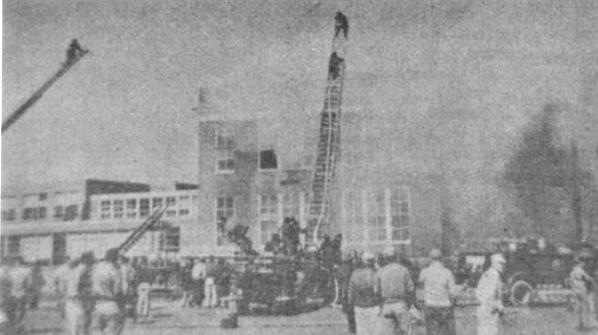
Marple-Newtown Junior High-Senior High School Fire, April 9, 1956
We were in the 8th grade of Marple-Newtown Junior-Senior High School. On that day we were eating lunch, getting ready for our next class when the fire alarm sounded. Must be a fire drill. We knew the drill. So did the teachers. The teachers led us outside, hand-in-hand in the continuous line processional we’d learned in those ridiculous fire drills. The school was going up in flames.
One of my classmates, Dave, remembers it this way:
The Boys’ Room was crowded with guys smoking cigarettes before class, the air was filled with a cloud of tobacco smoke and smells, so we didn’t have any indication that a fire was building below the first floor. Hearing the fire alarm, we stepped out into the hallway to see a trickle of smoke rising from each plank of the hardwood flooring. Seeing that smoke, we knew that the school and the students were facing a serious fire emergency. An orderly evacuation began and although it was a cold day, no one was permitted to go back to their homerooms for their coats.
To a chorus of cheers, we all stood outside shivering for what seemed to be a long time and watched the fire fully consume the building. To a chorus of boos, the fire trucks finally arrived and the volunteer firemen had trouble hooking up the hoses and getting water on the destructive blaze.
The school building was obviously a total loss and since I was cold, I decided to hitchhike home. It was about lunchtime, when I arrived home. My mother immediately descended on me, “…why are you home, are you playing hooky and where is your leather jacket?” “No,” I said. “It wasn’t my fault,” I blurted out, before feeling the back of her hand across my face. “Tell me the truth,” she demanded. I said,”the school burned down,” just before getting a fresh one on the other cheek.
One of the memories we share is the picture of Mr. Harvey, still inside the building, handing the typewriters out the upstairs window from his typing class to Seniors who were ascending and descending a firetruck ladder to save the typewriters until he had to come down himself to loud gasps and cheers.
Fred, remembers being “in typing class a year later using one of those ‘saved’ machines with melted keys.”
Ellie, who wasn’t in the building when the first started, adds something else:
I was approaching the school entrance after lunch at the pizza shop and was met by students rushing out to safety. Still remember that once we were all assembled by homerooms Mr. Rathey went tearfully from group to group checking whether we were all accounted for.
What a surreal day!

Mr. Rathey pointing
The miracle is that we all made it out safely. Before Mr. Rathey, shown here pointing to the school, could see his charges walk across the stage at graduation, he was diagnosed with cancer. The Class of 1960 presented him with a gold watch at his early retirement. Ellie reminded us today of Mr. Rathey’s tearful care on the day the school burned down and in the years that followed.
– Gordon C. Stewart, Chaska, MN, April 9, 2015.
… it sometimes pours.
News came today of the death of John, followed hours later by news of the death of Jerry, and the impending demise of two more friends. Life is like that, or so I tell myself. But it doesn’t help much, if at all, because grief has its own way. Grief wends its course through the soul the way a river eventually ignores the man-made routes and dams imposed to keep it in its place. Nature always wins.
Loss is always hard, even for those who believe, as the Creed does, “in the life everlasting.” I look to the presence of the Eternal in this life, this side of death, this side of my mortal end, as the heart of things, knowing that love continues, no matter how many deaths and sorrows it suffers.
On days like today when it pours, a familiar hymn often sings itself in me, and I am strangely comforted.
“Time, like an ever-rolling stream, soon bears us all away, we fly forgotten as a dream dies at the opening day.
“O God, our help in ages past, our hope for years to come; be Thou our Guide while life shall last, and our eternal Home.”
I pray the same comfort for John’s and Jerry’s spouses, relatives and friends, and for the readers of Views from the Edge, in whatever circumstance you find yourself tonight.
– Gordon C. Stewart, Chaska, MN, April 8, 2015.
Her voice is low and very resonant,
but now, with age, I often cannot hear
each word. She rightly takes offense at that
and thinks me inattentive. If my ear
is turned away, or if I do not see
her moving lips, the sounds are often lost.
For other women there is jealousy
since I can hear them fine. It is not lust
for at the string trio tonight, the sound
of violin was clear, cello was round,
but viola was lost in the background…
– Steve Shoemaker, Urbana, IL April 8, 2015
Listen in on John Rutter, one of the world’s great composers, discuss the choir as “a kind of emblem for what we need in this world, when so much of the world is at odds with itself….”

