Unknown's avatar

About Gordon C. Stewart

I've always liked quiet. And, like most people, I've experienced the world's madness. "Be Still! Departure from Collective Madness" (Wipf and Stock Publishers, Jan. 2017) distills 47 years of experiencing stillness and madness as a campus minister and Presbyterian pastor (IL, WI, NY, OH, and MN), poverty criminal law firm executive director, and social commentator. Our cat Lady Barclay reminds me to calm down and be much more still than I would be without her.

Compassion expressed or withheld – Plato and Luke

The question of the relation between compassion and property and the emotional-psychological-spiritual results of expressing or withholding compassion came to the fore several Sundays ago after hearing a reading from The Book of the Acts of the Apostles.

“Now the whole group of those who believed were of one heart and soul, and no one claimed private ownership of any possessions, but everything they owned was held in common” [Acts 4:32].

The whole group, i.e. the early disciples of Jesus, were putting into practice the political philosophy Plato recommended centuries before to legislators in the Greek republic:

“The form of law which I propose would be as follows: In a state which is desirous of being saved from the greatest of all plagues—not faction, but rather distraction—there should exist among the citizens neither extreme poverty nor, again, excessive wealth, for both are productive of great evil . . . Now the legislator should determine what is to be the limit of poverty or of wealth.”

– Plato, Greek philosopher (427-347 B.C.E.)

The idea of a ceiling on the accumulation of wealth is a democratic socialist principle. So is a floor to prevent poverty.

Interestingly, Plato seemed to think distraction was a greater plague than factionalism. Distraction from what? The good, the true, and the beautiful perhaps, the trinity of cardinal virtue, perhaps.

Material security becomes an obsessive distraction. Hoarding becomes a way of life. “More” becomes life’s purpose. More ad infinitum until more is no more  when il morte levels the rich and the poor to their shared destiny of dust and ashes.

The distribution of wealth is a profound spiritual issue, both publicly and psychologically. How wealth is distributed in any society is a measure of its compassion. The New Testament texts have a jarring way of discussing this. They discuss compassion as originating in “the bowels”.

Though the more recent versions translate the First Epistle of John in a sanitized way – “How does God’s love abide in anyone who has the world’s goods and sees a brother or sister in need and yet refuses help?” – the original Greek text is better translated by the KJV: “But whoso hath this world’s good, and seeth his brother have need, and shutteth up his bowels of compassion from him, how dwelleth the love of God in him?” [I John 3:17].

The words “of compassion” are added by the King James translator for purposes of giving the English reader the original sense of the Greek text. “Shutting up one’s bowels” toward someone in need is the equivalent of walling one’s self off from the common lot of humankind.

The Hebrew location of the emotions was the bowels, also translated “inner parts”  – stomach and intestines. The instinctive response to human need is a pit in the bottom of the stomach, a visceral response. One has to be carefully taught not to feel it.

The word “bowels” appears also in the Book of Acts description of the tragic death of Judas, whose bowels (compassion) had not gone out to Jesus until it was too late. Luke, the author of The Book of Acts, paints a gruesome picture intended, perhaps, to draw the psychic consequences of withholding compassion. Judas goes out and buys a field with the 30 pieces of silver he received for guiding the authorities to Jesus at the Mount of Olives. The description of Judas’ death leaves a choice of interpretation of a Greek word [prenes] that can be translated “falling headlong” or “swelling up” and splagchnon, the word for bowels, inward parts, entrails. A literal translation and choices are:

“Now indeed [Judas] acquired a field with the wages of unrighteousness. And having become prostrate/prone/flat on his face/ swelling up, he burst-open in the middle and all his bowels/inward-parts/entrails spilled-out.”

The bowels, not the heart, were regarded as the seat of human emotion. Seeing another person starving or injured leaves a pit in the stomach. Unresolved guilt or violation of one’s own moral standards or integrity often produces ulcers and intestinal problems.

Whether one translates prenes as becoming prostrate (the position of a penitent) or swollen, Luke’s picture of Judas’ death is a kind of internal combustion, a psychic explosion with societal implications.  The field that Judas bought became known as Akel’dama, the Field of Blood, so labeled from the Psalm (69:25) which Luke loosely renders, “Let his estate become desolate, and let no one be dwelling in it.”

Plato and Luke were both political philosophers. Plato, the elitist philosopher of the philosopher kings, and Luke, the author of the Gospel of Luke and the Book of Acts, seem to agree that we are meant for compassion and that extremes of wealthy and poverty were injurious to personal and societal health.

We are built for community. We are so constructed that buying a field is no substitute for the release of compassion. Compassion will release itself one way or the other. When withheld, it swells up to burst open a person or a society from the inside out. In that spirit, a society that legislates a ceiling on accumulated wealth and a floor of economic well-being is a field worth dwelling in.

– Gordon C. Stewart, Chaska, MN, April 29, 2015.
Verse – The Physical

The annual report
says I’m alive,
but my most memorable
recent dream
is of a portico
that’s unattached,
that leads nowhere, that needs
to be rebuilt.

The parts no longer fit
together. They
may still look strong and sound,
but lie there in
the dirt and will not move.
The contractors
I hire all do their best,
to no avail.

– Steve Shoemaker, Urbana, IL, April 26, 2015

Tax Wall Street speculation

What we forget often hurts us. Sometimes remembering helps turn the tide.

Establishing a 0.03 percent Wall Street speculation fee, similar to what we had from 1914-1966, would dampen the dangerous level of speculation and gambling on Wall Street, encourage the financial sector to invest in the productive economy and reduce the deficit by more than $350 billion over 10 years.

Senator Bernie Sanders

Wealth for the Common Good, a movement of America’s wealthiest people with a conscience, is calling for the same:

Tax Wall Street Speculation

We, the undersigned investors, business owners and executives, call on the President and Congress to institute a modest federal tax on trades of stocks, futures, credit default swaps, and options. This modest levy would dampen speculation that threatens financial markets while also raising more than $150 billion annually in revenue for the US Treasury.

– See more at Wealth for the Common Good

In the run up to the 2016 national elections, citizen support for re-establishing the speculation fee is one specific way to register voters’ desire for economic fairness and democracy.

– Gordon C. Stewart, Chaska, MN, April 25, 2015.

Verse – Sweep, vacuum, dust

Sweep, Vacuum, Dust
(with presbyopia)

We’re not in a health club–we have no cool shirt.
We don’t go to yoga–nor live in a yurt.
In our house, we clean,
And try to stay lean,
But now with our old eyes, we see much less dirt!

– Steve Shoemaker, Urbana, IL, April 24, 2015

The Day after Earth Day

The day after Earth Day the world is returning to business-as-usual. Which opens the door to a commentary on the nature of the human species within the order of nature, and the way religion supports or belittles the Earth.

Two days ago we posted about a curious and rather humorous dream of Jesus as a patient in the hospital (Jesus in the Hospital).

Some readers likely stopped reading when they saw the name Jesus. Others like or are neutral about or curious to read the story. Yet another group is distraught or confused by the thought of Jesus as a patient in the hospital; it might be okay for him to appear in the dream as the doctor, but the thought of Jesus as a patient seems over the top.

The picture of Jesus in a hospital bed is a day-after-Earth-Day issue, an every day question of how we see ourselves, the world, and Eternity.

A Jesus who was never sick a day in his life, a Jesus without bodily functions, pains, and hungers, a Jesus who didn’t feel the hammer slam his thumb at his carpenter’s bench, is a not one of us. That Jesus is a figment of imagination.

The theological tradition of the church has always insisted on the full humanity of Jesus. His humanity was only half the Chaledonian Formula (fully divine-fully man), but Jesus’ humanity is the starting point for any claim to the formula’s other half: the divinity of Christ. From roughly 70 C.E. until now fanciful representations of Jesus have diminished Jesus’ humanity. The historical Jesus is, in effect, obliterated by a dualism that views spirit and matter as mutually exclusive, as are immortality and morality, eternity and finitude. Jesus wears flesh and blood the way an actor playing a part assumes a costume to draw an audience into the play. In these versions of Christian faith, the bodily Jesus is a disguise for God, but not fully human as we are.

According to Hebrew Scripture the human species is of the earth. The human being is named “adam” (Hebrew for “earthling”). We are one with the dirt, the earth, nature. Likewise, our end is dust. “Dust to dust, ashes to ashes” we say at the end, as we do every Ash Wednesday to remind ourselves before the end.

Strangely, the dream I had the other night didn’t seem strange at the time. A friend who knows the Byron who appeared in the dream wrote that she laughed and laughed because “I could totally hear you and Byron having that conversation” about whether a member of the church staff had visited Jesus in the hospital and whether to announce his hospitalization from the pulpit and pray for Jesus in the morning prayers.

The day after Earth Day I still don’t know what prompted the dream. What I do know is that the dream wouldn’t have come without a deep sense of Jesus as flesh and blood, an “adam” like us.  Only a deeper appreciation of our complete oneness with nature will open our eyes to the real Jesus, the real us, and the sacredness of creation. Matter is not evil; matter is sacred.

Jesus in the hospital is a game changer – a view of human frailty and mutual dependence in a world that too often confuses the goal of religion as the escape from mortality, the soul’s release from the prison of material existence. This dualism is notably errant and it is dangerous to the planet.

Earth is in the hospital. Will we work and pray for healing – a kind of planetary resurrection? Or will we go back to a deadly dualism – business-as-usual – the day after Earth Day?

– Gordon C. Stewart, Chaska, MN, April 21, 2015.

Verse – And now they both have Ph.Ds

Well, everyone liked him, but she
had only been 16, (“Almost
was 17!” she still would say),
when he met both her parents first
and said, “Yes, I am 25,
but can I take your daughter out?”

They made him wait six months, and have
what then was called a double date,
and bring her back by ten. But when
she was in college and told them
it’s his ring on her finger, then
they almost made her stay at home.

He promised she would graduate,
and so they set their wedding date.
In spite of strong parental fears,
they have been married for ten years.

[For M and K, whose life has been
only somewhat like this.]

– Steve Shoemaker, Urbana, IL, April 23, 2015

Jesus in the Hospital

Jesus is in the hospital.

I had one of those nocturnal throw-back dreams retired people sometimes have.

It’s a Sunday morning. I’m the Senior Minister just returned from being out-of-town. The other ministerial staff and I are robing for worship. Though I’m the preacher for the morning, I am totally unprepared.  In addition, I remember that we are scheduled to receive new members from the new members class during worship. I ask Byron (a wonderful former colleague who shows up in the dream) for an update. He is clueless. He fears the members of the class haven’t been notified. Perhaps no one will be joining, though the reception of new members is clearly listed as part of the morning Order of Worship. We wonder how to handle an embarrassing situation.

Then Byron says, “Oh…and I just learned Jesus is in the hospital.”

“Which hospital?”

“I think it’s Star,” he says.

“What’s Star? I’ve never heard of it.”

“Oh,” says Byron, “it’s a private wing of Christ Hospital for public figures concerned about their privacy.”

“When was he admitted, and why? What’s the diagnosis?

“I don’t know; I just learned of it a moment ago from John (the custodian).”

“Well… what should we do?  The congregation’ll be shocked, but we should announce it. We should remember Jesus in the Prayers of Church, don’t you think?”

The idea of Jesus being in the hospital didn’t strike me as that strange in the dream, but it did pose its own kind of curious scenario. I’d never imagined Jesus sick. I wonder if Jesus was ever in the hospital? There was something strangely comforting about the thought of Jesus in the hospital, one of the flock for whom  we could pray.

Dreams, they say, are ways the subconscious works on things the conscious mind dares not address. What if Jesus had died in the hospital?

– Gordon C. Stewart, Chaska, MN, April 20, 2015.

The Punishment and Rescue of the Talkative

You’re reading a blog post. Blogging is talking. Sometimes it’s downright t-a-l-k-a-t-i-v-e. Chatty. Pointless. Silence is to be preferred to word pollution.

Two photographs in The Wood of Our Lady, Dennis Aubrey’s Via Lucis post, give reason to talk about talkativeness. Open the link and scroll down near the bottom to see two capitals: 1) two figures with their heads in their hands, weeping, and 2) what Dennis calls “The Punishment of the Talkative”.

The weeping figures of 12th century Église Notre-Dame-de-la-Nativité strike a chord of familiarity.  How many times a day does the news cause us to put our head in our hands in despair? But “the punishment of the talkative” capital evokes no such sympathy. It strikes us moderns as barbaric, the art of a Christian first-cousin of ISIL with grotesque figures excising the tongue of the talkative. Yet it served to remind the worshipers in the 12th century, as it still does in its startling way, that talkativeness is no virtue. Words are sacred. Dennis Aubrey puts it this way:

Perhaps the most famous capital represents the punishment of the talkative, presumably by excising the tongue with tongs. I don’t know if this condemns lying, calumny, or verbal abuse, or if it is a more generalized censure of chattiness or language in general. While this punishment somehow seems fitting for the slanderers who fill our public lives, I would prefer these thoughts of Voltaire, … les anges m’ont tué par leur silence. Le silence est le just chatiment des bavard. Je meurs, je suis mort. “The angels have killed me with their silence. Silence is the just punishment for the talkative. I’m dying. I’m dead.”

It was poet Kahlil Gibran, author of The Prophet, whose first published book (1918) was titled The Madman, who used words to say, “I have learned silence from the talkative, tolerative from the intolerant, and kindness from the unkind; yet strange, I am ungrateful to those teachers.”

Thank you, Dennis Aubrey and P.J. McKey for bringing the teachers to light.

– Gordon C. Stewart, Chaska, MN, April 20, 2015.

The Race to the White House 2016

Ted Cruz, Ron Paul, Marco Rubio, and Hillary Clinton are taking their places in the starting gates for the horse race to the White House in 2016. Smiles and frowns all around, emails asking “Are you IN?“with a request for money from the partisan Yea-Sayers and Nay-Sayers. But the fact is that every horse they ride – conservative and liberal – is owned by Wall Street.

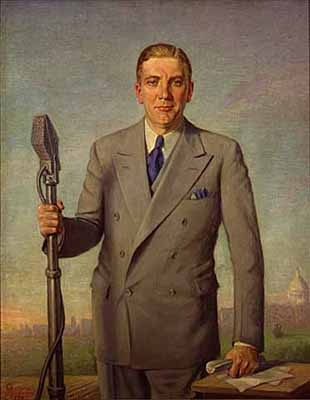
Painting of Governor Floyd B. Olson

Painting of Governor Floyd B. Olson

I’m not “IN” until a candidate rides a different horse into the starting gate. Until someone acts and sounds like Floyd B. Olson.

Click What would Floyd B. do? to find a candidate who puts them all the declared candidates to shame.

Floyd B. Olson was neither a Democrat nor a Republican. He was the first third party candidate elected Governor of Minnesota as the candidate of the progressive Farmer-Labor Party. Years later the Farmer-Labor Party joined with the Democratic Party to form the Democratic Farm-Labor Party (DFL).

I am not a liberal. I am what I want to be — a radical,” said Governor Olson to the 1934 Farmer-Labor party convention. A radical is not an ideologue. It’s a person who insists on going to the root of things. Olson was the nemesis of Wall Street, a champion of the people.

The Farmer-Labor party, a loose and, at times, tenuous coalition of farmers, workers, socialists, isolationists and progressives, coalesced around the idea that working together they would bring about a fairer distribution of income for themselves and increase social justice for the larger society. – Russell Fridley, Minnesota Law & Politics.

If and when someone like Floyd B. Olson rides a different horse into the starting gate for the 2016 White House horse race, I’ll be IN with both feet.  Until then, I’m not IN.

– Gordon C. Stewart, Chaska, MN, April 18, 2015.

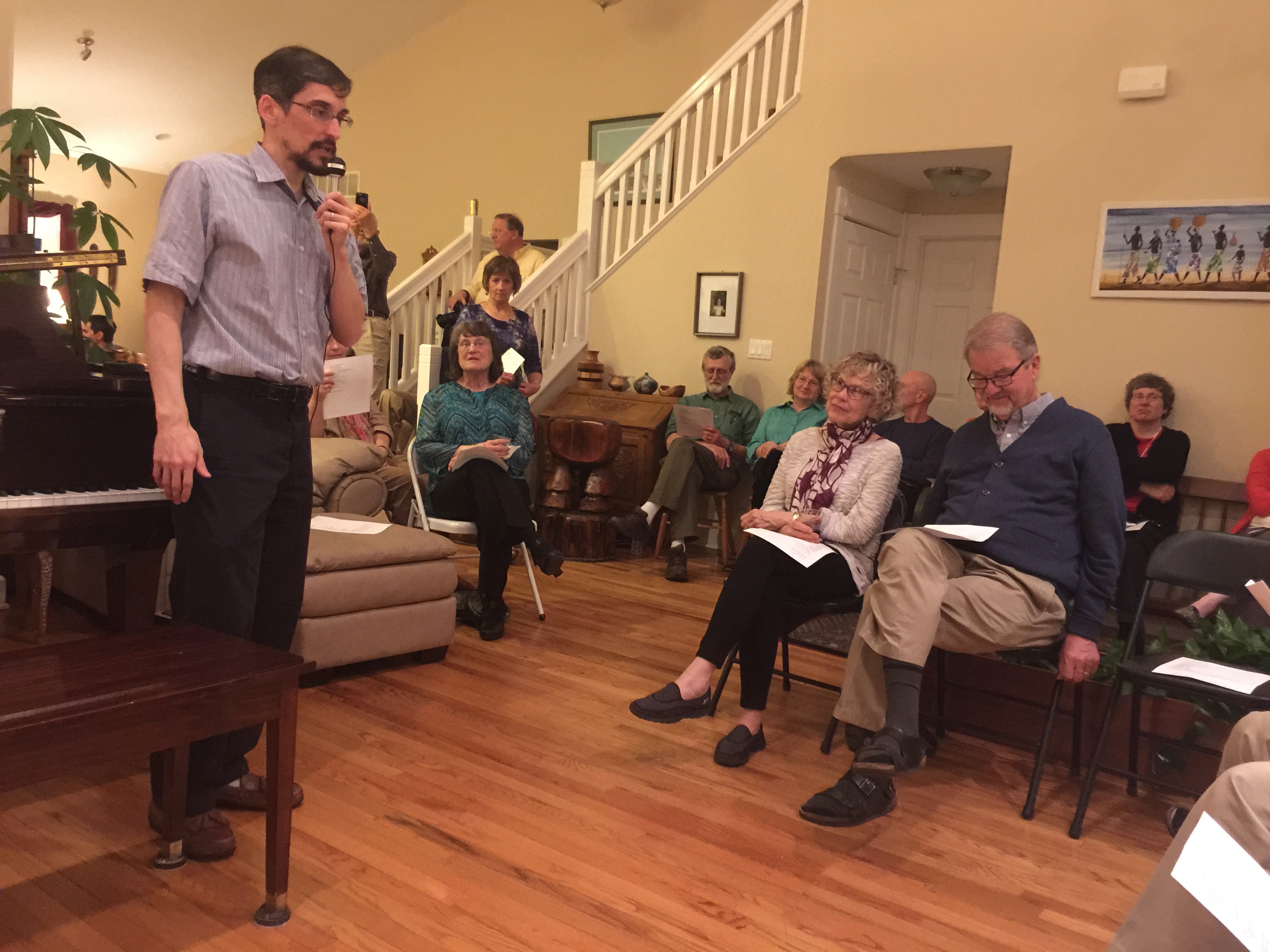
Verse – House Concert

House concert(April 17, Michael Hammer
piano)

so many keys played carefully
one at a time or recklessly
in clumps in chords in runs in scales
hands bouncing fingers waggling trills
yet knowing each composer’s need
for a performer’s sloth or speed
for piano or fortissimo
to Hammer or to gently go

– Steve Shoemaker, Urbana, IL, April 18, 2015