Soccer Puppy

After posting a heavy piece on the President’s speech on Syria, 15-week-old Barclay took me aside and suggested I lighten up. “Dad, you have to stop being so serious. Besides, Dad,” he said, “I like President Obama. I thought you did, too. You need to chill out. You need to watch Mom’s video from last night and show it to the world. You humans are just too mean. All this Syria stuff is just a big soccer game.”

“Okay,” I said, “I’ll put your video up on the blog to bring some laughter and lighten up the superior species. Good dog!”

The President and Kosuke Koyama

“Our ideals and principles, as well as our national security, are at stake in Syria, along with our leadership of a world where we seek to ensure that the worst weapons will never be used. America is not the world’s policeman. Terrible things happen across the globe, and it is beyond our means to right every wrong. But when, with modest effort and risk, we can stop children from being gassed to death and thereby make our own children safer over the long run, I believe we should act. That’s what makes America different. That’s what makes us exceptional.”

Conclusion of President Obama’s Sept. 10 national address on Syria.

Kosuke Koyama

Kosuke Koyama

By the end of his life in 2009, Kosuke Koyama had concluded that there is only one sin: exceptionalism.

I wish President Obama had been able to consult with Kosuke Koyama (1929 – 2009) before delivering this speech. He might have chosen his words more carefully. Koyama was a world-renowned Japanese Christian theologian and leader in inter-religious dialogue, author of Waterbuffalo Theology, Mount Fuji and Mount Sinai: a Critique of Idols, among other books.

Koyama first heard the claim of national exceptionalism in the Japan of his childhood. Japan was exceptional. The best. Number one. The Empire of the Rising Sun. The Emperor, supported by the religion of the imperial cult, could do no wrong. He was divine. So was Japan.

Dr. Koyama and his wife Lois moved to Minneapolis following his retirement. He shared with his friends his deep sadness that the old Japanese imperial claim had become the American claim.

America’s “leadership of a world where we seek to ensure that the worst weapons will never be used” is at stake.

Fact: the worse weapons ever used (nuclear and chemical) have already been used. We used them. We are the only nation on the planet to have dropped the atomic bomb. We dropped on Hiroshima and Nagasaki, Japan. We used chemical weapons in Vietnam. Agent Orange is a chemical weapon. Napalm is a chemical weapon.

America is not the world’s policeman. Terrible things happen across the globe, and it is beyond our means to right every wrong.

We have thought of ourselves as the world’s policeman and we still do. A policeman insures that the law of the land is enforced. The law that causes such resentment in the Middle East is the law of American exceptionalism and prerogatives. For the Arab world, this is what makes America different: the presumption of American exceptionalism expressed by re-arranging the economic-political-cultural landscape to advance Western interests, as in the case of Saudi Arabia, or by imposing and disposing, as in the CIA assassination of the legitimate President of Iran and the installation of the Shah, or our support for Saddam Hussein and Iraq in the Iraq-Iran War.

Very clearly, the U.S. has not sought to right every wrong. Nor should we. But our language is hollow at best and jingoistic at worst when one surveys the history of American intervention into the internal affairs of other sovereign states as the heir of British colonialism. The arrangements in the Middle East have their genesis in deals made by wealthy British and American elites with elite Arab Sheiks and strong men like Hosni Mubarak and Muammar Gaddafi until they no longer were useful.

“But when, with modest effort and risk, we can stop children from being gassed to death and thereby make our own children safer over the long run, I believe we should act.”

International scenes of human suffering and terror abound. In some cases we have chosen to act. In others, like Darfur, we chose not to act based largely on the principle of American self-interest. If American national interests were not threatened or affected, we did not act militarily. We acted humanely with humanitarian aid, but we did not act militarily to stop the horror of genocide in Darfur.

The principle of American national security and self-interest is clear in the President’s speech where he ties together the long-term safety of American children here at home with the short-term safety of children being gassed in Syria. That is, arguably, the way it should be. The use of chemical weapons and the threat of them in the hands of those who hate us is an ominous prospect.

Whether we should act is not, however, the question. The question is how America should act? Furthermore, how we decide to act should be informed and guided by the lessons of our own historic use of weapons of mass destruction and our own involvement in the supply of chemical weapons to Saddam Hussein, used in the Iraq-Iran War and allegedly used against his own people in Iraq.

It is an essentially moral position to condemn the use of weapons of mass destruction (chemical, nuclear, or biological. It is immoral to use them –an offense against humanity, and offense against all nature, and, for religious people, an offense against God.

Unfortunately there is not an equivalent of confession for nation states when they themselves have acted against their own declared moral principles. President Obama did not drop the bombs on Japan. Nor did he or his Administration supply the chemical weapons that did in Iraq what has happened to the mothers and children in Damascus. He might wish he could wash the blood from America’s hands or erase these chapters of American history, but he cannot. He cannot because the facts are facts, and the rest of the world remembers.

<

em>“That’s what makes America different. That’s what makes us exceptional.”

“There is only one sin,” said Kosuke Koyama,.“Exceptionalism.”

The myth of American exceptionalism dates back to a great hope as the new nation was about to be born. It was spoken in a sermon by Puritan John Winthrop on the Arbella sailing the high seas from the Old World of England to the New World of America. The biblical text of John Winthrop’s sermon was the Sermon on the Mount in the Gospel of Matthew applied to the adventure of establishing an exceptional nation, “the city set upon a hill” (Matthew 5:14) to give light to the world.

Although the word ‘exceptionalism’ is foreign to most Americans except those in academia or those who are especially attuned to American politics, it is the controlling myth of American life and the ground to which succeeding American Administrations and Congresses have turned to justify American ventures – economic, spiritual, political, cultural, and military.

In some way or another it falls to each Administration to uphold the myth, even and perhaps especially, when the myth appears to be false. The aspiration of a city set upon a hill was etched in mind of the Church, not a nation-state. It was and is a call to a different way, and its original spokesman saw that city quite differently from the American military-industrial-technological-corporate complex. This Jesus, a Jewish rabbi living under the Roman occupation of the First Century C.E., was not a warrior or a policeman. He saw to the heart of the human condition and the tragedy of high moral claims that justify all forms of violence.

“Why do you see the speck in your neighbor’s eye, but do not notice the log in your own eye? Or how can you say to your neighbor, ‘Let me take the speck out of your eye’, while the log is in your own eye? You hypocrite, first take the log out of your own eye, and then you will see clearly to take the speck out of your neighbor’s eye” (Gospel of Matthew 7:3-5, NRSV).

There is only one sin.

Koyama’s last work was Theology and Violence: Towards a Theology of Nonviolent Love, published in Japanese in 2009 in Tokyo. There is, as yet, no American translation.

Quaker Grit

Gravel and motorcycles don’t mix.
Even though the 73 year old Dean
(Emeritus) was only going 5 mph
on the last gravel mile to his
daughter’s lake house, when he looked
at the passing motorboat,
the big quiet bike slowly slid sideways
and down on his left leg.

A passing lake visitor helped lift
the bike off his bruised, he thought,
limb, and he limped the half-mile
to his daughter’s place carrying
his helmet–the same red as his bike.
After resting, she drove him back
to the unharmed motorcycle,
which he rode the 30 miles home.

He drove his pick-up truck to the
Walk-in Clinic to check the leg
that kept hurting as he walked.
After the X-Rays showed two
breaks, waiting for surgery,
his daughter said, “I’ll bet you
are smiling because your bike
wasn’t even scratched!”

– Steve Shoemaker, Urbana, IL, September 10, 2013

Chemical Weapons in Syria

Good news comes today of Russia using its influence on the Assad regime to turn over its store of chemical weapons to international oversight, control, and eventual destruction.

Meanwhile, this piece came to the attention of Views from the Edge from the Steering Committee of Veteran Intelligence Professionals for Sanity.

Click HERE for a story you won’t see in the corporate-owned media.

Tuesday Dialogue tomorrow: 3 Yrs after Deepwater Horizon

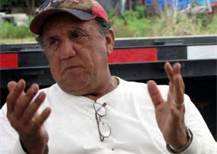
Chief Albert Naquin

Chief Albert Naquin

What’s happening on the coast of the Gulf of Mexico and the Delta three years after Deepwater Horizon and the BP settlement?

Join the Tuesday Dialogue tomorrow, September 10, at 7:00 p.m. at Shepherd of the Hill Presbyterian Church (145 Engler Blvd. in Chaska, MN) with guests from the Gulf coast of Louisiana.

Chief Albert “White Buffalo” Naquin is Chief of the Isle de Jean Charles Biloxi-Chitimacha-Choctaw, the indigenous subsistence community of a disappearing island. PBS, ABC News, New York Times, and other national and international media have featured the Chief while covering the story of Isle de Jean Charles.

The Rev. Dr. Kristina Peterson is Pastor of the Bayou Blue Presbyterian Church of Gray, LA and community disaster recovery professional who works also with Alaskan communities affected by Exxon-Valdez. Kris brings a wealth of experience that includes her research and organizing work with the University of New Orleans’ Center for Hazard Assessment, Response, and Technology, and her pastoral experience in three communities impacted by environmental disasters.

Chief Albert and Kris tell their stories of what’s happening three years after Deepwater Horizon.

Free and open to the general public.

The GPS

Lost in Chicago

Parking now is privatized,
on-street prices very high,
all hotels have also raised
valet costs in the same way:
everybody wants to make
as much money as they can
before bankruptcy will take
everybody down just like
Detroit.

Mile Magnificent is still
mostly white except for men
parking cars or begging on
sidewalk sides. Inside, women
wear their diamonds on pale hands–
colored hands wear vinyl, fill
buckets, pails, trash bags, and cans:
garbage left behind by all
the rich.

Foreigners drive taxis, make
more here than at home. Send back
salaries and tips to help
families survive. I stop,
lost on lower Wacker Drive,
lower Michigan, no help
here from GPS, “Now drive
east 500 feet and stop.”
(I’d be in the lake…)

– Steve Shoemaker, Urbana, IL, September 9, 2013

P.S. On Tuesday, October 1 Steve will bring his poetry to Tuesday Dialogues at Shepherd of the Hill Church in Chaska. Free and open to the public.

Sermon on the City of Violence and the City of God

Syria and the War on Terror

This morning an historian who reads Views from the Edge left this comment on yesterday’s post about Prevarication and Syria:

What happened to the “war on terror”? We are actually backing Al Qaeda in the Syrian civil war. The training we have given the anti-govt. Al Qaeda forces in Syria includes training in the use of chemical weapons. This civil war was induced by the US in order to create regime change in Syria in order to neutralize the rise of Iran & thus stabilize Israel’s future. By doing so we maintain Israel as a Western base for nuclear weapons that are able to threaten anyone that attempts to threaten the supply of Saudi oil to Europe. The fact that California Dem Diane Feinstein announced yesterday we would be making available new video showing gassed Syrian victims writhing in pain is so transparent it makes one want to vomit. Here we caused the death of 600,000 children in Saddam‘s Iraq with our trade embargo & backed Saddam’s use of gas against Iran in a war that killed a million or so. With calls against an attack running 90 to one the need for Feinstein’s video is a desperate attempt by the MIC to change US public opinion.

The bolding and italicizing are not original to the comment; they were added by Views from the Edge. Your thoughts, in support of the statement or contrary it, are welcomed here and will promote discussion.

Use the Comment mechanism to tell others what you think.

Prevarication: the U.S. and chemical weapons

“What we saw in Syria last week should shock the conscience of the world. It defies any code of morality. Let me be clear. The indiscriminate slaughter of civilians, the killing of women and children and innocent bystanders by chemical weapons is a moral obscenity. By any standard, it is inexcusable. And despite the excuses and equivocations that some have manufactured, it is undeniable.” – Secretary of State John Kerry, August 28, 2013

What happened in Syria is a “moral obscenity”, but there’s MUCH more to the story and it’s not the first moral obscenity. History is a stern teacher.

Question 1: Have chemical weapons ever been used by the United States of America?

Answer: Yes. The United States used Agent Orange and Napalm, burning the flesh off innocent civilians as well as soldiers of the Viet Cong, and destroying habitats in Vietnam and in Laos.

Question 2: Is the tragic use of chemical weapons in Syria unique or an historical watershed?

Answer: No. Click HERE for the history of U.S. Administration’s supply of Iraq in the Iran-Iraq War when Saddam was still a U.S. ally, and the number of times the U.S. has chosen to look the other way when chemical weapons have been used.

Compassion is in order. So is truth. Ignoring the history is a form of official prevarication. Prevarication is a gentle word for half a lie. We deserve better and so does the world.

Questions 3: Can assurance be given that there will no further military consequences to a narrow strategic strike?

Answer: How can any such assurance be given when there are at least two parties involved and likely more? Syria will not lie back without rocket strikes at U.S. warships, and then….. the game is on. Seems like moral obscenity, prevarication, and high risk no matter where one looks. Let those with clean hands cast the first missile… or work non-violently to stop the cycle of violence.

Sermon – The Divided House

A sermon at Shepherd of the Hill Presbyterian Church in Chaska, Minnesota. It could also be called “Take a Risk – Stand for Something!”