Wounded Pride

Just as the truth was dropped by a pigeon on Steve Shoemaker’s head during a moment of professional aspiration (see “SPLAT”, [published earlier today), it was spoken to me riding the bus after an interview that had gone badly. Steve was a candidate for a deanship. I was one of two finalist candidates for a presidency.

I had left the interview disappointed by my performance, increasingly concerned about the fit, and feeling that it wasn’t right (i.e. it wasn’t “a call”, as we say in the Reformed theological tradition.

With suitcase in hand I got on the bus for the airport and took a lonely seat to lick the raw wounds of damaged pride.

Several stops later a distinguished looking older gentleman dressed in a coat and tie sat down next to me.

“You here for business?” he asked.

“No,” I said, “just visiting.”

“Hmmm… I saw your suitcase. I was just wondering. Usually people dressed like you are corporate executives on a business trip, but they don’t usually ride the bus. What do you do? What’s your line of work?”

“Well…I’m a pastor.”

“Wonderful,” he said, “Where you from?”

“Cincinnati.”

“So what brings you to the great city of Chicago?”

“Well, I came for an interview for a college presidency, but it didn’t go well.”

There was a pregnant pause.

“Hmmm…,” said he, “There’s no higher calling than being a pastor. Why would a pastor want to be a president?”

“SPLAT !!!”

Why, indeed! “Pride goeth before destruction and a haughty spirit before a fall.” (Proverbs 16:18)

I flew home to my church strangely comforted by the stranger on the bus, freshly called again to be a pastor.

But vanity is a curious disease that’s hard to heal, as Helen Hunt Jackson knew when she wrote in Ramona (1884),

“Wounded vanity knows when it is mortally hurt; and limps off the field, piteous, all disguises thrown away. But pride carries its banner to the last; and fast as it is driven from one field unfurls it in another.”

Beyond Fundamentalism

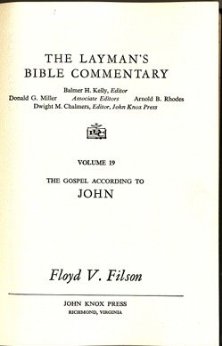
The influence of New Testament scholar Floyd Filson

The influence of New Testament scholar Floyd Filson

Conversion at Seminary”

Four years Wheaton College tried
to make a fundamentalist
Christianity the first
and last thought on my searching mind.
Then a liberal McCormick
Dean Filson took a chance on me–
I learned Bible truth could be
much wider, deeper, than mere fact:
changing this world was our call!
From civil rights to stopping war,
social justice cried for more
of faithful love, that holy force
learned by the Apostle Paul
when Jesus knocked him off his horse.

– Steve Shoemaker, Urbana, IL, May 25, 2013

Dean Floyd V. Filson was an internationally renowned New Testament scholar. A prolific writer, Filson published his own original New Testament commentaries and articles in scholarly journal, but he did not operate in a silo. He collaborated with co-authors and co-editors Oscar Cullman, G. Ernest Wright, and other world-class scholars. He also translated Rudolph Otto’s The Kingdom of God and the Son of Man, a book which, like Otto’s The Idea of the Holy represented a landmark shift in the understanding of God and of Jesus’s own consciousness. But more than a scholar, at least for the likes of Steve, was his unfailing kindness and belief in us. If he was aware of his stature in the world of academia, it was never apparent in the classroom or in his office. He was the definition of Christian humility. A ready smile, gentleness, respect for others, and a hearty “Good Morning!” were his signatures.

Monday six McCormick grads on whom Dean Filson took a chance will gather at the seminary for our annual Gathering. Steve and Don Dempsey were Class of ’68; Wayne Boulton, Harry Strong, Bob Young and I were the Class of ’67.

The Moment to Decide

Words are POWERFUL! They shape our most important decisions.

Language is the primary mechanism of mind control: truth becomes falsehood and falsehood becomes truth; beauty becomes ugliness and ugliness becomes beauty; goodness becomes evil and evil becomes goodness, twisted by the language of innuendo and word association.

American Crossroads’ campaign ad (see yesterday’s “Campaign Ads and the Snake”) is a case in point, an illustration of Timothy Egan’s New York Times piece,Deconstructing a Demagogue“:

Back in 1994, while plotting his takeover of the House, Gingrich circulated a memo on how to use words as a weapon.  It was called “Language: A Key Mechanism of Control.” Republicans were advised to use certain words in describing opponents — sick, pathetic, lie, decay, failure, destroy.  That was the year, of course, when Gingrich showed there was no floor to his descent into a dignity-free zone, equating Democratic Party values with the drowning of two young children by their mother, Susan Smith, in South Carolina.

Today, if you listen carefully to any Gingrich takedown, you’ll usually hear words from the control memo.

The cynicism that pervades the American electorate is due, in part, to this demagogic use of language. Words are precious things. Holy things. Sacred things. When they get twisted, they become vulgar and profane, one might even say ‘demonic’ in the sense in which philosophical theologian Paul Tillich defined ‘demonic’ as the twisting of the good.  (Paul Tillich, “Life and It’s Ambiguities,” Systematic Theology, Vol. 1, p. 102).

Paul Tillich was one of the first university professors dismissed from his teaching position during the Third Reich. At the invitation of Reinhold Niebuhr, he came to America where he taught at Union Theological Seminary in the City of New York, Harvard Divinity School, and the University of Chicago.

Tillich and his academic colleagues in theology, philosophy, and ethics (Willem Zuurdeeg, Martin Niemoller, Karl Barth, Dietrich Bonhoeffer, and Elie Wiesel) left us a rich legacy of careful analysis of the demagogic use of language.

Looking at America today, some observers argue that Hitler won his war after all. The Third Reich’s use of language and rhetoric is the substance of Language: a Key Mechanism of Control. The prescription that once led a nation regarded as “the most sophisticated culture” to swallow the toxin of twisted truth is with us still. The poison is peddled as cure and candy by candidates bought and sold by the private corporate powers whose Super PAC ads control our airwaves in America.

American Crossroads, led by the cunning of Karl Rove and the funding of the Koch Brothers and other wealthy Right Wing funders, is a Super PAC whose manual of operations is Gingrich’s memo, “Language: a Key Mechanism of [Social] Control,” renamed here as “Demonic Language: the Work of the Snake.” 

But the snake does not own the garden. Nor is it the author of language. Truth always has a way of peeking out from behind the bushes. And sometimes it cries out loud and clear, as it does from an old hymn I learned in childhood. It sings from the pews and in my heart in the hymn lyrics penned by James Russell Lowell I especially treasure in times when, watching a campaign ad, I need assurance that the snake has not won.

Once to every man and nation Comes the moment to decide, In the strife of truth with falsehood…. Though the cause of evil prosper, Yet t’is truth alone is strong; Though her portion be the scaffold, And upon the throne be wrong; Yet that scaffold sways the future, And, behind the dim unknown, Standeth God within the shadows, Keeping watch above His own.

– James Russell Lowell, 1845

Click to feel the power of the music on Preston Hawes’ violin. 

Alice in Wonderland – Did I Miss Something?

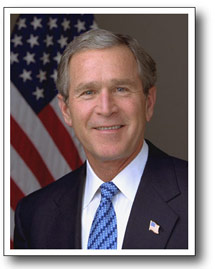
President George W. Bush

Official portrait from the George W. Bush Presidential Library

Sometime my stuff gets published. Other times it doesn’t.  This one was submitted to several major outlets eight months before the 2004 Presidential election that re-elected George W Bush. It never saw the light of day.

I wrote this following a Presidential Bush news conference. I was disturbed by the President. I was equally disturbed by the press. Here’s the piece as originally submitted…and rejected.  This morning, all these years later, the editor of “Views from the Edge” accepted the submission!


Did I miss something?  I watched the President’s news conference Tuesday night and scratched my head over the media coverage that followed it.  Time after time when asked to address reasons for concern about his truth-telling, the President of the United States sidestepped the question like a running back seeking to avoid the hit of a middle linebacker.

Question: “What about the pre-Iraq war claim that we needed to invade Iraq because we knew beyond any shadow of doubt that Iraq had weapons of mass destruction and that we knew where they were?”

Sidestep: Saddam Hussein was an evil man.  He was a threat and the people of Iraq and the world are safer because a brutal dictator is gone.

This question and response typified virtually every exchange between the questioner and the President.  It was as though one were speaking English and the other Greek, as though the one responding were deaf, or as though the President believed that if he just repeated his handler’s lines again, the American people would follow him.  Does the President believe that we’re willing to trust authority, exchanging truth for falsehood, for the sake of security?

If ever there were grounds for impeachment, surely it is this President’s use of disinformation to mislead Congress and the American people into a war and occupation that have alienated traditional allies and fanned the fires of hatred of the U.S. across the Arab and Muslim worlds.  In the name of a “war on terror” this President continually makes up reality to suit his mission: the export of Western democracy everywhere in the world, supposing that of course everyone would want what we have.

Did I miss something?  At virtually every turn of the press conference the President repeated answers to questions that were not being asked and refused to answer the question that was being asked.  Nowhere in the mainstream press or television media have I seen this most obvious disconnect addressed head on. They all back off, like bit players in a king’s court.

In a recent interview with Bill Moyers, Kevin Phillips, the conservative Republican critic of the Bush Presidency, author of The Bush Dynasty, spoke the truth about this President’s deception and the long-lasting devastating consequences of his policies.  Asked about John Kerry’s presidential candidacy, Mr. Phillips answered that it remained to be seen whether Kerry had enough fire in his belly to “go for the jugular.”

What will it take for us, the American people, to recognize that this President has taken us into an Alice-in-Wonderland world where up is down and earth is sky and falsehood is truth?  What will it take before all of us insist that the Mad Hatter not define our reality? Have we become so cynical about our democratically elected officials that we expect evasion from our questions?

Did I miss something?  Did not this President once again refuse to take any responsibility for peddling disinformation that has placed 135,000 American soldiers directly in “harm’s way” while putting all of us at home in the sights of growing numbers of people around the world who see the truth and hate us?

Impeachment will not happen, of course, because no one has the stomach for another partisan wrestling match, and because a Presidential election is only eight months away.  As the recent DFL ad here in Minnesota regarding sexual offenders reminds us, neither party is immune to demagoguery. But in the name of sanity, this President must be turned out of office and our political discussions must shift boldly to insist unfailingly that real questions receive real answers rather than shifty side-step speeches that only take us further down the rabbit hole of national illusion and implosion.

In the Strife of Truth with Falsehood

Get ready for the verbal assaults.The PAC ads. The disinformation and misinformation media campaigns funded by big money with big interests that know how powerful words are.

Words are POWERFUL! Sometimes those of us who stand in pulpits doubt that our words matter. But reading this paragraph in Timothy Egan’s NYT,Deconstructing a Demagogue,”reminds me of just how powerful words are:

Back in 1994, while plotting his takeover of the House, Gingrich circulated a memo on how to use words as a weapon. It was called “Language: A Key Mechanism of Control.” Republicans were advised to use certain words in describing opponents — sick, pathetic, lie, decay, failure, destroy. That was the year, of course, when Gingrich showed there was no floor to his descent into a dignity-free zone, equating Democratic Party values with the drowning of two young children by their mother, Susan Smith, in South Carolina.

Today, if you listen carefully to any Gingrich takedown, you’ll usually hear words from the control memo.

And that’s just the beginning of the story of how language is used and abused for purposes of social manipulation. Gingrich knew that language is “A Key Mechanism of Control.”  Those who are well-schooled in theology and politics know that language is the primary mechanism of mind control: truth becomes falsehood and falsehood becomes truth; beauty becomes ugliness and ugliness becomes beauty; goodness becomes evil and evil becomes goodness, twisted by the language of innuendo and word association.

The cynicism that pervades the American electorate is due, in part, to this demagogic use of language. Words are precious things. Holy things. Sacred things. When they get twisted, they become vulgar and profane, one might even say ‘demonic’ in the sense in which Paul Tillich defined ‘demonic’: the twisting of the good. “The claim of something finite to infinity or to divine greatness is the characteristic of the demonic” (Paul Tillich, “Life and It’s Ambiguities,” Systematic Theology, Vol. 1, p. 102).

Paul Tillich, “The Courage to Be”

Paul Tillich was one of the first university professors fired during the Third Reich in 1933. At the invitation of Reinhold Niebuhr, he came to America where he taught at Union Theological Seminary in the City of New York, Harvard Divinity School, and the University of Chicago. Tillich and his academic colleagues in theology, philosophy, and ethics (Willem Zuurdeeg, Martin Niemoller, Karl Barth, Dietrich Bonhoeffer, and Elie Wiesel) left us a rich legacy of linguistic analysis of the language of demagogic use of language.They speak with authority because they each paid a price for their opposition to it.

There are those who say that Hitler won his war after all. His ingenious use of language and rhetoric is the substance of Language: a Key Mechanism of Control. Newt Gingrich is not Adolf Hitler. And we are all well-advised to be very careful with contemporary references to him, the Third Reich, or the Holocaust. Yet the language that once led a nation regarded as “the most sophisticated culture” to swallow the toxin of twisted truth is with us still. The demonic poison how rules the day in America, peddled as cure and candy by candidates bought and sold by the private corporate powers whose PAC ads control the airwaves.

Words are sacred. And those who abuse them enter into the darkness of the demonic twistings that led James Russell Lowell to write the hymn lyrics I sang as a child:

Once to every man and nation Comes the moment to decide, In the strife of truth with falsehood…. Though the cause of evil prosper, Yet t’is truth alone is strong; Though her portion be the scaffold, And upon the throne be wrong;, Yet that scaffold sways the future, And, behind the dim

unknown, Standeth God within the shadows, Keeping watch above His own. – James Russell Lowell, 1945, “Once to Every Man and Nation”

The PAC ads are coming. Plug your ears…or…better yet, listen carefully, listen critically. Then speak out “in the strife of truth with falsehood.”

What do YOU think?

Sit and reflect awhile

Amish Rocking chair

This post requests YOUR views on a hot topic.

“The GOOD Society: Religion and Politics” drew a crowd last night in Chaska.  The panel was a Quaker, a Christian, and a Baha’i. Those who came were Jewish, Protestant, Catholic, Unitarian-Universalist, Lutheran, Disciples of Christ, agnostic, atheist searching together. Add your voice to the discussion.

QUESTIONS FOR YOUR COMMENT:

What is your vision of the GOOD society, the kind of world you believe in?  Here are several answers from last night to whet your appetite.

The kingdom of God realized (Jesus’ prayer, “Thy kingdom come on earth…as it is in heaven”).

What would that look like? What would be different if it was realized?

What are the qualities of that society? A ‘kingdom’ is a society.

The kin-dom of God, the idea of the kingdom without the ‘g’ – the society of universal kinship. “There is only nation: the human family.”

Agree or disagree and why?

The Unites States is a secular republic, not a religious republic. The founders were clear that America was not to be a theocracy. The “wall of separation” between church and state guarantees the free expression of religion.  It also protects the state (government) against any one religion being on the throne, as in Iran, and as had once been the case in the Massachusetts Bay Colony.

What is the role of religion in the shaping of public life and in politics? By “politics” we do not mean “dirty politics” or “partisan politics’; we mean politics as the work of the polis (the people) in determining the values and laws that hold a religiously free society together. For example:

The Minnesota referendum on Marriage illustrates the problem.

What is “marriage”? Who defines it? Is it a religious concept or a civil concept?

Should a constitution be amended to define marriage?

Should the “wall of separation” leave the definition of and celebration of                  “marriage” (however defined) to the church, synagogue, mosque, etc., and instead provide for “civil unions” (legal contracts between two people irrespective of gender)?

All of us have religious/humanist and political traditions that informs us. One of those for me is the “Principles of Church Order” adopted in 1789 at the founding of the Presbyterian Church in the United States meeting in Philadelphia.  The Rev. John Witherspoon, one of the  signers of the Declaration of Independence and President of Princeton University, was also a key player in the Principles of Church Order intended to guide the church’s internal life and its relation to “the civil power”. Three of the eight principles, it seems to me, inform the current discussion.

On Church and State:

“God alone is Lord of the conscience…. Therefore we consider the rights of private judgment, in all matters that respect religion, as universal and unalienable. We do not even wish to see any religious constitution aided by the civil power, further than may be necessary for protection and security, and at the same time, be equal and common to all others.

In short, we live in a secular democratic republic in which “the civil power” does not aid any religion, but protects the free exercise of all religions equally, without privileging one over another.

On the shared search for truth and goodness: That truth is in order to goodness; and the great touchstone of truth, its tendency to promote holiness, according to our Savior’s rule, ‘By their fruits ye shall know them.’ And that no opinion can either be more pernicious or more absurd than that which brings truth and falsehood upon a level, and represents it of no consequence what a person’s opinions are.  On the contrary, we are persuaded that there is an inseparable connection between faith and practice, truth and duty.  Otherwise, it would be of no consequence either to discover truth or to embrace it.

In short: ideas do matter. The search for what I’m calling “the good society” is based on a shared commitment to the search for truth, not just opinion. Some degree of objectivity or what philosopher Gabriel Marcell called “inter-subjectivity”, not just my own subjectivity. My opinion might be that the moon is made of green cheese or that Earth, not the sun, is the center of our solar system. Ideas and opinions have social consequences.  And in all things, the truth exists for the sake of “goodness” – human and environmental wellbeing.

On the exercise of mutual forbearance: That, while under the conviction of the above principle we think it necessary to make effective provision that all who are admitted as teachers be sound in the faith, we also believe that there are truths and forms with respect to which people of good character and principles may differ.  And in all these we think it the duty both of private Christians and societies to exercise mutual forbearance toward each other.

In summary:  In a secular democratic republic, 1) no religion gets to “capture the flag” of the United States of America.  We honor individual conscience as the corrective light that reforms the prevailing ideas of truth and goodness. 2) We seek truth rather than sinking into the swamp of “I’m sorry, that’s the way I feel, and it’s none of your business, and yours is none of mine.” The acceptance of pluralism is not surrender to the swamp of anarchy or the refusal to look at the evidence of science or to engage in the common search for solutions to social problems.  3) Where we differ and disagree, however intensely, we will exercise mutual respect and patience while we work it out together.

Enough for this morning.  Chime in. Let others know what you’re thinking.

Thanks for visiting.

Opening a Vein- a reflection on grief

Keep Me in the Light

Gordon C. Stewart  –  Tuesday, 15 March 2011 21:28
This piece grew out of the experience of grief – the loss of step-daughter Katherine following a four year courageous battle with cancer.   was down, way down. I had to preach the following Sunday. I had nothing to say…only a swamp of feelings. I had connected the grief over Katie’s death with the sense of homelessness I had walking the streets iof Minneapolis. I decided to sit down and write. 

What does a preacher or writer do when the well runs dry? For well over a month my well has been dry as a bone. I have nothing to say.

I watch the news. I listen. I am lonely and confused, like a street person hearing the garbled voices of the public address system blaring over the loudspeaker and the thunderous cheers and jeers from the sports stadium blocks away from where I live under the bridge.

When the well runs dry, you sit down at your typewriter “staring at a blank sheet of paper,” said journalist Gene Fowler, “until drops of blood form on your forehead.” Fowler, like famed sportswriter Red Smith, knew that “There’s nothing to writing. All you do is sit down at a typewriter and open a vein.”

Opening a vein is hard when what’s in the vein is grief. It’s even harder when you’re alone and silent on the street, bombarded by all the noise from the stadium.
Only as I begin to write again do I realize the grief. I don’t recognize the world in which I live. I live under the bridge with a cheap bottle of wine. I hear the shouts from the stadium and recognize the passion in their voices, like fans from Green Bay and Minnesota rooting for the Packers and the Vikings: loud cheers and boos from the spectators, shouting the old platitudes, participating vicariously in what’s really happening between the two professional teams down on the playing field.
I don’t know this world. All the rules that favor the middle class and the poor are up for grabs. I’m not sure I want to learn this new game.

I am a man of faith informed by the Hebrew prophets, Jesus of Nazareth and the faith and labor movements of the 20th century that ended child labor; stopped employers from working their employees 12 hours a day, seven days a week; closed the sweat shops that were taking advantage of immigrants from Italy, Poland and Ireland; bridled the horses of runaway greed—the banks, the robber barons and corporations— that profiteered at public expense; won the right of collective bargaining; demanded basic financial security for retirees (Social Security); established a woman’s right to vote; enacted the Civil Rights Act; ended the war in Vietnam; and called for ecological sense, the protection of our natural habitat, the air and the water on which life on the planet depends. I grieve that Jesus’ and the prophets’ vision of turning the upside down world right-side up is gasping for air.

Like Gene Flower, the journalist who described writing with drops of blood forming on his forehead, I’m losing it the way he did when a stranger who claimed to be a healer suddenly appeared at the hospital room of his dear friend John Barrymore. “Just give me three minutes with Mr. Barrymore,” said the charlatan, and I will cure him!” Fowler grabbed him by the collar and threw him down the stairs, calling after him, “Physician, heal thyself!”

I want to throw the impostor healers who have suddenly appeared outside the national hospital room down the stairs, which is not a good thing for one who claims to follow Jesus and the prophets. I’m mildly comforted that Jesus lost it when he threw over the money-changing tables of the financial establishment of his time. But then, I’m not Jesus.

Opening a vein may not change the world. I’m still walking the street three blocks from the stadium. But as I think about where I come from and wipe the beads of blood that are forming on my forehead, a hymn that was ripped from the Presbyterian hymnal rises from deep wells of childhood memory:

God of the prophets, bless the prophets’ heirs; Elijah’s mantle o’er Elisha cast; Each age its solemn task may claim but once; Make each one nobler, stronger, than the last.
Anoint them prophets! Make their ears attent To Thy divinest speech; their hearts awake To human need; their lips make eloquent To gird the right and every evil break. I am strangely consoled.

The vision and the call are still alive and well in my soul. I pass the homeless shelter near the bridge and hear the faint sound of other street people singing another old familiar hymn.

Be Thou my vision, O Lord of my heart; Naught be all else to me, save that Thou art – Thou my best thought, by day or by night, Waking or sleeping, Thy presence my light.

I’m bleeding. But warm blood is a sign of life. Lord, keep me in the light.

The American Oligarchy

By the Rev. Gordon C. Stewart | Thursday, April 29, 2010

We do not live in a democracy; we live in an oligarchy, “government by the few, especially despotic power exercised by a small and privileged group for corrupt or selfish purposes” (Encyclopaedia Britannica). I’ve been waiting for people in high places to say it.

Goldman Sachs executives’ testimony Tuesday before the Senate Permanent Subcommittee on Investigations brought the elephant into the living room, but the name of this species of government remains unspoken for understandable reasons.
A democratic republic is a constitutional form of government where the people rule through their elected representatives gathered in deliberative bodies. The faces and voices of Goldman Sachs’ executives demonstrated the intransigent arrogance of the private institutional concentration of wealth and power of deregulated capitalism.