Sermon at Shepherd of the Hill Presbyterian Church in Chaska, MN, Sunday of the Transfiguration, March 4, 2014.

Sermon at Shepherd of the Hill Presbyterian Church in Chaska, MN, Sunday of the Transfiguration, March 4, 2014.

Kosuke Koyama – RIP
Texts: Ps. 139: 7-10; Luke 14: 1-6
Dear Sisters and Brothers in Jesus Christ,
The text from the Book of Leviticus:
When an alien resides with you in your land, you shall not oppress the alien. The alien who resides with you shall be to you as the citizen among you; you shall love the alien as yourself, for you were aliens in the land of Egypt: I am the Lord your God.
This is a challenging suggestion for the immigration and naturalization policy of any nation. God does not discriminate between citizens and aliens. The God of the Bible is more concerned about the welfare of the aliens, the weak, than of citizens, the strong. Remember your own experience in Egypt! “Love the alien as yourself!” Jesus is even more emphatic when he says, “Love your enemies!” We think of aliens and enemies as potential threats to our community. They must be kept outside of our boundaries.
“Something there is that doesn’t love a wall,” observes the New England poet, with sharp insight. Something there is in the gospel of Christ that dismantles walls. Jesus “has broken down the dividing walls,” we read in the Epistle to the Ephesians. (2:14)
+++
“In the beginning was the Word” (John 1:1) – This Word, the truthful Word, “breaks down the dividing walls” by making honest dialogue possible. When communication breaks down peace breaks down. It takes a great deal of dialogue to come to mutual understanding between peoples of different language, religions, racial and cultural practice. Often the choice is between dialogue and mutual destruction, between diplomacy and war. The alternative to dialogue is taking the sword. Jesus says; “all who take the sword will perish by the sword” (Mt.26:52). Our “sword” today is incredibly destructive! Our fear, today, is of nuclear proliferation. We fear it because we started it! “Choose life so that you and your descendants may live”! (Dt.30:19)
+++
The brief gospel text for this morning is a record of a profound dialogue. The story is honest and transparent. We can understand it very well. The dumfounded lawyers and Pharisees only reveal the sincere quality of the story. In conversation with Jesus, the man of total honesty, human hypocrisy is exposed and expelled.
On one occasion when Jesus was going to the house of a leader of the Pharisees to eat a meal on the Sabbath, they were watching him closely. Just then, in front of him, there was a man who had dropsy. And Jesus asked the lawyers and Pharisees, “Is it lawful to cure people on the sabbath, or not?” but they were silent. So Jesus took him and healed him, and sent him away. Then he said to them, “If one of you has a child or an ox that has fallen into a well, will you not immediately pull it out on a Sabbath day?” And they could not reply to this (Luke 14:1-6).
How boldly Jesus simplifies and zeroes-in on the central issue! “Is it lawful to cure people on the Sabbath, or not?” This is the question that distinguishes the gospel from religion. This story is only one of a number of “Sabbath controversies” told in the gospels. The gospel breaks boundaries. Religion often insists on boundaries. The gospel opens windows in hope. Religion may shut windows in fear. The gospel is “scandalously” inclusive. Religion often is piously exclusive. “You shall love the alien as yourself” expresses the spirit of the gospel. Religion tends to question whether everyone deserves to be loved.
The Sabbath is a holy institution commemorating the holy rest God has taken after creating “heaven and earth.” Sabbath is mentioned as one of the Ten Commandments:
“Remember the sabbath day, and keep it holy. Six days you shall labor and do all your work. But the seventh day is a Sabbath to the Lord your God; you shall not do any work – you, your son or your daughter, your male or female slave, your livestock, or the alien resident in your towns. For in six days the Lord made heaven and earth, the sea, all that is in them, but rested the seventh day; therefore the Lord blessed the Sabbath day and consecrated it” (Ex.20: 8-11).
“On another Sabbath he entered the synagogue and taught, and there was a man there whose right hand was withered” (Lk. 6:6) “Now he was teaching in one of the synagogues on the Sabbath. And just then there appeared a woman with a spirit that had crippled her for eighteen years. She was bent over and was quite unable to stand up straight” (13:10,11).
“On one occasion when Jesus was going to the house of a leader of the Pharisees to eat a meal on the Sabbath, … Just then, in front of him, there was a man who had dropsy” (the disease of the swelling from abnormal fluid retention ). A man of withered hand, a woman who is bent over, and a man with dropsy appear “on the Sabbath in front of him.”
Jesus cures them. Jesus “works” on the Sabbath! Some for whom it is important to “keep” the sabbath complain, “There are six days on which work ought to be done; come on those days and be cured, and not on the sabbath day”(Lk.13:14). Jesus, for whom the persons with need are more important than the rule, responds, “If one of you has a child or an ox that has fallen into a well, will you not immediately pull it out on a Sabbath day?”
Jesus comes to heal the broken human community. He is the embodiment of direct love-action and action-love. He cures sick people publicly on the Sabbath with unassailable authority and freedom. The people are amazed – ecstatic – and praise God. Representing the God of compassion, Jesus breaks the boundary attached to the sacred Sabbath tradition. In his “boundary breaking” he restores the authentic purpose of the sabbath – that is, to bring health to human community. The Sabbath is for healing. “The Sabbath was made for humankind, and not humankind for the Sabbath,” says Jesus (Mk.2:27). What a freedom he exhibits!
+++
The gospel of Jesus Christ is “scandalous” says the apostle Paul in his letter to the Corinthians (1 Cor. 1: 18-25) for he is “the man who fits no formula” (Eduard Schweizer, (Jesus, chap. 2). Creeds, doctrine, theology, or tradition cannot domesticate Jesus. No one can confine Jesus within walls. Let me quote from a Swiss New Testament scholar:
“…teaching in itself does not convey the living God. It may even hinder his coming, though it (the teaching) may be totally correct. It is exactly the most correct and orthodox teaching that would suggest that we had got hold of God. Then he can no longer come in his surprising ways” (Eduard Schweizer, Luke: A Challenge to Present Theology p.58)
We feel uneasy when Jesus breaks the boundaries we make, because boundaries are a part of our accepted culture. “Good fences make good neighbors.” Yet, fences can never be the final word. Tragically in our real lives fences work more in the direction of mutual alienation than mutual embrace. “Before I build a wall I’d ask to know what I was walling in or walling out” – says the poet. That is a good question!
When I was in my early teens, Japan followed her gods who were rather poorly educated in international relations. They were parochial. They spoke only Japanese. They did not criticize Japanese militarism. They endorsed the inflated idea that Japan is a righteous empire. Trusting these parochial gods, the people recited, to paraphrase: “If I take the wings of the morning and settle at the farthest limits of the sea, behold the glory of the divine emperor of Japan is there!” Japan broke international boundaries in pursuit of self-glorification and aggrandizement. Without any threat from her Asian neighbors, Japan attacked and invaded them. The Japanese gods approved and Japan ruined herself. Blessed are nations that have a God who criticize what they do! The God of Israel said to God’s own people: “You are a stiff-necked people!”
+++
The infant Jesus “was placed in a manger – “for there was no place for them in the inn.” (Luke 2:7) Being thus edged out even from a human birth place, Jesus breaks a boundary. When he “eats with sinners and tax collectors” (Mk.2:16) he breaks a boundary. Crucified, nailed to the cross, – completely immobilized – he breaks a boundary. Dying between two criminals, becoming a member of this community of three crosses, he breaks a boundary. Being “numbered with the transgressors”, to quote from the Book of Isaiah (53:12), he breaks boundaries. This is an amazing story. The one who is totally vulnerable, disarmed, non-violent, and immobilized and humiliated has broken all the boundaries, which threaten the health of human community.
With our geopolitical realities, we may think that the way of Christ is romantic and not realistic. Then we must know that the alternative is the historical fact of 5000 years of human civilization replete with constant warfare. Should we continue this state of endless destruction for another 5000 years? Gandhi’s practice of non-violence has done more to increase the welfare of humanity upon the earth than many wars put together. Martin Luther King Jr. says: “Far from being the pious injunction of a Utopian dreamer, the command to love one’s enemy is an absolute necessity for our survival”! (Strength to Love, p.47) “For God’s foolishness is wiser than human wisdom, and God‘s weakness is stronger than human strength” cries the apostle Paul (1 Cor.1:25).
+++
“Look at the birds of the air,” Jesus says. “They neither sow nor reap nor gather into barns, and yet your heavenly Father feeds them. Are you not of more value than they?” (Matt. 6:26). The birds of the air and the Father who feeds them are free from all boundaries. Climate change – global warming – has no boundaries. The light of the sun and the air that sustain all living beings know no boundaries. The Berlin Wall of 96 miles was there for 28 years up to 1989. The racial wall of the South African Apartheid existed for 46 years and ended in 1994. In their limited existence, these walls have done immeasurable damage to humanity on the both sides of the wall. The Orthodox Church of the East and the Catholic Church of the West did not speak to each other for 911 years from 1054 to 1965. The Great Wall of China and Check Point Charlie in Berlin are tourist spots today. “One cannot dehumanize others without dehumanizing oneself” says James Baldwin. “Forgive us our debts as we forgive our debtors,” we pray. It is this prayer that breaks the boundaries in a way that is pleasing to God.
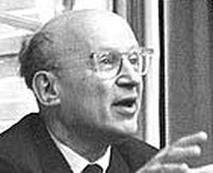
The Rev. Dr. Paul Louis Lehmann
Pondering his statement over the years led to an alteration of Dr. Lehmann’s statement to the effect that it is as though God ties the right hand (the hand of power) behind God’s own back and invites us to do the same. The left hand, the non-dominant hand, the hand of weakness, you might say, is the way the world enters into its own salvation from its own tyranny.
The previous week’s sermon at Shepherd of the Hill had addressed the question “What must I do to be saved?” with “You already are! God is not wrathful. God is loving. Now start to live into that gift. Stop living so anxiously. Live more joyfully. Take more risks….”
“Costly Grace” is a follow-up anchored in a clear, though impossible, ethic where Jesus instructs his disciples on how to live as children of God.
“Love your enemies and pray for those who persecute you, so that you may be children of your Father in heaven, for he makes his sun rise on the evil and on the good, and sends rain on the just and on the unjust…. You, therefore, must be perfect, as your heavenly Father is perfect.” (Sermon on the Mount, Gospel of Matthew 5:44-48.)
A sermon at the Olivet Congregational Church in Saint Paul, Minnesota, March, 2003.
Texts: Exodus 20:1-17; Psalm 19; I Corinthians 1:18-25; John 2:13-22
“For God’s foolishness is wiser than human wisdom, and the weakness of God is stronger than human strength.” “God chose what is foolish in the world to shame the wise, God chose what is weak in the world to shame the strong. God chose what is low and despised in the world, things that are not, to reduce to nothing the things that are, so that no one might boast in the presence of God.”
Author Frederick Buechner reminds us that as the curtain falls on the final tragic scene of Shakespeare’s King Lear, the final words are uttered: “The weight of this sad time we must obey, Speak what we feel, not what we ought to say.”
We cannot help but speak what we feel and if what I say this morning misses the mark of preaching the gospel, perhaps by God’s grace you will hear nonetheless a Word for your life and the world’s. For the Spirit takes our words and uses them in the hearing of the listener at least as much as in the speaking of the speaker.
I speak to you this morning – in the weight of this sad time of war – as a child of wartime. I was born 1942. When I was a year old my father enlisted as an Army chaplain. When I was one-and-a-half I waved goodbye from a dock in Los Angeles as the tears streamed down my mother’s face. Although too young to understand the reason for the tears, I was not too young to inhabit the sorrow, the dread and the grief. I grew up with air raid sirens ringing in my ears. Several years after my father returned safely from the South Pacific – from Guam, Saipan, and Tinian, the island from which the “Enola Gay” made its run at Hiroshima – the sound of the fire siren would wake me with the horror of impending death.
Though the bombs never fell near my house or on my city, I grew up as a child of Baghdad, and I will be forevermore.
And so these days I awaken very early. I can’t sleep. I get up, make the coffee, turn on the reading lamp in the living room and read to still the storm. In the dark of night I feel like Alice in Wonderland. I plummet down one rabbit hole after another, trying to get my bearings in a world that seems to have lost its sanity – no north or south, no east or west, only a whirring gyroscope of confusion and nonsense. I feel sick over the bombs, sick over the lies and disinformation. Sick with a sense of impending doom.
But I also know that the Christian should not be surprised by this. “For the word of the cross is folly to those who are perishing, but to us who are being saved it is the power of God. For it is written,
‘I will destroy the wisdom of the wise,
and the cleverness of the clever I will thwart.’”
The cross of Jesus refutes all human wisdom that confuses might with right. The cross – the Roman means of State execution, the first century equivalent of an electric chair – stands empty. In the light of Easter, the might of the mighty is powerless. The cleverness of the clever is thwarted. The wisdom of the wise is destroyed. The cross exposes the vanity of power. It judges every act of ethnic cleansing, every assassination, every torture, every death committed in the name of national security. It exposes the untruth of every clever piece of propaganda and disinformation that twists the truth to shiver our knees in fear. The cross of Jesus exposes the foolishness of the wise, the powerlessness of the powerful, the folly of the clever.
As I sit in the pre-dawn darkness with my morning paper and a cup of coffee, the dawn slowly lights the horizon ‘til the sun lights the eastern sky and floods the porch with morning light. With the rising of the sun on the far horizon there rises within me the psalmist’s psalm of joyful praise, an awareness of a larger providence:
The heavens are telling the glory of God;
and the firmament proclaims his handiwork…
In them he has set a tent for the sun,
which comes forth like a bridegroom leaving his chamber,
and like a strong man runs its course with joy.
Its rising is from the end of the heavens, and its circuit
to the end of them. (Ps. 19:1-1,4b-5)
I am suddenly keenly aware that the sun rises on my neighbor, as well as on me, and that it rises every morning on Iraq and North Korea, on Afghanistan and China, on Venezuela and Timbuktu…without discrimination. It rises on Muslims and Christians and Jews, on Sikhs and Buddhists, on atheists and agnostics, capitalists, communists and anarchists. “The foolishness of God” – this expansive, inclusive providence and generosity of God – is wiser than human wisdom.” It is in that spirit that our Lord said to all would-be disciples:
“You have heard that it was said, ‘You shall love your neighbor and hate your enemy.’ But I say to you, ‘Love your enemies and pray for those who persecute you, so that you may be children of your Father who is in heaven; for he makes his sun to rise on the evil and on the good, and sends rain on the just and on the unjust. If you love those who love you, what reward have you? Do not even the tax collectors do the same? And if you greet only your neighbors, what more are you doing than others? Do not even the Gentiles do the same? You, therefore, must be perfect, as your heavenly Father is perfect.” (Mt. 5:43-48)
God’s care is like that. To be perfected in God’s image is to love like that – ubiquitously! If it were up to us, there would be sunshine fences everywhere. “Send a little sun over here, God, and ominous clouds over there! Send a few spring showers over here, God, and torrents of rain over there! A little warmth over here, a blizzard over there.” God’s providence does not create sunshine fences. God plays no favorites. There is no such division in God’s care.
So, when Paul writes to the Corinthians about the divine folly being wiser than human wisdom – when he says that “to those who are being saved (notice that Paul does not say “To those who are saved, but to those who are being saved”), “it (the cross) is the power of God” – it cannot be a division between the saved and the damned. No war of the children of light against the children of darkness. No sunshine fences. All such constructs are of human origin. Salvation (healing) is a work in progress. And it’s a work of God, not us. It’s not a done deal. It’s a daily process of transformation day-by-day, hour-by-hour, minute-by-minute. There can be no boasting except to boast of the man on the cross, no definition of human perfection other than this extravagant love of God.
Several years ago I was blessed by the friendship of Japanese theologian Kosuke Koyama, former John D. Rockefeller Professor of Ecumenical Theology at Union Theology Seminary in the City of New York, who now lives here in the Twin Cities with his American wife, Lois.
Dr. Koyama vividly remembers being baptized as a teenager. He was baptized during the bombing of Tokyo. As the bombs rained down on his city, Kosuke’s pastor told him that those who are baptized in Christ must love their enemies. “Kosuke, you are a disciple of Jesus Christ. You must love your enemies. Even the Americans.” The planes that were bombing Kosuke’s city were sent off from my father’s airstrips!
Dr. Koyama recalls being startled by the God of the Bible, as he read the Book of Isaiah. What struck him was that the God of the Bible stands not only for but also against his own people. God takes the people to task. The God of Isaiah, Amos and Jeremiah is saddened and offended by their behavior. In stark contrast, says Koyama, the Japanese god – the god of the emperor and the imperial cult, never criticized the emperor or the people. “You want to invade Manchuria? Sure. Go ahead. Good boy, good boy. Japanese. Good boy! You want to bomb Pearl Harbor? Go ahead. Good boy, good boy! Japanese. Good boy!”
At that early age, Kosuke Koyama decided that he would never again follow a god that spoke only one language. And that he would never again worship an uneducated god. The God of the Bible, he says, speaks more than one language. The God of the universe speaks many languages. The God of the Bible is a spacious God. Not the god of an imperial cult. The God of the Bible is an educated God. Not the god of the nation.
__________________
In the early morning hours, even as my soul rises in praise of the sun’s rising, I feel sad and just a bit angry. I can feel something of that tremendous feeling of loneliness and anger that Jesus must have felt as he watched the commerce of the temple and sat there in silence, braiding a whip out of the chords they had used to tie the animals. I can see him and hear him cracking his whip to chase out the traders and the money-changers: “You shall not make of my Father’s house a house of trade!”
There is a place in the Christian faith for indignation. There is a place for anger when wrong is done, when falsehood parades as truth, when arrogance takes the place of diplomacy, when religion blesses bombs. And for the sake of the nation, if not for ourselves, we need to recover our ability to feel things deeply. All around us and within us there is fear and acquiescence. Only the power of God’s kingdom can revive in us the capacity for outrage when children anywhere shiver in fear in air raid shelters.
Terrorism is a real threat. But the greater threat to America is that we will lose our capacity to mourn unnecessary death, that we will lose our capacity for anger when a child dies or is psychologically damaged by American bullets and bombs, that we will lose our souls by placing them on the altar of what President Eisenhower chillingly described as a military-industrial complex which, one day, would be out of control, turned loose to do its job.
And when Jesus had driven out those who sold and those who bought, he taught them, and said to them, “Is it not written, ‘My house shall be called a house of prayer for all nations’? But you have made it a den of robbers. And the chief priests and the scribes heard it and sought a way to destroy him, for they feared him.” (Mk. 17-18b)
And so Paul writes that “the word of the cross is folly to those who are perishing, but to us who are being saved it is the power of God. For it is written,
‘I will destroy the wisdom of the wise,
And the cleverness of the clever I will thwart.’”
Why is the word of the cross the power of God?
Bishop Desmond Tutu tells the story of a visit to Rwanda after the genocide of 1994. In his book No Future Without Forgiveness, Bishop Tutu tells of visiting a church in the capitol of Rwanda where Tutsis had been mowed down and where the bodies continued to lie as they had fallen the year before during the massacre. He describes the church as a disturbing monument to the viciousness of which we as human beings are capable.
“Those who had turned against each other in this gory fashion had often lived amicably in the same villages and spoken the same language. They had frequently intermarried and most of them had espoused the same faith – most were Christians. The colonial overlords had sought to maintain their European hegemony by favoring the main ethnic group, the Tutsis, over the other, the Hutu, thus planting the seeds of what would in the end be one of the bloodiest episodes in modern African history.”
Asked to preach at the main stadium in Kigali, the capitol, the Bishop said that the history of Rwanda “was typical of a history of ‘top dog’ and ‘underdog’. The top dog wanted to cling to its privileged position and the underdog strove to topple the top dog. When that happened, the new top dog engaged in an orgy of retribution to pay back the new underdog for all the pain and suffering it had inflicted when it was top dog.
He said that the extremists among the Hutus had proven that they were quite capable of waiting thirty years for the day when they could exact revenge, and that the same could be expected of the Tutsis – unless the cycle of reprisal and counter-reprisal was broken. He told the crowd that “the only way to do this was to go beyond retributive justice to restorative justice, to move on to forgiveness, because without it there was no future.”
Human wisdom is “top dog” wisdom. Divine wisdom is the wisdom of the cross. Human wisdom is cyclical and vicious. Divine wisdom is a breakthrough – from cross to empty tomb.
Why is the word of the cross the power of God?
At the center of our crucifying behavior is fear. “The chief priests and the scribes sought a way to destroy him, because they feared him.” So do we. For the sake of this fear, we have been given a spirit of courage and boldness. We “did not receive a spirit of slavery to fall back into fear, but … have received the spirit of adoption. When we cry, ‘Abba! Father!’ it is that very Spirit bearing witness with our spirit that we are children of God, and if children, then heirs, heirs of God and joint heirs with Christ, if, in fact, we suffer with him in order that we may also be glorified with him” (Rom. 8:15-17).
A client in deep distress, grief and sorrow, after struggling alone in anonymity with what Chaim Potok has called “the four-o’clock-in- the-morning-questions” and battening down the hatches of his psyche finally goes to a therapist for help. When he arrives, the therapist asks how it feels to be there. “Good,” says the man. “Good. If feels good to be in a safe place.” To his surprise, the therapist asks, “What makes you think this is a safe place? This isn’t a safe place. This is a very dangerous place! You didn’t come looking for safety. The only really safe place is six feet under. You didn’t come looking for safety. You came here looking for life.”
Isn’t it the same with you? We come here looking for life, not safety, not death. We come looking for wisdom, not folly. For straight talk, not double-talk. We come listening for the genuine good news of the gospel. We come because we’re tired of falling down rabbit holes. We come for truth and straight talk about a gospel that lays bare every lie and every pretense, every fleeting power – a gospel that lays us bare before God.
In our nakedness, standing before the Mercy Seat of God’s judgment, exposed in our vain substitute of safety for life, may the Spirit that cries out with our spirits for life in its fullness silence every voice but its own, free us from fear and from the tyranny of security, and grant us to enter boldly through the foolishness of the cross to the fullness and joy of life itself.
And let us remember that this world is no cheap five and dime house of trade in which life is bought and sold for nickels and dimes. This world is the House of our Father who is in Heaven! And now to the One who is able to keep us from falling, to the only wise God our Savior, be glory and majesty, dominion and power, now and forever. Amen.
by Gordon C. Stewart (copyright)
Was Jesus of Nazareth guilty as charged?
The charge against Jesus of Nazareth was that he “refused to pay tribute to Caesar” and that “he stirred up the people.” One translation called him a “seditionist” or, in a congressman’s language, a subversive, an enemy of the state. The late lay theologian and lawyer William Stringfellow argued that Jesus was a revolutionary. Not a rhetorical revolutionary, but one whose very existence threatened his world in a revolutionary way.
Years of pouring over the Gospel texts and the Dead Sea Scrolls for clues as to the nature of the time of Jesus of Nazareth have not quite brought me to the stark nakedness of Bishop James Pike, but I’m close.
The Bishop was in Washington, D.C. for a meeting of some sort. His friend Anthony Towne went to his hotel room to take him to breakfast. When Anthony knocked on the door, the Bishop shouted out, “Come on in, Tony, the door’s open.” He opened the door to find the Bishop sitting in an arm chair, Dead Sea Scroll manuscripts scattered around the floor surrounding the chair, sitting there in the altogether. The Bishop was so entranced with the Scrolls and the Scriptures that he had forgotten to dress; he was unaware of his nakedness. Bishop Pike later died alone in the Judean wilderness searching for the historical Jesus.
I’m not as obsessed with the question as James Pike was, but I am nonetheless intrigued, fascinated, confused, and excited by Jesus of Nazareth and the New Testament witness to him precisely because of the new information that invites us to ask again who Jesus was.
Christians often see the cross as something that God intended for Jesus as the Son of God, as if God sent his son into the world that we might kill him and that Jesus was surely innocent of the charges brought before Pilate. Rarely do we consider the possibility that Jesus was guilty as charged. Likewise, what we in the church call Palm Sunday/Passion Sunday is often observed in a way that paints Jesus as the non-political spiritual man whose kingdom is not of this world, contrary to the people on the street who mistakenly hailed him as the warrior king whose aim was to throw Rome out of Palestine.
Palm Sunday provides a window into the question of whether Jesus was guilty as charged. Go beneath all theological assumptions to step onto the road with the people who waved the branches and ask what they were doing there and why Jesus did what he did. But before we look at the parade into Jerusalem we remember that the death we observe on “Good Friday” was a political execution, the Roman equivalent of the electric chair, the firing squad, and the gas chamber. The charges against him at the trial are clearly political. “We found this man inciting our people to revolt, opposing payment of the tribute to Caesar, and claiming to be Christ, a King” (Luke 23:2, Jerusalem Bible). Jesus was executed as a revolutionary against the Roman Empire.
Behind the New Testament texts lie the familiar strains of the older texts from Zachariah and II Maccabees.
The background of Palm Sunday in the Book of Zachariah
One of the first things to notice about the Palm Sunday episode, the “triumphal entry” into Jerusalem, is that the demonstration is not spontaneous. “The master has need of it” – the words the disciples have been instructed to speak to a man in town who owns a donkey – is code language, arranged in advance. Furthermore, Christ rides on the donkey, not a horse. Traditionally this has been taken to mean that he refuses the title of king and prefers to come instead in humility, riding on a donkey. But look more closely at the setting for the donkey passage in the literature of Zachariah and you will find an oracle against a foreign occupier. It is in the context of his oracle against oppression that Jesus chooses to ride on a donkey (or two donkeys!). Here’s the Zachariah passage:
“Near my house I will take my stand like a watchman on guard against prowlers; the tyrant shall pass their way no more, because I have now taken notice of its distress. Rejoice heart and soul, daughter of Zion! Shout with gladness, daughter of Jerusalem! See now, your king comes to you; he is victorious, he is triumphant, humble and riding on a donkey, on a colt, the foal of a donkey. He will banish chariots from Ephraim and horses from Jerusalem; the bow of war will be banished. he will proclaim peace for the nations. His empire shall stretch from sea to sea, from the River to the ends of the earth. As for you, because of the blood of your covenant, I sending back your prisoners from the pit (in which there is no water?” – Zachariah 9:8-11, Jerusalem Bible.
Jesus’ entry into Jerusalem is rooted in the hope of Zachariah. Riding the colt identifies Jesus with the long-held hopes of Jesus’ people for an end to their bondage – economic, political, financial, cultural, spiritual, imperial bondage. The Zachariah text occurs in a section of curses against oppressors. To cherry pick humility from the text while ignoring the context and symbolism of the donkey fails to do justice to the sweeping hope of an altogether new and totally revolutionary transformation.
The background of Palm Sunday in Second Maccabees
The people lining the streets are waving branches hailing Jesus as the Messiah, the liberator of the nation from foreign occupation. The palm was a symbol of Jewish resistance. At an earlier time in the Second Century BCE Simon Maccabaeus was hailed with palm branches after a successful Jewish warfare that had regained the nation’s freedom and reclaimed the integrity of the Temple. Here’s the text:
“Maccabaeus and his companions, under the LORD’s guidance, restored the Temple and the city, and pulled down the altars erected by the foreigners in the market place, as well as the sacred enclosures. They purified the sanctuary and built another altar; then striking fire from flints and using this fire, they offered the first sacrifice for two years, burning incense, lighting the lamps and setting out the loaves. When they had done this they threw themselves flat on the ground and implored the LORD never again to let them fall into such adversity, but if they should ever sin, to correct them with moderation and not to deliver them over to blasphemous and barbarous nations. This day of the purification of the Temple fell on the very day on which the Temple had been profaned by the foreigners, the twenty-fifth of the same month, Chislev. They kept eight festal days with rejoining, in the manner of the Feast of Tabernacles, remembering how, not long before at the time of the Feast of Tabernacles, they had been living in the mountains and caverns like wild beasts. Then, carrying branches, leafy boughs and palms, they offered hymns to him who had brought the cleansing of his own Holy Place to a happy outcome. They also decreed by public edict, ratified by vote, that the whole Jewish nation should celebrate the same every year.” (II Maccabees 10:1-8)
In times such as this I join Bishop Pike in asking who he was and find myself quite naked and often alone in the search. But one thing I think I know. Bill Stringfellow nailed it. Jesus was a revolutionary of the most profound sort. His very existence – his being – was enough to bring charges from a world that refused to be disturbed by him. “See now, your king comes to you; he is victorious, he is triumphant, humble and riding on a donkey, on a colt, the foal of a donkey. He will banish chariots from Ephraim and horses from Jerusalem; the bow of war will be banished. he will proclaim peace for the nations. His empire shall stretch from sea to sea….”
Will we shrink Jesus of Nazareth to our own small size and purposes, or will we line the streets with festal branches for the humble man on the colt whose kingdom of justice, peace, and love is always being crucified but can never be extinguished?
NOTE
This sermon was preached March 19, 1978 in McGaw Chapel at The College of Wooster, Wooster, OH.
It was so cold last Sunday that your breath froze in mid-air. It called for a lighter touch and for compliments for those who braved the cold. Here’s the sermon at Shepherd of the Hill Presbyterian Church in Chaska, MN.
Preached the Sunday after the death of Nelson Mandela, this sermon sought to tie together the first anniversary of the tragedy of Sandy Hook in Newtown, CT (December 15) and the date of Reconciliation Day in post-Apartheid South Africa (December 16), the date in 1977 when Nelson Mandela marked a quote from Shakespeare’s Julius Caesar in what became known as The Robbins Bible, a complete works of Shakespeare that had been smuggled into the Robbins Prison by an Indian inmate.
A sermon delivered at Shepherd of the Hill Presbyterian Church in Chaska, Minnesota.
Preparing to preach last Sunday, I stumbled across this sermon by New Testament scholar Robert Hamerton-Kelly, former Dean of Chapel at Stanford. I came to know him during his stay as Associate Professor of New Testament at McCormick Theological Seminary in Chicago, where I had returned to work on a New Testament passage that consumed my interest. No matter that he didn’t know me; he made himself available to two days.
Robert preached the sermon on Christ the King Sunday in 2007 to a meeting of the Saint John Society. Having read the sermon, I looked further only to discover his obituary from last July. His sermon and the obituary spoke powerfully to me, not only in and of themselves, but because his interest in the memetic theory of Rene Girard, one of Robert’s colleagues at Stanford, is one I have come to share. Robert, it turns out, was a leader in the Girardian theological interpretation.

Rene Girard, Robert Hammerton-Kelly, et. al. at conference on Girardian theory.
Having felt as though I had discovered a pearl of great price, I shared the entire sermon with the congregation last Sunday, Christ the King Sunday, 2013. RIP, Robert, your influence survives your passing.
Christ the King and the Ethics of the Kingdom
by Robert Hamerton-Kelly
Scripture: Col 1: 11-20; Luke 23: 33-43
“There was also an inscription over him. ‘This is the King of the Jews’.” — Luke 23:38
Today, on the festival of Christ the King and the last day of the Christian year AD 2006-2007, I want to approach the Kingship of Christ through the ethics of the Kingdom. I want to ask, ” Given that our King expects us to live in a certain way in his Kingdom, what may we deduce from this life about His nature, what do the ethics of the Kingdom tell us about the nature of its King? The short answer: He is a Generous King; the ethics of generosity reveal a generous king and a kingdom of expansive kindness.
I love to preach in the summers when the lessons set are the parables in the central portion of Luke’s gospel: the prodigal son (the generous father), the good shepherd (the caring king – shepherd was one of the prime symbols of the king in the ancient near east, e.g. the Pharaohs were always portrayed with a shepherd’s crook in hand), the unjust steward (the generous boss), the lost sheep (the shepherd of impetuous love). These parables and others (e.g. the man who pays all the workers the same despite some having worked longer than others, showing that our reward depends not on our deserts but on God’s generosity, and who says to the complainers ” Can I not do what I please with my own money? Or is your eye evil because I am good?” And Jesus adds, “Thus the last shall be first and the first last” Matthew 20:15-16) all attest that our God is a God of expansive generosity, rather than retributive justice.
It is a truism in liberal theology that the historical Jesus was so to speak “on the side of” the poor and against the rich. So far do these theologians, like Marcus Borg for instance, go in identifying him with the poor that they empty him of divinity. Jesus is not, as we believe, “…the image of the invisible God, the first-born of all creation,” but rather a social prophet, concerned to clean up corruption among politicians, exploitation by businesses, and cruelty in kings. He is a partisan of democracy and an enemy of aristocracy. As far as he is concerned, “Behind every great fortune is a great crime.” These theologians must be the last Marxists in the world out side the jungles of Nepal.
His theological identity aside for the moment, such a claim clashes with the title Jesus was given, namely, King, and the name he gave to the nature of his community, Kingdom. For me, Borg’s Jesus is a complete mystery; a social worker who became in the eyes of his followers the image of the invisible God and the first-born of all creation. For Borg such claims are not statements of fact but metaphors of feeling, to which I say that such distinctions are impermissible because metaphors are statements of fact too. When someone says Jesus is the image of God he does not mean only that he personally believes this but that it is not “objectively” true. This kind of logic is way out of date, especially in view of progress in the neurosciences and in what used to be called epistemology but is now known as “cognitive science.” Metaphors are ways of stating “facts,” (another term that has lost its firmness of meaning).
I picked up Borg recently and found myself appalled at the sloppy reasoning and careless historiography by which he erases the King of life and death, the conqueror of sin and despair, and replaces him with a poet of social justice, like the folk singers of the sixties of last century. (I once reviewed Borg and said that his Jesus was like the Hippy remnants of Boulder Creek where we then had a house, and Santa Cruz). Now that is very bad news indeed; Jesus the community organizer and the Kingdom a great commune of love, flowers, and free sex.
Jesus is a king, which is not such a bad thing to be when you compare it to presidents. Currently we have a president who would be king and whose best pals are the rancid royals of Saudi. On this evidence there is no a priori reason to be anti-monarchy and pro-presidency; on the whole kings have not been more corrupt and rapacious than presidents. In the case in point look what democracy achieved: twice it produced catastrophe.
To be sure it was Jesus’ executioners who give us the title we cite today; it is the title on the Cross. However, it was not simply a slander, it must have had basis in fact; people did call him “King of the Jews,” and for good reason; there was something royal about him, something that reminded them of the great king David.
There was also something in his ethical teaching that was royal or at least aristocratic, namely, generosity. In this alone Jesus was not a social prophet of the OT kind. Those wooly rubes were far from generous; on the contrary they were hypercritical and flamingly partisan. If you listen to those OT prophets you hear mostly ferocious condemnation, self-righteous accusation, and venomous jingoism. You hear them excoriating the kings for being friendly with foreigners and at the bottom of the well you hear them demand that true Jews divorce and drive out all non-Jewish wives, and one of their exemplars, Phineas the priest once took a spear and killed an Israelite man and a Moabite woman in the act of love, for the sake of his god (Numbers 25:6-9). (Just like the Taliban religious police). Their vision of social justice would bring about a community like Stalin’s USSR or Warren Jeffs’ fundamentalist Mormons, or Saudi Arabia, or Taliban land.
Against the low class ressentiment and venomous indignation of these OT prophets, Jesus sets the ethic of generosity. He behaved like an aristocrat of the best kind; he was merciful, he was humane and he was generous. This is the overwhelming evidence of the parables of the Gospels.
Recently I have been reading Charles Taylor, A Secular Age (Cambridge, Mass.: Harvard University, 2007), a very good book, sane and reliable, which I recommend to those who are willing and able to read a demanding text. I learned from Taylor the history of the word “generosity” from its arrival in Western European discourse in 16th century French. Here is the description: Taylor is asking where we might have found the resources for a universal beneficence absent the divine commands. He writes, “Now one obvious place they might have found these resources was in pride. Not the negatively judged pride of Christian preaching but the positive force which was central to the warrior- aristocratic ethic, whereby one is moved by the sense of ones own dignity to live up to the demands of ones estate. This motive in 17th century French was called ‘generosite.’ Corneille’s characters incessantly evoked it. Here is Cleopatra’s speech from Pompe:
‘Les Princes ont cela de leur haute naissance…
Leur generosite soumet tout a leur gloire.’
(This to their high extraction Princes owe…
Their magnanimity subjects all to their glory.)
Generosite is translated “magnanimity,” a marvelous word! The opposite of pusillanimity and the narrow, nationalist meanness of the prophets. And the phrase, “…whereby one is moved by the sense of one’s own dignity to live up to the demands of ones estate,” translates the biblical phrase, “for Thy name’s sake.” We pray God to act generously not for our sake nor for our merit but for his own name, that is, the sense of his own dignity which makes him live up to the demands of his estate.
Think again of Christ the King in this light: his high birth is without peer, (“He is the image of God, the first-born of all creation…in him all the fullness of God was pleased to dwell…” Colossians1: 15&19). Out of this peerless dignity Jesus would of course show magnanimity and not pronounce condemnation. My friend Ed P Sanders of Duke University, whom I regard as the best historian of Jesus of our generation, points out that Jesus did not call first for repentance and then for entrance to the Kingdom, but rather for sinners to enter the Kingdom as they were, unrepentant or whatever, and subject themselves to its magnanimous influences. This, Sanders says was one of the reasons they crucified him, that is, for undermining the prophetic demands that people measure up to the prophets’ standards before they approach God. Jesus reversed this, and that is how he became the King who ruled from the Cross, the highest born among us in the place of slaves and traitors; he offered unconditional acceptance in a world of competition and conditions.
But through it all he never once ceased to be the King, your sovereign and mine. From that Cross he forgave us because we did not know what we were doing (Luke 23:34); and out of his magnanimity he still forgives us when we pander to current culture and its incapacity for truth, and thus crucify him again on a cross of pusillanimity and obsequiousness. Be assured, when we have Judas-like given over to them our magnanimous king, the prize givers of our culture, whom our renegades regard with such awe, will not reward us; they will despise us more, because we will have exchanged the pearl of great price for a video game, and even in their ignorance they can smell the rot of self-destruction.
Amen.
 Views from the Edge