This sermon on Nicodemus, the good man who comes to Jesus in the night, was delivered last Sunday at Shepherd of the Hill Presbyterian Church in Chaska, Minnesota. Edward Tanner’s painting, referred to in the sermon, depicts Jesus sitting on the edge of a house rooftop with his back to the far horizon. Nicodemus is facing Jesus. Jesus tells Nicodemus he must be born again.
Tag Archives: Jesus
A Wilderness Spirituality
Once upon a time a pompous nobleman paid a call to the English Embassy in St. Petersburg, Russia. He walked into the office and demanded to see the ambassador immediately. “Pray, take a chair,” said the young attaché, “the ambassador will be here soon.”
The visitor took exception to the off-hand way he had been treated. “Young man, do you know who I am?” he demanded, and recited a list of his many titles and appointments.
The lowly attaché listened, paused and said, “Well then take two chairs.”
Pride, vanity, greed, self-deception, and grandiose illusion are part of the human condition…except, of course, for me.
We are creatures of the wilderness, wanderers and sojourners in time who have here no lasting city to dwell in. And so, as in the legend of the Genesis 11, we come upon the Plain of Shinar…or some other place to settle down and rid ourselves of anxiety…and we settle there as though we could build something permanent that would be a fortress against the uncertainties of the wilderness and the knowledge of ultimate vulnerability and ultimate dependence. We build our own cities and towers of Babel.
Yet there is something about us that still loves a wilderness. Something in us that knows that refusing the nomadic wilderness –“ and as they journeyed, they came upon the Plain of Shinar, and settled there” – is fraught with greater danger and social peril. Something in us knows better than to settle down on the Plain of Shinar to build something impervious to the dangers of the wilderness and time. Something in us knows that the brick and mortar will crumble, that the projects of pride, vanity, and greed will fall of their own weight, and that the high towers we build with the little boxes for God at the top of them are little more than signs of a vast illusion, the vain acts of species grandiosity. For in the Hebrew tale of the tower of Babel with its “top in the heavens,” God has to come down to see their high tower.
Every society and culture has its own version of the city and the tower of Babel. In every society there is at least the memory of the wilderness, a sense of call to recover our deeper selves as mortals who keep traveling beyond the politics and religiosity of pride, vanity, greed, self-deception, and grandiose illusions.
Perhaps that is why John the Baptist heads out to the wilderness – “the voice of one crying in the wilderness” –away from delusions and distractions of the city of Babel. And the people also went out to the wilderness and the Jordan River to go under the muddy Jordan waters to rise to the hope of a fresh beginning on the other side of the formative influences of Babel.
After the authorities have imprisoned John, Jesus asks the crowds what had drawn them to John in the wilderness. “What did you go out to see,” he asks them, “a reed shaken by the wind? A man clothed in soft raiment? No. Those who wear soft clothing live in kings’ houses. What then, did you go out to see?”
Perhaps that is why Jesus begins his ministry in the wilderness. After submitting to John’s baptism, the Spirit grasped him and called him into it – “drove him into the wilderness” – away and apart from all distractions and illusions – back to the place where humankind lives before it “settles” to build the political-economic-religious tower, the impervious fortress and monuments to itsel fn the Plain of Shinar.
Those who wish to follow Jesus and those who would learn the lesson of the legend of the people who settled too early on the Plain of Shinar are called to go out into the wilderness to restart the long spiritual journey that stopped too early.
For the fact we deny is that underneath all our steel, glass, and technology, we are still animals – mortals subject to the most primitive yearnings, vulnerable creatures who possess nothing.
In his poem “The Wilderness” American poet laureate Carl Sandberg realized a great truth long before it came into vogue.
There s a wolf in me … fangs pointed for tearing gashes … a red tongue for raw meat … and the hot lapping of blood—I keep this wolf because the wilderness gave it to me and the wilderness will not let it go.
There is a fox in me … a silver-gray fox … I sniff and guess … I pick things out of the wind and air … I nose in the dark night and take sleepers and eat them and hide the feathers … I circle and loop and double-cross.
There is a hog in me … a snout and a belly … a machinery for eating and grunting … a machinery for sleeping satisfied in the sun—I got this too from the wilderness and the wilderness will not let it go.
There is a fish in me … I know I came from salt blue water-gates … I scurried with shoals of herring … I blew waterspouts with porpoises … before land was … before the water went down … before Noah … before the first chapter of Genesis.
There is a baboon in me … clambering-clawed … dog-faced … yawping a galoot’s hunger … hairy under the armpits … here are the hawk-eyed hankering men … here are the blond and blue-eyed women … here they hide curled asleep waiting … ready to snarl and kill … ready to sing and give milk … waiting—I keep the baboon because the wilderness says so.
There is an eagle in me and a mockingbird … and the eagle flies among the Rocky Mountains of my dreams and fights among the Sierra crags of what I want … and the mockingbird warbles in the early forenoon before the dew is gone, warbles in the underbrush of my Chattanoogas of hope, gushes over the blue Ozark foothills of my wishes—And I got the eagle and the mockingbird from the wilderness.
O, I got a zoo, I got a menagerie, inside my ribs, under my bony head, under my red-valve heart—and I got something else: it is a man-child heart, a woman-child heart: it is a father and mother and lover: it came from God-Knows-Where; it is going to God-Knows-Where—For I am the keeper of the zoo: I say yes and no: I sing and kill and work: I am a pal of the world: I came from the wilderness.
Jesus walked in our wilderness to live authentically and faithfully as a human being with all the beasts that were part of his nature and are part of our nature. When in the wilderness of John he had gone down into the waters of the Jordan and the voice from heaven declared him “my beloved Son in whom I take pleasure,” immediately the spirit drove him into the wilderness. And he was there for forty days among the wild beasts, and angels ministered to him.
By God’s grace and power, may it be so also with us.

Sermon – Like a Lamp in a Dark Place
Video
Sermon at Shepherd of the Hill Presbyterian Church in Chaska, MN, Sunday of the Transfiguration, March 4, 2014.
The Right and Left Hand of God
Pondering his statement over the years led to an alteration of Dr. Lehmann’s statement to the effect that it is as though God ties the right hand (the hand of power) behind God’s own back and invites us to do the same. The left hand, the non-dominant hand, the hand of weakness, you might say, is the way the world enters into its own salvation from its own tyranny.
Costly Grace
The previous week’s sermon at Shepherd of the Hill had addressed the question “What must I do to be saved?” with “You already are! God is not wrathful. God is loving. Now start to live into that gift. Stop living so anxiously. Live more joyfully. Take more risks….”
“Costly Grace” is a follow-up anchored in a clear, though impossible, ethic where Jesus instructs his disciples on how to live as children of God.
“Love your enemies and pray for those who persecute you, so that you may be children of your Father in heaven, for he makes his sun rise on the evil and on the good, and sends rain on the just and on the unjust…. You, therefore, must be perfect, as your heavenly Father is perfect.” (Sermon on the Mount, Gospel of Matthew 5:44-48.)
Listening to the Stones from the Wall Street Wall
Last evening we published Susan Lince’s wonderful poem “Every Stone Shall Cry” and her accompanying art work. Thanks to Susan for permission to publish them.
Not everyone is familiar with this line about the stones. The poetry of the stones crying out has its roots in Hebrew Scripture in a poem from the Book of Habakkuk, later echoed by Luke as Jesus’ response to those who want to silence his disciples and protesters to Roman occupation – “I tell you,” says Jesus riding on an ass into the city occupied by the Romans, “if these [people] were silent, the very stones would cry out” (Luke 19:40).
The original Ode of Woe against the Chaldeans’ foreign interventions and military-economic occupation becomes, on Jesus’ lips, the ode against the Roman system of occupation and internal collaboration by indigenous leaders, and, on Susan’s lips, it echoes from the walls of intractable powers that nature itself will not long abide in silence. Nature will not be silent! Think of the stones in the wall of Wall Street. Even the stones cry out against the abuse. Here’s the text from the Book of Habakkuk where the reference to the crying stones first appears:
Woe to him who heaps up what is not his own—
for how long? —
and loads himself with pledges!”
Will not your debtors suddenly arise,
and those awake who will make you tremble?
Then you will be spoil for them.
Because you have plundered many nations,
all the remnant of the peoples shall plunder you,
for the blood of man and violence to the earth,
to cities and all who dwell in them.
Woe to him who gets evil gain for his house [society/empire],
to set his nest on high,
to be safe from the reach of harm!
You have devised shame for your house
by cutting off many peoples;
you have forfeited your life.
For the stone will cry out from the wall,and the beam from the woodwork respond.
Woe to him who builds a town with blood…– Habakkuk 2: 6b-12a
The ode against the Chaldean Empire ends with a lovely line looking for the day when the most intimate knowledge of the Breath of Life will cover the earth “as the waters cover the sea” and the stones will no long cry.
Susan is a writer, painter, poet, composer, environmental and social justice activist. She and her spouse, John Lince-Hopkins, developed the movement Requiem2020. They will lead the First Tuesday Dialogues event on Climate Departure at Shepherd of the Hill Presbyterian Church in Chaska, MN Tuesday evening, March 4, at 7:00 P.M.
God the Stranger
I “know” less and less of what I thought I knew. The world has driven me into the unknowing silence out of which James A. Whyte spoke at the funeral in Lockerbie, Scotland in 1989.
During his term as Moderator of the Church of Scotland, The Right Rev. Dr. Professor James A. Whyte , still grieving the death of his wife, was called upon to lead the memorial service after Pan Am Flight 103 was blown out of the sky over Lockerbie. Among the most quoted parts of the sermon is this excerpt:
“That such carnage of the young and of the innocent should have been willed by men in cold and calculated evil, is horror upon horror. What is our response to that?
The desire, the determination, that those who did this should be detected and, if possible, brought to justice, is natural and is right. The uncovering of the truth will not be easy, and evidence that would stand up in a court of law may be hard to obtain.
Justice is one thing. But already one hears in the media the word ‘retaliation’. As far as I know, no responsible politician has used that word, and I hope none ever will, except to disown it. For that way lies the endless cycle of violence upon violence, horror upon horror. And we may be tempted, indeed urged by some, to flex our muscles in response, to show that we are men. To show that we are what? To show that we are prepared to let more young and more innocent die, to let more rescue workers labour in more wreckage to find the grisly proof, not of our virility, but of our inhumanity. That is what retaliation means.”
For James Whyte God is often silent. We are called to enter the space of God’s silence, the silence of the cross, the confusion and horror of the suffering of God at the hands of a world filled with man-made gods: security, freedom, nationalism, religion, muscle, revenge and self-righteousness, cultural supremacy. In the Jesus of the cross, Whyte’s eyes saw not only a naked man but God’s nakedness – a naked God stripped of all power, his arms roped to a cross-beam paradoxically spread wide to embrace the whole world of human suffering and folly.
James Whyte took time out of his busy life in 1991 to act as a conversation partner and mentor for an American pastor whose congregation had granted its pastor a sabbatical leave in St. Andrews. They met twice weekly for two months in his flat over tea and scones, the young American absorbed in the vexations of Christian claims to Christ’s uniqueness and universality, on the one hand, and religious pluralism, on the other, the good Right Rev. Dr. Professor listening attentively, maintaining a poignant silence that respected his mentee’s process. When the pastor left Scotland, he asked his mentor for a copy of prayers James Whyte had offered during worship at the Hope Park Church in St. Andrews. Each of the prayers was as thing of beauty. Each began with a quotation from the Book of Psalms.
James Whyte’s spirituality echoes that of an old Hasidic Rabbi (Barukh of Medzebozh [1757-1811]) reflecting on Psalm 119.
“I live as an alien in the land;
do not hide your commandments from me”
– Psalm 119:19
Rabbi Barukh of Medzebozh said of this psalm:
“The one who life drives into exile and who comes to an alien land has nothing in common with the people there and has no one to talk to. But if a second stranger appears, even though that person may come from quite a different place, the two can confide in each other. And had they not both been strangers, they would never have known such a close relationship. That is what the psalmist means: ‘You, even as I, are a sojourner on earth and have no abiding place for your glory. So do not withdraw from me, but reveal your commandments, that I may become your friend.”
– Martin Buber, <a href="http://www.amazon.com/Tales-Hasidim-Early-Masters-Later/dp/0805209956(
” title=”Link to information on Tales of the Hassidim”>Tales of Hassidim – the Early Masters.
Thanks you, James Whyte, good and faithful servant and friend of God the Stranger. RIP.
The Palsied Man and Us
The family and friends of Susan Telander (b6.25.1947 – d.11.30.2013) gathered for her funeral at Shepherd of the Hill Church in Chaska. In her last days under hospice care in the memory care unit I had taken Barclay, the six-month old Cavalier King Charles Spaniel, on one of the visits. Susan loved dogs. Barclay licked her face. Susan’s face glowed with the joy of it, forgetting for a moment that she could not remember. Here is the homily shared with the congregation at her funeral.
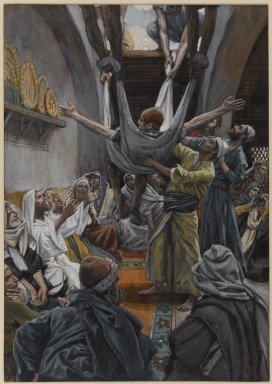
Thinking about Susan, both in the midst of her life in her strength and at the end of her life in her weakness, I couldn’t help but think of the story of the man who whose friends lowered him through the roof for healing (Luke 5:17-26).
The man was paralyzed, as each of us is, each in his or her own way. Not quite ourselves, not quite able to walk through life as fully as we might or as we ought. Burdened by some memory, some history, some bodily infirmity, some circumstance beyond our control, or of our own making. In that sense each of us is the person in the story who was lowered through the roof to Jesus.Susan played two parts in this ongoing story of the Christian life.
In her strength she reached out to others when they needed her. She helped them. Like the “friends” of the paralytic in the Jesus story, she helped to lift others up to onto the stretcher. Then she navigated the stairs that ran up the side of the house, a treacherous feat on narrow steps with no siding, no banister, the steps that were necessary to climb in order to get up to the roof. Managing, with great care, to carry her charges up those stairs, she used her own hands to dig a hole in the roof to lower someone else into the presence of the Healer.
Susan kept the faith. She was a carrier of those less fortunate than herself, changing their diapers, rocking them in a rocking chair, coming to the rescue when a friend had died and her children needed someone to care for them in her home. ….
If Susan was a rescuer who took people and animals into her home during her years of strength, she also had come to know what it is to be on the stretcher, at the mercy of others. Her children, her friends, the people of this church who brought her to worship, who visited her at Auburn, who sang to her and the other residents of the Memory Care Center, the marvelous staff at Auburn who did for Susan what she had once done for her own children and for the other children who had fallen to her care, and the Deacons and others who took turns sitting with Susan in her last days so that she would not be alone.
They all carried Susan up the stairs and dug a hole through the roof with their bare hands until they lowered her down every so gently into the arms of her Lord.
During the days when she was being lowered through that roof, she relaxed when we would pray. “The Lord is my shepherd, I shall not want….” “Our Father who art in heaven, hallowed be Thy Name, Thy kingdom come on earth as it is in heaven. Give us this day our daily bread. Forgive us our debts as we forgive our debtors, and lead us not into temptation, but deliver us from evil, for Thine is the kingdom, and the power, and glory forever.”
Her eyes would close. Her face relaxed. He body at ease. Her trust intact. Her faith still strong. She kept the faith.
Her eyes are closed now. She is at rest in the peace of her Lord. For those of us whose days and years remain awhile, let the traditional graveside prayer be ours:
“O Lord, support us all the day long, until the shadows lengthen, and the fever of life is over, and the busy world is hushed and our work is done. Then, in Your mercy, grant us a safe lodging, a holy rest, and peace at the last.”
-Rev. Gordon C. Stewart
John the Baptist, Jesus, and Mandela
Preached the Sunday after the death of Nelson Mandela, this sermon sought to tie together the first anniversary of the tragedy of Sandy Hook in Newtown, CT (December 15) and the date of Reconciliation Day in post-Apartheid South Africa (December 16), the date in 1977 when Nelson Mandela marked a quote from Shakespeare’s Julius Caesar in what became known as The Robbins Bible, a complete works of Shakespeare that had been smuggled into the Robbins Prison by an Indian inmate.